JOHN PROCTOR ACT ONE ANALYSIS AND EVALUATION John




- Slides: 25
JOHN PROCTOR- ACT ONE ANALYSIS AND EVALUATION
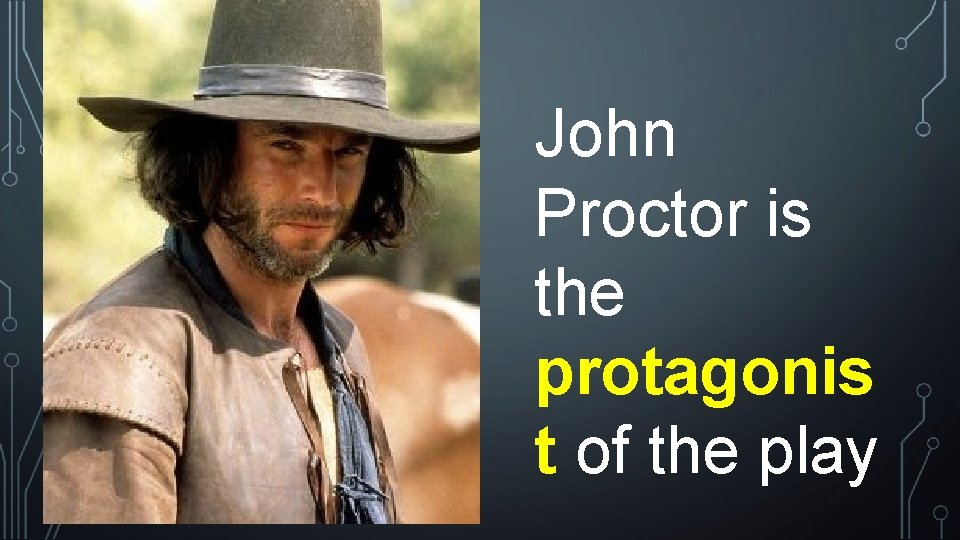
John Proctor is the protagonis t of the play
1. “He is a sinner…not only against the moral fashion of the time, but against his own vision of decent conduct” (p. 16). • Explain the ways in which Proctor regards himself as being a “sinner”, and why. • What is Proctor’s overall opinion of himself (as a Christian, husband, father) at the start of the play?
CLASS NOTES • He has disobeyed the strict religious culture of the time. Adultery is frowned upon, seen as being a serious offence. By being unfaithful to his wife, he has also gone against his own idea of what is acceptable conduct. • Proctor is ashamed of himself for what he has done. He hates himself. Disgusted with himself. Feels guilty. He feels that he is a poor example of a Christian, an unloyal husband, and a poor example to his sons.
CLASS NOTES • He has sinned by committing adultery, which was seen as being a crime in this strictly Puritan environment. He feels that he has violated Puritan values and morals. • He feels that he has failed: not only as a Christian but also as a father and husband. • Proctor feels ashamed and disgusted at himself. He feels intense guilt and anger at his immoral and indecent actions. • He feels like he is not worthy of being part of the Salem community due to his behaviour: he has betrayed his wife, his family, his God and his fellow Puritans.
TEACHER’S NOTES
• Proctor has committed an immoral act by having an affair with Abigail Williams: He has committed a serious crime by violating one of the Ten Commandments (adultery). He has committed an offence which betrays his religious beliefs. He has acted in a manner which goes against the strict moral code in Salem society. • Proctor believes that he has acted in an indecent manner by committing the crime of adultery. He knows that he has transgressed against God’s laws and that he must redeem himself for his disgraceful behaviour. He cannot forgive himself for what he has done. He hates himself
Techniques used: -Stage directions. -Characterisation.
2. “respected and even feared in Salem, has come to regard himself as a kind of fraud” (p. 16). • How is Proctor perceived by others in Salem? • Explain the ways in which Proctor is a “fraud”. • What is Proctor’s overall opinion of himself (as a Christian, husband, father) at the start of the
CLASS NOTES • People were intimidated by him. He has a great deal of power and influence in the town and this was evident in his manner and behaviour. He is held in high regard and admired. People looked up to him. He has a good reputation in the village. • He has a reputation of being a good Christian and a model member of the community but in actual fact he is a serious sinner who has committed adultery. He is a hypocrite as he gives the impression that he is a good Christian but is
• He feels that he does not deserve his weighty reputation and that he is not worthy of being held in such high regard. Even though he feels undeserving, he is too much of a coward to admit his wrongdoings and he continues to benefit from his good reputation.
CLASS NOTES • Proctor is viewed by others in Salem as being a very devout and committed Christian who is devoted to God and who performs his religious duties. People admire him and look up to him. He is an important figure in the community with a great deal of influence. • He views himself as being a “fraud” as he feels he has deceived the people of Salem into thinking he is a man of strong Puritan morals and values, when he is actually a dishonest adulterer who has lied and betrayed his wife and
CLASS NOTES • Proctor believes that he does not deserve his strong and weighty reputation in the village of being a model Christian.
TEACHER’S NOTES
• Proctor has a good reputation in Salem and is held in high regard in the community. He is perceived to be a powerful and intimidating figure who possesses some degree of influence. • Proctor is a “fraud” because he deceives others in the community into thinking that he is a devout Christian who lives his life in strict accordance with Salem’s religious and moral code, but in reality he is an adulterer. He hypocritically allows others to believe that he is an exemplary member of the community
• Proctor hates himself and feels deep shame and guilt over his adultery. He feels like he does not deserve his good reputation in Salem due to his dishonesty and his hypocrisy. Although he is respected by others in the village, he does not respect himself as a Christian, husband or father. Proctor is motivated by a profound need to redeem himself for his sins. He believes that if he redeems himself for his adultery then he will truly deserve his
Techniques used: -Stage directions. -Characterisation.
3. “I will cut off my hand before I’ll ever reach for you again. Wipe it out of mind. We never touched, Abby”. (p. 18). • How does Proctor respond to Abigail’s attempts to rekindle their affair? • How does Proctor view the affair he had with Abigail? • What do we learn about Proctor’s character from
CLASS NOTES • Proctor rejects Abigail’s advances and pushes her away. He is shamed of what he has done and does not want to repeat his past mistakes. He is insensitive and patronising and condescending towards her. • He sees it as being a mistake. He wants to erase it from his memory. He views Abigail as being an object of lust rather than someone he loves. He doesn’t want the affair to happen again. The affair has become a huge burden to him as he is living in fear of his adultery being exposed.
• He is trying to redeem himself by distancing himself from his past mistakes. He is willing to sacrifice his own pleasure in order to redeem himself. He regrets what he has done to his wife and family. His self-hatred and self-disgust is shown by the insensitive manner in which he treats Abigail.
CLASS NOTES • He makes it clear that the affair will never happen again. He firmly informs her that the affair is over and that he does not want her. He wants to forget about the affair and pretend like it never happened. • He views the affair as being a terrible mistake. He doesn’t love Abigail and sees her only as an object of lust. He has a patronising and condescending attitude towards Abigail and doesn’t seem to respect her very much. • He deeply regrets the affair and wishes that it never happened.
TEACHER’S NOTES
• Abigail’s advances make Proctor uncomfortable and he rejects her attempts at seduction. Although he admits that he still has tender thoughts about her occasionally, he tells her that he does not want to resume their affair. He makes it clear in no uncertain terms that the affair is over and done with, that he doesn’t want her, and that nothing will ever happen again between them. • The fact that Proctor refers to Abigail as “child” implies that he has a patronising and dismissive view of her and that he doesn’t take her or their affair seriously. He clearly sees Abigail as being an object of lust and passion, rather than love and romance. Although he likes her and does not want to hurt her, he certainly does not think that she is worth destroying his marriage or his good reputation over. Proctor does not regret their affair coming to an end.
• Proctor clearly feels deep guilt and regret over his affair with Abigail. He knows that he has risked his marriage and his good reputation in Salem by having the affair in the first place. He is determined not to allow her attempts at seduction to weaken his resolve. He wants to redeem himself for his adultery as he knows that he has betrayed his wife, his family and his religion. By rejecting Abigail, he takes the first step towards his redemption.
Techniques used: -Dialogue. -Characterisation. -Key scene. -Conflict.