Jamesons Rhetoric of Otherness and the National Allegory
- Slides: 21
Jameson’s Rhetoric of Otherness and the “National Allegory” Written by Aijaz Ahmad Report: Monica 497206077
Out line: n n I. II. Introduction Ahmad’s argument Metropolitan language Three Worlds Theory
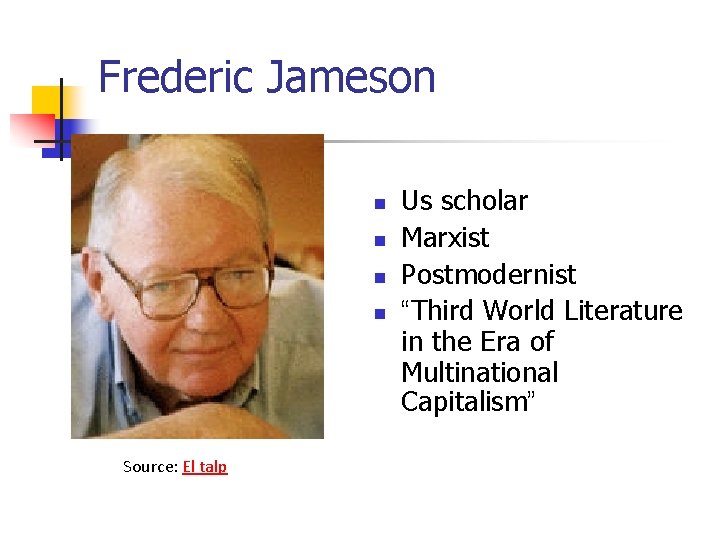
Frederic Jameson n n Source: El talp Us scholar Marxist Postmodernist “Third World Literature in the Era of Multinational Capitalism”
Frederic Jameson n Assert that third world literature are mostly national allegory. For example, Lu Xun’s text deal with Chinese society by dramatizing the libidinal force of his characters in his sketches in “Diary of a Maiden, ” in which individual allegorize his/her personal experience. Jameson focus on demonstrating the struggle affected by both imperialist and colonialist forces when third world artist try to construct its’ national culture and national identity.
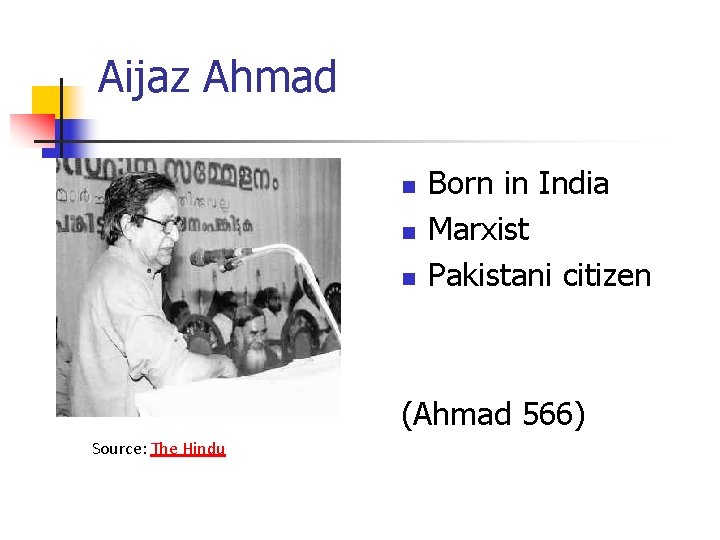
Aijaz Ahmad n n n Born in India Marxist Pakistani citizen (Ahmad 566) Source: The Hindu
Argument: Frederic Jameson is “my (Ahmad) civilization Other” (Ahmad 566). n Oppose “three worlds theory”(Ahmad 568) n Oppose the definition of third world based upon its’ ‘experience of colonialism and imperialism’(Ahmad 568). n Oppose “all the third world literature are necessarily national allegory”(Ahmad 571).
Ahmad’s critical approaches Exam: n Binary opposition ( First World/ Third World; Hegel’s master and slave relation) n Logic n Over-generalization
I. Metropolitan language n n n Jameson neglects that Asian and African literature do not adopt single metropolitan language. Us and European scholars believes in metropolitan tradition of literature because of translation while it is not the case in Asia and Africa; therefore, some Hindu literary traditions are unknown to foreign scholars(Ahmad 566 -8). Some Asian and African scholars’ theories are over valorized(Ahmad 567). E. g. Edward Said—Orientalism
II. Three Worlds Theory? Jameson—Three Worlds Theory *Ahmad responds: 1. There is no such knowledge of the world which is ‘essentially descriptive’(568). 2. “The binary opposition which Jameson constructs between a capitalist first world and a pre- or noncapitalist third world is empirically undergrounded”(570). E. g. India is a capitalist country (exchanges between Department I and Department II industry), which is not as Jameson suggested ‘ a world that based upon experience of colonialism and imperialism’(568). Jameson typified India as the slave in Hegelian’s master and slave relationship. n
III. Absolute Nationalism? The third world should be assessed with its’ mode of production rather than merely “experience of colonialism. ” Jameson over-valorizes the nationalist ideology (nationalism) in third world and the assertion of national allegory (cultural production) (Ahmad 571). Jameson neglects social factors (Socialist) within third world society and define societies merely through intra-national domination(Ahmad 571). E. g. Iran’s clerical fascism instead of social regeneration.
IV. Unitary search? “Jameson claims that one cannot proceed from the premise of a real unity ‘without falling back into some general liberal humanistic universalism’”(Ahmad 572). Ahmad: “What gives the world its unity, then, is not a humanistic ideology but the ferocious struggle of capital and labor which is now a strictly and fundamentally global in character”(Ahmad 572).
IV. Single Narrative? Jameson: insistence on the relation of otherness between the first world and the third world. Ahmad: 1. Jameson “de-historicise the global space and the struggle between these great motivating forces actually taken places (capitalist forces)” (Ahmad 573). 2. Jameson assimilates the heterogeneities and productivities of our life (the third world? ) into a single Hegelian metaphor of master/slave relation, this theory reduces us into an idealtype…(Ahmad 573).
V. Time Ahmad: The texts in the third world based upon “the experience of imperialism and colonialism” should be assessed with time concern. For example, Lu Xun’s texts are written around ten centuries, which is a precapitalism work. However, Jameson applies Lu Xun’s text to suggest “the difference between first world and third world are primordial and precapitalism”(Ahmad 574). --here “with ten centuries of specifically Chinese…, ” which means that Chinese society sustain individual’s libidinal energy because Ahmad assume Chinese suffer this problem for a long time. (Lu Xun’s texts: A Maiden’s Diary 1918, Medicine 1919, and The True Story of Ah Q 1921 according to Wikpedia)
V. Space n n The fallacy of Jameson’s text is his insistence upon “all the third world literature are necessarily national allegories” by validating those third world texts which presents national allegories as “authentic texts” (Jameson 574). Jameson suggests that third world is similar to pre- or non-capitalist literature through the “a unity between private and public space” because capitalist society has the radical split “between the private and public” in Marxism and Form (575).
V. Collectivity? Not “nation” but “collectivity” (Ahmad 577). Jameson argue that the first world writers “unconsciously allegorize their works while third world writer allegorize their works consciously. Ahmad claims that reflection upon collectivity is not an exclusive narrative strategy applied by third world writers, but also first world writer. E. g. Adrieen Rich or Alone with America
VI. Non-Canonical Jameson: Third world literatures conduct relist mode and thus have limited subject in the texts. Ahmad: 1. Urdu texts are not available in English. 2. Nobel Prize winner. E. g. Salman Rushdie 3. Not the single mode of Sherwood Aderson’s realism, now the third world novelist are also in the modernist discourse in the US.
VII. Urdu literary history n n Printing presses and publisher (Pandit Naval Kishore) assist in shaping Urdu literature (Ahmad 581). Subject not exclusively national allegory, but also “a new kind of bourgeois who was violating established social norms” and “female status” (Ahmad 583).
VIII. Conclusion n 1. 2. 3. Ahmad: Whether to put Jameson’s text in the “first world of his origin(Jameson), the second world of his ideology and politics, or the third world of his filiations and sympathy? ”(Ahmad 587). “Ideological condition of the text’s production are never singular but always several” Ahmad 587). There is a “veritable third world within the first world’s global postmodernist” Ahmad 587). Within the unity, there are “irreconcilable struggle of capital and labor”(Ahmad 588).
Comments n Ahmad’s essay is well structured, in which he correspondingly rejoins to Jameson’s statements. Besides, Ahmad strategically applies his identity card as the most persuasive evidence when he contradicts Jameson’s viewpoints of contemporary situation of third world, and thus the most worthy part in Ahmad’s essay is his description about Urdu literature and history. However, several Ahmad’s viewpoints are overlapped in different sections. Besides, I have difficulty with Ahmad’s conclusion in insisting that they are not each other’s “civilization others, ” which seem to deny the purpose of his own essay stated as Jameson is “my (Ahmad) civilization Other”(566) and somehow blur the focus.
Questions Q 1: What is the role of media in postmodern literature especially when the difference is between the effect of local media and international media? Can a nation be a nation when it is unknown or possess ambiguous image in the viewpoint of other nations? Q 2: Is globalization in the third and second world be viewed as postcolonial texts? Text: 1. What is the idea of “world literature”?
Works Cited n Ahmad, Aijaz. “Jameson’s Rhetoric of Otherness and the ‘National Allegory. ’” Nation and Narration. Ed. Homi Bhabha. NY: Routledge, 1990.