ISIS VPLS for Data Center Network draftxul 2


- Slides: 12
IS-IS VPLS for Data Center Network draft-xu-l 2 vpn-vpls-isis-02 Xiaohu Xu (xuxh@huawei. com) Himanshu Shah (hshah@ciena. com) IETF 82, TAIWAN www. huawei. com
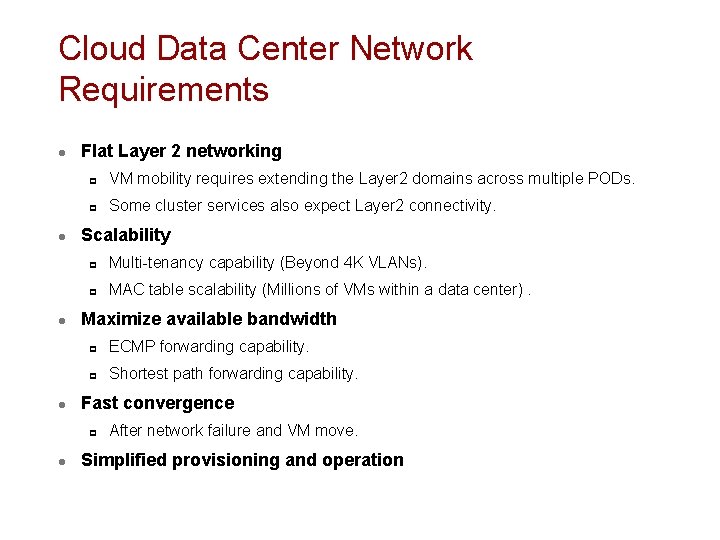
Cloud Data Center Network Requirements l l Flat Layer 2 networking p VM mobility requires extending the Layer 2 domains across multiple PODs. p Some cluster services also expect Layer 2 connectivity. Scalability p Multi-tenancy capability (Beyond 4 K VLANs). p MAC table scalability (Millions of VMs within a data center). Maximize available bandwidth p ECMP forwarding capability. p Shortest path forwarding capability. Fast convergence p l After network failure and VM move. Simplified provisioning and operation
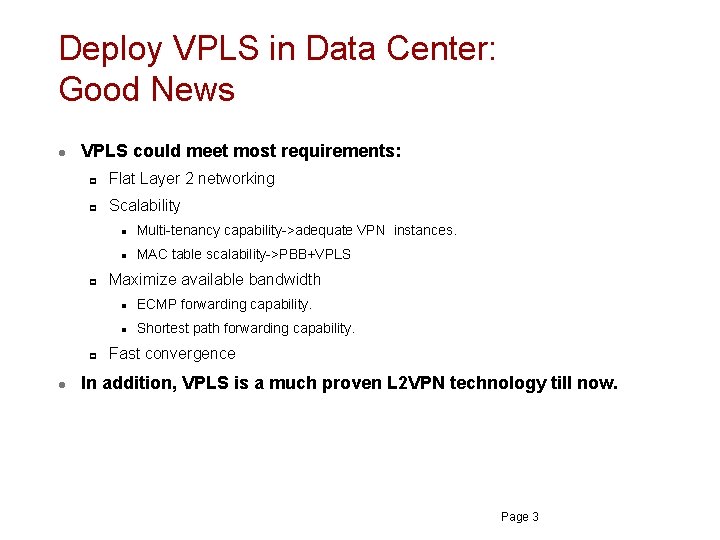
Deploy VPLS in Data Center: Good News l VPLS could meet most requirements: p Flat Layer 2 networking p Scalability p p l n Multi-tenancy capability->adequate VPN instances. n MAC table scalability->PBB+VPLS Maximize available bandwidth n ECMP forwarding capability. n Shortest path forwarding capability. Fast convergence In addition, VPLS is a much proven L 2 VPN technology till now. Page 3
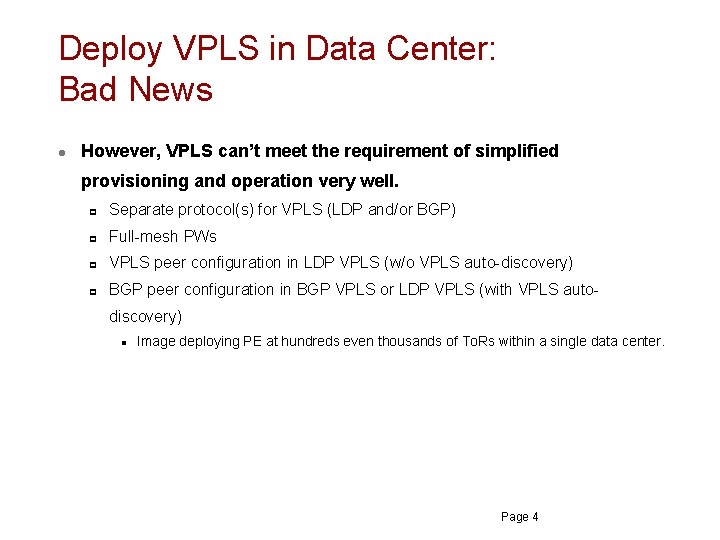
Deploy VPLS in Data Center: Bad News l However, VPLS can’t meet the requirement of simplified provisioning and operation very well. p Separate protocol(s) for VPLS (LDP and/or BGP) p Full-mesh PWs p VPLS peer configuration in LDP VPLS (w/o VPLS auto-discovery) p BGP peer configuration in BGP VPLS or LDP VPLS (with VPLS autodiscovery) n Image deploying PE at hundreds even thousands of To. Rs within a single data center. Page 4
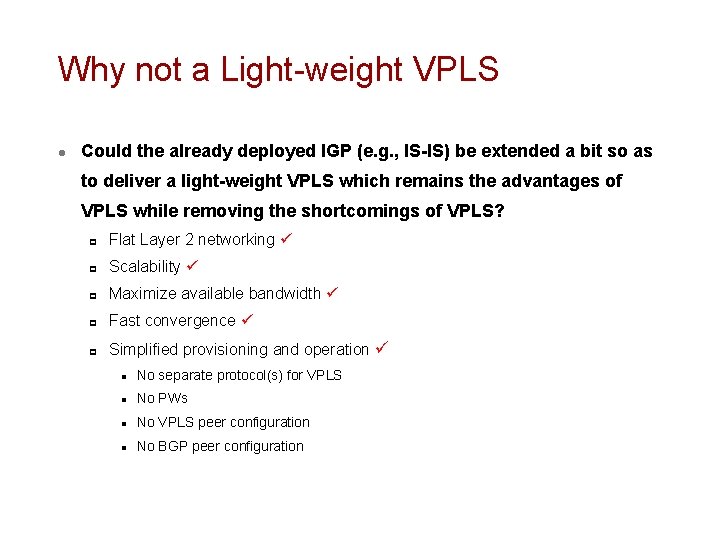
Why not a Light-weight VPLS l Could the already deployed IGP (e. g. , IS-IS) be extended a bit so as to deliver a light-weight VPLS which remains the advantages of VPLS while removing the shortcomings of VPLS? p Flat Layer 2 networking p Scalability p Maximize available bandwidth p Fast convergence p Simplified provisioning and operation n No separate protocol(s) for VPLS n No PWs n No VPLS peer configuration n No BGP peer configuration
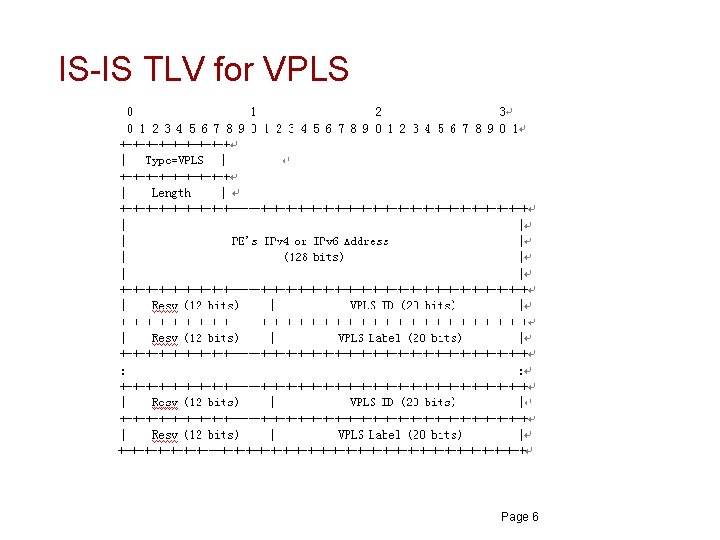
IS-IS TLV for VPLS Page 6
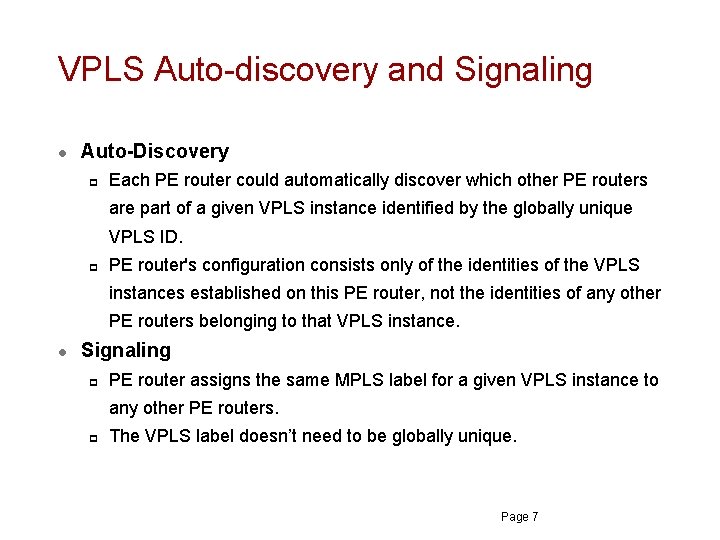
VPLS Auto-discovery and Signaling l Auto-Discovery p Each PE router could automatically discover which other PE routers are part of a given VPLS instance identified by the globally unique VPLS ID. p PE router's configuration consists only of the identities of the VPLS instances established on this PE router, not the identities of any other PE routers belonging to that VPLS instance. l Signaling p PE router assigns the same MPLS label for a given VPLS instance to any other PE routers. p The VPLS label doesn’t need to be globally unique. Page 7
Implications on the Control Plane l The extended IS-IS TLV for VPLS is partially transparent to P routers. p P routers don't need to process the VPLS membership information contained in that IS-IS TLV, but only need to synchronize the Link State PDUs with their IS-IS neighbors. Page 8
Implications on the Data Plane l Data encapsulation and data forwarding are not changed. l The only change is to the data-driven MAC learning: p The VPLS label in the received VPLS packet is only intended to identify a given VPLS instance on the egress PE. Hence, the source IP address in the IP-based tunnel header should be resorted to identify the ingress PE of the received VPLS packet. p Alternatively, MAC reachability could be distributed among PE routers on the control plane so as to eliminate unknown unicast flood. Page 9
How to Deliver Mcast/Bcast/Unknown Unicast l Two options: p Ingress Replication n p P-Multicast Tree Mode n l No state needed in the core, However, sub-optimal bandwidth utilization. Optimal bandwidth utilization. However, states required in the core. Operators could make the tradeoff flexibly on basis of per tenant instance. Page 10
How to Address the MAC Scalability Issue on PE Routers l PBB+VPLS p PBB could be done at To. R switches or even at the servers. p VPLS PE routers only need to learn B-MAC addresses. Page 11
Comments Page 12