Introduction to Linguistics 7403250 Dr Ghassan Adnan Elearning


- Slides: 17
Introduction to Linguistics 7403250 Dr. Ghassan Adnan E-learning and Distance Education Deanship Department of English Language College of Arts King Faisal University [11 ]
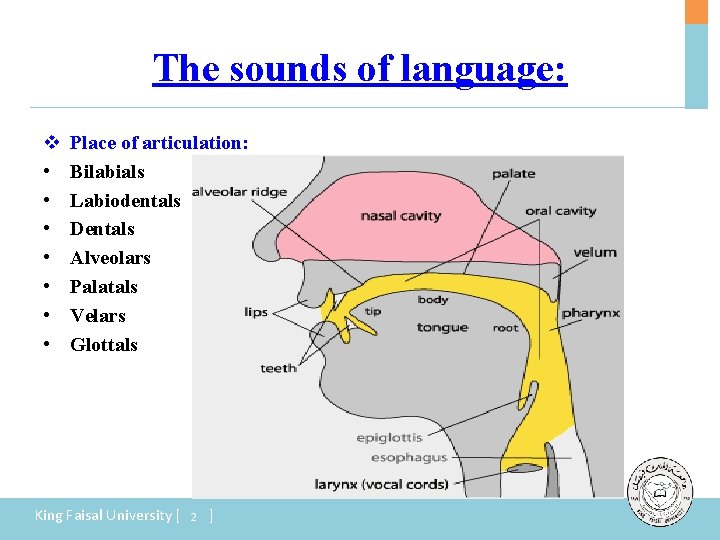
The sounds of language: v • • Place of articulation: Bilabials Labiodentals Dentals Alveolars Palatals Velars Glottals King Faisal University [ 2 ]
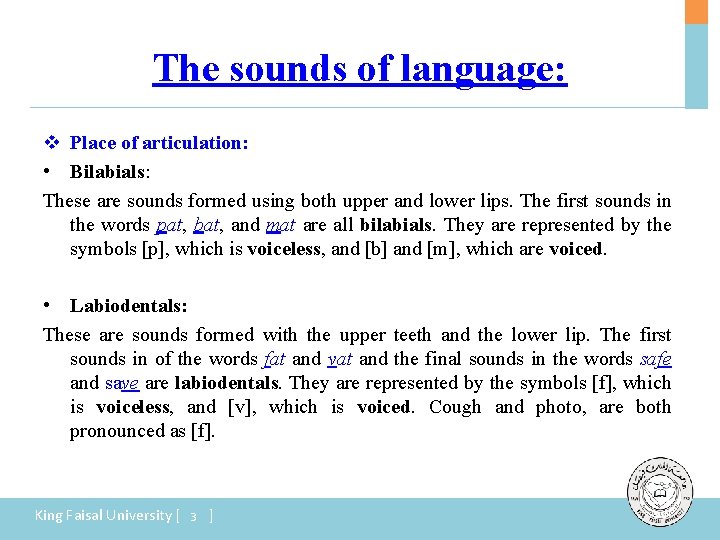
The sounds of language: v Place of articulation: • Bilabials: These are sounds formed using both upper and lower lips. The first sounds in the words pat, bat, and mat are all bilabials. They are represented by the symbols [p], which is voiceless, and [b] and [m], which are voiced. • Labiodentals: These are sounds formed with the upper teeth and the lower lip. The first sounds in of the words fat and vat and the final sounds in the words safe and save are labiodentals. They are represented by the symbols [f], which is voiceless, and [v], which is voiced. Cough and photo, are both pronounced as [f]. King Faisal University [ 3 ]
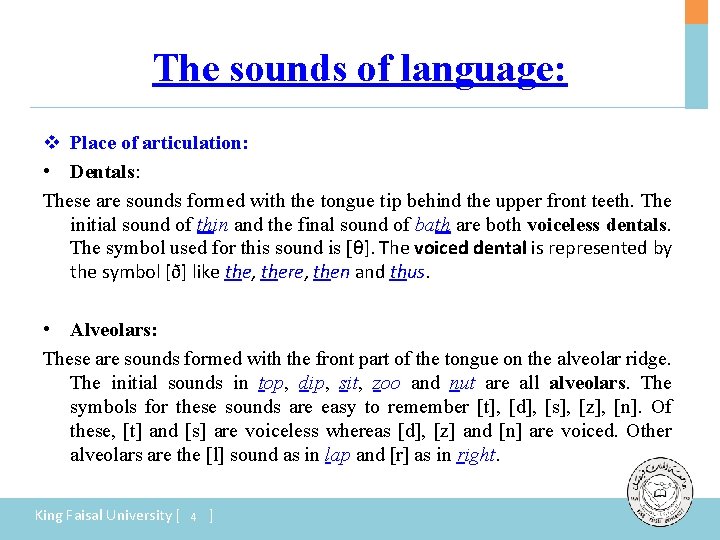
The sounds of language: v Place of articulation: • Dentals: These are sounds formed with the tongue tip behind the upper front teeth. The initial sound of thin and the final sound of bath are both voiceless dentals. The symbol used for this sound is [θ]. The voiced dental is represented by the symbol [ð] like the, there, then and thus. • Alveolars: These are sounds formed with the front part of the tongue on the alveolar ridge. The initial sounds in top, dip, sit, zoo and nut are all alveolars. The symbols for these sounds are easy to remember [t], [d], [s], [z], [n]. Of these, [t] and [s] are voiceless whereas [d], [z] and [n] are voiced. Other alveolars are the [l] sound as in lap and [r] as in right. King Faisal University [ 4 ]
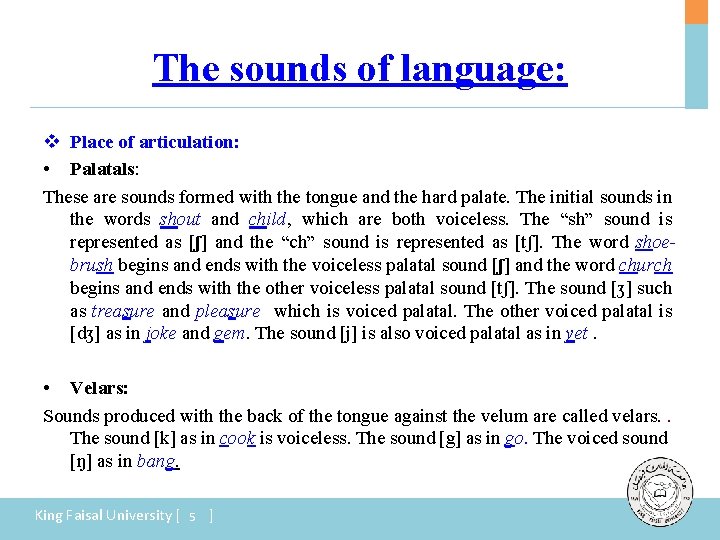
The sounds of language: v Place of articulation: • Palatals: These are sounds formed with the tongue and the hard palate. The initial sounds in the words shout and child, which are both voiceless. The “sh” sound is represented as [ʃ] and the “ch” sound is represented as [tʃ]. The word shoebrush begins and ends with the voiceless palatal sound [ʃ] and the word church begins and ends with the other voiceless palatal sound [tʃ]. The sound [ʒ] such as treasure and pleasure which is voiced palatal. The other voiced palatal is [dʒ] as in joke and gem. The sound [j] is also voiced palatal as in yet. • Velars: Sounds produced with the back of the tongue against the velum are called velars. . The sound [k] as in cook is voiceless. The sound [g] as in go. The voiced sound [ŋ] as in bang. King Faisal University [ 5 ]
The sounds of language: v Place of articulation: • Glottals: There is one sound that is produced without the active use of the tongue and other parts of the mouth. It is the voiceless sound [h] as in horse. King Faisal University [ 6 ]
The sounds of language: v • • • Manner of articulation: Stops Fricatives Affricates Nasals Liquids Glides King Faisal University [ 7 ]
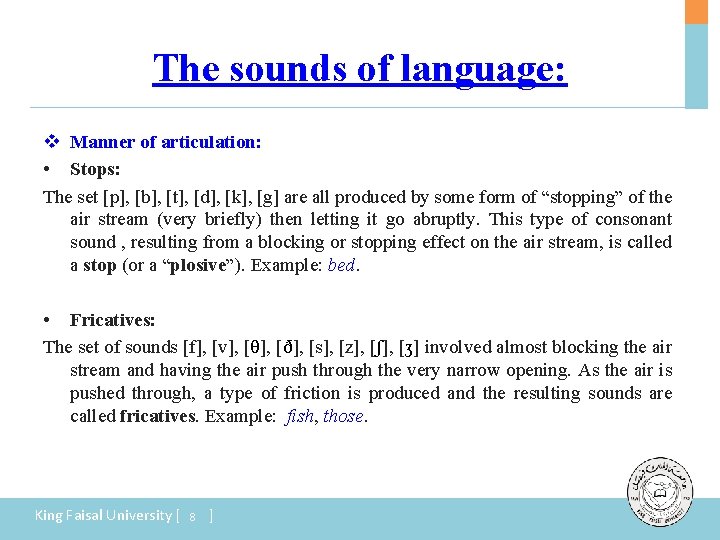
The sounds of language: v Manner of articulation: • Stops: The set [p], [b], [t], [d], [k], [g] are all produced by some form of “stopping” of the air stream (very briefly) then letting it go abruptly. This type of consonant sound , resulting from a blocking or stopping effect on the air stream, is called a stop (or a “plosive”). Example: bed. • Fricatives: The set of sounds [f], [v], [θ], [ð], [s], [z], [ʃ], [ʒ] involved almost blocking the air stream and having the air push through the very narrow opening. As the air is pushed through, a type of friction is produced and the resulting sounds are called fricatives. Example: fish, those. King Faisal University [ 8 ]
The sounds of language: v Manner of articulation: • Affricates: If you combine a brief stopping of the air stream with an obstructed release which causes some friction, you will be able to produce the sounds [tʃ] and [dʒ] these are called affricates. Example: cheap and jeep. • Nasals: When the velum is lowered and the air stream is allowed to flow out through the nose to produce [m], [n] and [ŋ], the sounds are described as nasals. Example: morning and name. King Faisal University [ 9 ]
The sounds of language: v Manner of articulation: • Liquids: The initial sounds in led and red are described as liquids. They are both voiced. The [l] sound is called a lateral liquid and formed by letting the air stream flow around the sides of the tongue as the tip of the tongue makes contact with the middle of the alveolar ridge. The [r] sound at the beginning of red is formed with the tongue tip raised and curled back near the alveolar ridge. • Glides: The sounds [w] and [j] are described as glides. They are both voiced and occur at the beginning of we, you and yes. These sounds are typically produced with the tongue in motion (or “gliding”) to or from the position of a vowel and are sometimes called semi-vowels. King Faisal University [ 10 ]
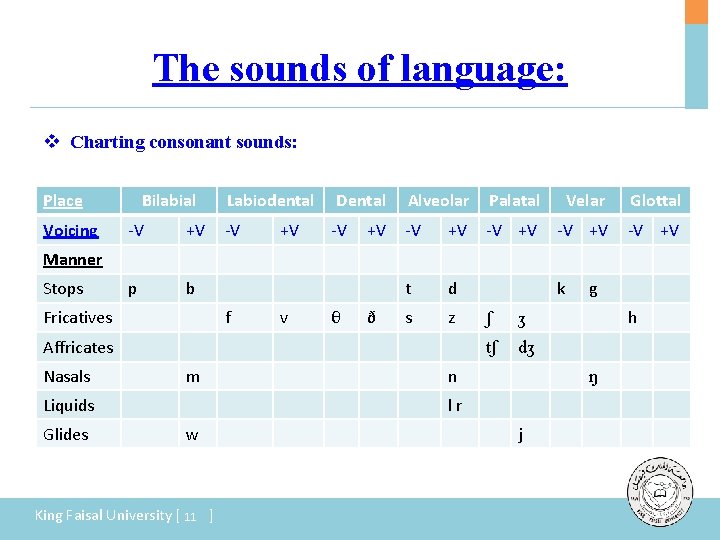
The sounds of language: v Charting consonant sounds: Place Voicing Bilabial -V +V p b Labiodental Dental Alveolar Palatal Velar Glottal -V -V -V +V t d s z +V +V Manner Stops Fricatives f v θ ð Affricates Nasals m Liquids Glides k ʃ ʒ tʃ dʒ n King Faisal University [ 11 ] h ŋ lr w g j
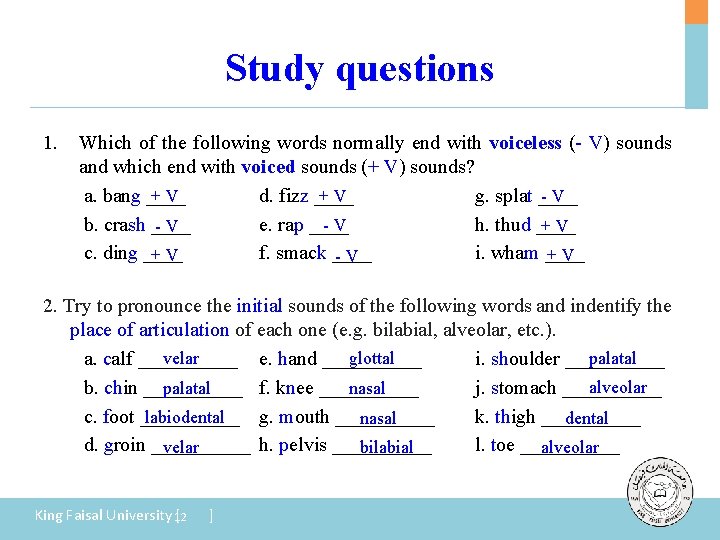
Study questions 1. Which of the following words normally end with voiceless (- V) sounds and which end with voiced sounds (+ V) sounds? a. bang ____ d. fizz ____ g. splat ____ +V +V -V b. crash ____ e. rap ____ h. thud ____ -V -V +V c. ding ____ f. smack ____ i. wham ____ +V +V -V 2. Try to pronounce the initial sounds of the following words and indentify the place of articulation of each one (e. g. bilabial, alveolar, etc. ). velar glottal palatal a. calf _____ e. hand _____ i. shoulder _____ alveolar b. chin _____ f. knee _____ j. stomach _____ palatal nasal c. foot _____ g. mouth _____ k. thigh _____ labiodental nasal dental d. groin _____ h. pelvis _____ l. toe _____ velar bilabial alveolar King Faisal University 12 [ ]
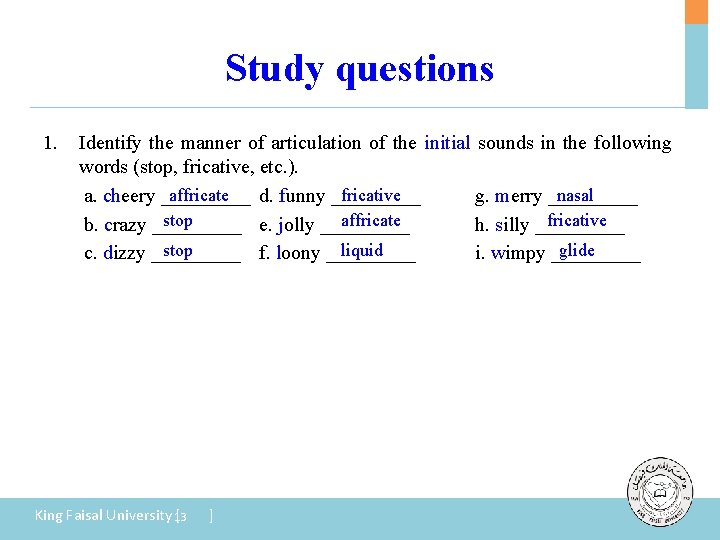
Study questions 1. Identify the manner of articulation of the initial sounds in the following words (stop, fricative, etc. ). affricate fricative nasal a. cheery _____ d. funny _____ g. merry _____ stop affricate fricative b. crazy _____ e. jolly _____ h. silly _____ stop liquid glide c. dizzy _____ f. loony _____ i. wimpy _____ King Faisal University 13 [ ]
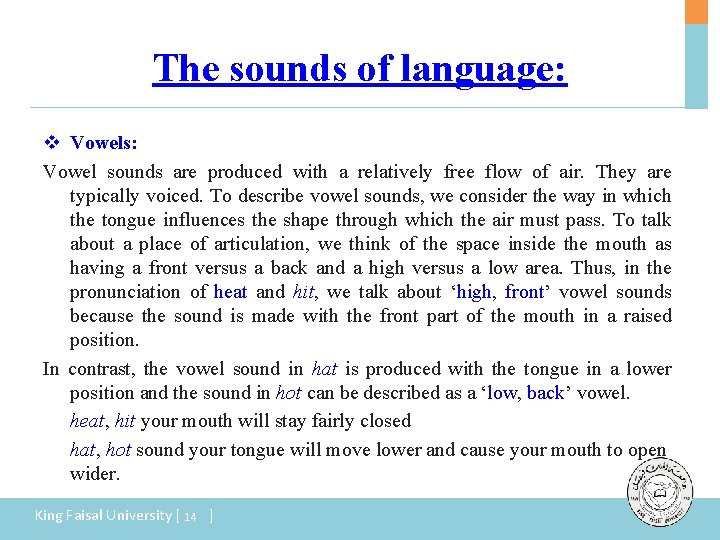
The sounds of language: v Vowels: Vowel sounds are produced with a relatively free flow of air. They are typically voiced. To describe vowel sounds, we consider the way in which the tongue influences the shape through which the air must pass. To talk about a place of articulation, we think of the space inside the mouth as having a front versus a back and a high versus a low area. Thus, in the pronunciation of heat and hit, we talk about ‘high, front’ vowel sounds because the sound is made with the front part of the mouth in a raised position. In contrast, the vowel sound in hat is produced with the tongue in a lower position and the sound in hot can be described as a ‘low, back’ vowel. heat, hit your mouth will stay fairly closed hat, hot sound your tongue will move lower and cause your mouth to open wider. King Faisal University [ 14 ]
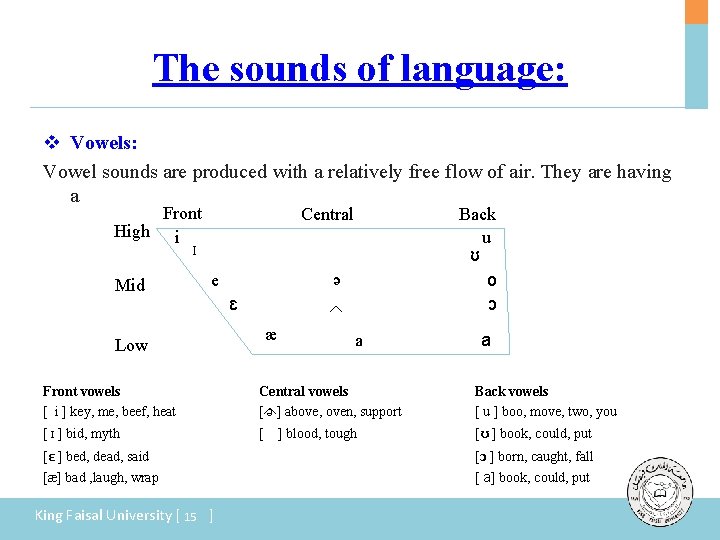
The sounds of language: v Vowels: Vowel sounds are produced with a relatively free flow of air. They are having a Front High i Central Back u ʊ o ɔ I Mid ә e ɛ æ Low a a Front vowels [ i ] key, me, beef, heat Central vowels [ ә ] above, oven, support Back vowels [ u ] boo, move, two, you [ I ] bid, myth [ [ʊ ] book, could, put ] blood, tough [ɛ ] bed, dead, said [ɔ ] born, caught, fall [æ] bad , laugh, wrap [ a] book, could, put King Faisal University [ 15 ]
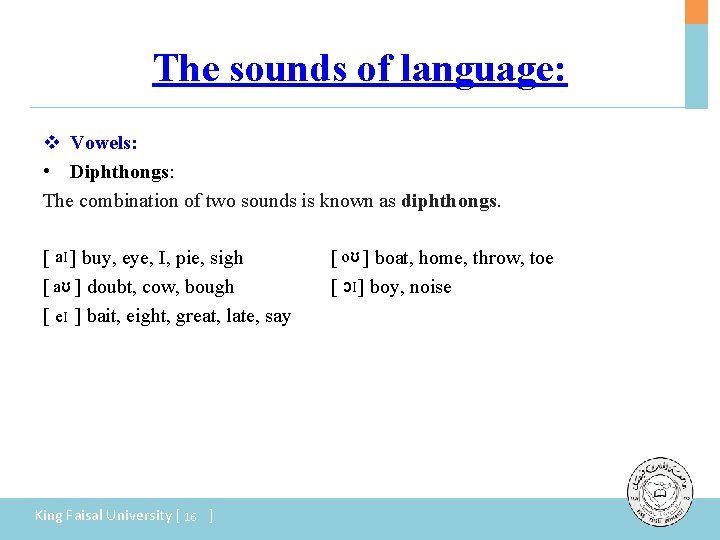
The sounds of language: v Vowels: • Diphthongs: The combination of two sounds is known as diphthongs. [ a. I ] buy, eye, I, pie, sigh [ aʊ ] doubt, cow, bough [ e. I ] bait, eight, great, late, say King Faisal University [ 16 ] [ oʊ ] boat, home, throw, toe [ ɔI ] boy, noise
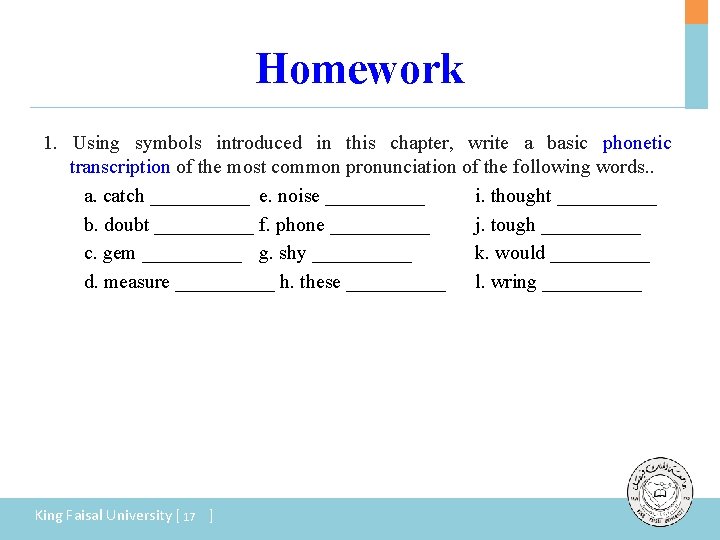
Homework 1. Using symbols introduced in this chapter, write a basic phonetic transcription of the most common pronunciation of the following words. . a. catch _____ e. noise _____ i. thought _____ b. doubt _____ f. phone _____ j. tough _____ c. gem _____ g. shy _____ k. would _____ d. measure _____ h. these _____ l. wring _____ King Faisal University [ 17 ]