Intercorporate Investments and Consolidations CHAPTER 11 2012 2010
- Slides: 30
Intercorporate Investments and Consolidations CHAPTER 11 © 2012 2010 Pearson Education Inc. Publishing as Prentice Hall Introduction to. Introduction Financial Accounting, to Financial 10/e Accounting, 10/e 2006 Prentice. Education Hall Business Publishing Introduction to Financial Accounting, 9/e Horngren/Sundem/Elliott/Philbrick
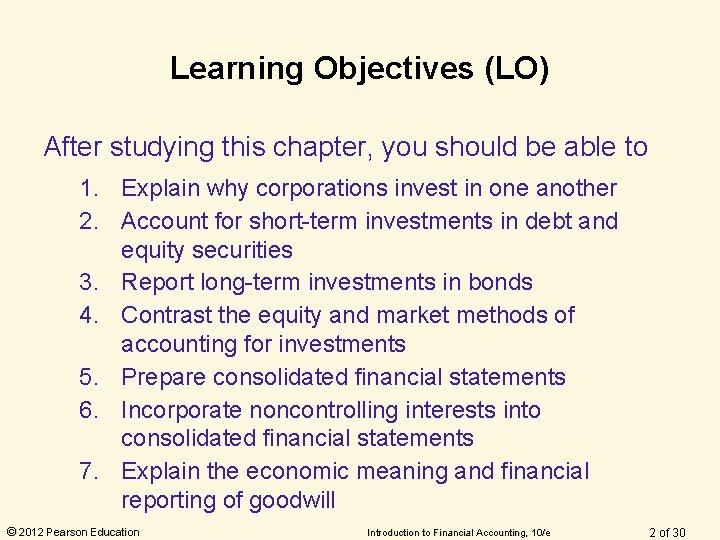
Learning Objectives (LO) After studying this chapter, you should be able to 1. Explain why corporations invest in one another 2. Account for short-term investments in debt and equity securities 3. Report long-term investments in bonds 4. Contrast the equity and market methods of accounting for investments 5. Prepare consolidated financial statements 6. Incorporate noncontrolling interests into consolidated financial statements 7. Explain the economic meaning and financial reporting of goodwill © 2012 Pearson Education Introduction to Financial Accounting, 10/e 2 of 30
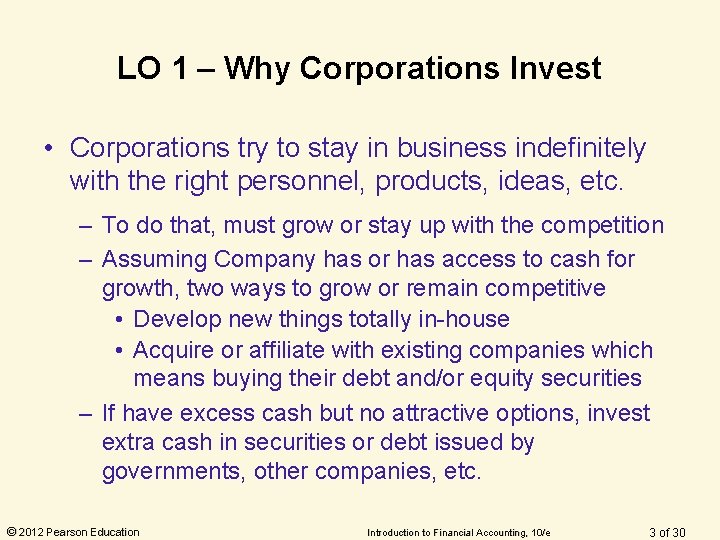
LO 1 – Why Corporations Invest • Corporations try to stay in business indefinitely with the right personnel, products, ideas, etc. – To do that, must grow or stay up with the competition – Assuming Company has or has access to cash for growth, two ways to grow or remain competitive • Develop new things totally in-house • Acquire or affiliate with existing companies which means buying their debt and/or equity securities – If have excess cash but no attractive options, invest extra cash in securities or debt issued by governments, other companies, etc. © 2012 Pearson Education Introduction to Financial Accounting, 10/e 3 of 30
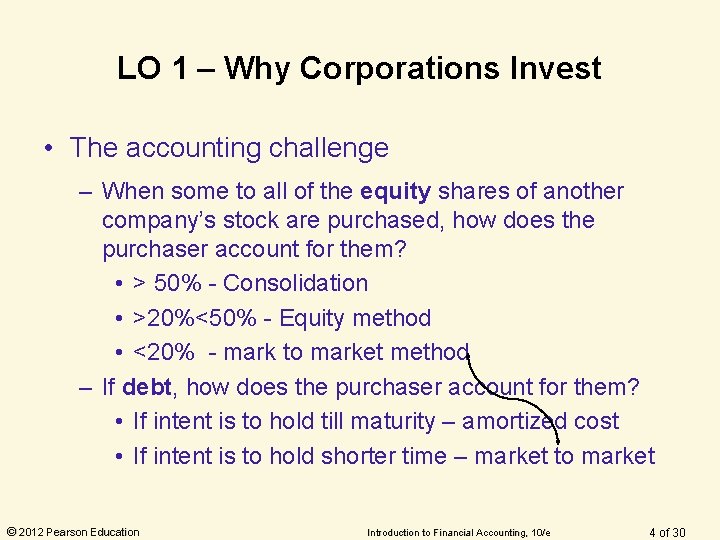
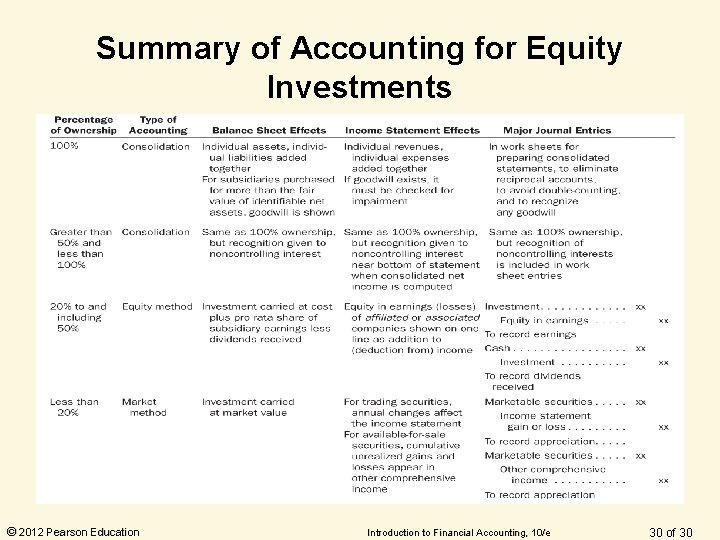
LO 1 – Why Corporations Invest • The accounting challenge – When some to all of the equity shares of another company’s stock are purchased, how does the purchaser account for them? • > 50% - Consolidation • >20%<50% - Equity method • <20% - mark to market method – If debt, how does the purchaser account for them? • If intent is to hold till maturity – amortized cost • If intent is to hold shorter time – market to market © 2012 Pearson Education Introduction to Financial Accounting, 10/e 4 of 30
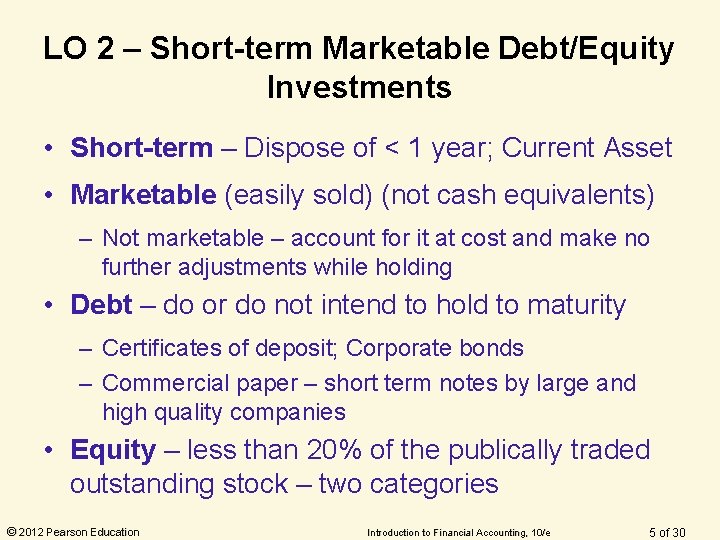
LO 2 – Short-term Marketable Debt/Equity Investments • Short-term – Dispose of < 1 year; Current Asset • Marketable (easily sold) (not cash equivalents) – Not marketable – account for it at cost and make no further adjustments while holding • Debt – do or do not intend to hold to maturity – Certificates of deposit; Corporate bonds – Commercial paper – short term notes by large and high quality companies • Equity – less than 20% of the publically traded outstanding stock – two categories © 2012 Pearson Education Introduction to Financial Accounting, 10/e 5 of 30
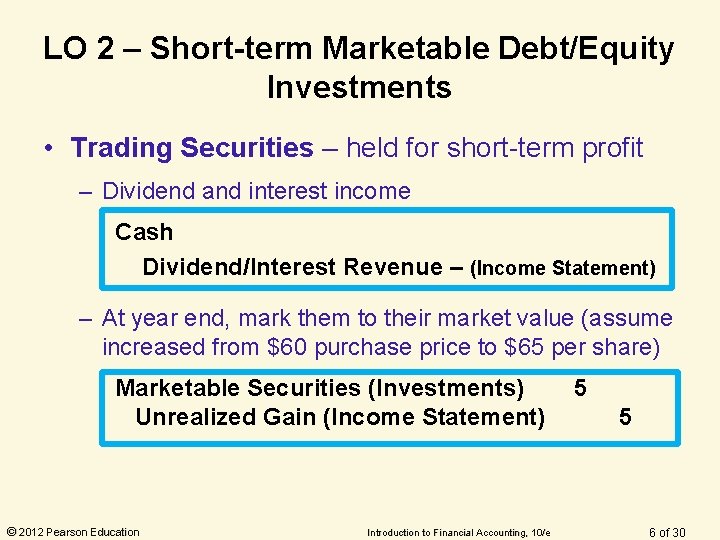
LO 2 – Short-term Marketable Debt/Equity Investments • Trading Securities – held for short-term profit – Dividend and interest income Cash Dividend/Interest Revenue – (Income Statement) – At year end, mark them to their market value (assume increased from $60 purchase price to $65 per share) Marketable Securities (Investments) Unrealized Gain (Income Statement) © 2012 Pearson Education Introduction to Financial Accounting, 10/e 5 5 6 of 30
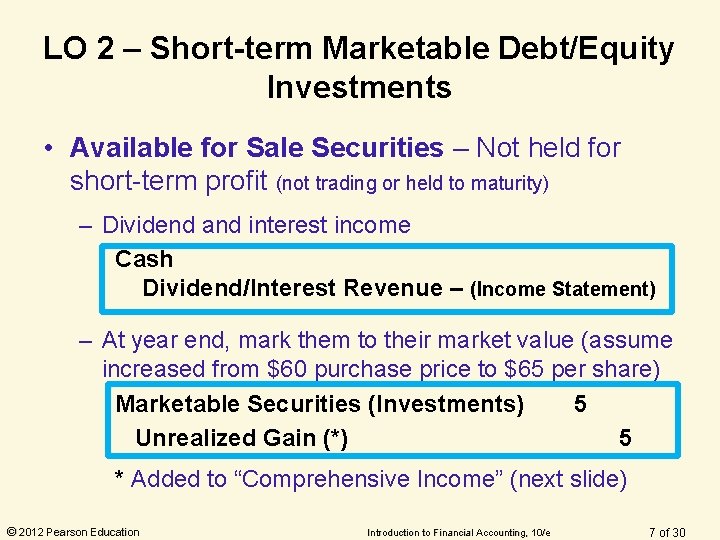
LO 2 – Short-term Marketable Debt/Equity Investments • Available for Sale Securities – Not held for short-term profit (not trading or held to maturity) – Dividend and interest income Cash Dividend/Interest Revenue – (Income Statement) – At year end, mark them to their market value (assume increased from $60 purchase price to $65 per share) Marketable Securities (Investments) 5 Unrealized Gain (*) 5 * Added to “Comprehensive Income” (next slide) © 2012 Pearson Education Introduction to Financial Accounting, 10/e 7 of 30
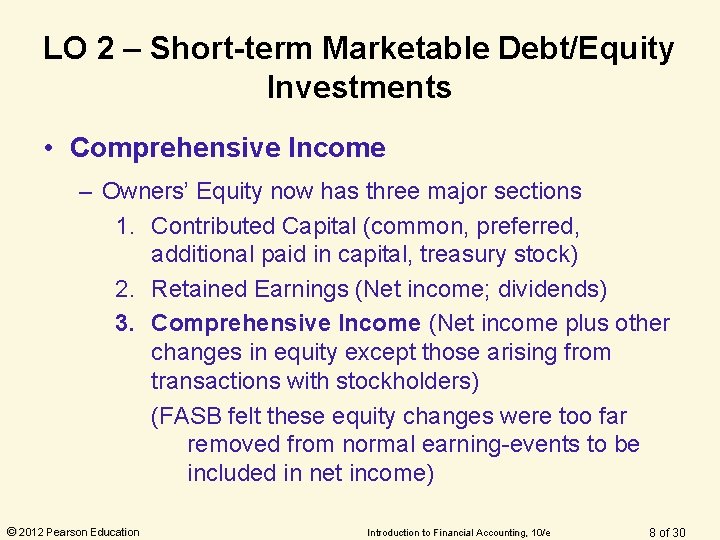
LO 2 – Short-term Marketable Debt/Equity Investments • Comprehensive Income – Owners’ Equity now has three major sections 1. Contributed Capital (common, preferred, additional paid in capital, treasury stock) 2. Retained Earnings (Net income; dividends) 3. Comprehensive Income (Net income plus other changes in equity except those arising from transactions with stockholders) (FASB felt these equity changes were too far removed from normal earning-events to be included in net income) © 2012 Pearson Education Introduction to Financial Accounting, 10/e 8 of 30
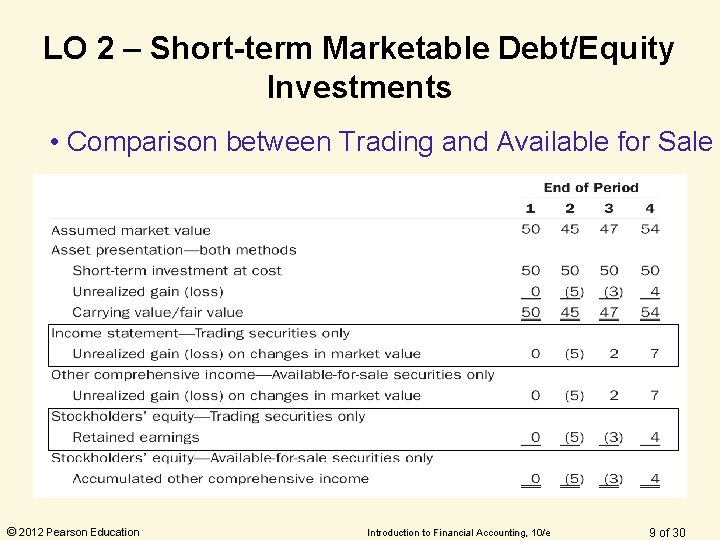
LO 2 – Short-term Marketable Debt/Equity Investments • Comparison between Trading and Available for Sale © 2012 Pearson Education Introduction to Financial Accounting, 10/e 9 of 30
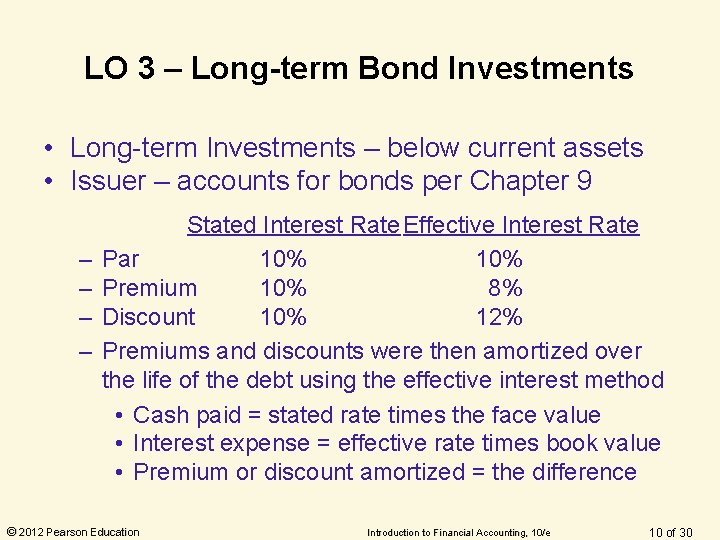
LO 3 – Long-term Bond Investments • Long-term Investments – below current assets • Issuer – accounts for bonds per Chapter 9 – – Stated Interest Rate Effective Interest Rate Par 10% Premium 10% 8% Discount 10% 12% Premiums and discounts were then amortized over the life of the debt using the effective interest method • Cash paid = stated rate times the face value • Interest expense = effective rate times book value • Premium or discount amortized = the difference © 2012 Pearson Education Introduction to Financial Accounting, 10/e 10 of 30
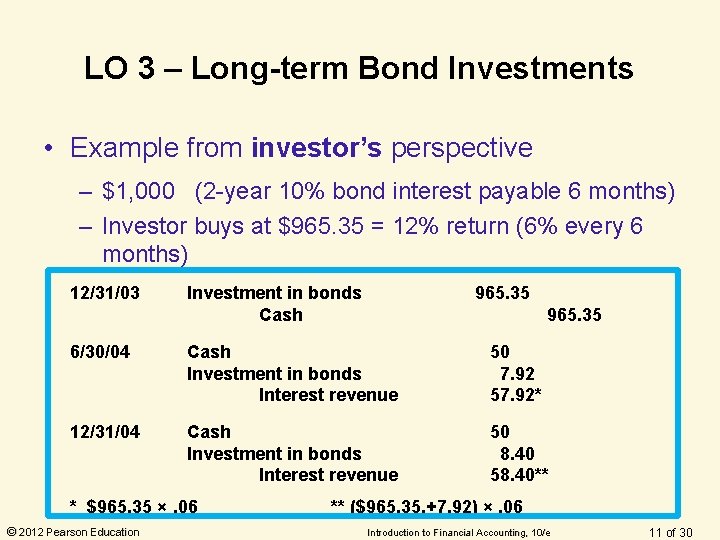
LO 3 – Long-term Bond Investments • Example from investor’s perspective – $1, 000 (2 -year 10% bond interest payable 6 months) – Investor buys at $965. 35 = 12% return (6% every 6 months) 12/31/03 Investment in bonds Cash 965. 35 6/30/04 Cash Investment in bonds Interest revenue 50 7. 92 57. 92* 12/31/04 Cash Investment in bonds Interest revenue 50 8. 40 58. 40** * $965. 35 ×. 06 © 2012 Pearson Education ** ($965. 35, +7. 92) ×. 06 Introduction to Financial Accounting, 10/e 11 of 30
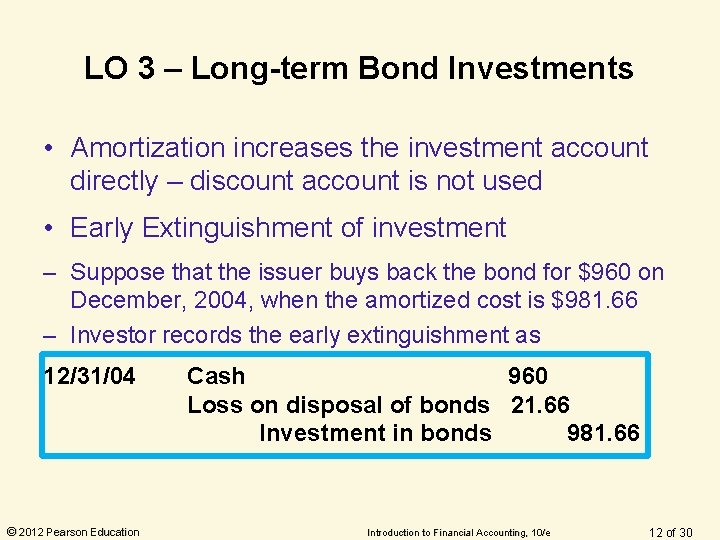
LO 3 – Long-term Bond Investments • Amortization increases the investment account directly – discount account is not used • Early Extinguishment of investment – Suppose that the issuer buys back the bond for $960 on December, 2004, when the amortized cost is $981. 66 – Investor records the early extinguishment as 12/31/04 © 2012 Pearson Education Cash 960 Loss on disposal of bonds 21. 66 Investment in bonds 981. 66 Introduction to Financial Accounting, 10/e 12 of 30
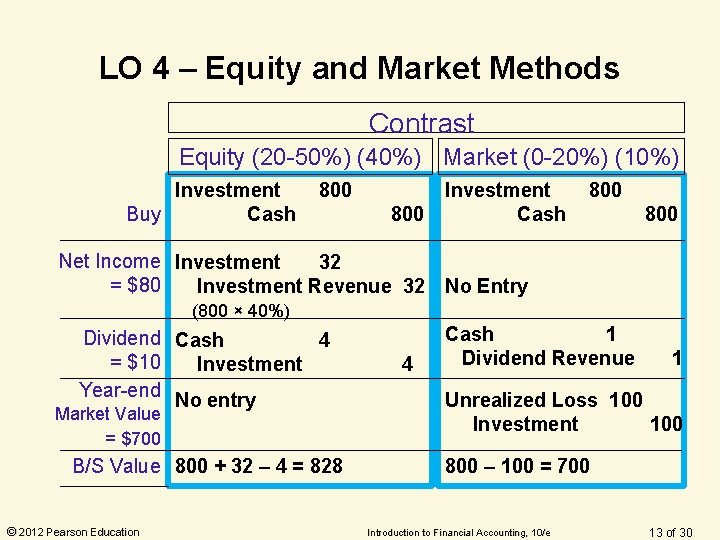
LO 4 – Equity and Market Methods Contrast Equity (20 -50%) (40%) Market (0 -20%) (10%) Investment Buy Cash 800 Net Income Investment 32 = $80 Investment Revenue 32 Investment Cash 800 No Entry (800 × 40%) Dividend Cash 4 = $10 Investment Year-end No entry Market Value = $700 B/S Value 800 + 32 – 4 = 828 © 2012 Pearson Education 4 Cash 1 Dividend Revenue 1 Unrealized Loss 100 Investment 100 800 – 100 = 700 Introduction to Financial Accounting, 10/e 13 of 30
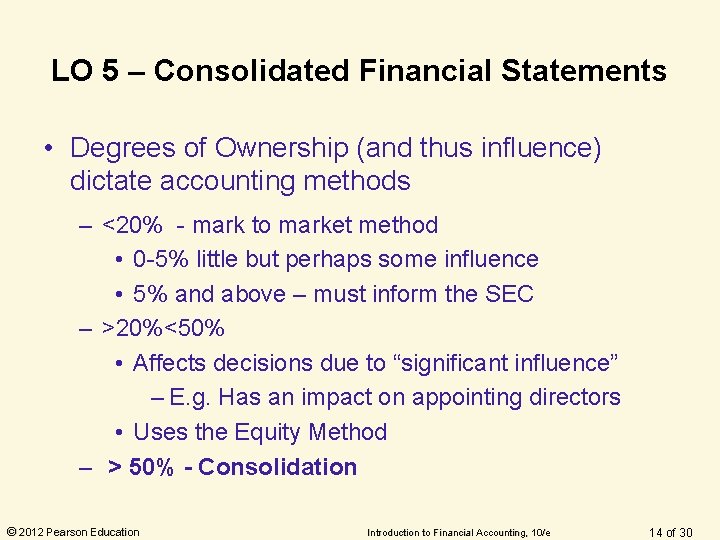
LO 5 – Consolidated Financial Statements • Degrees of Ownership (and thus influence) dictate accounting methods – <20% - mark to market method • 0 -5% little but perhaps some influence • 5% and above – must inform the SEC – >20%<50% • Affects decisions due to “significant influence” – E. g. Has an impact on appointing directors • Uses the Equity Method – > 50% - Consolidation © 2012 Pearson Education Introduction to Financial Accounting, 10/e 14 of 30
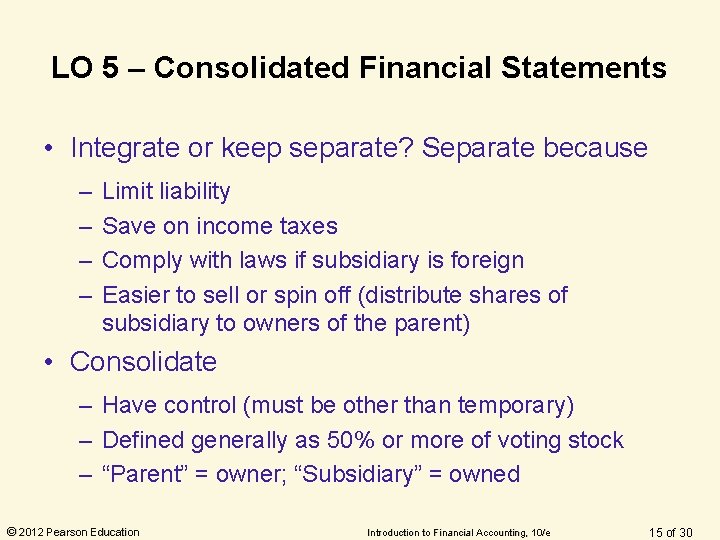
LO 5 – Consolidated Financial Statements • Integrate or keep separate? Separate because – – Limit liability Save on income taxes Comply with laws if subsidiary is foreign Easier to sell or spin off (distribute shares of subsidiary to owners of the parent) • Consolidate – Have control (must be other than temporary) – Defined generally as 50% or more of voting stock – “Parent” = owner; “Subsidiary” = owned © 2012 Pearson Education Introduction to Financial Accounting, 10/e 15 of 30
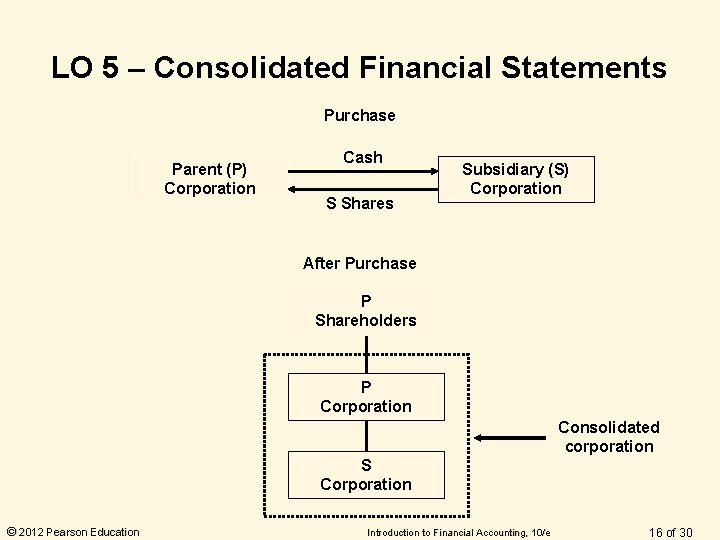
LO 5 – Consolidated Financial Statements Purchase Parent (P) Corporation Cash S Shares Subsidiary (S) Corporation After Purchase P Shareholders P Corporation Consolidated corporation S Corporation © 2012 Pearson Education Introduction to Financial Accounting, 10/e 16 of 30
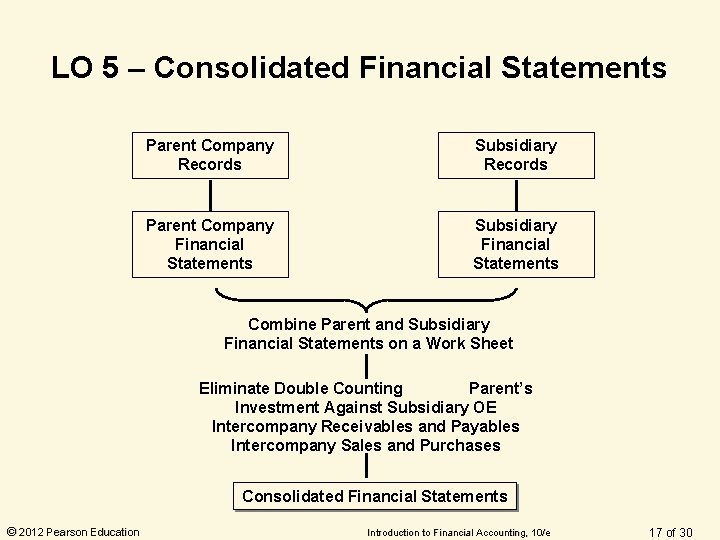
LO 5 – Consolidated Financial Statements Parent Company Records Subsidiary Records Parent Company Financial Statements Subsidiary Financial Statements Combine Parent and Subsidiary Financial Statements on a Work Sheet Eliminate Double Counting Parent’s Investment Against Subsidiary OE Intercompany Receivables and Payables Intercompany Sales and Purchases Consolidated Financial Statements © 2012 Pearson Education Introduction to Financial Accounting, 10/e 17 of 30
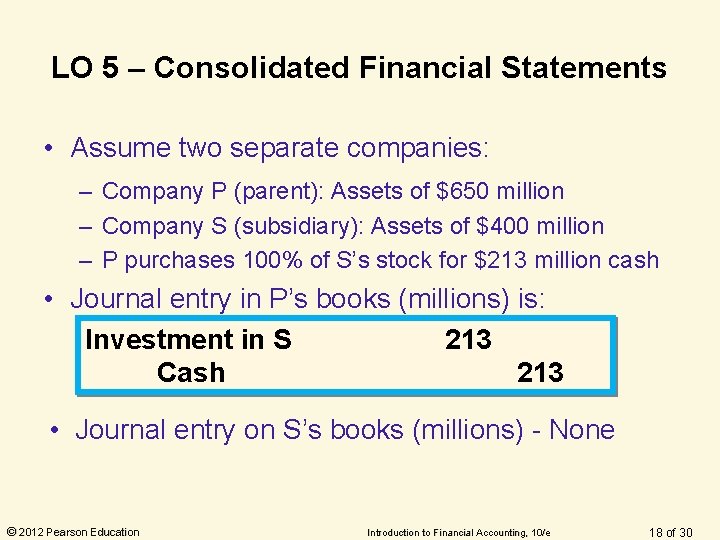
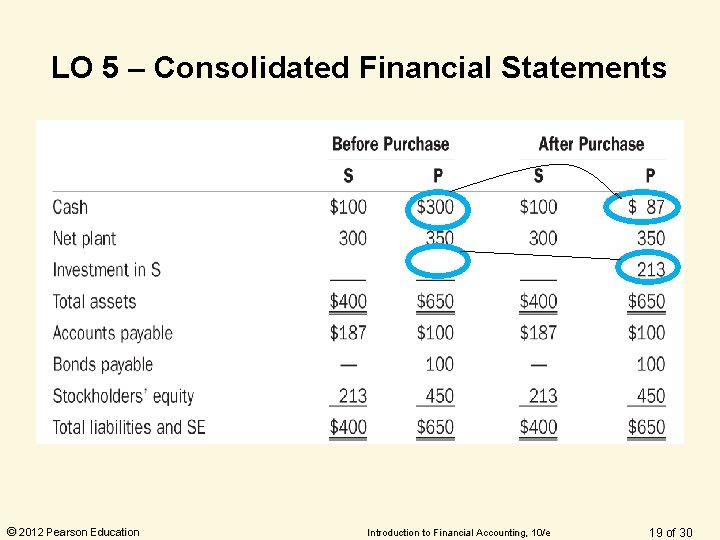
LO 5 – Consolidated Financial Statements • Assume two separate companies: – Company P (parent): Assets of $650 million – Company S (subsidiary): Assets of $400 million – P purchases 100% of S’s stock for $213 million cash • Journal entry in P’s books (millions) is: Investment in S 213 Cash 213 • Journal entry on S’s books (millions) - None © 2012 Pearson Education Introduction to Financial Accounting, 10/e 18 of 30
LO 5 – Consolidated Financial Statements © 2012 Pearson Education Introduction to Financial Accounting, 10/e 19 of 30
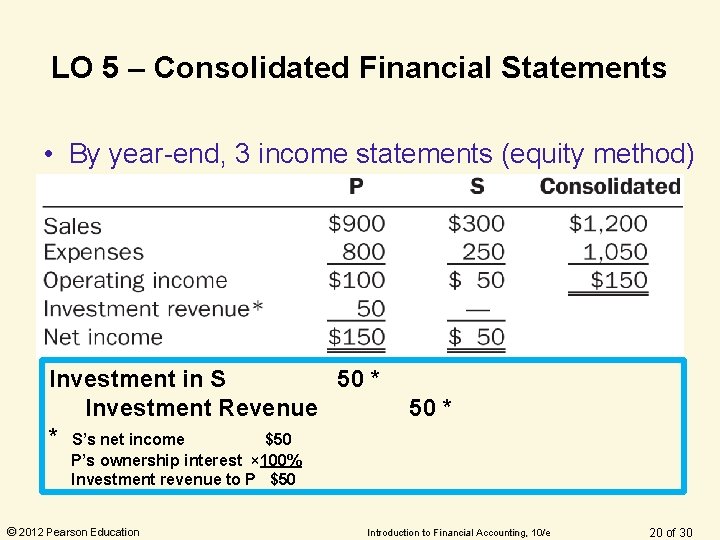
LO 5 – Consolidated Financial Statements • By year-end, 3 income statements (equity method) Investment in S 50 * Investment Revenue * S’s net income $50 50 * P’s ownership interest × 100% Investment revenue to P $50 © 2012 Pearson Education Introduction to Financial Accounting, 10/e 20 of 30
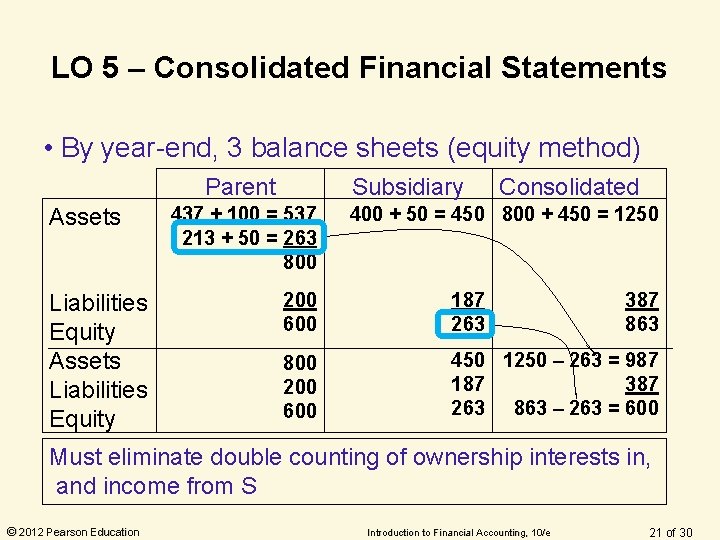
LO 5 – Consolidated Financial Statements • By year-end, 3 balance sheets (equity method) Parent Assets Liabilities Equity Subsidiary 437 + 100 = 537 213 + 50 = 263 800 Consolidated 400 + 50 = 450 800 + 450 = 1250 200 600 187 263 387 863 800 200 600 450 1250 – 263 = 987 187 387 263 863 – 263 = 600 Must eliminate double counting of ownership interests in, and income from S © 2012 Pearson Education Introduction to Financial Accounting, 10/e 21 of 30
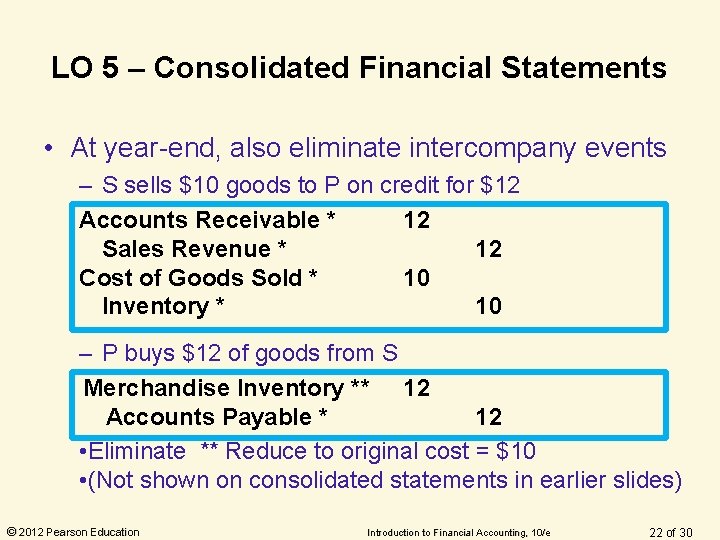
LO 5 – Consolidated Financial Statements • At year-end, also eliminate intercompany events – S sells $10 goods to P on credit for $12 Accounts Receivable * 12 Sales Revenue * 12 Cost of Goods Sold * 10 Inventory * 10 – P buys $12 of goods from S Merchandise Inventory ** 12 Accounts Payable * 12 • Eliminate ** Reduce to original cost = $10 • (Not shown on consolidated statements in earlier slides) © 2012 Pearson Education Introduction to Financial Accounting, 10/e 22 of 30
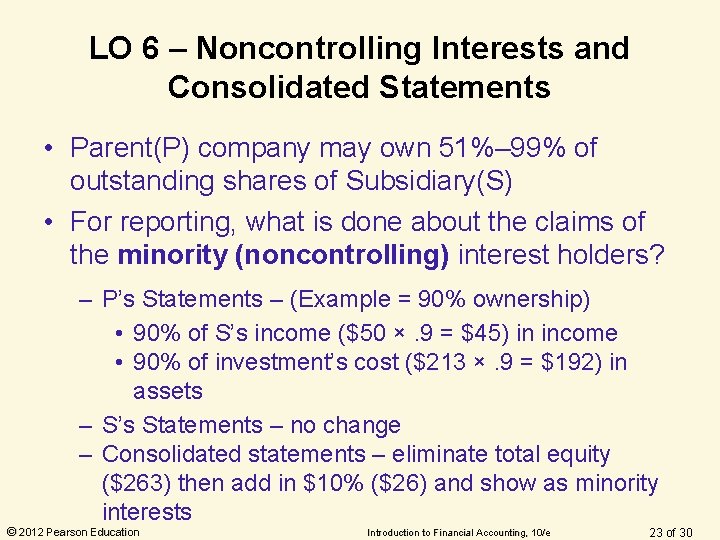
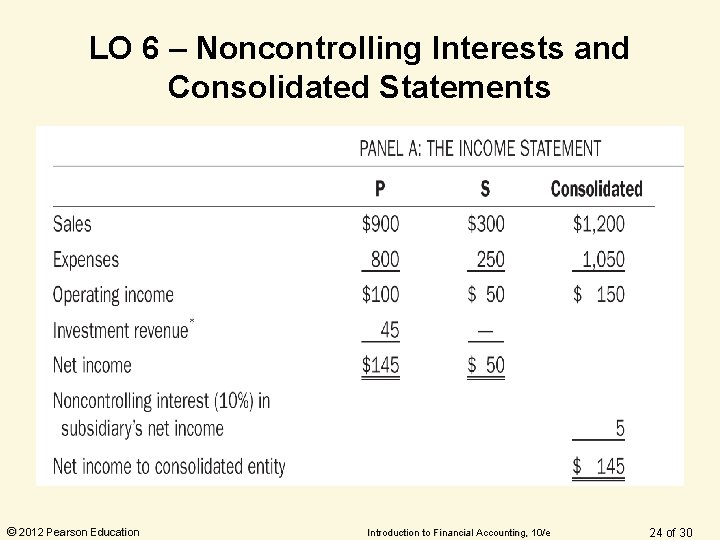
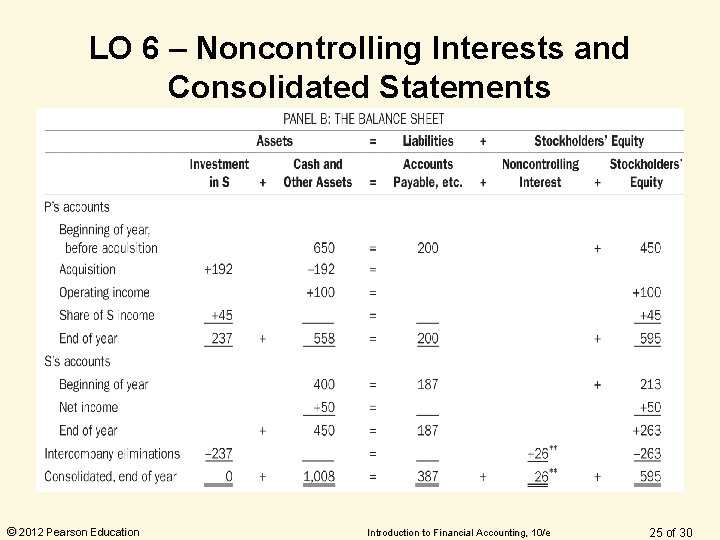
LO 6 – Noncontrolling Interests and Consolidated Statements • Parent(P) company may own 51%– 99% of outstanding shares of Subsidiary(S) • For reporting, what is done about the claims of the minority (noncontrolling) interest holders? – P’s Statements – (Example = 90% ownership) • 90% of S’s income ($50 ×. 9 = $45) in income • 90% of investment’s cost ($213 ×. 9 = $192) in assets – S’s Statements – no change – Consolidated statements – eliminate total equity ($263) then add in $10% ($26) and show as minority interests © 2012 Pearson Education Introduction to Financial Accounting, 10/e 23 of 30
LO 6 – Noncontrolling Interests and Consolidated Statements © 2012 Pearson Education Introduction to Financial Accounting, 10/e 24 of 30
LO 6 – Noncontrolling Interests and Consolidated Statements © 2012 Pearson Education Introduction to Financial Accounting, 10/e 25 of 30
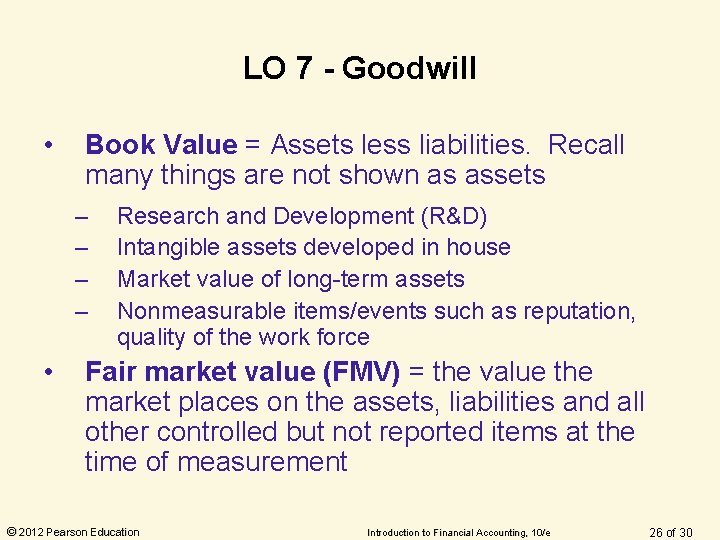
LO 7 - Goodwill • Book Value = Assets less liabilities. Recall many things are not shown as assets – – • Research and Development (R&D) Intangible assets developed in house Market value of long-term assets Nonmeasurable items/events such as reputation, quality of the work force Fair market value (FMV) = the value the market places on the assets, liabilities and all other controlled but not reported items at the time of measurement © 2012 Pearson Education Introduction to Financial Accounting, 10/e 26 of 30
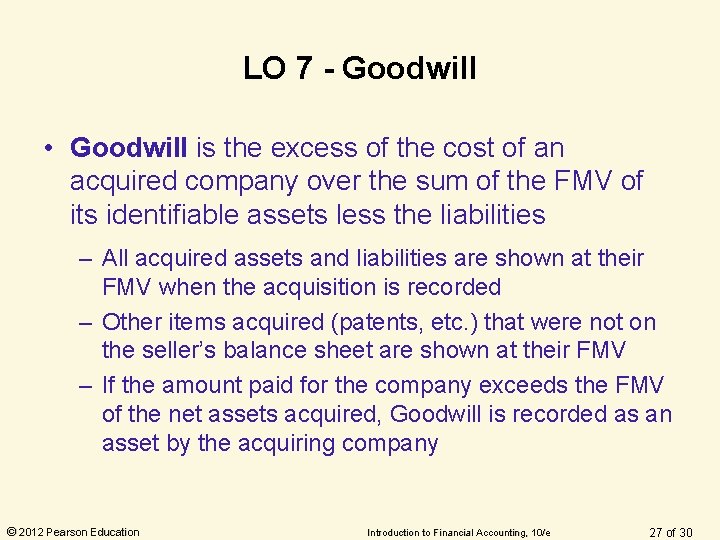
LO 7 - Goodwill • Goodwill is the excess of the cost of an acquired company over the sum of the FMV of its identifiable assets less the liabilities – All acquired assets and liabilities are shown at their FMV when the acquisition is recorded – Other items acquired (patents, etc. ) that were not on the seller’s balance sheet are shown at their FMV – If the amount paid for the company exceeds the FMV of the net assets acquired, Goodwill is recorded as an asset by the acquiring company © 2012 Pearson Education Introduction to Financial Accounting, 10/e 27 of 30
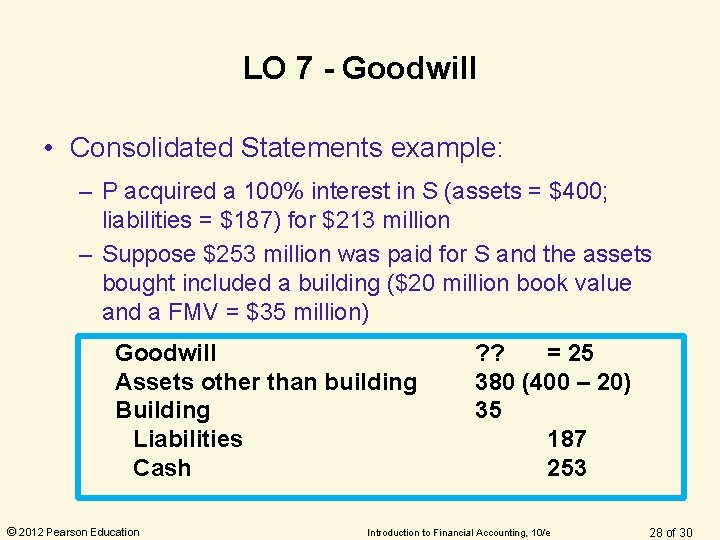
LO 7 - Goodwill • Consolidated Statements example: – P acquired a 100% interest in S (assets = $400; liabilities = $187) for $213 million – Suppose $253 million was paid for S and the assets bought included a building ($20 million book value and a FMV = $35 million) Goodwill Assets other than building Building Liabilities Cash © 2012 Pearson Education ? ? = 25 380 (400 – 20) 35 187 253 Introduction to Financial Accounting, 10/e 28 of 30
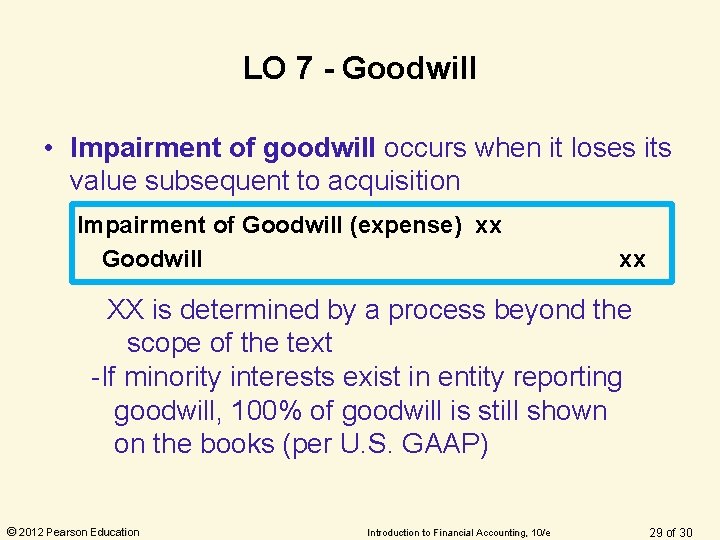
LO 7 - Goodwill • Impairment of goodwill occurs when it loses its value subsequent to acquisition Impairment of Goodwill (expense) xx Goodwill xx XX is determined by a process beyond the scope of the text -If minority interests exist in entity reporting goodwill, 100% of goodwill is still shown on the books (per U. S. GAAP) © 2012 Pearson Education Introduction to Financial Accounting, 10/e 29 of 30
Summary of Accounting for Equity Investments © 2012 Pearson Education Introduction to Financial Accounting, 10/e 30 of 30