
Intercorporate Investments and Consolidations 2006 Prentice Hall Business
Intercorporate Investments and Consolidations © 2006 Prentice Hall Business Publishing CHAPTER Introduction to Financial Accounting, 9/e 11 Horngren/Sundem/Elliott/Philbrick
Learning Objectives After studying this chapter, you should be able to 1. Explain why corporations invest in one another 2. Account for short-term investments in debt securities and equity securities 3. Report long-term investments in bonds 4. Contrast the equity and market methods of accounting for investments 5. Prepare consolidated financial statements 6. Incorporate minority interests into consolidated financial statements © 2006 Prentice Hall Business Publishing Introduction to Financial Accounting, 9/e Horngren/Sundem/Elliott/Philbrick 2
Learning Objectives After studying this chapter, you should be able to 7. Explain the economic meaning and financial reporting of goodwill © 2006 Prentice Hall Business Publishing Introduction to Financial Accounting, 9/e Horngren/Sundem/Elliott/Philbrick 3
Overview of Corporate Investments • Companies invest in short- and long-term debt securities issued by governments, banks, or corporations • Companies also invest in corporate equities that may be classified as marketable securities • Corporations combine in order to – Find the right combination of people and products to succeed in the long run – Create cost savings from eliminating duplications © 2006 Prentice Hall Business Publishing Introduction to Financial Accounting, 9/e Horngren/Sundem/Elliott/Philbrick 4
Overview of Corporate Investments • Smaller companies tend to result in more successful mergers • Companies sometimes sell parts of themselves when they purchase another company • Spin-offs often separate dissimilar business segments to create opportunities for more creative and innovative growth © 2006 Prentice Hall Business Publishing Introduction to Financial Accounting, 9/e Horngren/Sundem/Elliott/Philbrick 5
Overview of Corporate Investments • A short-term investment expected to be converted to cash should be carried as a current asset • Other investments are classified as noncurrent assets and usually appear as either: 1. A separate investment category between current assets and PP&E, or 2. A part of other assets below the plant assets category © 2006 Prentice Hall Business Publishing Introduction to Financial Accounting, 9/e Horngren/Sundem/Elliott/Philbrick 6

Short-Term Investments • A short-term investment is a temporary investment in marketable securities that are expected to be converted to cash within one year • Marketable securities are notes, bonds, or stocks that can be easily sold • Short-term debt securities consist of notes and bonds with maturities of one year or less – Examples: CDs, commercial paper, and Treasury bills © 2006 Prentice Hall Business Publishing Introduction to Financial Accounting, 9/e Horngren/Sundem/Elliott/Philbrick 7
Short-Term Investments • Short-term equity securities consist of capital stock in other corporations • Trading securities are short-term investments in debt and equity securities that the company intends to sell shortly • Held-to-maturity securities are debt securities that the company intends to hold until they mature • Available for sale securities are neither trading or held-to-maturity securities © 2006 Prentice Hall Business Publishing Introduction to Financial Accounting, 9/e Horngren/Sundem/Elliott/Philbrick 8
Changes in Market Prices of Securities • Held-to-maturity securities – Recognize interest income on the income statement – Are valued at amortized cost, ignoring changes in market value • Trading securities – Recognize dividend and interest revenue on the income statement – Are valued at market value (market method), recognizing unrealized gains and losses on the income statement © 2006 Prentice Hall Business Publishing Introduction to Financial Accounting, 9/e Horngren/Sundem/Elliott/Philbrick 9

Changes in Market Prices of Securities • Available for sale securities – Recognize dividend and interest revenue of the income statement – Are valued at market value (market method), recognizing unrealized gains and losses in a separate account in the stockholders’ equity section of the balance sheet (accumulated other comprehensive income) © 2006 Prentice Hall Business Publishing Introduction to Financial Accounting, 9/e Horngren/Sundem/Elliott/Philbrick 10

Changes in Market Prices of Securities • The exhibit below illustrates the accounting for trading securities and available-for-sale securities: © 2006 Prentice Hall Business Publishing Introduction to Financial Accounting, 9/e Horngren/Sundem/Elliott/Philbrick 11

Changes in Market Prices of Securities • The journal entries for periods 2, 3, and 4 would be: © 2006 Prentice Hall Business Publishing Introduction to Financial Accounting, 9/e Horngren/Sundem/Elliott/Philbrick 12
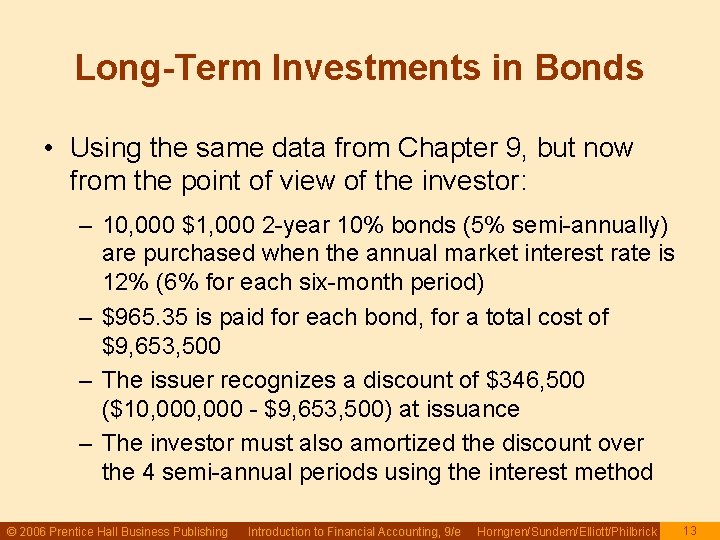
Long-Term Investments in Bonds • Using the same data from Chapter 9, but now from the point of view of the investor: – 10, 000 $1, 000 2 -year 10% bonds (5% semi-annually) are purchased when the annual market interest rate is 12% (6% for each six-month period) – $965. 35 is paid for each bond, for a total cost of $9, 653, 500 – The issuer recognizes a discount of $346, 500 ($10, 000 - $9, 653, 500) at issuance – The investor must also amortized the discount over the 4 semi-annual periods using the interest method © 2006 Prentice Hall Business Publishing Introduction to Financial Accounting, 9/e Horngren/Sundem/Elliott/Philbrick 13
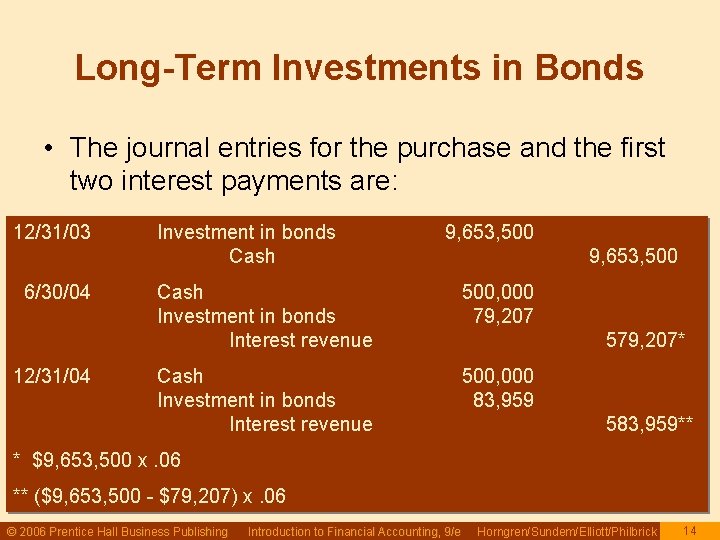
Long-Term Investments in Bonds • The journal entries for the purchase and the first two interest payments are: 12/31/03 6/30/04 12/31/04 Investment in bonds Cash 9, 653, 500 Cash Investment in bonds Interest revenue 500, 000 79, 207 Cash Investment in bonds Interest revenue 500, 000 83, 959 579, 207* 583, 959** * $9, 653, 500 x. 06 ** ($9, 653, 500 - $79, 207) x. 06 © 2006 Prentice Hall Business Publishing Introduction to Financial Accounting, 9/e Horngren/Sundem/Elliott/Philbrick 14
Long-Term Investments in Bonds • The discount makes up for the difference between the coupon rate of 10% and the market rate of 12% • Amortization of a discount increases the interest revenue for the investor • Amortization increases the investment account directly – a separate discount account is not used for the investor © 2006 Prentice Hall Business Publishing Introduction to Financial Accounting, 9/e Horngren/Sundem/Elliott/Philbrick 15
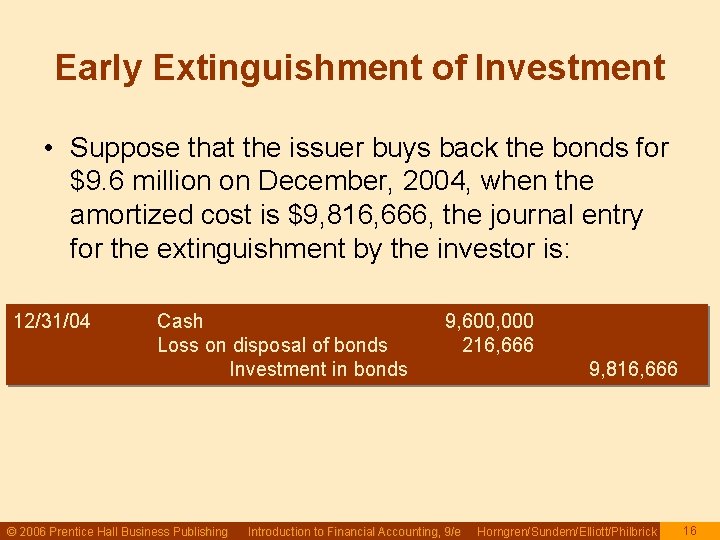
Early Extinguishment of Investment • Suppose that the issuer buys back the bonds for $9. 6 million on December, 2004, when the amortized cost is $9, 816, 666, the journal entry for the extinguishment by the investor is: 12/31/04 Cash Loss on disposal of bonds Investment in bonds © 2006 Prentice Hall Business Publishing 9, 600, 000 216, 666 Introduction to Financial Accounting, 9/e 9, 816, 666 Horngren/Sundem/Elliott/Philbrick 16
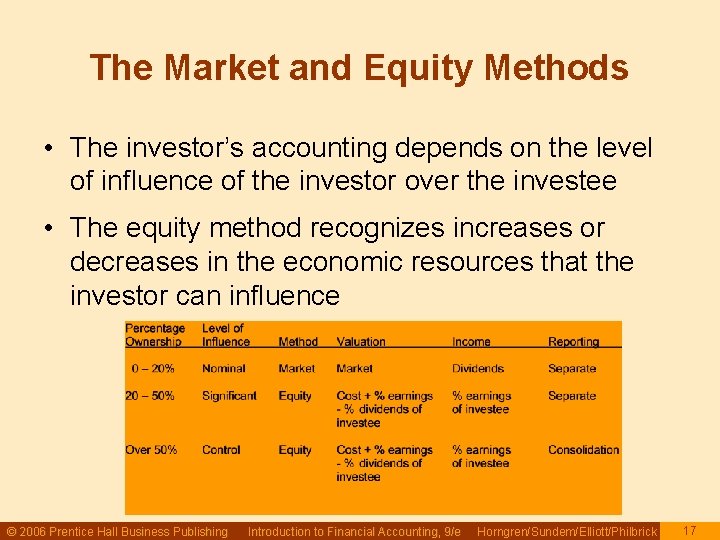
The Market and Equity Methods • The investor’s accounting depends on the level of influence of the investor over the investee • The equity method recognizes increases or decreases in the economic resources that the investor can influence © 2006 Prentice Hall Business Publishing Introduction to Financial Accounting, 9/e Horngren/Sundem/Elliott/Philbrick 17
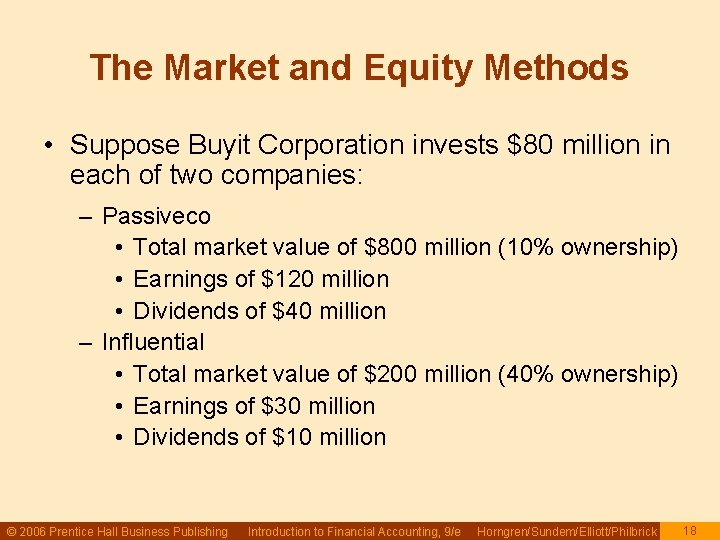
The Market and Equity Methods • Suppose Buyit Corporation invests $80 million in each of two companies: – Passiveco • Total market value of $800 million (10% ownership) • Earnings of $120 million • Dividends of $40 million – Influential • Total market value of $200 million (40% ownership) • Earnings of $30 million • Dividends of $10 million © 2006 Prentice Hall Business Publishing Introduction to Financial Accounting, 9/e Horngren/Sundem/Elliott/Philbrick 18
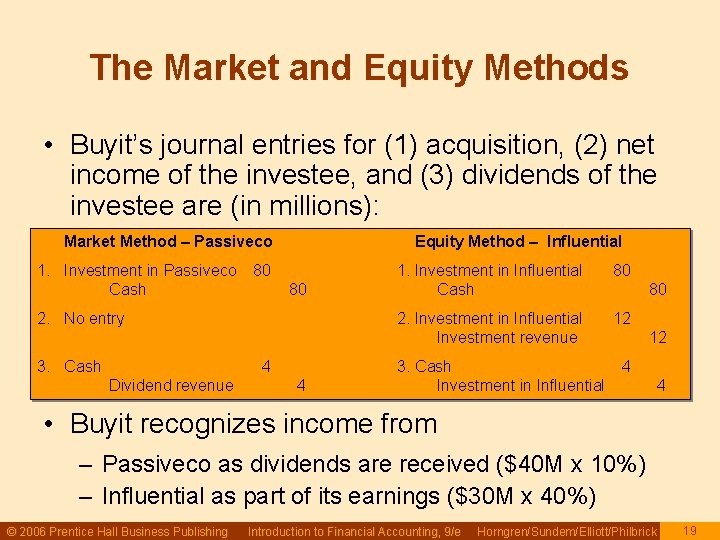
The Market and Equity Methods • Buyit’s journal entries for (1) acquisition, (2) net income of the investee, and (3) dividends of the investee are (in millions): Market Method – Passiveco 1. Investment in Passiveco Cash Equity Method – Influential 80 80 2. No entry 3. Cash 4 Dividend revenue 4 1. Investment in Influential Cash 80 2. Investment in Influential Investment revenue 12 3. Cash Investment in Influential 80 12 4 4 • Buyit recognizes income from – Passiveco as dividends are received ($40 M x 10%) – Influential as part of its earnings ($30 M x 40%) © 2006 Prentice Hall Business Publishing Introduction to Financial Accounting, 9/e Horngren/Sundem/Elliott/Philbrick 19
Consolidated Financial Statements • When a investor has control over an investee company (over 50% ownership), it must prepare consolidated financial statements • The investor company is called the parent • The investee company is called the subsidiary • Although both companies remain separate legal entities, the financial position and earnings reports of the parent are combined with those of the subsidiary © 2006 Prentice Hall Business Publishing Introduction to Financial Accounting, 9/e Horngren/Sundem/Elliott/Philbrick 20
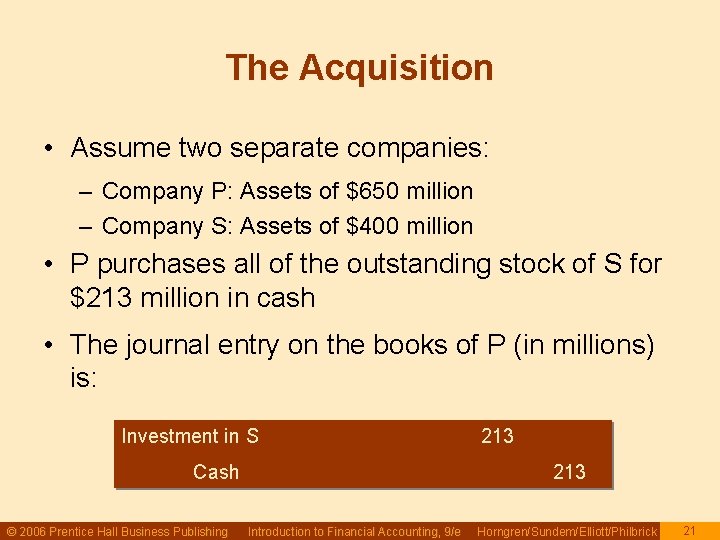
The Acquisition • Assume two separate companies: – Company P: Assets of $650 million – Company S: Assets of $400 million • P purchases all of the outstanding stock of S for $213 million in cash • The journal entry on the books of P (in millions) is: Investment in S Cash © 2006 Prentice Hall Business Publishing 213 Introduction to Financial Accounting, 9/e Horngren/Sundem/Elliott/Philbrick 21
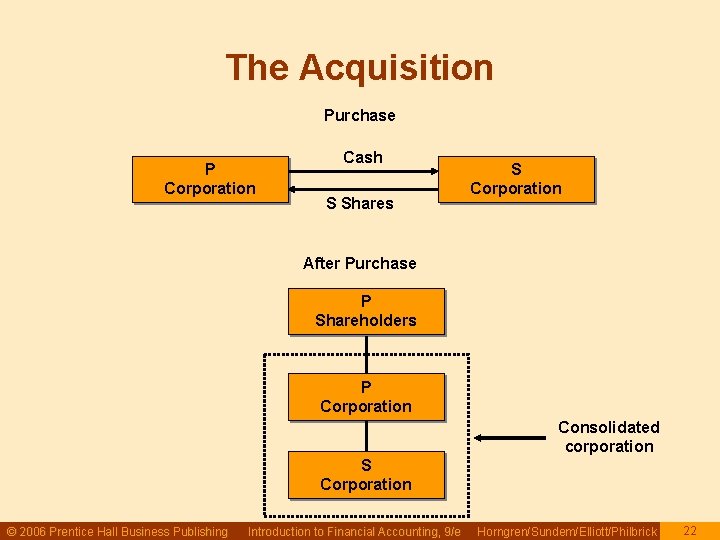
The Acquisition Purchase P Corporation Cash S Shares S Corporation After Purchase P Shareholders P Corporation Consolidated corporation S Corporation © 2006 Prentice Hall Business Publishing Introduction to Financial Accounting, 9/e Horngren/Sundem/Elliott/Philbrick 22
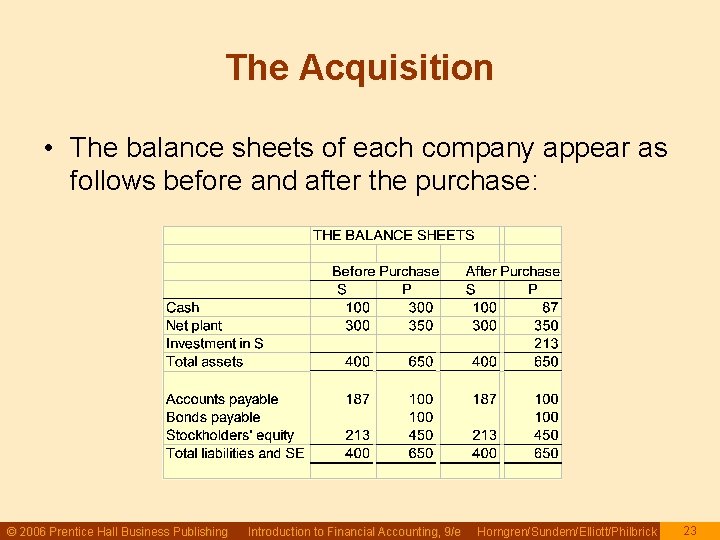
The Acquisition • The balance sheets of each company appear as follows before and after the purchase: © 2006 Prentice Hall Business Publishing Introduction to Financial Accounting, 9/e Horngren/Sundem/Elliott/Philbrick 23
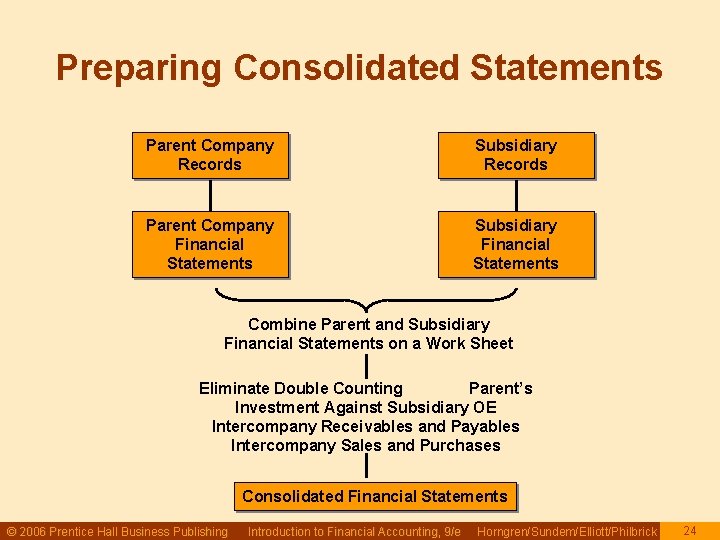
Preparing Consolidated Statements Parent Company Records Subsidiary Records Parent Company Financial Statements Subsidiary Financial Statements Combine Parent and Subsidiary Financial Statements on a Work Sheet Eliminate Double Counting Parent’s Investment Against Subsidiary OE Intercompany Receivables and Payables Intercompany Sales and Purchases Consolidated Financial Statements © 2006 Prentice Hall Business Publishing Introduction to Financial Accounting, 9/e Horngren/Sundem/Elliott/Philbrick 24
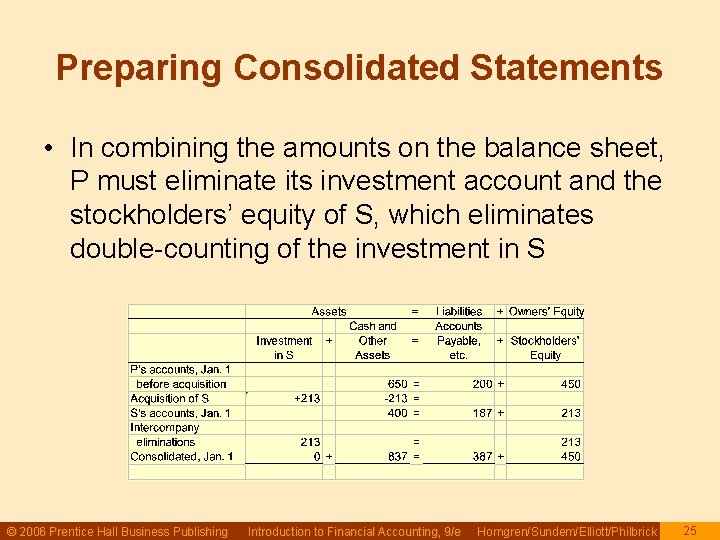
Preparing Consolidated Statements • In combining the amounts on the balance sheet, P must eliminate its investment account and the stockholders’ equity of S, which eliminates double-counting of the investment in S © 2006 Prentice Hall Business Publishing Introduction to Financial Accounting, 9/e Horngren/Sundem/Elliott/Philbrick 25
After Acquisition • P continues to use the equity method during the period • To prepare consolidated statements, P must eliminate: – Its investment account and the SE of the subsidiary on the consolidated balance sheet – Intercompany revenues and expenses on the income statement – Other intercompany transactions © 2006 Prentice Hall Business Publishing Introduction to Financial Accounting, 9/e Horngren/Sundem/Elliott/Philbrick 26
Minority Interests • A parent company may own less than 100% of the outstanding stock (51% - 99%) • Claims by non-majority stockholders on assets and earnings in the consolidated statements are called minority interests • Minority interest must be shown on both the consolidated income statement and consolidated balance sheet © 2006 Prentice Hall Business Publishing Introduction to Financial Accounting, 9/e Horngren/Sundem/Elliott/Philbrick 27
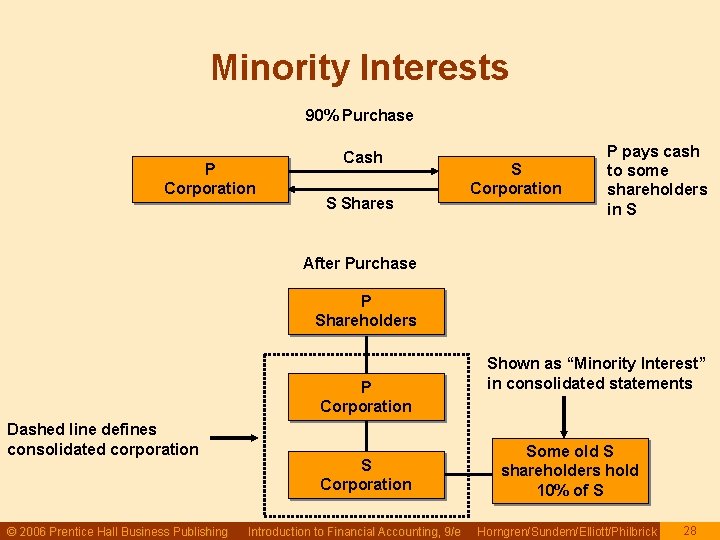
Minority Interests 90% Purchase P Corporation Cash S Shares S Corporation P pays cash to some shareholders in S After Purchase P Shareholders P Corporation Dashed line defines consolidated corporation © 2006 Prentice Hall Business Publishing S Corporation Introduction to Financial Accounting, 9/e Shown as “Minority Interest” in consolidated statements Some old S shareholders hold 10% of S Horngren/Sundem/Elliott/Philbrick 28
Purchase Price Not Equal to Book Value • When the acquiring company pays more than the book value of the acquired company’s net assets, consolidation requires a two-step adjustment: 1. All acquired assets and liabilities are shown at their fair market value (FMV) 2. If the purchase price > FMV of the net assets, goodwill must be shown on the consolidated balance sheet • Goodwill is the excess of the cost of an acquired company over the sum of the FMV of its identifiable assets less the liabilities © 2006 Prentice Hall Business Publishing Introduction to Financial Accounting, 9/e Horngren/Sundem/Elliott/Philbrick 29
Accounting for Goodwill • In the previous example, assume that: – P acquired a 100% interest in S for $253 million rather than $213 million – A building with a book value of $20 million had a FMV of $35 million • The tabulation of the consolidated balance sheet including the calculation of goodwill is shown in the next exhibit © 2006 Prentice Hall Business Publishing Introduction to Financial Accounting, 9/e Horngren/Sundem/Elliott/Philbrick 30
Accounting for Goodwill © 2006 Prentice Hall Business Publishing Introduction to Financial Accounting, 9/e Horngren/Sundem/Elliott/Philbrick 31
Accounting for Goodwill • Impairment of goodwill occurs when it loses its value subsequent to acquisition • The consolidated company must record any impairment with a decrease to the goodwill account and a charge to an expense account © 2006 Prentice Hall Business Publishing Introduction to Financial Accounting, 9/e Horngren/Sundem/Elliott/Philbrick 32
Goodwill and Abnormal Earnings • Goodwill is the price paid for “excess” or “abnormal” earning power • This abnormal earning power could be due to location, human resource, or reputation advantages • Normal earnings and excess earnings are capitalized by a multiple • The multiple for excess earnings is lower since it is riskier © 2006 Prentice Hall Business Publishing Introduction to Financial Accounting, 9/e Horngren/Sundem/Elliott/Philbrick 33
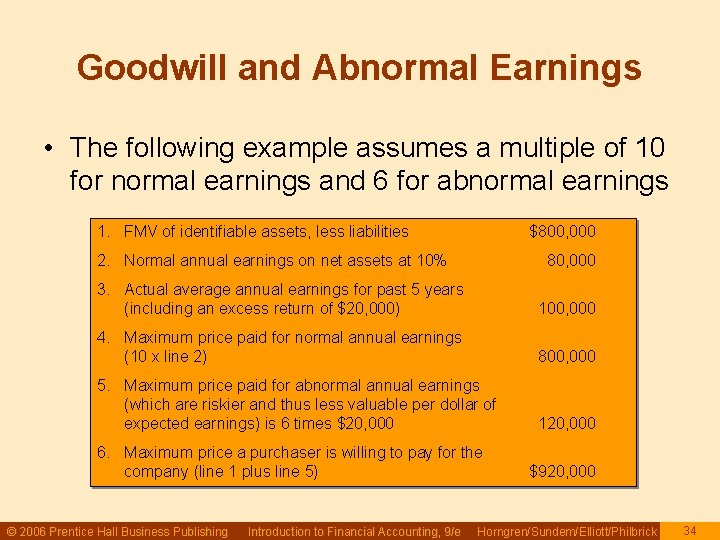
Goodwill and Abnormal Earnings • The following example assumes a multiple of 10 for normal earnings and 6 for abnormal earnings 1. FMV of identifiable assets, less liabilities $800, 000 2. Normal annual earnings on net assets at 10% 80, 000 3. Actual average annual earnings for past 5 years (including an excess return of $20, 000) 100, 000 4. Maximum price paid for normal annual earnings (10 x line 2) 800, 000 5. Maximum price paid for abnormal annual earnings (which are riskier and thus less valuable per dollar of expected earnings) is 6 times $20, 000 120, 000 6. Maximum price a purchaser is willing to pay for the company (line 1 plus line 5) © 2006 Prentice Hall Business Publishing Introduction to Financial Accounting, 9/e $920, 000 Horngren/Sundem/Elliott/Philbrick 34
Equity Affiliates, Minority Interest, and the Statement of Cash Flows • The statement of cash flows is affected for a company having equity affiliates (firms for which the investor uses the equity method) in the follow way: – Direct method: A cash dividend received from the affiliate appears in the operating section – Indirect method: Net income is increased (decreased) by the investor’s share of its affiliates’ earnings (loss) in the operating section © 2006 Prentice Hall Business Publishing Introduction to Financial Accounting, 9/e Horngren/Sundem/Elliott/Philbrick 35

Summary of Accounting for Equity Securities © 2006 Prentice Hall Business Publishing Introduction to Financial Accounting, 9/e Horngren/Sundem/Elliott/Philbrick 36
- Slides: 36