Integrated Care PLT Patient Activation Measure PAM Zakia

- Slides: 11
Integrated Care PLT: Patient Activation Measure (PAM) Zakia Khatun Programme Manager for Personalisation Tower Hamlets CCG 9 th June 2016
Patients at the heart of health Person-centred healthcare • Self management support – effectively managing their health • Shared decision making – making informed decisions Self management programmes typically: • build patient awareness • provide information and education • use decision support tools to structure consultations BUT Many patients are not sufficiently ‘activated’ to benefit. Those who are least activated are unlikely to even attend.
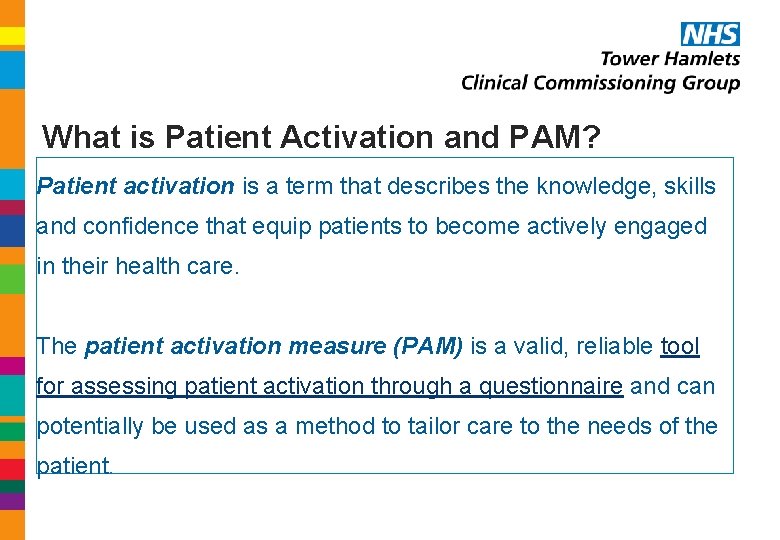
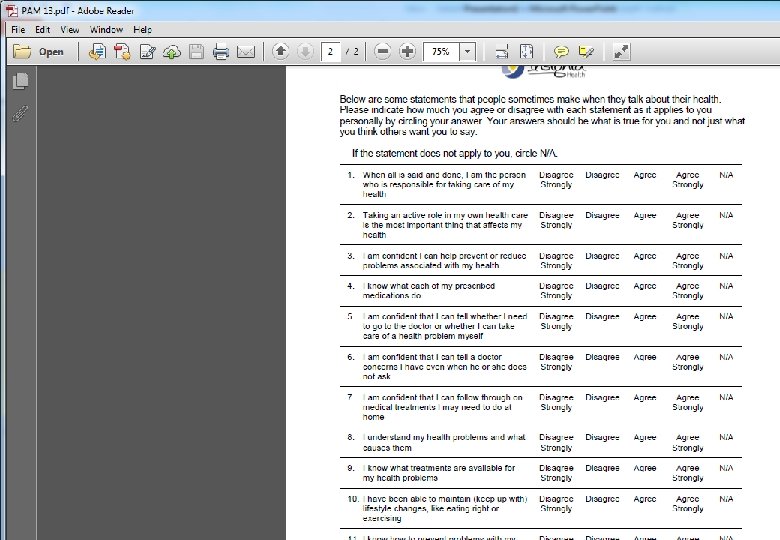
What is Patient Activation and PAM? Patient activation is a term that describes the knowledge, skills and confidence that equip patients to become actively engaged in their health care. The patient activation measure (PAM) is a valid, reliable tool for assessing patient activation through a questionnaire and can potentially be used as a method to tailor care to the needs of the patient.
Addressing health inequalities 25 -40% of the populations researched have the lowest levels of patient activation. • Least likely to adopt healthy behaviours • Have the worst health outcomes • Have the highest healthcare costs • Least likely to access and benefit from health interventions available. PDesign & target interventions for least activated individuals.
Behaviour associated with low activation • Feeling overwhelmed with the tasks of managing their health; • Little confidence in their ability to have a positive impact on their health; • Have had substantial experience of failing to manage their health leading to passivity, preferring not to think about their health; • Less likely to follow clinical advice or manage their health following treatment or know about treatment guidelines for their conditions; • Higher A&E attendance; hospitalisation; readmissions. Particularly as this group of patients are also two or three times more likely to have unmet medical need and delay seeking medical help.
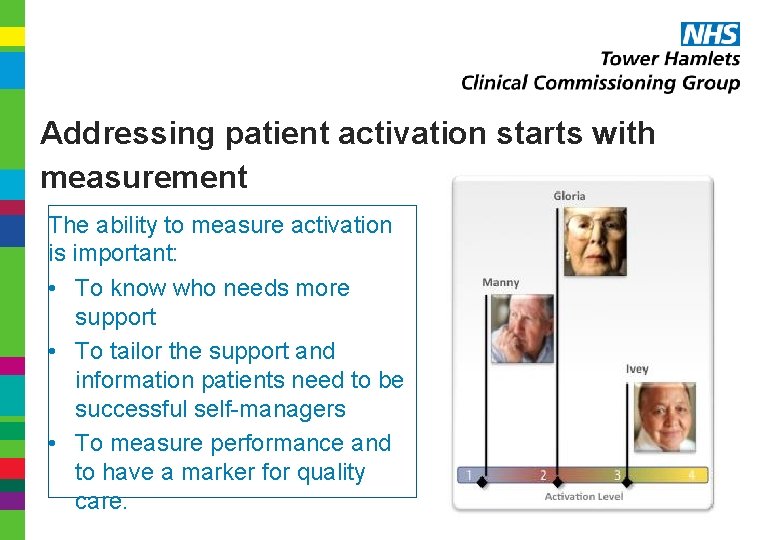
Addressing patient activation starts with measurement The ability to measure activation is important: • To know who needs more support • To tailor the support and information patients need to be successful self-managers • To measure performance and to have a marker for quality care.
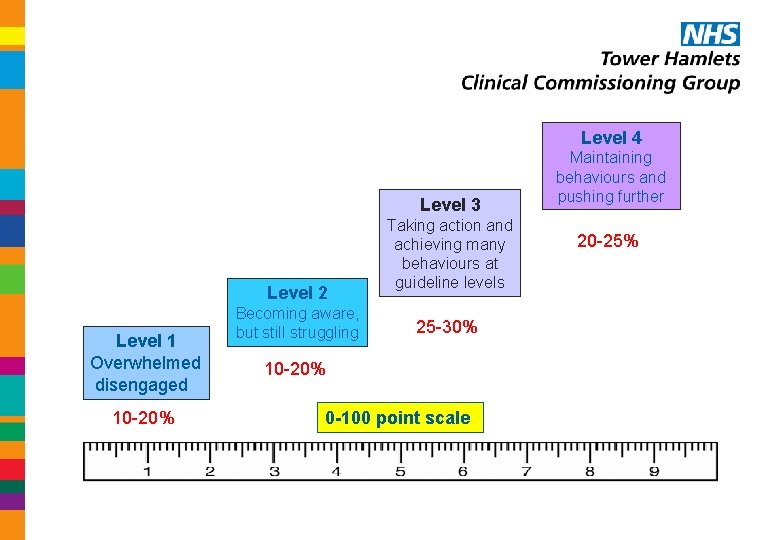
Level 4 Level 3 Level 2 Level 1 Overwhelmed disengaged 10 -20% Becoming aware, but still struggling Taking action and achieving many behaviours at guideline levels 25 -30% 10 -20% 0 -100 point scale Maintaining behaviours and pushing further 20 -25%
Interventions to improve activation Many of the behaviours expected of people by the health system are undertaken by those in highest level of activation. The complexity of the behaviour change required can be discouraging for those with low activation and reinforce the experience of “failing”. Programmes which successfully raised activation levels had the following in common: • Focused on developing skills and building confidence • Use of strategies to stimulate autonomous motivation by encouraging the individual to make choices and to self-initiate behaviours; • Are tailored to an individual’s level of activation e. g. tailored coaching. Clear link between patient activation and health outcomes across a range of different populations and health conditions. Increased activation results in improved engagement, multiple behaviours change and health outcomes. Those who are least activated make the most progress when given appropriate support.
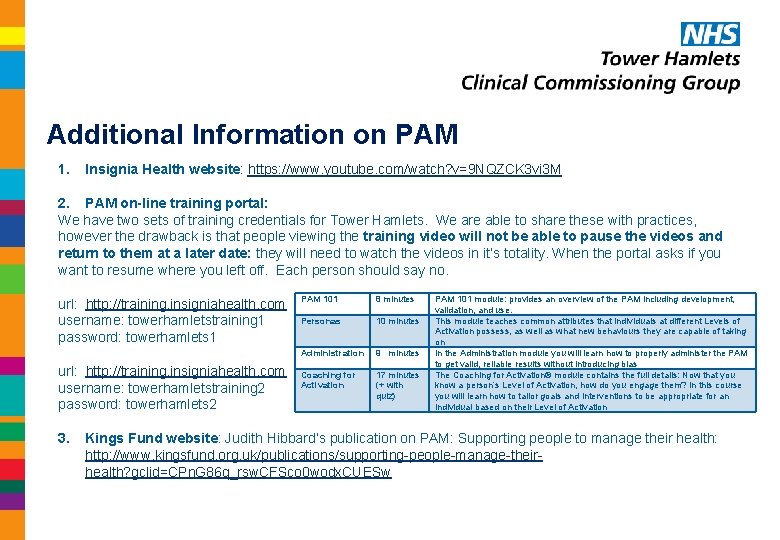
Additional Information on PAM 1. Insignia Health website: https: //www. youtube. com/watch? v=9 NQZCK 3 vi 3 M 2. PAM on-line training portal: We have two sets of training credentials for Tower Hamlets. We are able to share these with practices, however the drawback is that people viewing the training video will not be able to pause the videos and return to them at a later date: they will need to watch the videos in it’s totality. When the portal asks if you want to resume where you left off. Each person should say no. 8 minutes PAM 101 module: provides an overview of the PAM including development, url: http: //training. insigniahealth. com PAM 101 validation, and use. Personas 10 minutes This module teaches common attributes that individuals at different Levels of username: towerhamletstraining 1 Activation possess, as well as what new behaviours they are capable of taking password: towerhamlets 1 on Administration 9 minutes In the Administration module you will learn how to properly administer the PAM to get valid, reliable results without introducing bias url: http: //training. insigniahealth. com Coaching for 17 minutes The Coaching for Activation® module contains the full details: Now that you Activation (+ with know a person’s Level of Activation, how do you engage them? In this course username: towerhamletstraining 2 quiz) you will learn how to tailor goals and interventions to be appropriate for an password: towerhamlets 2 individual based on their Level of Activation 3. Kings Fund website: Judith Hibbard’s publication on PAM: Supporting people to manage their health: http: //www. kingsfund. org. uk/publications/supporting-people-manage-theirhealth? gclid=CPn. G 86 q_rsw. CFSco 0 wodx. CUESw
Additional Information on PAM 4. PAM factsheet – (will be circulated separately via Ekramul) 5. Primer on Obtaining Valid & Reliable PAM® Responses (will be circulated separately via Ekramul) 6. CS-PAM report (will be circulated separately via Ekramul) 7. ‘Prudent Health Care and Patient Activation’ report by the Welsh Government (will be circulated separately by Ekramul) 8. You. Tube videos on PAM: • Clinician support (CS) PAM video: https: //www. youtube. com/watch? v=4 Ni 3 LOc 1 KPo • Kings Fund video with Judith Hibbard discussing PAM: https: //www. youtube. com/watch? v=9 NQZCK 3 vi 3 M 9. Insignia presentation: overview of PAM (will be circulated separately via Ekramul)