InService Teacher Training Assessment in IGCSE Mathematics 05800581
- Slides: 19
In-Service Teacher Training Assessment in IGCSE Mathematics 0580/0581 Session 2: Question papers and mark schemes
www. cie. org. uk Welcome • Introductions • Background • Aim of training
www. cie. org. uk Session 2 looks at: • • • How question papers are set The construction of questions Grade Descriptions Developing and applying mark schemes Analysis of candidates’ scripts and creating mark schemes
www. cie. org. uk How question papers are set (1): Assessment Objectives • Questions set with reference to Assessment Objectives • Topics for the structured papers set first • Balance is maintained across the four areas of Number, Algebra, Shape and Space and Statistics and Probability. • Questions set across a range of grades
www. cie. org. uk How question papers are set (2): Levels of difficulty • Questions are written so that each follows a logical pattern • Answers in earlier parts of questions may be needed to help with later parts in the question • In general, easier questions are put at the beginning of a paper • Within a question there is usually a graduation of increasing difficulty, being the most difficult at the end
www. cie. org. uk Setting internal summative assessments • Setting tests in the style of IGCSE assessments • Decide on a ‘department house style’ that is similar to IGCSE style • Using command words in questions in IGCSE style • Benefits to students – they get used to this one style and the language used
www. cie. org. uk Devising mark schemes • For any question, the mark scheme must allow all of the marks available for the question to be achieved • Mark scheme must take into account different methods used by candidates • Mark schemes are always amended to take into account the ways that candidates answer particular questions
www. cie. org. uk Types of marks used on mark schemes (1) • M marks for method • A marks for accuracy - cannot be given unless M marks gained • B marks - independent of method marks
www. cie. org. uk Types of marks used on mark schemes (2) • On graphs: S - scale, P - points, C curve, L - line • SC marks (Special Case) • Other letters as appropriate Correct answers without working usually score full marks.
www. cie. org. uk Important marking issues Other marking issues • Deleted work is marked, provided it is not replaced by another answer • If a choice of solutions is offered, the last is marked • Consistent misreads can score full marks with a misread penalty of one mark only throughout the question
www. cie. org. uk Setting questions in context • Can increase the level of difficulty • Brings relevance to the mathematics being tested • Assesses the candidates’ ability to use and apply knowledge when confronted with new situations
www. cie. org. uk The construction of questions Command words • Command words are key words used in questions • Candidates should work on their understanding of the command words to improve their exam technique • Knowledge of command words greatly assists language interpretation in context -rich questions
www. cie. org. uk Grade Descriptions (1): Why have Grade Descriptions? • Make clear the level of performance required for different grades • Help examiners set questions of the appropriate difficulty and to balance exam papers • Help teachers assess the level of their students
www. cie. org. uk Grade Descriptions (2): Analysing Grade Descriptions • See syllabus page 10 for descriptions of grades A, C and F • Only a selection of syllabus items are listed • Using the topics from pages 6 -9 of the syllabus, pick a topic or selection of topics and write Grade Descriptions for that topic
www. cie. org. uk Grade Descriptions (3) • What other topics / questions would be grade A? • What about grade B? • Where would matrices be graded? • What about averages?
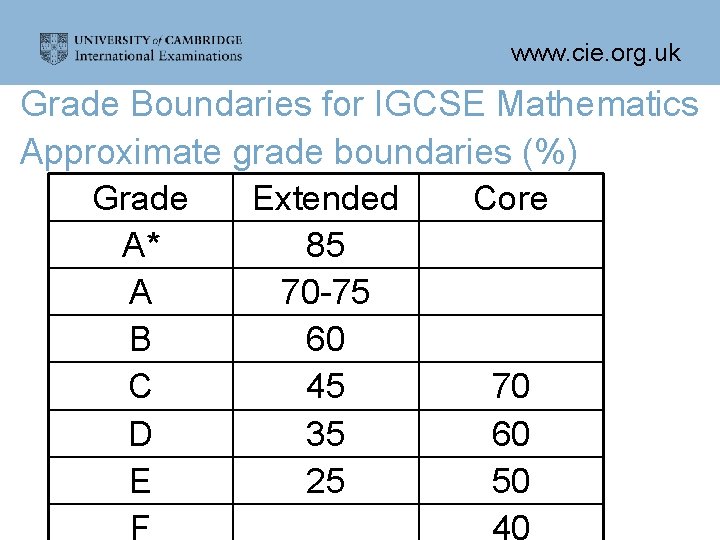
www. cie. org. uk Grade Boundaries for IGCSE Mathematics Approximate grade boundaries (%) Grade Extended Core A* 85 A 70 -75 B 60 C 45 70 D 35 60 E 25 50
www. cie. org. uk Strategies for marking questions: Core questions • Look at the examples of Core / Extended questions along with mark schemes and student responses
www. cie. org. uk Creating a mark scheme for a question Activity 2. 16 • For the question given, create a mark scheme in the style of those on Handout 2. 16 • Consider the student responses to the question and adjust the scheme if necessary to take these answers in to account
Closing comments