Infinitiivi ingmuoto thatlause Infinitiivi ingmuoto thatlause SPOTPA P
- Slides: 133
Infinitiivi, ing-muoto, that-lause
Infinitiivi, ing-muoto, that-lause • SPOTPA • P = predikaatti
Infinitiivi, ing-muoto, that-lause • SPOTPA • P = predikaatti • Entäpä jos verbi on lauseessa muualla kuin predikaattina?
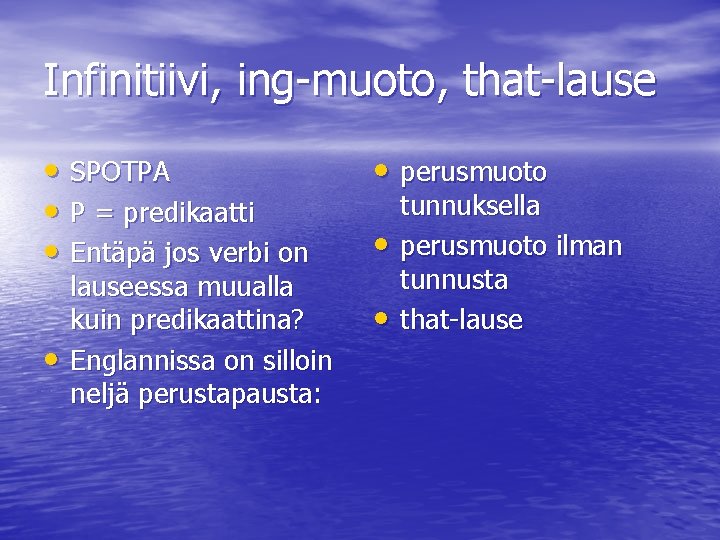
Infinitiivi, ing-muoto, that-lause • SPOTPA • P = predikaatti • Entäpä jos verbi on • lauseessa muualla kuin predikaattina? Englannissa on silloin neljä perustapausta:
Infinitiivi, ing-muoto, that-lause • SPOTPA • P = predikaatti • Entäpä jos verbi on • lauseessa muualla kuin predikaattina? Englannissa on silloin neljä perustapausta: • perusmuoto tunnuksella
Infinitiivi, ing-muoto, that-lause • SPOTPA • P = predikaatti • Entäpä jos verbi on • lauseessa muualla kuin predikaattina? Englannissa on silloin neljä perustapausta: • perusmuoto • tunnuksella perusmuoto ilman tunnusta
Infinitiivi, ing-muoto, that-lause • SPOTPA • P = predikaatti • Entäpä jos verbi on • lauseessa muualla kuin predikaattina? Englannissa on silloin neljä perustapausta: • perusmuoto • • tunnuksella perusmuoto ilman tunnusta that-lause
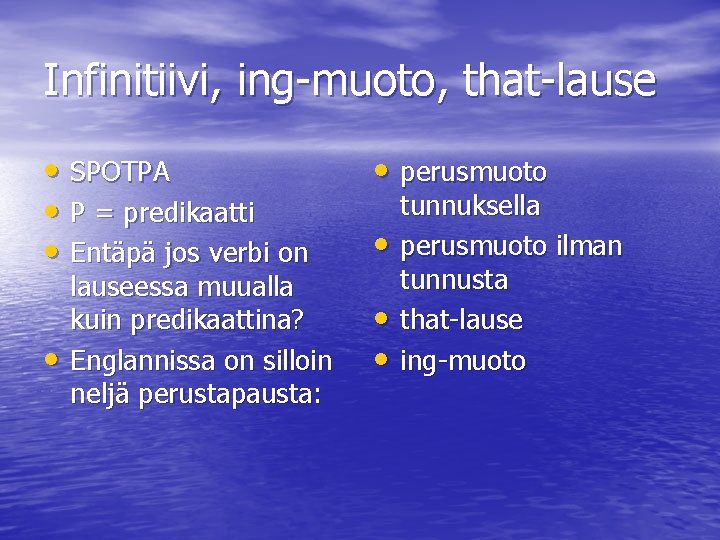
Infinitiivi, ing-muoto, that-lause • SPOTPA • P = predikaatti • Entäpä jos verbi on • lauseessa muualla kuin predikaattina? Englannissa on silloin neljä perustapausta: • perusmuoto • • • tunnuksella perusmuoto ilman tunnusta that-lause ing-muoto
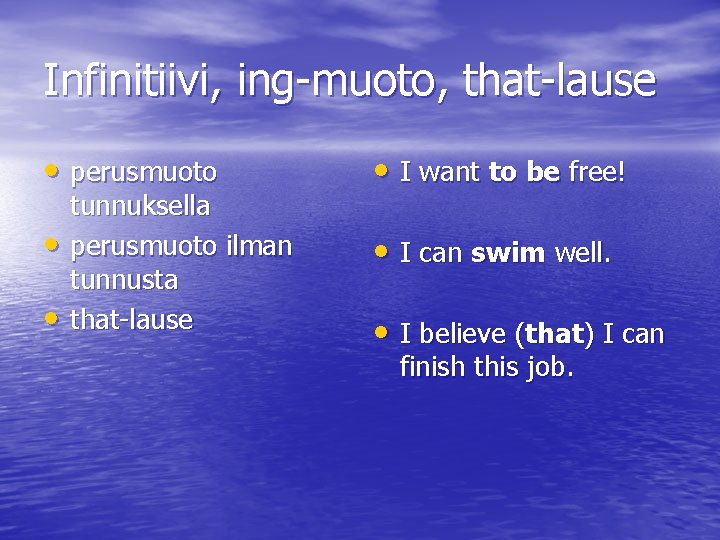
Infinitiivi, ing-muoto, that-lause • perusmuoto tunnuksella • I want to be free!
Infinitiivi, ing-muoto, that-lause • perusmuoto • I want to be free! • • I can swim well. tunnuksella perusmuoto ilman tunnusta
Infinitiivi, ing-muoto, that-lause • perusmuoto • I want to be free! • • I can swim well. • tunnuksella perusmuoto ilman tunnusta that-lause • I believe (that) I can finish this job.
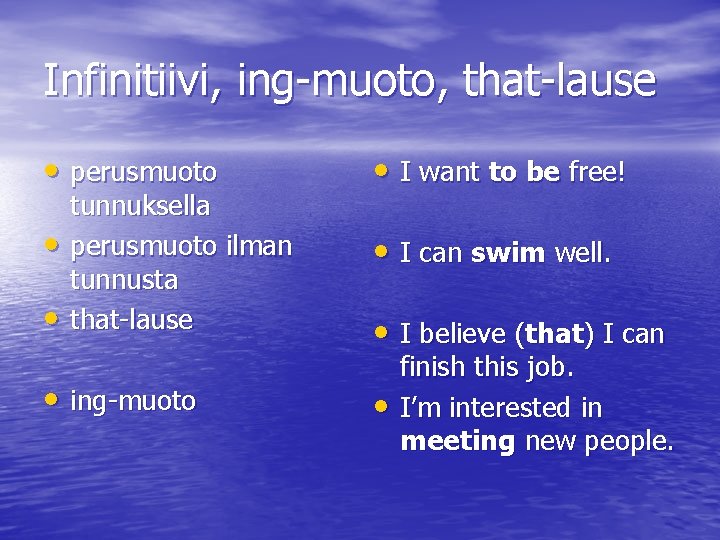
Infinitiivi, ing-muoto, that-lause • perusmuoto • I want to be free! • • I can swim well. • tunnuksella perusmuoto ilman tunnusta that-lause • ing-muoto • I believe (that) I can • finish this job. I’m interested in meeting new people.
Verbin perusmuoto eli Infinitiivi • Perusmuotoja on neljä eri tilanteisiin:
Verbin perusmuoto eli Infinitiivi • Perusmuotoja on neljä • eri tilanteisiin: AKTIIVI • eri tilanteisiin: PASSIIVI
Verbin perusmuoto eli Infinitiivi • Perusmuotoja on neljä • • eri tilanteisiin: AKTIIVI Nykyviittaus • • eri tilanteisiin: PASSIIVI Nykyviittaus
Verbin perusmuoto eli Infinitiivi • Perusmuotoja on neljä • • eri tilanteisiin: AKTIIVI Nykyviittaus • • eri tilanteisiin: PASSIIVI Nykyviittaus • Menneen ajan viittaus
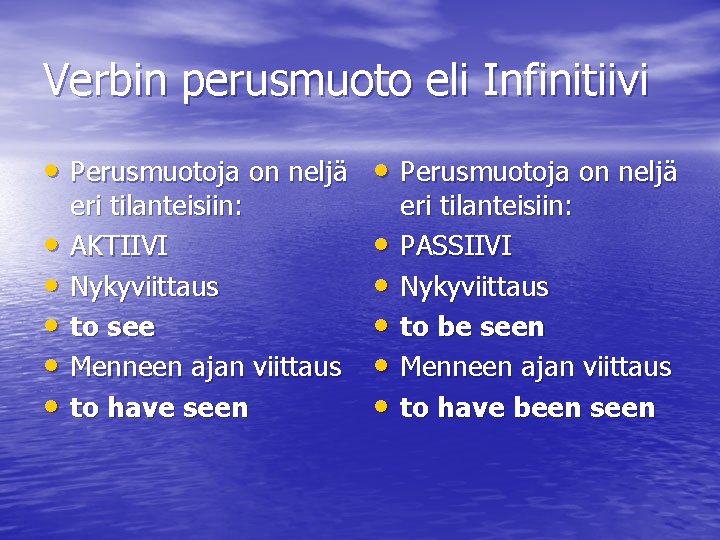
Verbin perusmuoto eli Infinitiivi • Perusmuotoja on neljä • • • eri tilanteisiin: AKTIIVI Nykyviittaus to see Menneen ajan viittaus to have seen • • • eri tilanteisiin: PASSIIVI Nykyviittaus to be seen Menneen ajan viittaus to have been seen
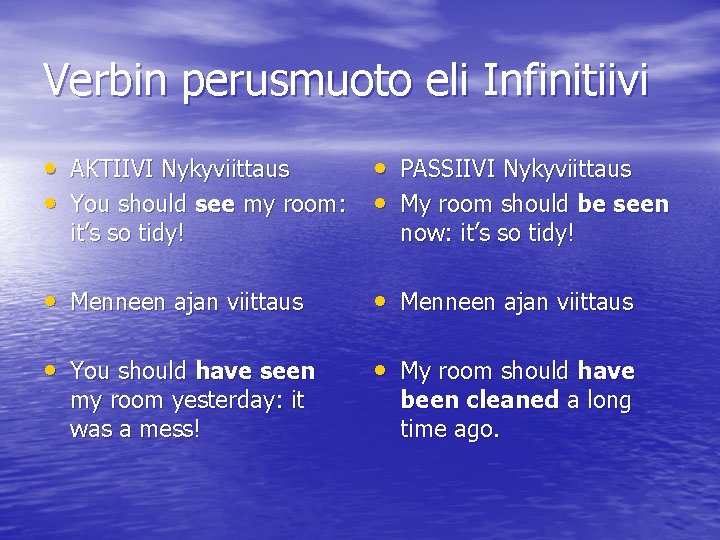
Verbin perusmuoto eli Infinitiivi • AKTIIVI Nykyviittaus • PASSIIVI Nykyviittaus • You should see my room: • My room should be seen it’s so tidy! now: it’s so tidy! • Menneen ajan viittaus • You should have seen • My room should have my room yesterday: it was a mess! been cleaned a long time ago.
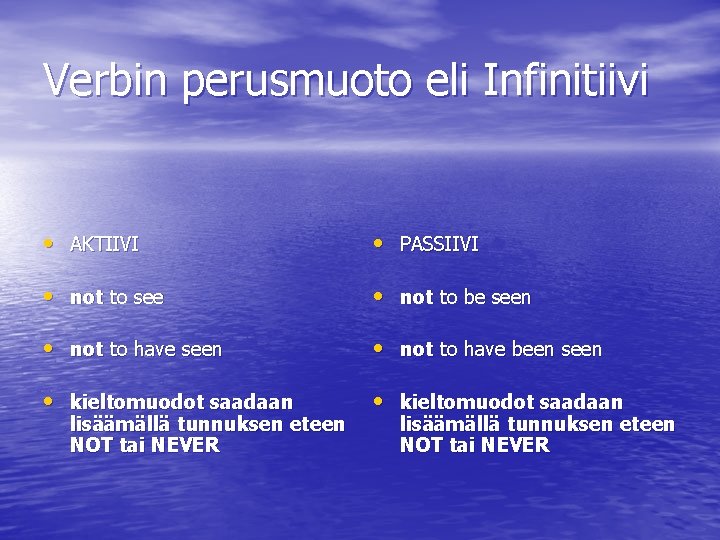
Verbin perusmuoto eli Infinitiivi • AKTIIVI • PASSIIVI • not to see • not to be seen • not to have been seen • kieltomuodot saadaan lisäämällä tunnuksen eteen NOT tai NEVER
Verbin perusmuoto tunnuksella • Perusmuoto tunnuksella liitetään moniin suuriin sanaluokkiin
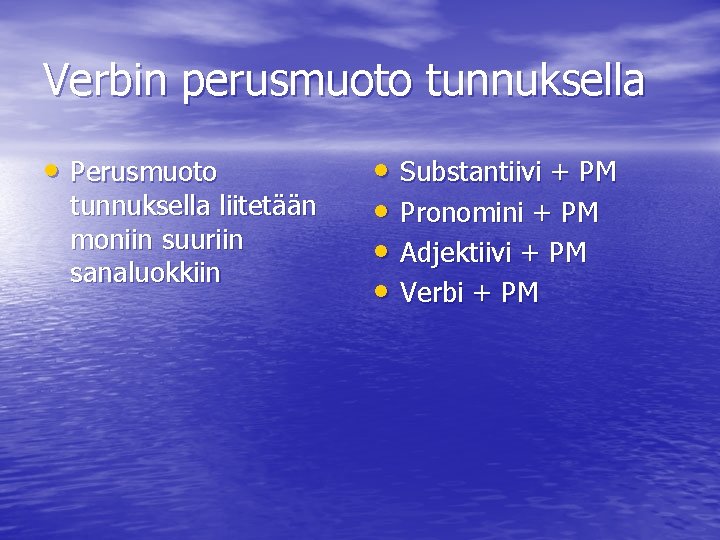
Verbin perusmuoto tunnuksella • Perusmuoto tunnuksella liitetään moniin suuriin sanaluokkiin • Substantiivi + PM • Pronomini + PM • Adjektiivi + PM • Verbi + PM
Verbin perusmuoto tunnuksella • Substantiivi + PM • Pronomini + PM • Adjektiivi + PM • Verbi + PM
Verbin perusmuoto tunnuksella • Substantiivi + PM • Pronomini + PM • Adjektiivi + PM • Verbi + PM • I’ve got a good reason to go.
Verbin perusmuoto tunnuksella • Substantiivi + PM • I’ve got a good reason • Pronomini + PM • • Adjektiivi + PM • Verbi + PM to go. We all need somebody to love.
Verbin perusmuoto tunnuksella • Substantiivi + PM • I’ve got a good reason • Pronomini + PM • • Adjektiivi + PM • • Verbi + PM to go. We all need somebody to love. I’m proud to be a Finn.
Verbin perusmuoto tunnuksella • Substantiivi + PM • I’ve got a good reason • Pronomini + PM • • Adjektiivi + PM • • Verbi + PM • to go. We all need somebody to love. I’m proud to be a Finn. I want you to go.
Verbin perusmuoto tunnuksella • Kysymyssana + PM
Verbin perusmuoto tunnuksella • Kysymyssana + PM • I’m not sure what I should do or where I should go.
Verbin perusmuoto tunnuksella • Kysymyssana + PM • Perusmuodolla korvataan usein raportoituja kysymyksiä • I’m not sure what I • should do or where I should go. I’m not sure what to do or where to go.
Verbin perusmuoto tunnuksella • Perusmuodolla korvataan usein raportoituja kysymyksiä • (WHY + ei tunnusta) I’m not sure what to do or where to go. Everybody is here so why not start right away.
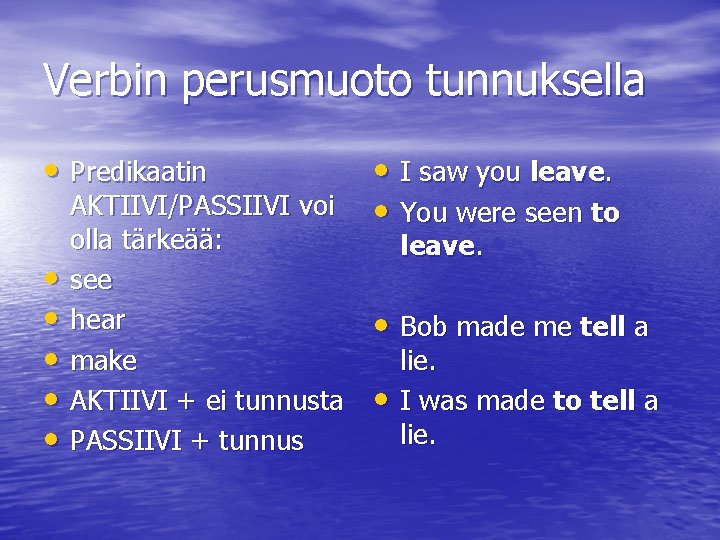
Verbin perusmuoto tunnuksella • Predikaatin AKTIIVI/PASSIIVI voi olla tärkeää:
Verbin perusmuoto tunnuksella • Predikaatin • • • AKTIIVI/PASSIIVI voi olla tärkeää: see hear make
Verbin perusmuoto tunnuksella • Predikaatin • • • AKTIIVI/PASSIIVI voi olla tärkeää: see hear make AKTIIVI + ei tunnusta PASSIIVI + tunnus
Verbin perusmuoto tunnuksella • Predikaatin • • • AKTIIVI/PASSIIVI voi olla tärkeää: see hear make AKTIIVI + ei tunnusta PASSIIVI + tunnus • I saw you leave. • You were seen to leave.
Verbin perusmuoto tunnuksella • Predikaatin • • • AKTIIVI/PASSIIVI voi olla tärkeää: see hear make AKTIIVI + ei tunnusta PASSIIVI + tunnus • I saw you leave. • You were seen to leave. • Bob made me tell a • lie. I was made to tell a lie.
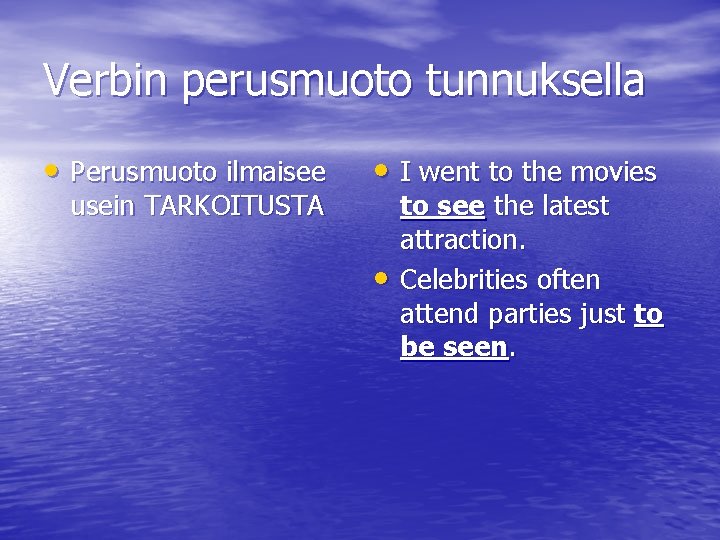
Verbin perusmuoto tunnuksella • Perusmuoto ilmaisee usein TARKOITUSTA
Verbin perusmuoto tunnuksella • Perusmuoto ilmaisee usein TARKOITUSTA • I went to the movies • to see the latest attraction. Celebrities often attend parties just to be seen.
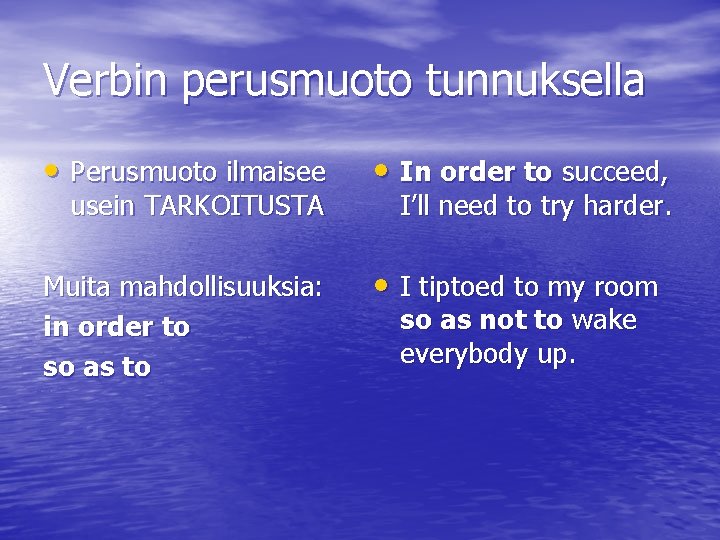
Verbin perusmuoto tunnuksella • Perusmuoto ilmaisee • In order to succeed, Muita mahdollisuuksia: in order to so as to • I tiptoed to my room usein TARKOITUSTA I’ll need to try harder. so as not to wake everybody up.
Verbin perusmuoto tunnuksella • Perusmuoto toimii hienona lauseenvastikkeena (joka/mikä-lauseet) • superlatiivi • järjestysluku • first, next, last, only
Verbin perusmuoto tunnuksella • Perusmuoto toimii hienona lauseenvastikkeena (joka/mikä-lauseet) • superlatiivi • järjestysluku • first, next, last, only • The best thing that • we can do now is to stay calm. The best thing to do now is to stay calm.
Verbin perusmuoto tunnuksella • Perusmuoto toimii hienona lauseenvastikkeena (joka/mikä-lauseet) • superlatiivi • järjestysluku • first, next, last, only • Who was the first • man who landed on the moon? Who was the first man to land on the moon?
Verbin perusmuoto tunnuksella • Perusmuoto toimii jopa lauseen tekijän paikalla
Verbin perusmuoto tunnuksella • Perusmuoto toimii jopa lauseen tekijän paikalla • To tell the truth is not always easy.
Verbin perusmuoto tunnuksella • Perusmuoto toimii • To tell the truth is • Yleisempi on • Telling the truth is jopa lauseen tekijän paikalla • • kuitenkin: ing-muoto It is … not always easy. • not always easy. It is not always easy to tell the truth.
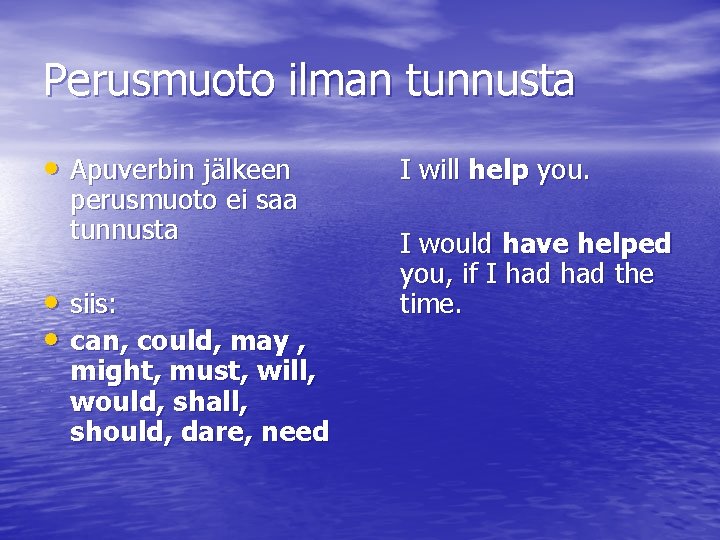
Perusmuoto ilman tunnusta • Apuverbin jälkeen perusmuoto ei saa tunnusta
Perusmuoto ilman tunnusta • Apuverbin jälkeen perusmuoto ei saa tunnusta • siis: • can, could, may , might, must, will, would, shall, should, dare, need
Perusmuoto ilman tunnusta • Apuverbin jälkeen perusmuoto ei saa tunnusta • siis: • can, could, may , might, must, will, would, shall, should, dare, need I will help you. I would have helped you, if I had the time.
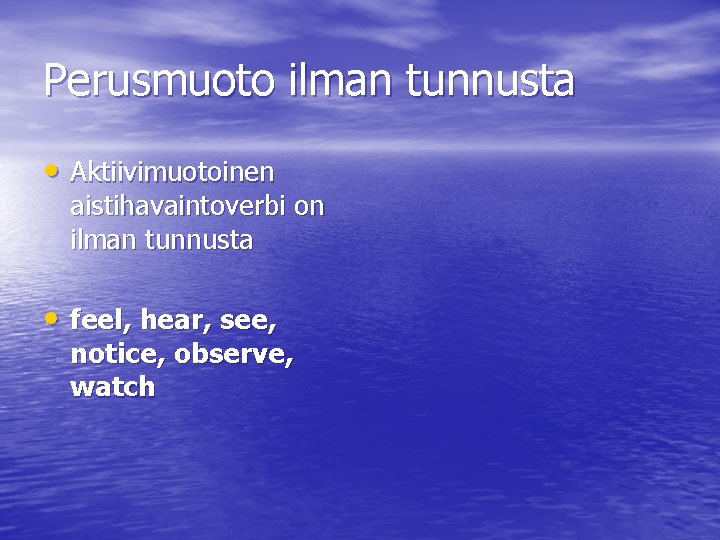
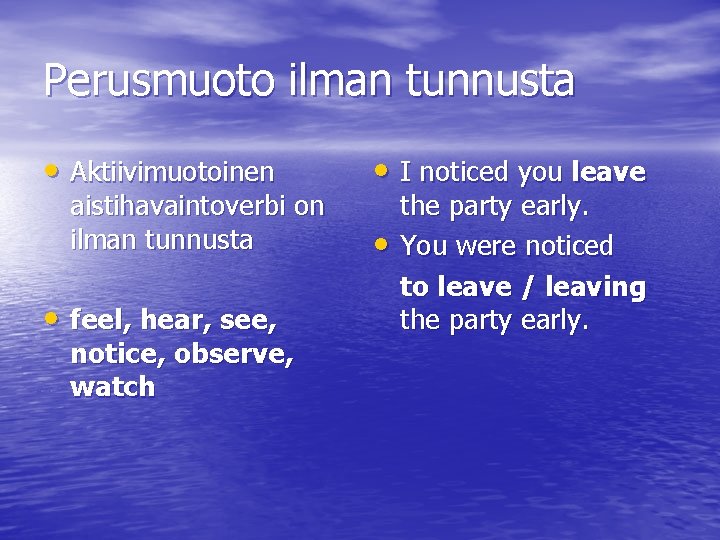
Perusmuoto ilman tunnusta • Aktiivimuotoinen aistihavaintoverbi on ilman tunnusta
Perusmuoto ilman tunnusta • Aktiivimuotoinen aistihavaintoverbi on ilman tunnusta • feel, hear, see, notice, observe, watch
Perusmuoto ilman tunnusta • Aktiivimuotoinen aistihavaintoverbi on ilman tunnusta • feel, hear, see, notice, observe, watch • I noticed you leave • the party early. You were noticed to leave / leaving the party early.
Perusmuoto ilman tunnusta • Aistihavaintoverbin toiminta on KESKEN
Perusmuoto ilman tunnusta • Aistihavaintoverbin toiminta on KESKEN • Meneillään olevaa toimintaa kuvaa ingmuoto
Perusmuoto ilman tunnusta • Aistihavaintoverbin toiminta on KESKEN • Meneillään olevaa toimintaa kuvaa ingmuoto • I saw you … • You were seen …
Perusmuoto ilman tunnusta • Aistihavaintoverbin • I saw you … • You were seen … • Meneillään olevaa talking to the teacher. toiminta on KESKEN toimintaa kuvaa ingmuoto …puhumassa opelle.
Perusmuoto ilman tunnusta • MAKE, HELP ja LET aktiivissa
Perusmuoto ilman tunnusta • MAKE, HELP ja LET aktiivissa • ei tunnusta
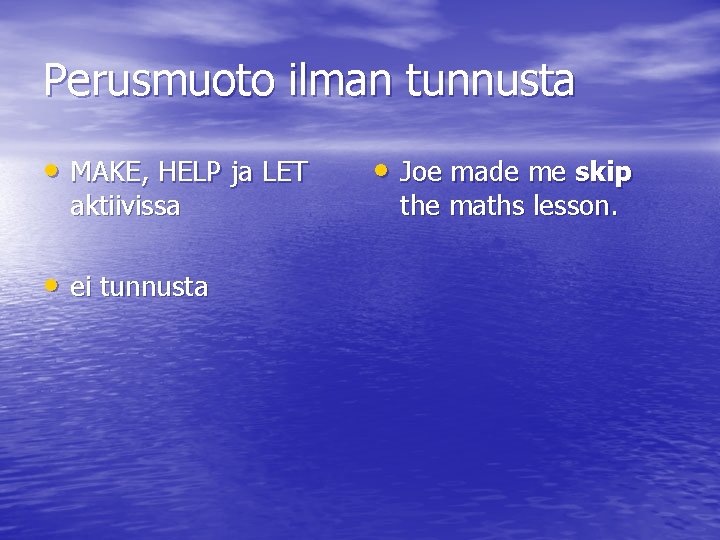
Perusmuoto ilman tunnusta • MAKE, HELP ja LET aktiivissa • ei tunnusta • Joe made me skip the maths lesson.
Perusmuoto ilman tunnusta • MAKE, HELP ja LET • Joe made me skip • ei tunnusta • Daphne helped me aktiivissa the maths lesson. (to) find an apartment.
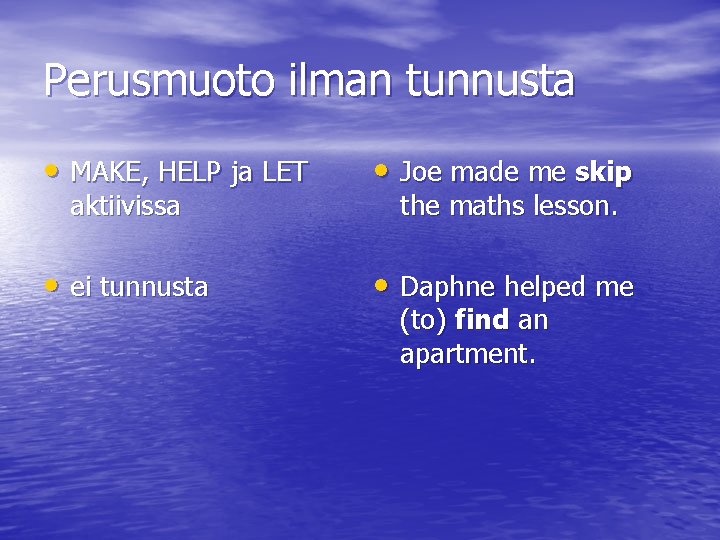
Perusmuoto ilman tunnusta • MAKE, HELP ja LET • Joe made me skip • ei tunnusta • Daphne helped me aktiivissa the maths lesson. (to) find an apartment. • They let young people come to this concert.
Perusmuoto ilman tunnusta • MAKE, HELP ja LET PASSIIVISSA
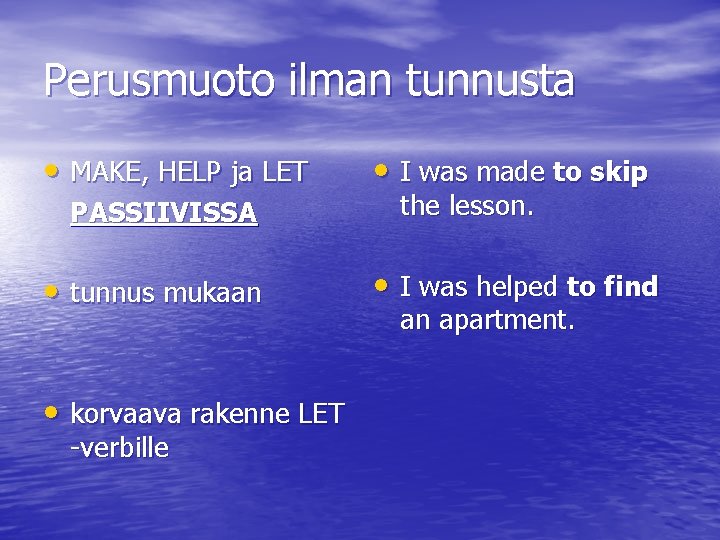
Perusmuoto ilman tunnusta • MAKE, HELP ja LET PASSIIVISSA • tunnus mukaan • korvaava rakenne LET -verbille
Perusmuoto ilman tunnusta • MAKE, HELP ja LET PASSIIVISSA • tunnus mukaan • korvaava rakenne LET -verbille • I was made to skip the lesson.
Perusmuoto ilman tunnusta • MAKE, HELP ja LET PASSIIVISSA • tunnus mukaan • korvaava rakenne LET -verbille • I was made to skip the lesson. • I was helped to find an apartment.
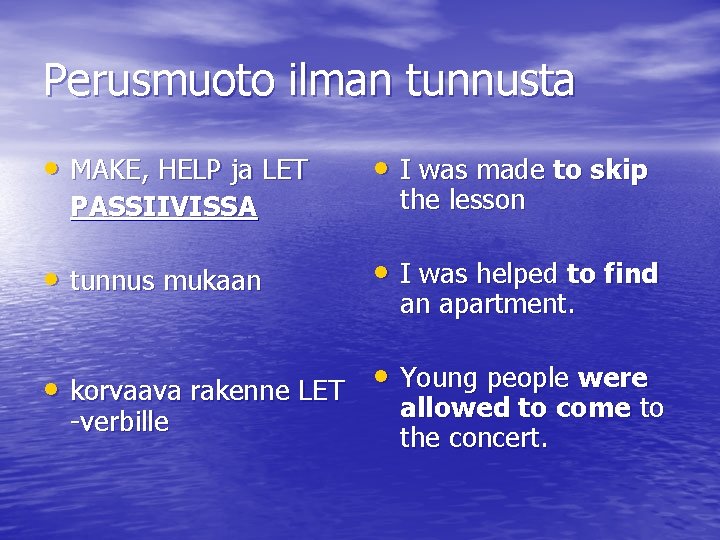
Perusmuoto ilman tunnusta • MAKE, HELP ja LET PASSIIVISSA • tunnus mukaan • I was made to skip the lesson • I was helped to find an apartment. • Young people were • korvaava rakenne LET allowed to come to -verbille allowed to come to the concert.
Perusmuoto ilman tunnusta • Tietyt sanonnat järjestyvät ilman tunnusta
Perusmuoto ilman tunnusta • Tietyt sanonnat järjestyvät ilman tunnusta • had better • rather than • do nothing but
Perusmuoto ilman tunnusta • Tietyt sanonnat järjestyvät ilman tunnusta • had better • rather than • do nothing but • You had better start right now!
Perusmuoto ilman tunnusta • Tietyt sanonnat järjestyvät ilman tunnusta • had better • rather than • do nothing but • You had better start • right now! I’d like to go outside rather than stay indoors.
Perusmuoto ilman tunnusta • Tietyt sanonnat järjestyvät ilman tunnusta • had better • rather than • do nothing but • You had better start • • right now! I’d like to go outside rather than stay indoors. I did nothing but sleep all day long last Sunday.
PM + tunnus kertaus • substantiivi + PM • pronomini + PM • adjektiivi + PM • verbi + PM • kysymyssana + PM • PM tarkoitusta ilmaisemassa • PM korvaamassa • joka/mikä-lausetta PM lauseen subjektina (yleisemmin ingmuoto tai It is …)
PM + ei tunnusta kertaus • apuverbin kanssa ei • • • tunnusta aktiivissa olevat aistihavaintoverbit make, help, let tietyt sanonnat – – – had better rather than do nothing but
Välimaasto: PM vai THAT-lause • PM tunnuksella seuraavien verbien kanssa
Välimaasto: PM vai THAT-lause • PM tunnuksella seuraavien verbien kanssa • advise, allow, ask, order, permit. tell, want, would like
Välimaasto: PM vai THAT-lause • PM tunnuksella seuraavien verbien kanssa • advise, allow, ask, order, permit. tell, want, would like I want you to remember this!
Välimaasto: PM vai THAT-lause • PM tunnuksella seuraavien verbien kanssa • advise, allow, ask, order, permit. tell, want, would like I want you to remember this! Mother allowed me to go to the concert.
Välimaasto: PM vai THAT-lause • PM tunnuksella seuraavien verbien kanssa • advise, allow, ask, order, permit. tell, want, would like I want you to remember this! Mother allowed me to go to the concert. Would you like to have another piece of cake?
Välimaasto: PM vai THAT-lause • THAT-lause seuraa uskomista, arvelua tai tietämistä ilmaisevien verbien jälkeen (aktiivi)
Välimaasto: PM vai THAT-lause • THAT-lause seuraa • • uskomista, arvelua tai tietämistä ilmaisevien verbien jälkeen (aktiivi) believe suppose know think
Välimaasto: PM vai THAT-lause • THAT-lause seuraa • • uskomista, arvelua tai tietämistä ilmaisevien verbien jälkeen (aktiivi) believe suppose know think I believe (that) I can answer your question.
Välimaasto: PM vai THAT-lause • THAT-lause seuraa • • uskomista, arvelua tai tietämistä ilmaisevien verbien jälkeen (aktiivi) believe suppose know think I believe (that) I can answer your question. I suppose (that) you’re right.
Välimaasto: PM vai THAT-lause • THAT-lause seuraa • • uskomista, arvelua tai tietämistä ilmaisevien verbien jälkeen (aktiivi) believe suppose know think I believe (that) I can answer your question. I suppose (that) you’re right. Betty knew (that) I would look her up.
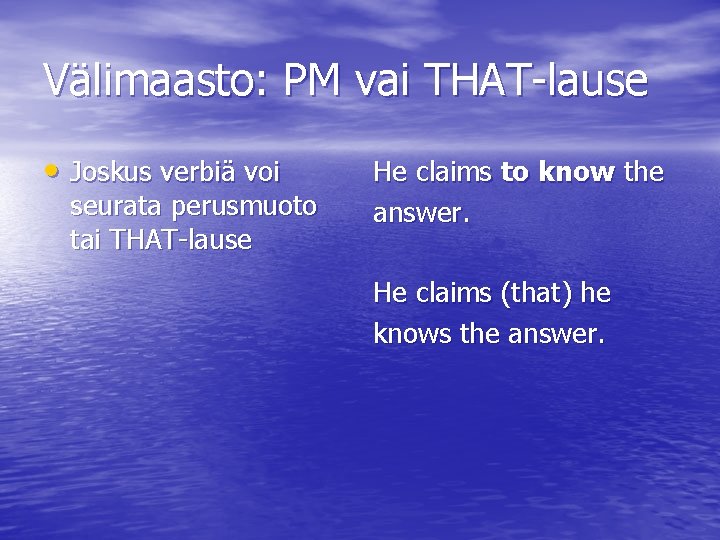
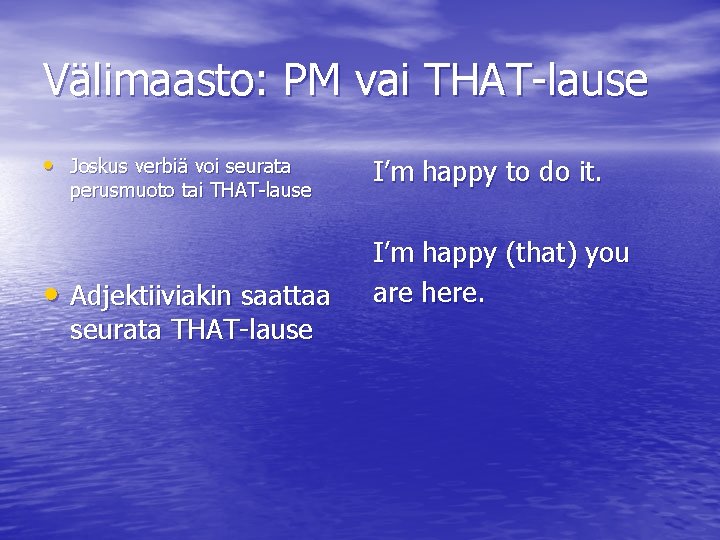
Välimaasto: PM vai THAT-lause • Joskus verbiä voi seurata perusmuoto tai THAT-lause
Välimaasto: PM vai THAT-lause • Joskus verbiä voi seurata perusmuoto tai THAT-lause He claims to know the answer. He claims (that) he knows the answer.
Välimaasto: PM vai THAT-lause • Joskus verbiä voi seurata I’m happy to do it. • Adjektiiviakin saattaa I’m happy (that) you are here. perusmuoto tai THAT-lause seurata THAT-lause
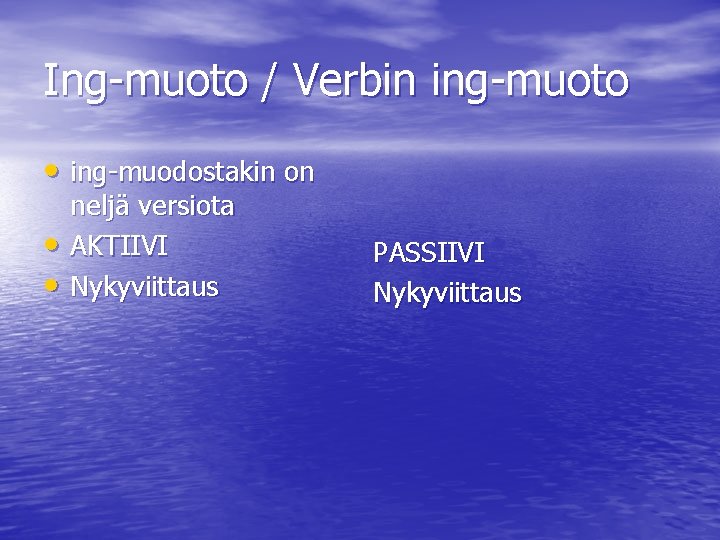
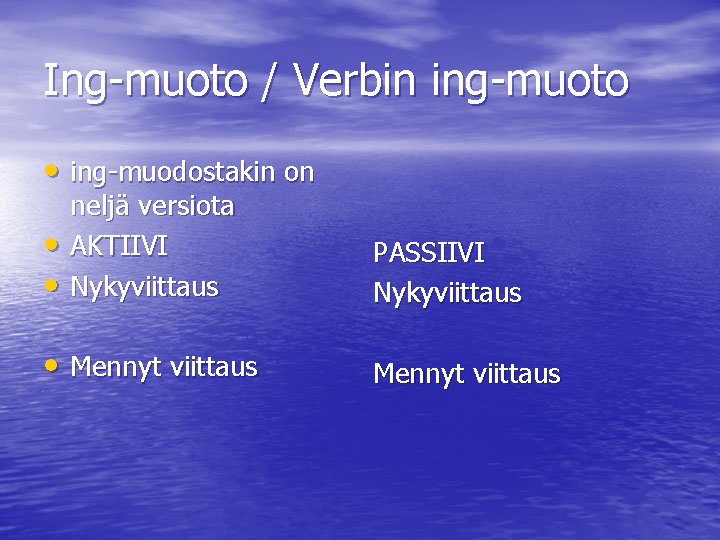
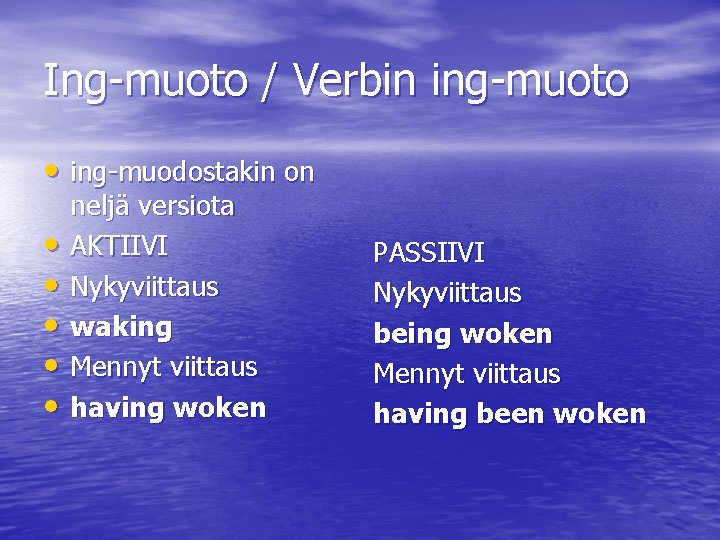
Ing-muoto / Verbin ing-muoto • ing-muodostakin on neljä versiota
Ing-muoto / Verbin ing-muoto • ing-muodostakin on • • neljä versiota AKTIIVI Nykyviittaus PASSIIVI Nykyviittaus
Ing-muoto / Verbin ing-muoto • ing-muodostakin on • • neljä versiota AKTIIVI Nykyviittaus • Mennyt viittaus PASSIIVI Nykyviittaus Mennyt viittaus
Ing-muoto / Verbin ing-muoto • ing-muodostakin on • • • neljä versiota AKTIIVI Nykyviittaus waking Mennyt viittaus having woken PASSIIVI Nykyviittaus being woken Mennyt viittaus having been woken
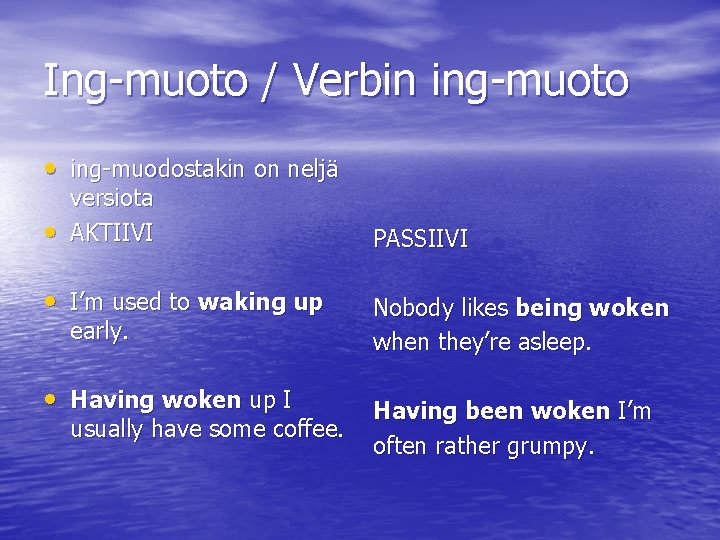
Ing-muoto / Verbin ing-muoto • ing-muodostakin on neljä • versiota AKTIIVI • I’m used to waking up early. • Having woken up I usually have some coffee. PASSIIVI Nobody likes being woken when they’re asleep. Having been woken I’m often rather grumpy.
Ing-muoto / Verbin ing-muoto • Verbistä voi tehdä substantiivin ingmuodolla
Ing-muoto / Verbin ing-muoto • Verbistä voi tehdä substantiivin ingmuodolla Singing is my passion.
Ing-muoto / Verbin ing-muoto • Verbistä voi tehdä substantiivin ingmuodolla • Tekemiseen voi liittyä myös määreitä Singing is my passion.
Ing-muoto / Verbin ing-muoto • Verbistä voi tehdä substantiivin ingmuodolla • Tekemiseen voi liittyä myös määreitä Singing is my passion. I like walking in the rain.
Ing-muoto / Verbin ing-muoto • Ing-muoto voi toimia adjektiivina
Ing-muoto / Verbin ing-muoto • Ing-muoto voi toimia adjektiivina Collecting stamps is an interesting hobby.
Ing-muoto / Verbin ing-muoto • Ing-muoto voi toimia adjektiivina Collecting stamps is an interesting hobby. I like your smiling face.
Ing-muoto / Verbin ing-muoto • TÄRKEÄÄ: Verbistä kaytetään aina ingmuotoa preposition jälkeen!
Ing-muoto / Verbin ing-muoto • TÄRKEÄÄ: Verbistä kaytetään aina ingmuotoa preposition jälkeen! I’m interested in collecting stamps.
Ing-muoto / Verbin ing-muoto • TÄRKEÄÄ: Verbistä kaytetään aina ingmuotoa preposition jälkeen! • Prepositio voi liittyä adjektiiviin, substantiiviin tai verbiin
Ing-muoto / Verbin ing-muoto • TÄRKEÄÄ: Verbistä kaytetään aina ingmuotoa preposition jälkeen! • Prepositio voi liittyä adjektiiviin, substantiiviin tai verbiin There is no excuse for being late.
Ing-muoto / Verbin ing-muoto • TÄRKEÄÄ: Verbistä kaytetään aina ingmuotoa preposition jälkeen! • Prepositio voi liittyä adjektiiviin, substantiiviin tai verbiin There is no excuse for being late. The student objected to being sent home from the language course.
Ing-muoto / Verbin ing-muoto • Kestoaikamuodoissa olemme maailman sivu käyttäneet ingmuotoa
Ing-muoto / Verbin ing-muoto • Kestoaikamuodois- Ritchie is thinking of sa olemme maailman sivu käyttäneet ingmuotoa quitting his job.
Ing-muoto / Verbin ing-muoto • Kestoaikamuodois- Ritchie is thinking of sa olemme maailman sivu käyttäneet ingmuotoa quitting his job. He’s been working hard all his life.
Ing-muoto / Verbin ing-muoto • Tässä verbejä, joiden jälkeen käytetään ingmuotoa
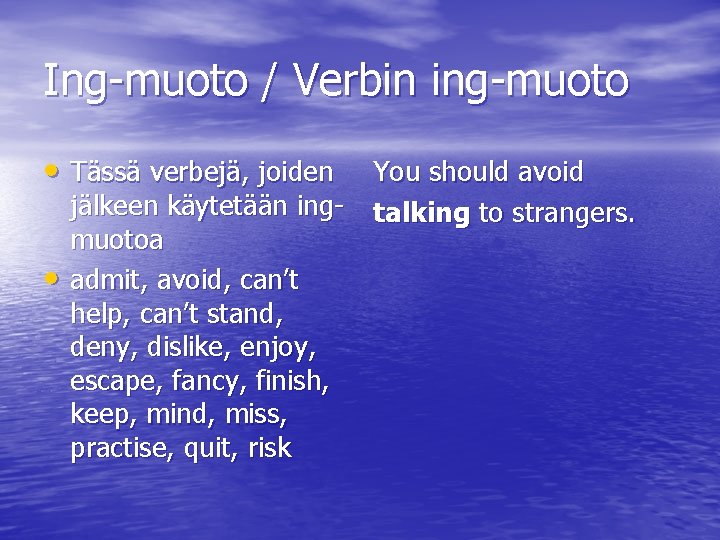
Ing-muoto / Verbin ing-muoto • Tässä verbejä, joiden • jälkeen käytetään ingmuotoa admit, avoid, can’t help, can’t stand, deny, dislike, enjoy, escape, fancy, finish, keep, mind, miss, practise, quit, risk
Ing-muoto / Verbin ing-muoto • Tässä verbejä, joiden • You should avoid jälkeen käytetään ing- talking to strangers. muotoa admit, avoid, can’t help, can’t stand, deny, dislike, enjoy, escape, fancy, finish, keep, mind, miss, practise, quit, risk
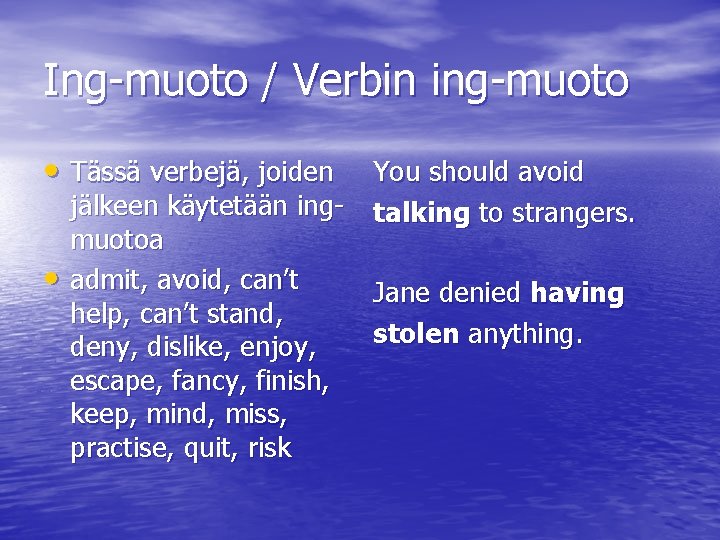
Ing-muoto / Verbin ing-muoto • Tässä verbejä, joiden • You should avoid jälkeen käytetään ing- talking to strangers. muotoa admit, avoid, can’t Jane denied having help, can’t stand, stolen anything. deny, dislike, enjoy, escape, fancy, finish, keep, mind, miss, practise, quit, risk
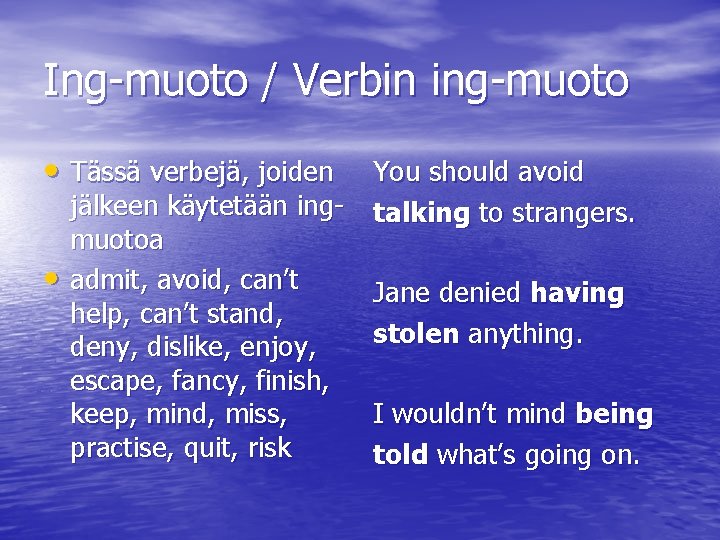
Ing-muoto / Verbin ing-muoto • Tässä verbejä, joiden • You should avoid jälkeen käytetään ing- talking to strangers. muotoa admit, avoid, can’t Jane denied having help, can’t stand, stolen anything. deny, dislike, enjoy, escape, fancy, finish, keep, mind, miss, I wouldn’t mind being practise, quit, risk told what’s going on.
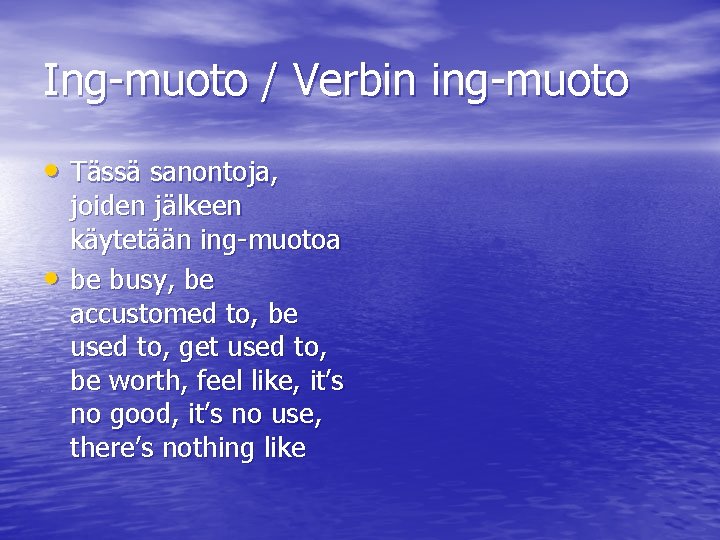
Ing-muoto / Verbin ing-muoto • Tässä sanontoja, joiden jälkeen käytetään ing-muotoa
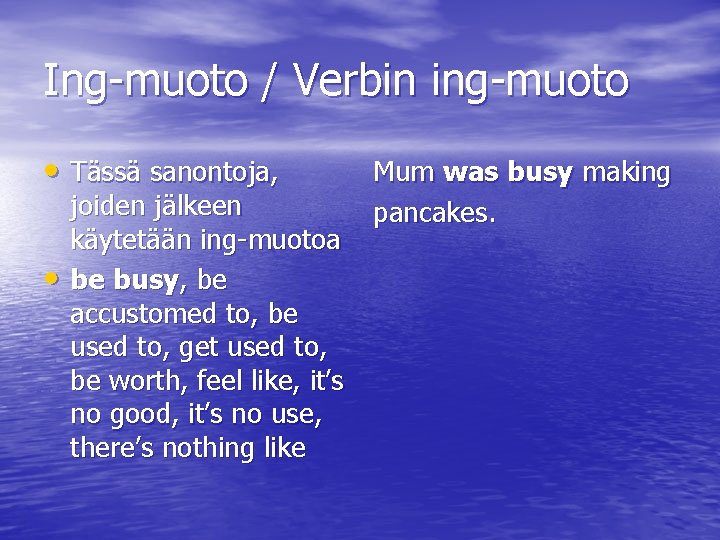
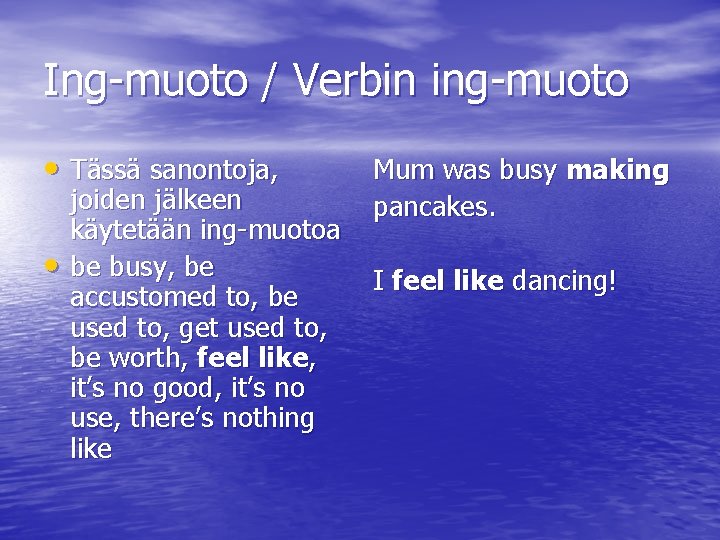
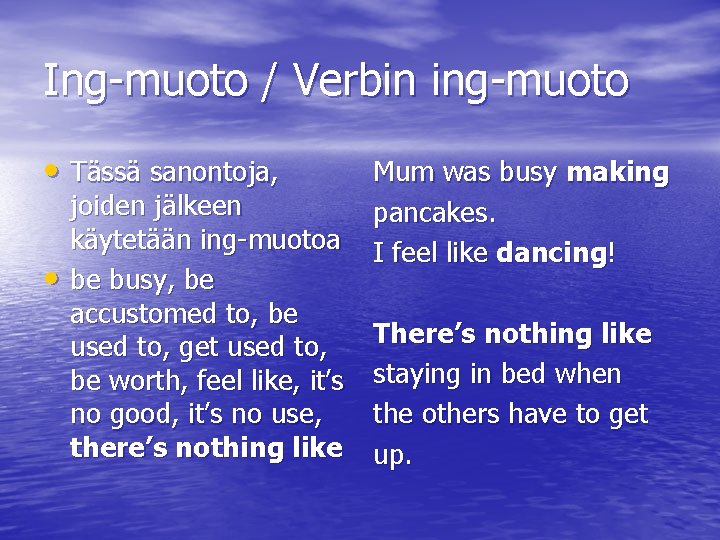
Ing-muoto / Verbin ing-muoto • Tässä sanontoja, • joiden jälkeen käytetään ing-muotoa be busy, be accustomed to, be used to, get used to, be worth, feel like, it’s no good, it’s no use, there’s nothing like
Ing-muoto / Verbin ing-muoto • Tässä sanontoja, • joiden jälkeen käytetään ing-muotoa be busy, be accustomed to, be used to, get used to, be worth, feel like, it’s no good, it’s no use, there’s nothing like Mum was busy making pancakes.
Ing-muoto / Verbin ing-muoto • Tässä sanontoja, • joiden jälkeen käytetään ing-muotoa be busy, be accustomed to, be used to, get used to, be worth, feel like, it’s no good, it’s no use, there’s nothing like Mum was busy making pancakes. I feel like dancing!
Ing-muoto / Verbin ing-muoto • Tässä sanontoja, • joiden jälkeen käytetään ing-muotoa be busy, be accustomed to, be used to, get used to, be worth, feel like, it’s no good, it’s no use, there’s nothing like Mum was busy making pancakes. I feel like dancing! There’s nothing like staying in bed when the others have to get up.
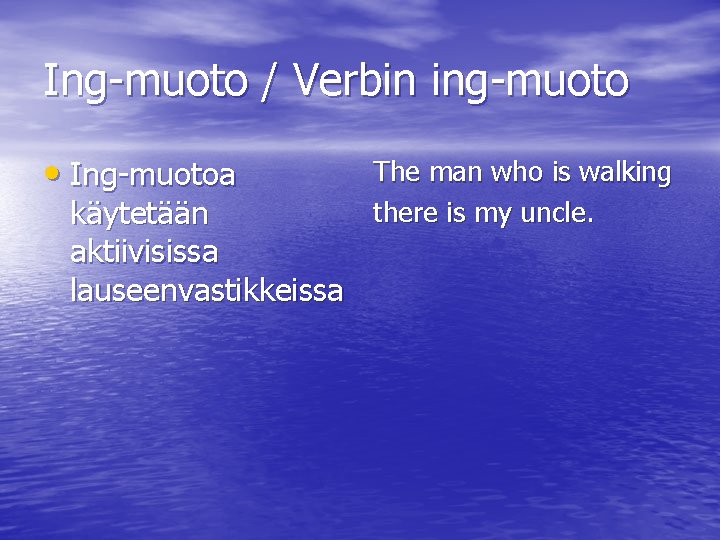
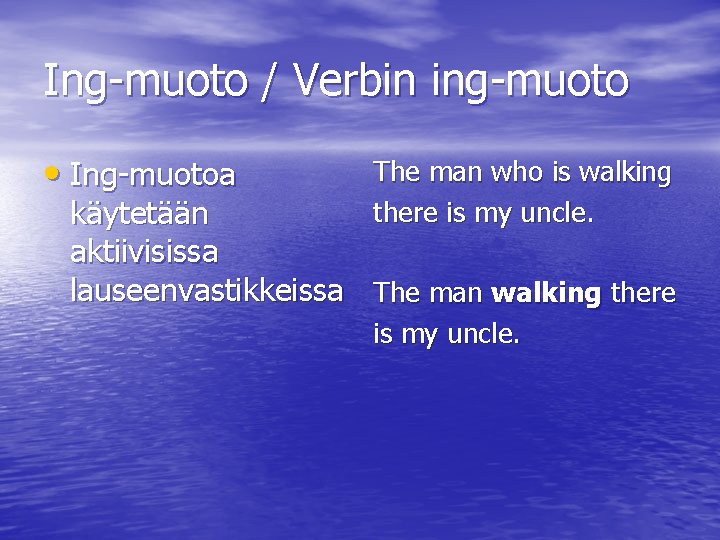
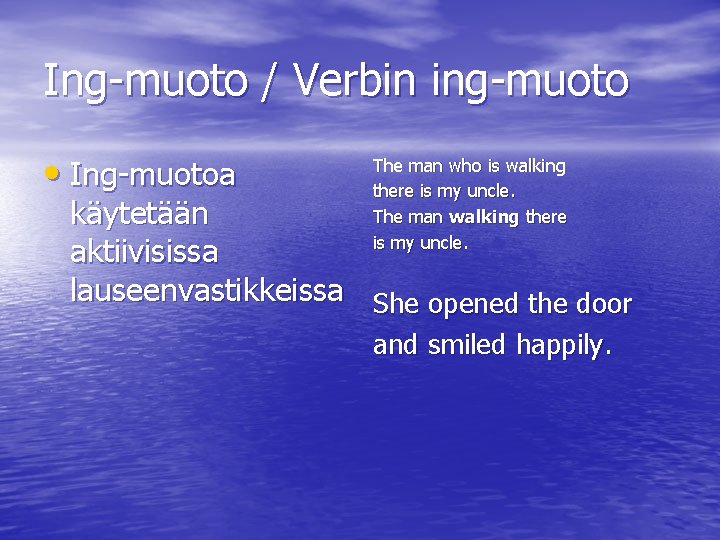
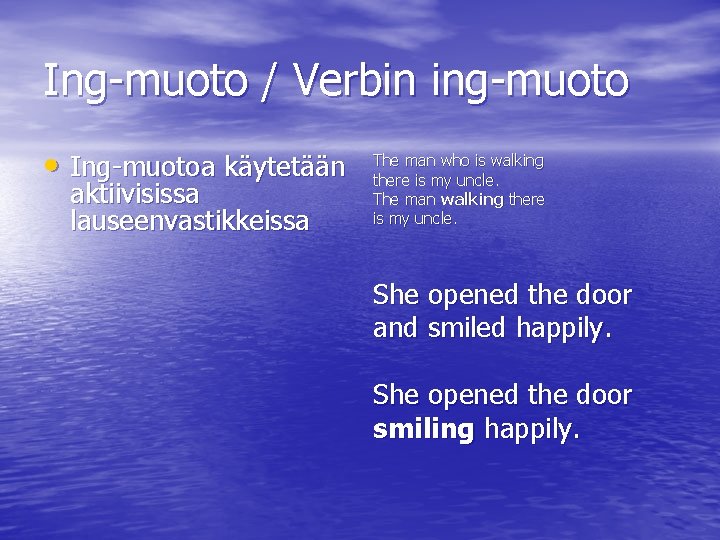
Ing-muoto / Verbin ing-muoto • Ing-muotoa käytetään aktiivisissa lauseenvastikkeissa
Ing-muoto / Verbin ing-muoto • Ing-muotoa käytetään aktiivisissa lauseenvastikkeissa The man who is walking there is my uncle.
Ing-muoto / Verbin ing-muoto • Ing-muotoa The man who is walking there is my uncle. käytetään aktiivisissa lauseenvastikkeissa The man walking there is my uncle.
Ing-muoto / Verbin ing-muoto • Ing-muotoa The man who is walking there is my uncle. The man walking there is my uncle. käytetään aktiivisissa lauseenvastikkeissa She opened the door and smiled happily.
Ing-muoto / Verbin ing-muoto • Ing-muotoa käytetään aktiivisissa lauseenvastikkeissa The man who is walking there is my uncle. The man walking there is my uncle. She opened the door and smiled happily. She opened the door smiling happily.
Perusmuoto TAI ing-muoto • Joidenkin verbien jälkeen käy perusmuoto tai ingmuoto
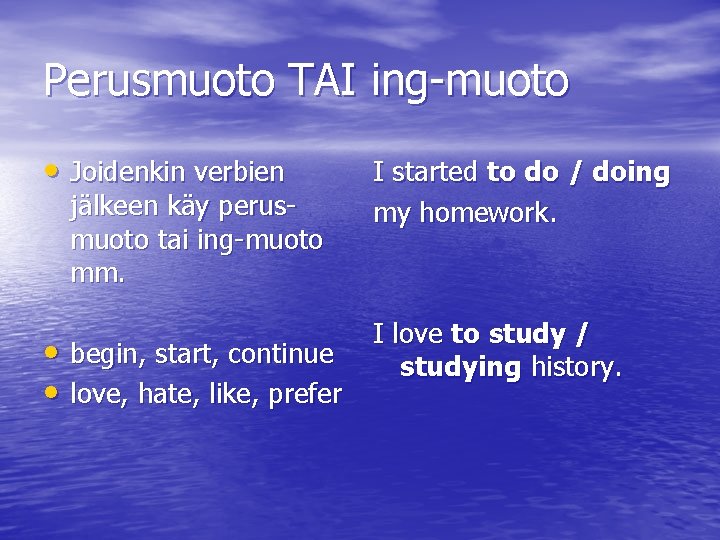
Perusmuoto TAI ing-muoto • Joidenkin verbien jälkeen käy perusmuoto tai ing-muoto mm. • begin, start, continue • love, hate, like, prefer
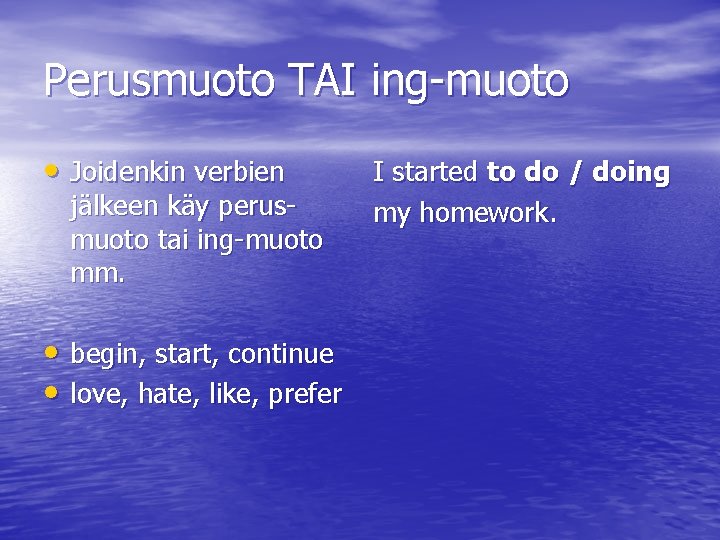
Perusmuoto TAI ing-muoto • Joidenkin verbien jälkeen käy perusmuoto tai ing-muoto mm. • begin, start, continue • love, hate, like, prefer I started to do / doing my homework.
Perusmuoto TAI ing-muoto • Joidenkin verbien jälkeen käy perusmuoto tai ing-muoto mm. • begin, start, continue • love, hate, like, prefer I started to do / doing my homework. I love to study / studying history.
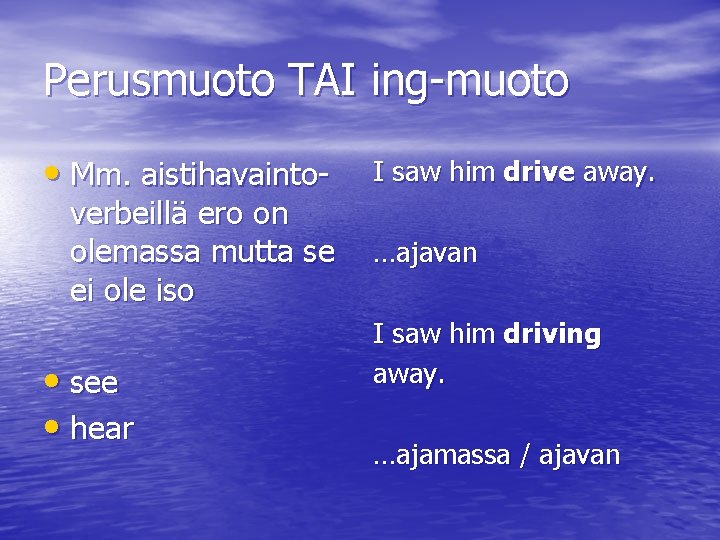
Perusmuoto TAI ing-muoto • Mm. aistihavainto- verbeillä ero on olemassa mutta se ei ole iso
Perusmuoto TAI ing-muoto • Mm. aistihavainto- verbeillä ero on olemassa mutta se ei ole iso • see • hear
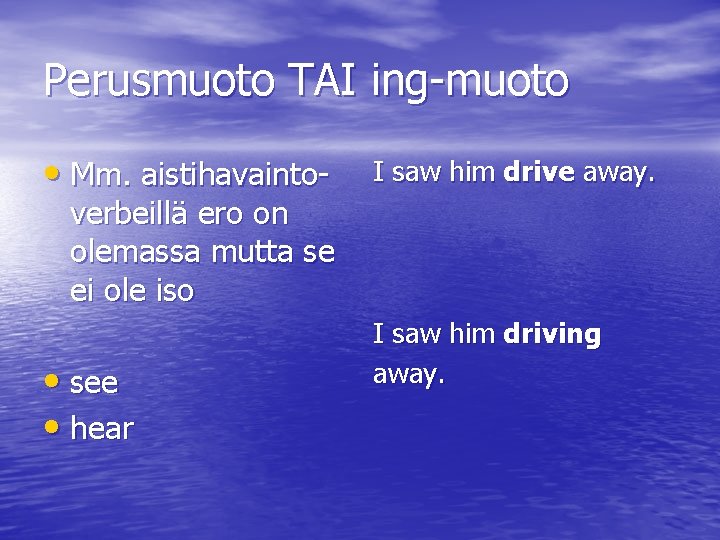
Perusmuoto TAI ing-muoto • Mm. aistihavainto- I saw him drive away. verbeillä ero on olemassa mutta se ei ole iso • see • hear I saw him driving away.
Perusmuoto TAI ing-muoto • Mm. aistihavainto- verbeillä ero on olemassa mutta se ei ole iso • see • hear I saw him drive away. …ajavan I saw him driving away. …ajamassa / ajavan
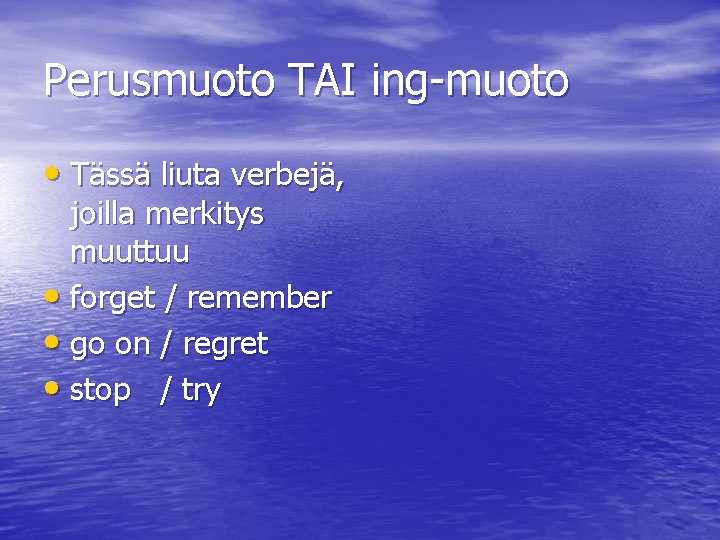
Perusmuoto TAI ing-muoto • Tässä liuta verbejä, joilla merkitys muuttuu
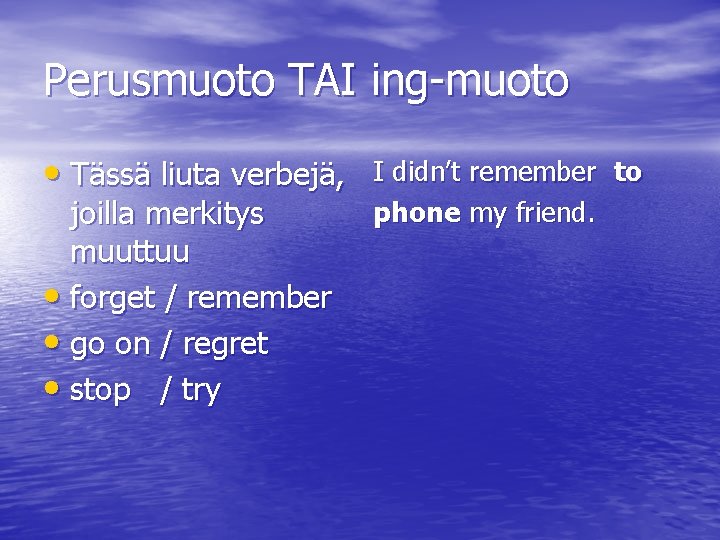
Perusmuoto TAI ing-muoto • Tässä liuta verbejä, joilla merkitys muuttuu • forget / remember • go on / regret • stop / try
Perusmuoto TAI ing-muoto • Tässä liuta verbejä, joilla merkitys muuttuu • forget / remember • go on / regret • stop / try I didn’t remember to phone my friend.
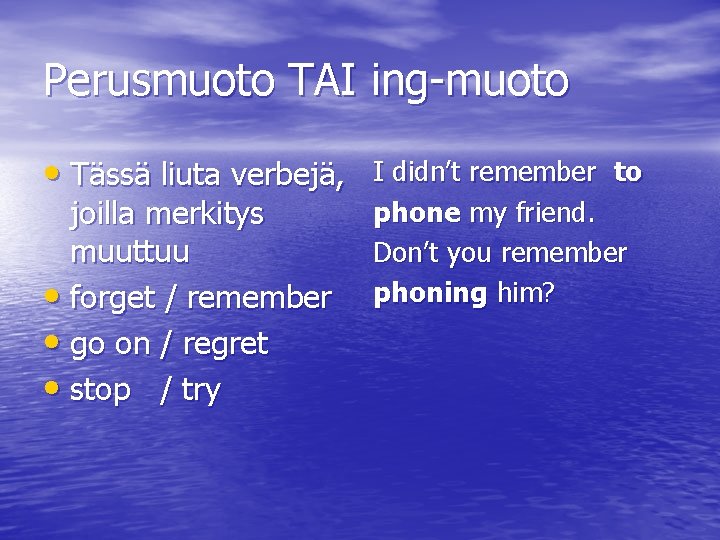
Perusmuoto TAI ing-muoto • Tässä liuta verbejä, joilla merkitys muuttuu • forget / remember • go on / regret • stop / try I didn’t remember to phone my friend. Don’t you remember phoning him?
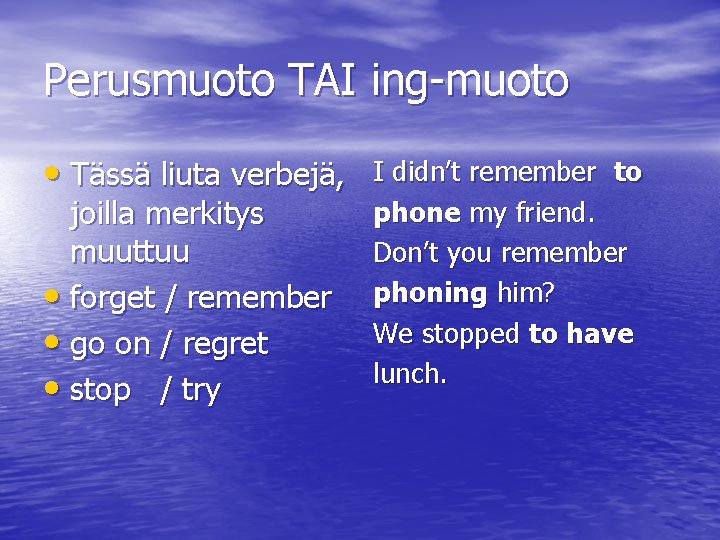
Perusmuoto TAI ing-muoto • Tässä liuta verbejä, joilla merkitys muuttuu • forget / remember • go on / regret • stop / try I didn’t remember to phone my friend. Don’t you remember phoning him? We stopped to have lunch.
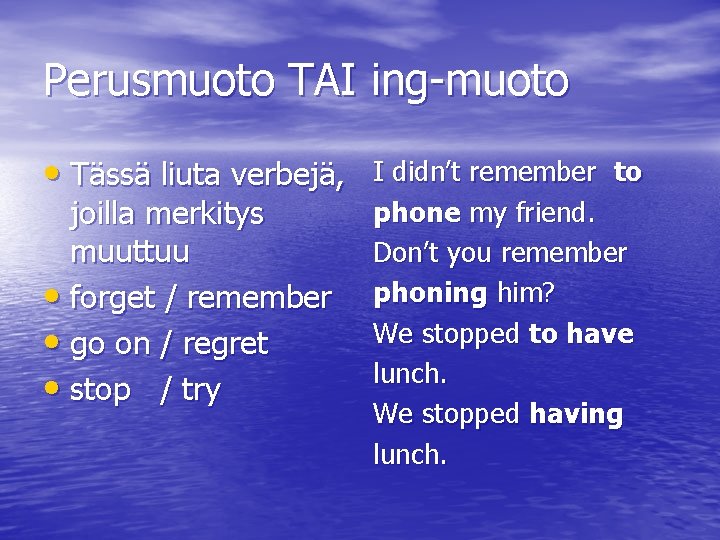
Perusmuoto TAI ing-muoto • Tässä liuta verbejä, joilla merkitys muuttuu • forget / remember • go on / regret • stop / try I didn’t remember to phone my friend. Don’t you remember phoning him? We stopped to have lunch. We stopped having lunch.