Indirect Investing Chapter 3 Charles P Jones Investments





- Slides: 19
Indirect Investing Chapter 3 Charles P. Jones, Investments: Analysis and Management, 12 th Edition, John Wiley & Sons 31
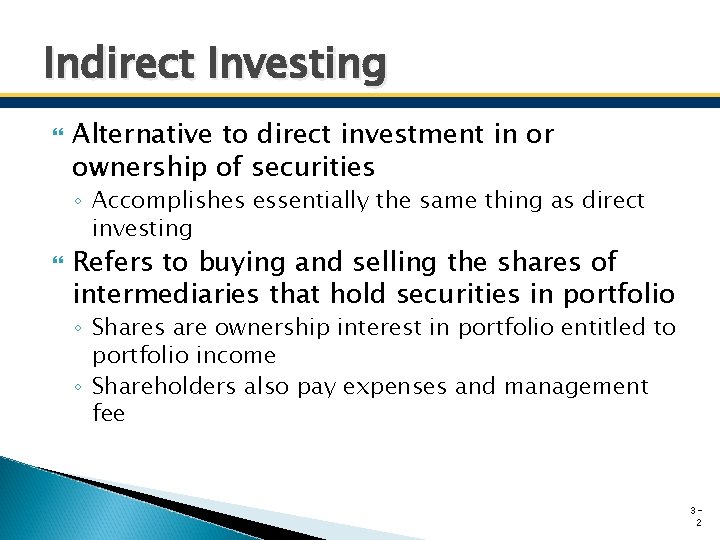
Indirect Investing Alternative to direct investment in or ownership of securities ◦ Accomplishes essentially the same thing as direct investing Refers to buying and selling the shares of intermediaries that hold securities in portfolio ◦ Shares are ownership interest in portfolio entitled to portfolio income ◦ Shareholders also pay expenses and management fee 32
Investment Companies Firm that sells shares to the public and uses the proceeds to invest in marketable securities ◦ Acts as conduit for distribution of dividends, interest, and realized gains ◦ Offers professional management ◦ Regulated but not insured or guaranteed by any federal agency ◦ Shareholders pay taxes as if they directly owned securities 33
Company Types Unit Investment Trust (UIT) ◦ Typically holds an unmanaged, fixed-income portfolio ◦ Relatively small share of market Closed-End Investment Company ◦ Actively managed portfolio ◦ Fixed number of shares ◦ Trade on stock exchanges like other stocks 34
Company Types Exchange Traded Funds ◦ Portfolio of assets that tracks a sector, region, or market ◦ Trade like individual equities on exchange ◦ Management fees low Typically unmanaged portfolios ◦ Tax efficiency Investor has greater control over realization of capital gains/losses than with a mutual fund 35
Company Types Mutual Funds (Open-end Investment Companies) ◦ Investors buy fund shares from investment companies, sell shares back to those companies Mutual funds not sold on exchanges ◦ Number of shares outstanding constantly changing (unlike closed-end funds) ◦ Offer diversification, professional management, other services ◦ Popular with investors, especially in retirement plans 36
Mutual Fund Categories Money Market Funds (MMFs) ◦ Invest in portfolio of money market securities ◦ Taxable or tax-exempt ◦ Investors pay a management fee but not a sales or redemption charge (load) ◦ Not insured by the federal government ◦ Attempt to keep price at $1/share ◦ Offer investors broad diversification, great liquidity and a way to earn going money market rate 37
Mutual Fund Categories Equity, bond, and hybrid mutual funds ◦ Equity funds hold primarily stocks, bond funds primarily hold bonds and hybrid funds hold a combination ◦ All invest in portfolio of securities consistent with the objectives of the fund ◦ Company’s board sets objects, must specify them in investment policy ◦ Objectives can be achieved in various ways, so investment style can also be important 38
Equity Funds Most equity funds are either: ◦ Value funds, which invest in stocks that are cheap according to standard financial analysis methods ◦ Growth funds, which invest in stocks of firms expected to show future rapid earnings growth These fund types tend to perform well at different times, appeal to investors with different objectives Best strategy is probably to hold both fund types 39
Index Funds Mutual Funds designed to match a market index Unmanaged portfolio, typically with low expense ratio ◦ Expenses vary widely, though, so investors need to be sure expenses are reasonable Often outperform actively managed mutual funds 310
Net Asset Value Per Share (NAV) NAV is per share value of securities in a fund Is the total market value of securities, minus any liabilities, divided by number of shares outstanding Changes daily and is calculated daily after markets close at 4 p. m. If no sales charges, NAV is price investors pay to buy mutual fund or price paid to investors selling fund 311
The Details of Indirect Investing Closed-end funds ◦ Market prices often differ from NAV ◦ Market price may be less than NAV (discount) or more than NAV (premium) ◦ Portfolio’s return calculated based on NAVs ◦ Shareholder’s return calculated based on closing prices Individual investors should avoid purchasing newly offered shares of closed-end funds 312
The Details of Indirect Investing Mutual Funds Investors can purchase directly or indirectly Usually only require a small minimum investment Investors can redeem shares anytime Investors purchase/redeem at NAV plus or minus sales charges ◦ Fund’s prospectus discloses fees and expenses ◦ ◦ Load funds charge a sales fee No-load funds do not charge a sales fee 313
The Details of Indirect Investing Mutual Fund Share Classes ◦ Way to give investors choice over fees ◦ Each class has same claim on portfolio, same NAV No-load funds ◦ Purchased at NAV directly from the investment company ◦ No sales force expense to cover ◦ Investors must seek out funds ◦ Annual operating expenses paid out of fund income All funds charge shareholders an expense ratio 314
The Details of Indirect Investing Exchange-Traded Funds ◦ Can be bought or sold anytime during the trading day ◦ Can be bought on margin or sold short ◦ Have much lower expenses than actively managed funds ◦ Can weight indexes differently, which can affect return 315
Performance Reported on a regular basis in the popular press Price performance not the same as total return ◦ Total return measures both price changes and income (from dividends) over a specified time period ◦ Average annual return is a hypothetical measure Costs and taxes should also be considered Expenses may be the best indicator of a fund’s performance 316
International Funds Some mutual funds specialize in international securities ◦ Can have higher costs ◦ International funds or global funds emphasize international stocks ◦ Single-country funds concentrate on one country ◦ Some ETFs match foreign indexes Not hedged against currency risk 317
The Future of Indirect Investing Mutual fund “supermarkets” ◦ Investors can buy/sell funds from various mutual fund families through a single source ◦ Offer fee and no-fee “aisles” Hedge Funds ◦ Largely unregulated investment companies available to private investors May use leverage, derivatives, other strategies not available to mutual fund managers Require substantial initial investment, charge substantial fees 318
Copyright 2013 John Wiley & Sons, Inc. All rights reserved. Reproduction or translation of this work beyond that permitted in section 117 of the 1976 United States Copyright Act without express permission of the copyright owner is unlawful. Request for further information should be addressed to the Permissions Department, John Wiley & Sons, Inc. The purchaser may make backup copies for his/her own use only and not for distribution or resale. The Publisher assumes no responsibility for errors, omissions, or damages caused by the use of these programs or from the use of the information herein. 319