
Personal Finance SIXTH EDITION Chapter 17 Investing in


- Slides: 51
Personal Finance SIXTH EDITION Chapter 17 Investing in Mutual Funds Copyright © 2017, 2014, 2011 Pearson Education, Inc. All Rights Reserved
Chapter Objectives (1 of 2) 17. 1 Provide a background on mutual funds 17. 2 Identify types of stock and bond mutual funds 17. 3 Explain the return-risk trade-off among mutual funds 17. 4 Discuss how to choose among mutual funds 17. 5 Describe quotations of mutual funds Copyright © 2017, 2014, 2011 Pearson Education, Inc. All Rights Reserved
Chapter Objectives (2 of 2) 17. 6 Explain how to diversify among mutual funds 17. 7 Explain how investing in mutual funds fits within your financial plan Copyright © 2017, 2014, 2011 Pearson Education, Inc. All Rights Reserved
Background on Mutual Funds (1 of 7) • Stock mutual funds: funds that sell shares to individuals and invest the proceeds in stocks • Bond mutual funds: funds that sell shares to individuals and invest the proceeds in bonds • All are managed by professional portfolio managers who decide what securities to purchase Copyright © 2017, 2014, 2011 Pearson Education, Inc. All Rights Reserved
Background on Mutual Funds (2 of 7) • Motives for investing in mutual funds: – Small initial investment with immediate diversification benefits – Expertise of portfolio manager – To meet specific investment goals • Net asset value (NAV): the market value of the securities that a mutual fund has purchased minus any liabilities owed – Usually reported on a per share basis Copyright © 2017, 2014, 2011 Pearson Education, Inc. All Rights Reserved
Background on Mutual Funds (3 of 7) • Open-end versus closed-end funds – Open-end mutual funds: funds that sell shares directly to investors and repurchase those shares whenever investors wish to sell them § Usually managed by investment companies that are subsidiaries of a large financial conglomerate § Family: a group of separately managed open-end mutual funds held by one investment company Copyright © 2017, 2014, 2011 Pearson Education, Inc. All Rights Reserved
Background on Mutual Funds (4 of 7) – Closed-end mutual funds: funds that sell shares to investors but do not repurchase them; instead fund shares are purchased and sold on stock exchanges § Premium: the amount by which a closed-end fund’s share price in the secondary market is above the fund’s NAV § Discount: the amount by which a closed-end fund’s share price in the secondary market is below the fund’s NAV Copyright © 2017, 2014, 2011 Pearson Education, Inc. All Rights Reserved
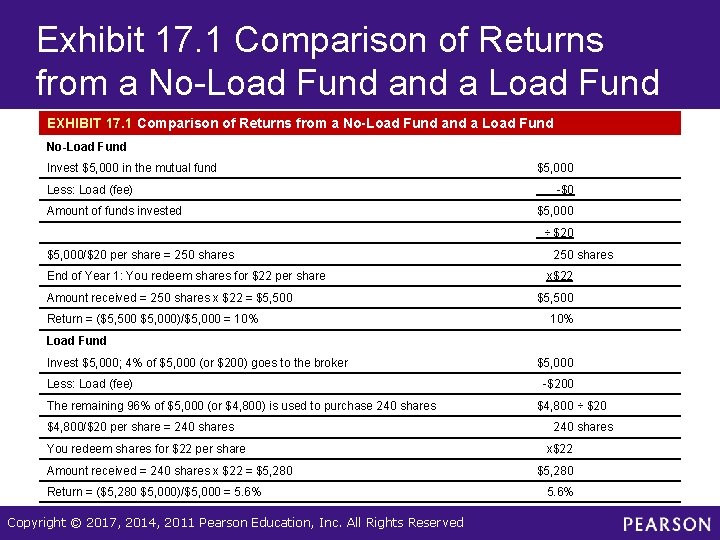
Background on Mutual Funds (5 of 7) • Load versus no-load funds – No-load mutual funds: funds that sell directly to investors and do not charge a fee – Load mutual funds: funds whose shares are sold by a stockbroker who charges a fee (or load) for the transaction – Loads can have significant impact on investment performance Copyright © 2017, 2014, 2011 Pearson Education, Inc. All Rights Reserved
Exhibit 17. 1 Comparison of Returns from a No-Load Fund a Load Fund EXHIBIT 17. 1 Comparison of Returns from a No-Load Fund a Load Fund No-Load Fund Invest $5, 000 in the mutual fund Less: Load (fee) Amount of funds invested $5, 000 -$0 $5, 000 ÷ $20 $5, 000/$20 per share = 250 shares End of Year 1: You redeem shares for $22 per share Amount received = 250 shares x $22 = $5, 500 Return = ($5, 500 $5, 000)/$5, 000 = 10% 250 shares x$22 $5, 500 10% Load Fund Invest $5, 000; 4% of $5, 000 (or $200) goes to the broker Less: Load (fee) The remaining 96% of $5, 000 (or $4, 800) is used to purchase 240 shares $4, 800/$20 per share = 240 shares You redeem shares for $22 per share Amount received = 240 shares x $22 = $5, 280 Return = ($5, 280 $5, 000)/$5, 000 = 5. 6% Copyright © 2017, 2014, 2011 Pearson Education, Inc. All Rights Reserved $5, 000 -$200 $4, 800 ÷ $20 240 shares x$22 $5, 280 5. 6%
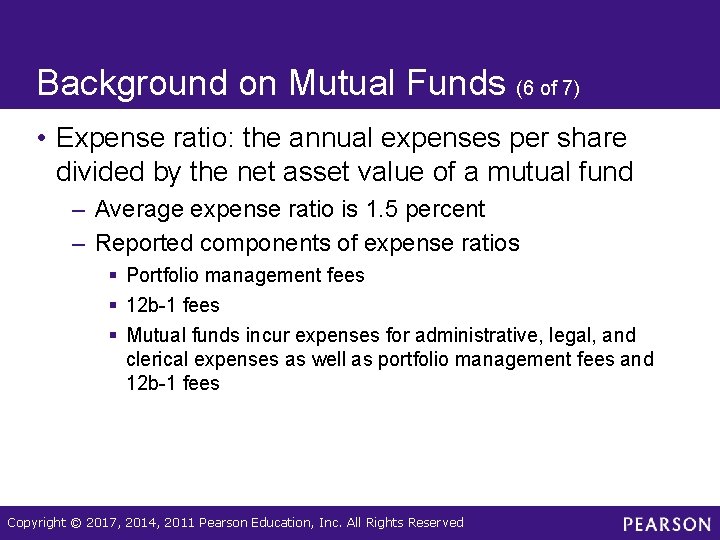
Background on Mutual Funds (6 of 7) • Expense ratio: the annual expenses per share divided by the net asset value of a mutual fund – Average expense ratio is 1. 5 percent – Reported components of expense ratios § Portfolio management fees § 12 b-1 fees § Mutual funds incur expenses for administrative, legal, and clerical expenses as well as portfolio management fees and 12 b-1 fees Copyright © 2017, 2014, 2011 Pearson Education, Inc. All Rights Reserved
Background on Mutual Funds (7 of 7) – Relationship between expense ratios and performance § Funds with lower expense ratios tend to outperform other funds Copyright © 2017, 2014, 2011 Pearson Education, Inc. All Rights Reserved
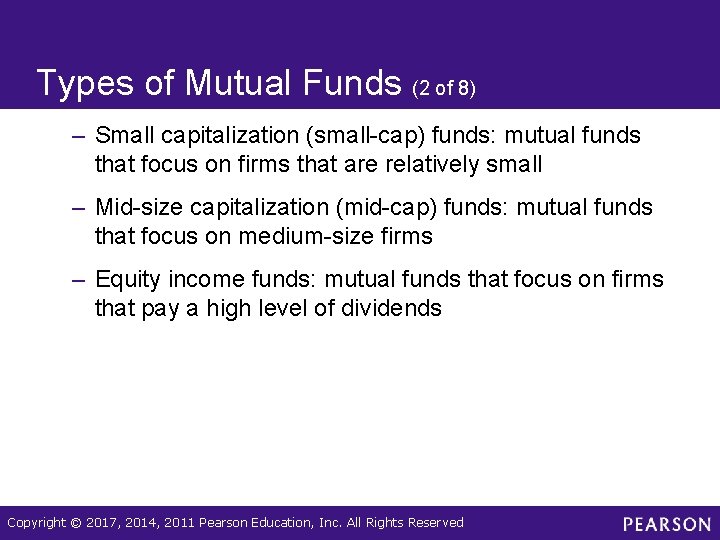
Types of Mutual Funds (1 of 8) • Types of stock mutual funds – Growth funds: mutual funds that focus on stocks that have potential for above-average growth – Capital appreciation funds: mutual funds that focus on stocks that are expected to grow at a very high rate Copyright © 2017, 2014, 2011 Pearson Education, Inc. All Rights Reserved
Types of Mutual Funds (2 of 8) – Small capitalization (small-cap) funds: mutual funds that focus on firms that are relatively small – Mid-size capitalization (mid-cap) funds: mutual funds that focus on medium-size firms – Equity income funds: mutual funds that focus on firms that pay a high level of dividends Copyright © 2017, 2014, 2011 Pearson Education, Inc. All Rights Reserved
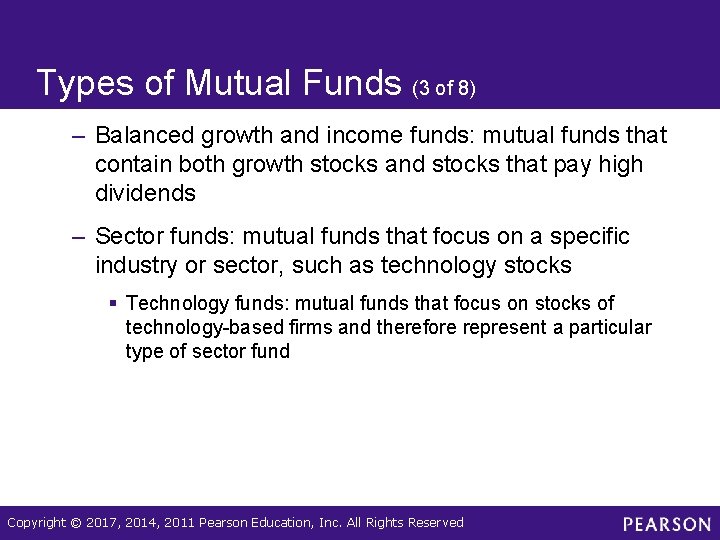
Types of Mutual Funds (3 of 8) – Balanced growth and income funds: mutual funds that contain both growth stocks and stocks that pay high dividends – Sector funds: mutual funds that focus on a specific industry or sector, such as technology stocks § Technology funds: mutual funds that focus on stocks of technology-based firms and therefore represent a particular type of sector fund Copyright © 2017, 2014, 2011 Pearson Education, Inc. All Rights Reserved
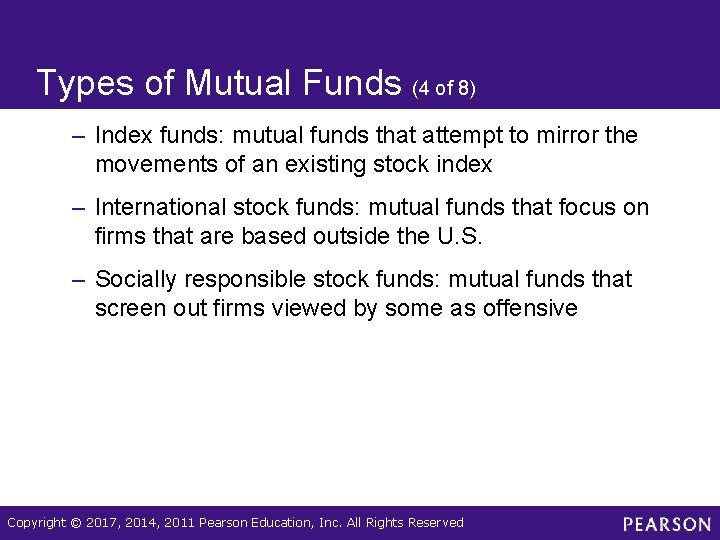
Types of Mutual Funds (4 of 8) – Index funds: mutual funds that attempt to mirror the movements of an existing stock index – International stock funds: mutual funds that focus on firms that are based outside the U. S. – Socially responsible stock funds: mutual funds that screen out firms viewed by some as offensive Copyright © 2017, 2014, 2011 Pearson Education, Inc. All Rights Reserved
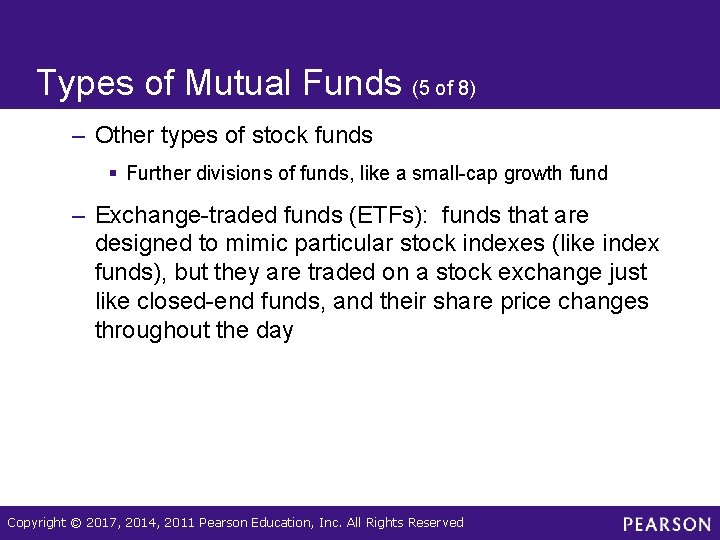
Types of Mutual Funds (5 of 8) – Other types of stock funds § Further divisions of funds, like a small-cap growth fund – Exchange-traded funds (ETFs): funds that are designed to mimic particular stock indexes (like index funds), but they are traded on a stock exchange just like closed-end funds, and their share price changes throughout the day Copyright © 2017, 2014, 2011 Pearson Education, Inc. All Rights Reserved
Financial Planning Online (1 of 4) • Go to http: //www. vanguard. com and insert the search term “mutual funds” • This Web site provides news and other information about index mutual funds that can guide your investment decisions. Copyright © 2017, 2014, 2011 Pearson Education, Inc. All Rights Reserved
Types of Mutual Funds (6 of 8) • Types of bond mutual funds – Treasury bond funds: mutual funds that focus on investment in Treasury bonds – Ginnie Mae funds: mutual funds that invest in bonds issued by the Government National Mortgage Association – Corporate bond funds: mutual funds that focus on bonds issued by high-quality firms that tend to have a low degree of default risk Copyright © 2017, 2014, 2011 Pearson Education, Inc. All Rights Reserved
Types of Mutual Funds (7 of 8) – High-yield (junk) bond funds: mutual funds that focus on relatively risky bonds issued by firms that are subject to default risk – Municipal bond funds: mutual funds that invest in municipal bonds – Index bond funds: mutual funds that are intended to mimic performance of a specified bond index Copyright © 2017, 2014, 2011 Pearson Education, Inc. All Rights Reserved
Types of Mutual Funds (8 of 8) – International bond funds: mutual funds that focus on bonds issued by non-U. S. firms or governments § Exchange rate risk: risk realized when the value of a bond drops because the currency denominating the bond weakens against the dollar – Global bond funds: mutual funds that invest in foreign bonds as well as U. S. bonds – Maturity classifications—some funds are also segmented by their maturities Copyright © 2017, 2014, 2011 Pearson Education, Inc. All Rights Reserved
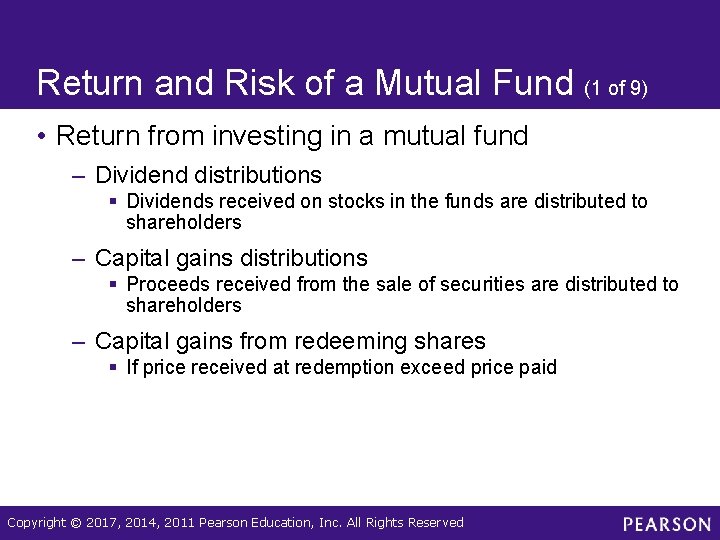
Return and Risk of a Mutual Fund (1 of 9) • Return from investing in a mutual fund – Dividend distributions § Dividends received on stocks in the funds are distributed to shareholders – Capital gains distributions § Proceeds received from the sale of securities are distributed to shareholders – Capital gains from redeeming shares § If price received at redemption exceed price paid Copyright © 2017, 2014, 2011 Pearson Education, Inc. All Rights Reserved
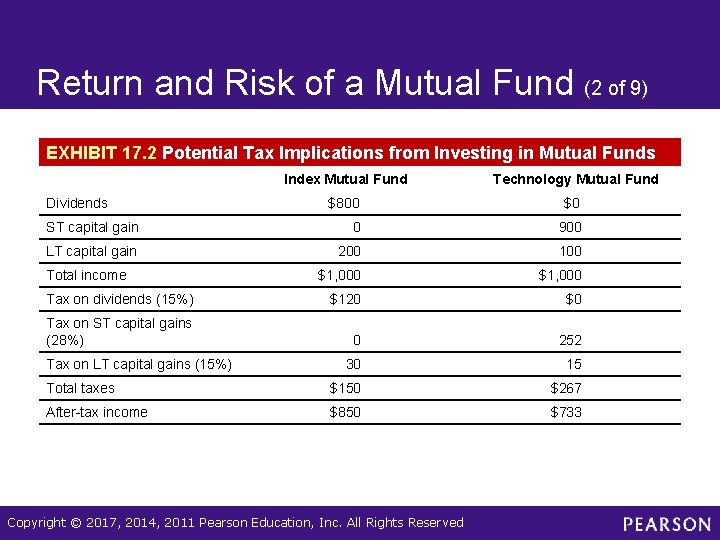
Return and Risk of a Mutual Fund (2 of 9) EXHIBIT 17. 2 Potential Tax Implications from Investing in Mutual Funds Index Mutual Fund Technology Mutual Fund $800 $0 ST capital gain 0 900 LT capital gain 200 100 $1, 000 Tax on dividends (15%) $120 $0 Tax on ST capital gains (28%) 0 252 30 15 Total taxes $150 $267 After-tax income $850 $733 Dividends Total income Tax on LT capital gains (15%) Copyright © 2017, 2014, 2011 Pearson Education, Inc. All Rights Reserved
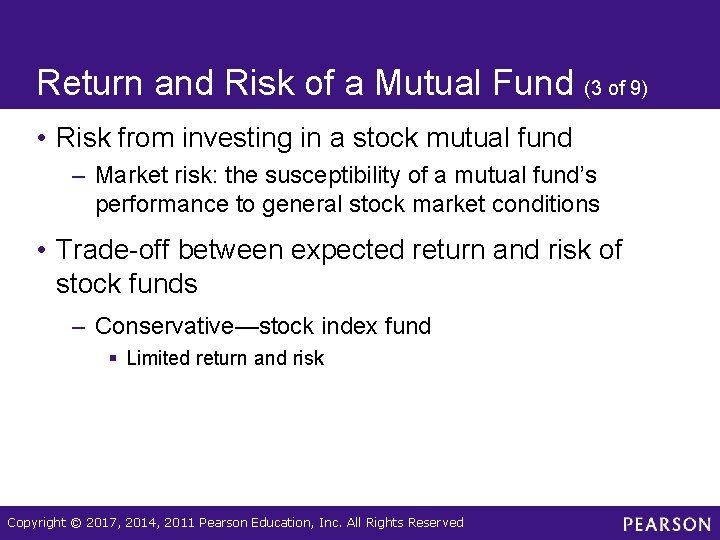
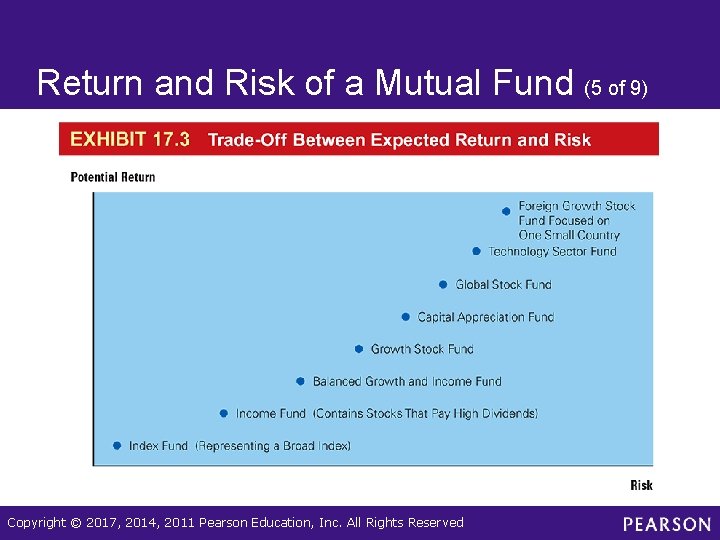
Return and Risk of a Mutual Fund (3 of 9) • Risk from investing in a stock mutual fund – Market risk: the susceptibility of a mutual fund’s performance to general stock market conditions • Trade-off between expected return and risk of stock funds – Conservative—stock index fund § Limited return and risk Copyright © 2017, 2014, 2011 Pearson Education, Inc. All Rights Reserved
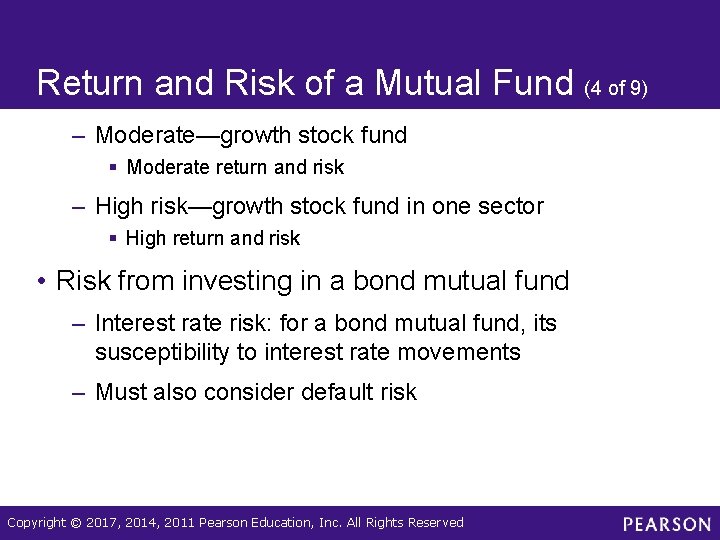
Return and Risk of a Mutual Fund (4 of 9) – Moderate—growth stock fund § Moderate return and risk – High risk—growth stock fund in one sector § High return and risk • Risk from investing in a bond mutual fund – Interest rate risk: for a bond mutual fund, its susceptibility to interest rate movements – Must also consider default risk Copyright © 2017, 2014, 2011 Pearson Education, Inc. All Rights Reserved
Return and Risk of a Mutual Fund (5 of 9) Copyright © 2017, 2014, 2011 Pearson Education, Inc. All Rights Reserved
Financial Planning Online (2 of 4) • Go to the markets section of http: //www. bloomberg. com • This Web site provides information about mutual funds Copyright © 2017, 2014, 2011 Pearson Education, Inc. All Rights Reserved
Return and Risk of a Mutual Fund (6 of 9) Copyright © 2017, 2014, 2011 Pearson Education, Inc. All Rights Reserved
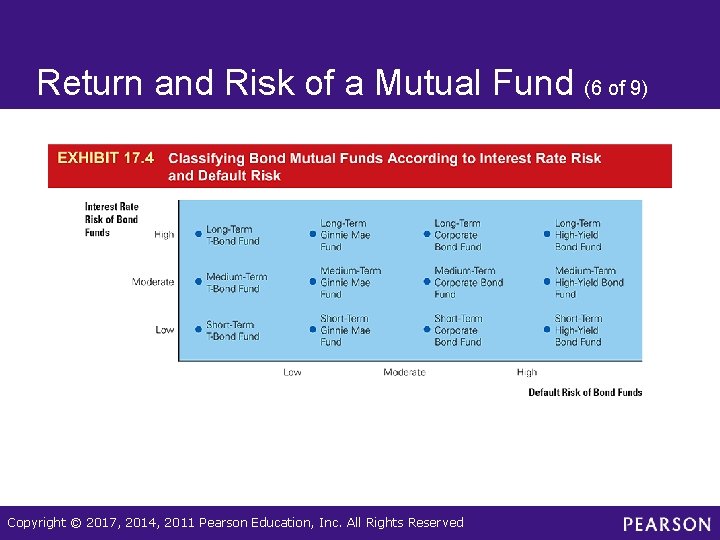
Return and Risk of a Mutual Fund (7 of 9) • Risk from investing in a bond mutual fund – Interest rate risk: for a bond mutual fund, its susceptibility to interest rate movements – Longer-term bonds most sensitive – Must also consider default risk – Bond funds can have either interest rate risk, default risk, or both Copyright © 2017, 2014, 2011 Pearson Education, Inc. All Rights Reserved
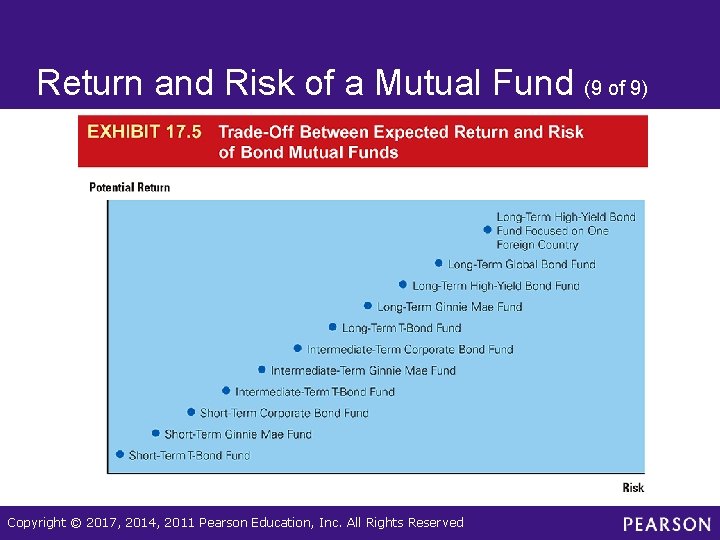
Return and Risk of a Mutual Fund (8 of 9) • Tradeoff between expected return and risk of bond funds – Conservative—short-term Treasury bond fund § No default risk and limited interest rate risk § Low return – Moderate—Ginnie Mae bond fund § Slight default risk and moderate interest rate risk § Moderate return – High risk—junk bond fund § High default risk and high interest rate risk § Potentially high return Copyright © 2017, 2014, 2011 Pearson Education, Inc. All Rights Reserved
Return and Risk of a Mutual Fund (9 of 9) Copyright © 2017, 2014, 2011 Pearson Education, Inc. All Rights Reserved
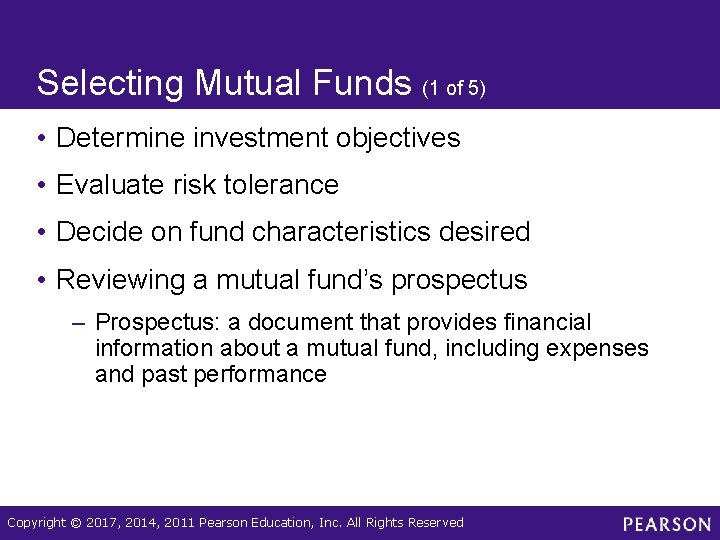
Selecting Mutual Funds (1 of 5) • Determine investment objectives • Evaluate risk tolerance • Decide on fund characteristics desired • Reviewing a mutual fund’s prospectus – Prospectus: a document that provides financial information about a mutual fund, including expenses and past performance Copyright © 2017, 2014, 2011 Pearson Education, Inc. All Rights Reserved
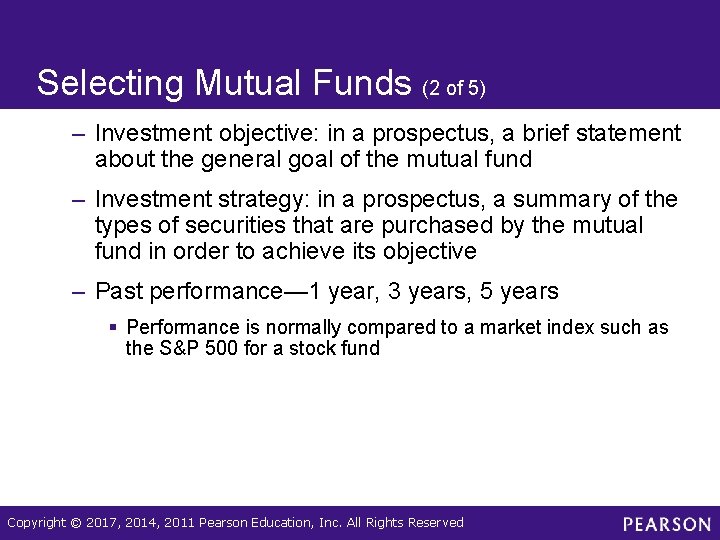
Selecting Mutual Funds (2 of 5) – Investment objective: in a prospectus, a brief statement about the general goal of the mutual fund – Investment strategy: in a prospectus, a summary of the types of securities that are purchased by the mutual fund in order to achieve its objective – Past performance— 1 year, 3 years, 5 years § Performance is normally compared to a market index such as the S&P 500 for a stock fund Copyright © 2017, 2014, 2011 Pearson Education, Inc. All Rights Reserved
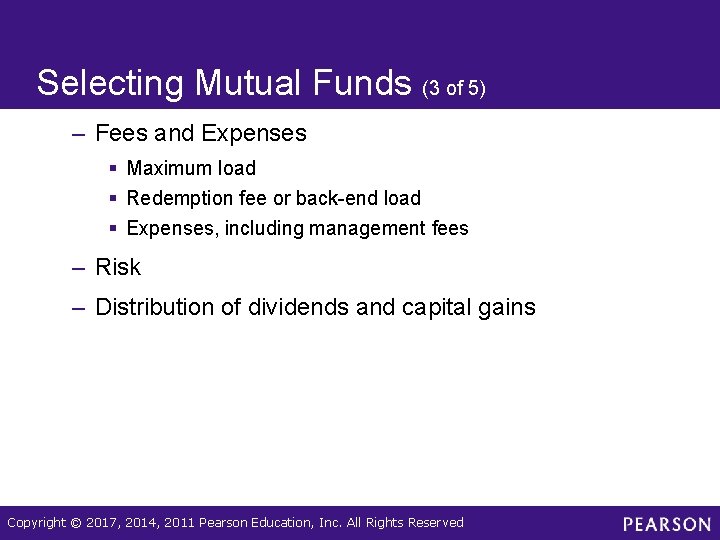
Selecting Mutual Funds (3 of 5) – Fees and Expenses § Maximum load § Redemption fee or back-end load § Expenses, including management fees – Risk – Distribution of dividends and capital gains Copyright © 2017, 2014, 2011 Pearson Education, Inc. All Rights Reserved
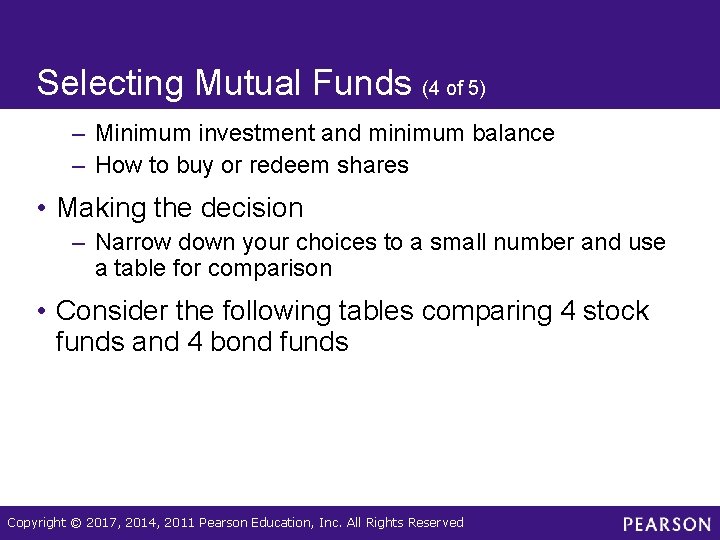
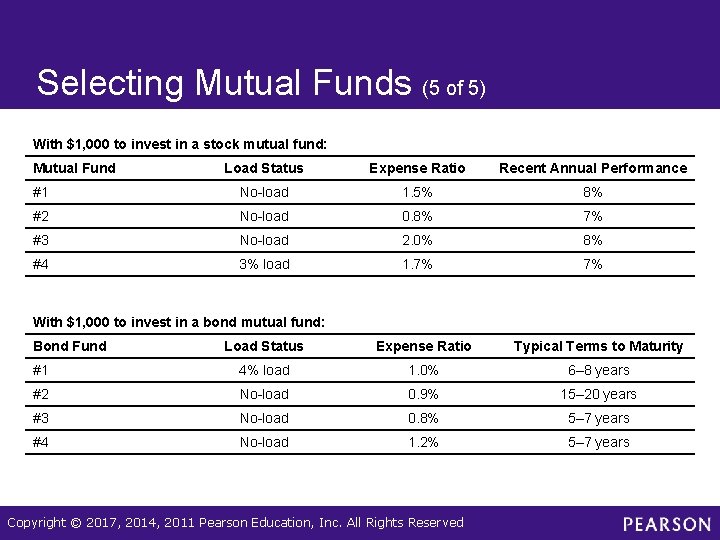
Selecting Mutual Funds (4 of 5) – Minimum investment and minimum balance – How to buy or redeem shares • Making the decision – Narrow down your choices to a small number and use a table for comparison • Consider the following tables comparing 4 stock funds and 4 bond funds Copyright © 2017, 2014, 2011 Pearson Education, Inc. All Rights Reserved
Selecting Mutual Funds (5 of 5) With $1, 000 to invest in a stock mutual fund: Mutual Fund Load Status Expense Ratio Recent Annual Performance #1 No-load 1. 5% 8% #2 No-load 0. 8% 7% #3 No-load 2. 0% 8% #4 3% load 1. 7% 7% With $1, 000 to invest in a bond mutual fund: Bond Fund Load Status Expense Ratio Typical Terms to Maturity #1 4% load 1. 0% 6– 8 years #2 No-load 0. 9% 15– 20 years #3 No-load 0. 8% 5– 7 years #4 No-load 1. 2% 5– 7 years Copyright © 2017, 2014, 2011 Pearson Education, Inc. All Rights Reserved
Financial Planning Online (3 of 4) • Go to http: //www. fidelity. com • This Web site provides detailed information for many individual mutual funds that you specify, including past performance and expense ratio. You can review the Web sites of other investment companies that sell mutual funds. Copyright © 2017, 2014, 2011 Pearson Education, Inc. All Rights Reserved
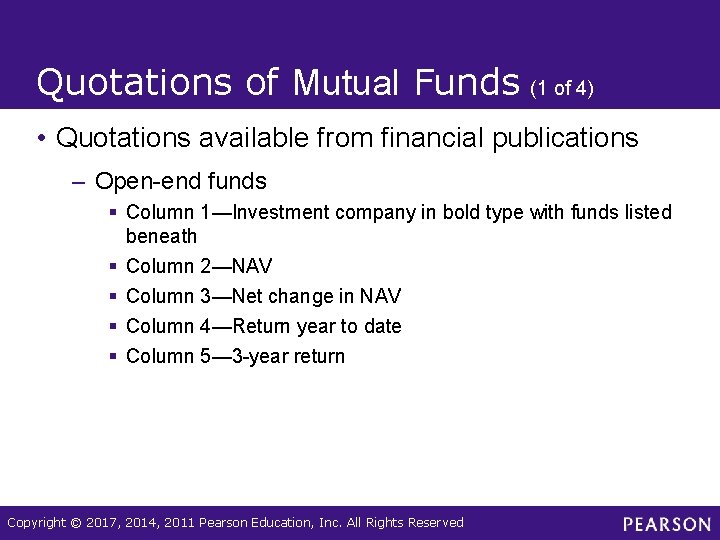
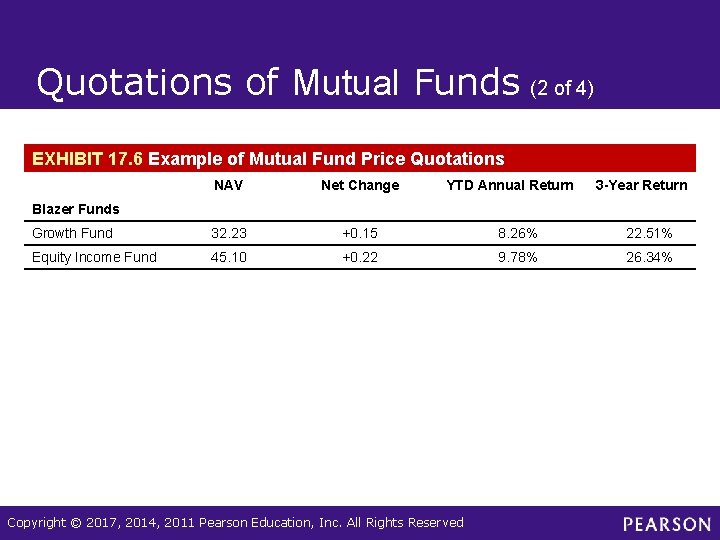
Quotations of Mutual Funds (1 of 4) • Quotations available from financial publications – Open-end funds § Column 1—Investment company in bold type with funds listed beneath § Column 2—NAV § Column 3—Net change in NAV § Column 4—Return year to date § Column 5— 3 -year return Copyright © 2017, 2014, 2011 Pearson Education, Inc. All Rights Reserved
Quotations of Mutual Funds (2 of 4) EXHIBIT 17. 6 Example of Mutual Fund Price Quotations NAV Net Change YTD Annual Return 3 -Year Return Growth Fund 32. 23 +0. 15 8. 26% 22. 51% Equity Income Fund 45. 10 +0. 22 9. 78% 26. 34% Blazer Funds Copyright © 2017, 2014, 2011 Pearson Education, Inc. All Rights Reserved
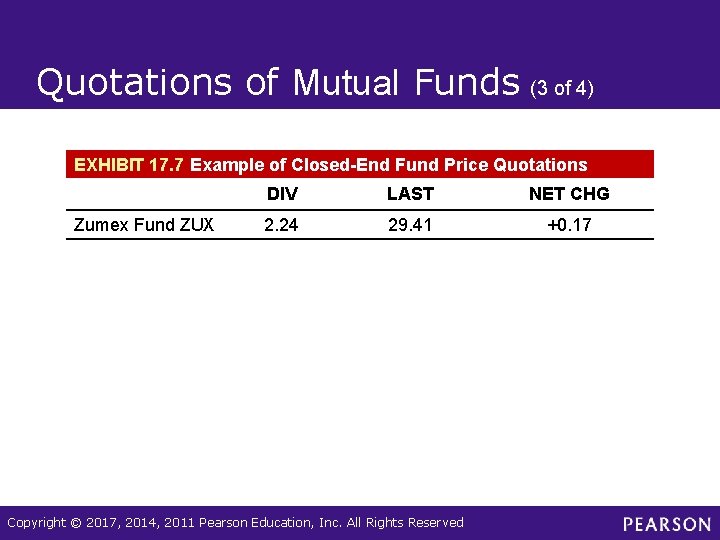
Quotations of Mutual Funds (3 of 4) EXHIBIT 17. 7 Example of Closed-End Fund Price Quotations Zumex Fund ZUX DIV LAST NET CHG 2. 24 29. 41 +0. 17 Copyright © 2017, 2014, 2011 Pearson Education, Inc. All Rights Reserved
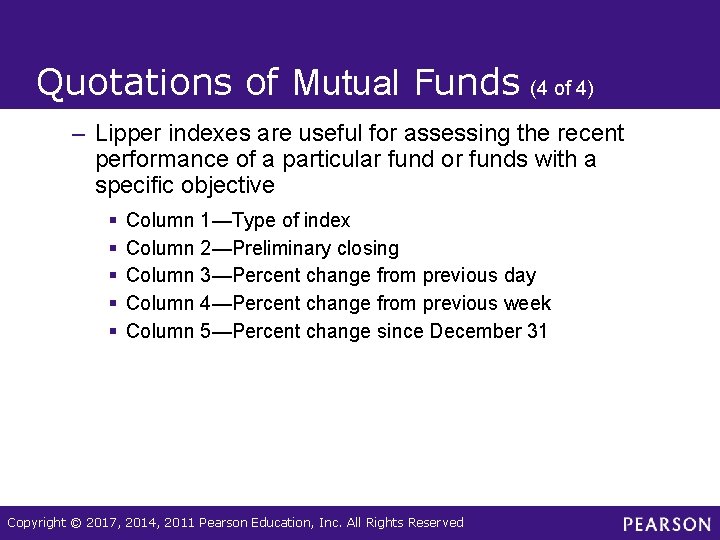
Quotations of Mutual Funds (4 of 4) – Lipper indexes are useful for assessing the recent performance of a particular fund or funds with a specific objective § § § Column 1—Type of index Column 2—Preliminary closing Column 3—Percent change from previous day Column 4—Percent change from previous week Column 5—Percent change since December 31 Copyright © 2017, 2014, 2011 Pearson Education, Inc. All Rights Reserved
Financial Planning Online (4 of 4) • Go to http: //www. mfea. com • This Web site provides general information about investing in mutual funds Copyright © 2017, 2014, 2011 Pearson Education, Inc. All Rights Reserved
Diversification Among Mutual Funds (1 of 5) • Diversify among several types of funds to lower risk • Best strategy is to diversify across stock and bond mutual funds • Can also diversify among mutual funds representing different countries Copyright © 2017, 2014, 2011 Pearson Education, Inc. All Rights Reserved
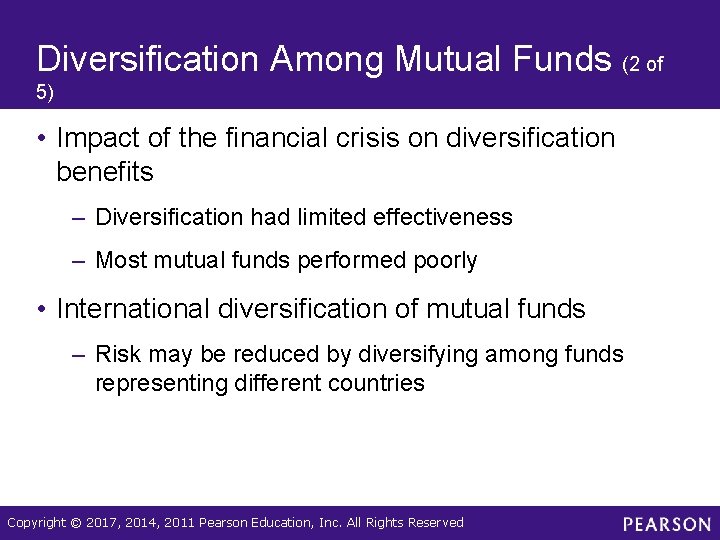
Diversification Among Mutual Funds (2 of 5) • Impact of the financial crisis on diversification benefits – Diversification had limited effectiveness – Most mutual funds performed poorly • International diversification of mutual funds – Risk may be reduced by diversifying among funds representing different countries Copyright © 2017, 2014, 2011 Pearson Education, Inc. All Rights Reserved
Diversification Among Mutual Funds (3 of 5) • Diversification through mutual fund supermarkets: an arrangement offered by some brokerage firms that enables investors to diversify among various mutual funds (from different mutual fund families) and to receive a summary statement for these funds on a consolidated basis Copyright © 2017, 2014, 2011 Pearson Education, Inc. All Rights Reserved
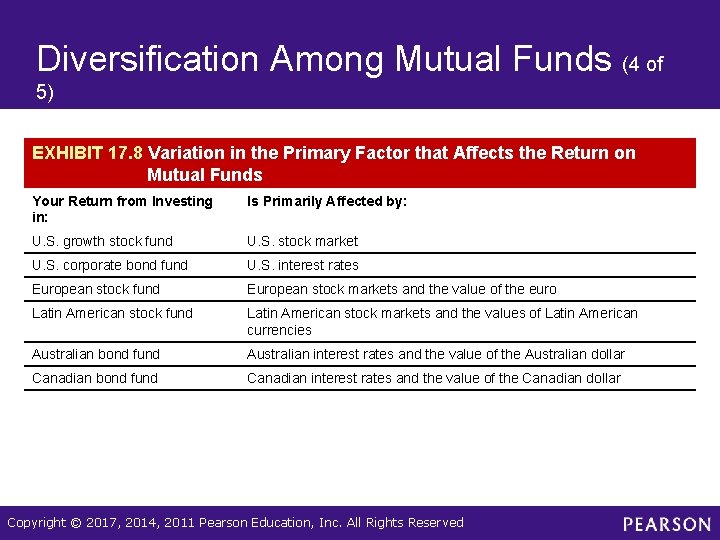
Diversification Among Mutual Funds (4 of 5) EXHIBIT 17. 8 Variation in the Primary Factor that Affects the Return on Mutual Funds Your Return from Investing in: Is Primarily Affected by: U. S. growth stock fund U. S. stock market U. S. corporate bond fund U. S. interest rates European stock fund European stock markets and the value of the euro Latin American stock fund Latin American stock markets and the values of Latin American currencies Australian bond fund Australian interest rates and the value of the Australian dollar Canadian bond fund Canadian interest rates and the value of the Canadian dollar Copyright © 2017, 2014, 2011 Pearson Education, Inc. All Rights Reserved
Diversification Among Mutual Funds (5 of 5) • Other types of funds – Hedge funds: limited partnerships that manage portfolios of funds for wealthy individuals and financial institutions – Madoff fund scandal § Reported favorable returns when the actual returns were much worse § Investors should have been suspicious Copyright © 2017, 2014, 2011 Pearson Education, Inc. All Rights Reserved
How Mutual Funds Fit Within Your Financial Plan (1 of 5) • Key decisions about mutual funds for your financial plan are: – Should you consider investing in mutual funds? – What types of mutual funds would you invest in? Copyright © 2017, 2014, 2011 Pearson Education, Inc. All Rights Reserved
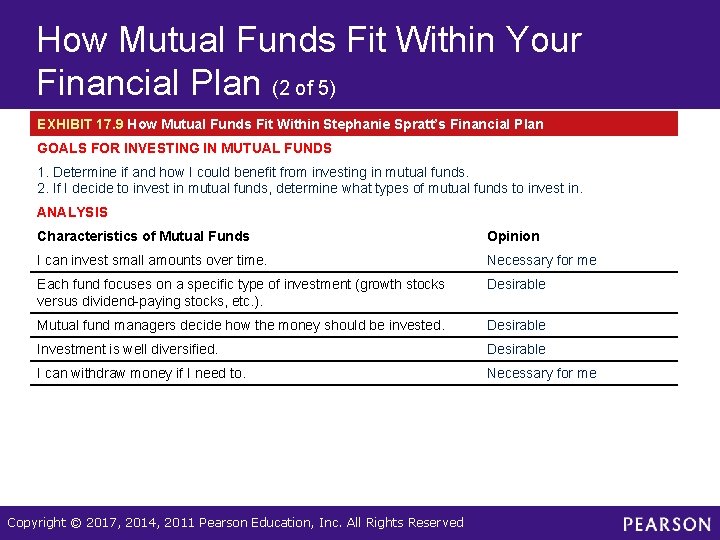
How Mutual Funds Fit Within Your Financial Plan (2 of 5) EXHIBIT 17. 9 How Mutual Funds Fit Within Stephanie Spratt’s Financial Plan GOALS FOR INVESTING IN MUTUAL FUNDS 1. Determine if and how I could benefit from investing in mutual funds. 2. If I decide to invest in mutual funds, determine what types of mutual funds to invest in. ANALYSIS Characteristics of Mutual Funds Opinion I can invest small amounts over time. Necessary for me Each fund focuses on a specific type of investment (growth stocks versus dividend-paying stocks, etc. ). Desirable Mutual fund managers decide how the money should be invested. Desirable Investment is well diversified. Desirable I can withdraw money if I need to. Necessary for me Copyright © 2017, 2014, 2011 Pearson Education, Inc. All Rights Reserved
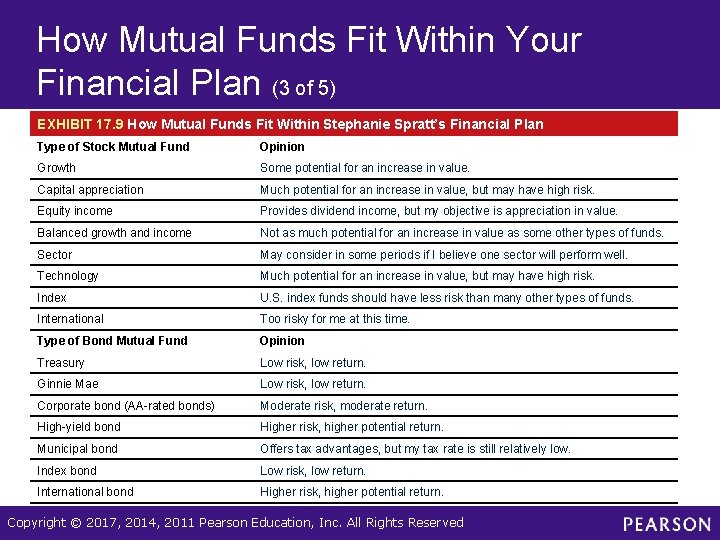
How Mutual Funds Fit Within Your Financial Plan (3 of 5) EXHIBIT 17. 9 How Mutual Funds Fit Within Stephanie Spratt’s Financial Plan Type of Stock Mutual Fund Opinion Growth Some potential for an increase in value. Capital appreciation Much potential for an increase in value, but may have high risk. Equity income Provides dividend income, but my objective is appreciation in value. Balanced growth and income Not as much potential for an increase in value as some other types of funds. Sector May consider in some periods if I believe one sector will perform well. Technology Much potential for an increase in value, but may have high risk. Index U. S. index funds should have less risk than many other types of funds. International Too risky for me at this time. Type of Bond Mutual Fund Opinion Treasury Low risk, low return. Ginnie Mae Low risk, low return. Corporate bond (AA-rated bonds) Moderate risk, moderate return. High-yield bond Higher risk, higher potential return. Municipal bond Offers tax advantages, but my tax rate is still relatively low. Index bond Low risk, low return. International bond Higher risk, higher potential return. Copyright © 2017, 2014, 2011 Pearson Education, Inc. All Rights Reserved
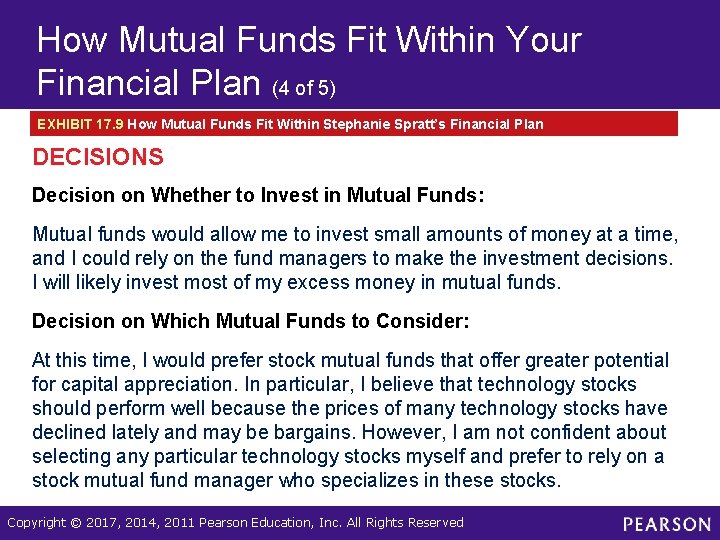
How Mutual Funds Fit Within Your Financial Plan (4 of 5) EXHIBIT 17. 9 How Mutual Funds Fit Within Stephanie Spratt’s Financial Plan DECISIONS Decision on Whether to Invest in Mutual Funds: Mutual funds would allow me to invest small amounts of money at a time, and I could rely on the fund managers to make the investment decisions. I will likely invest most of my excess money in mutual funds. Decision on Which Mutual Funds to Consider: At this time, I would prefer stock mutual funds that offer greater potential for capital appreciation. In particular, I believe that technology stocks should perform well because the prices of many technology stocks have declined lately and may be bargains. However, I am not confident about selecting any particular technology stocks myself and prefer to rely on a stock mutual fund manager who specializes in these stocks. Copyright © 2017, 2014, 2011 Pearson Education, Inc. All Rights Reserved
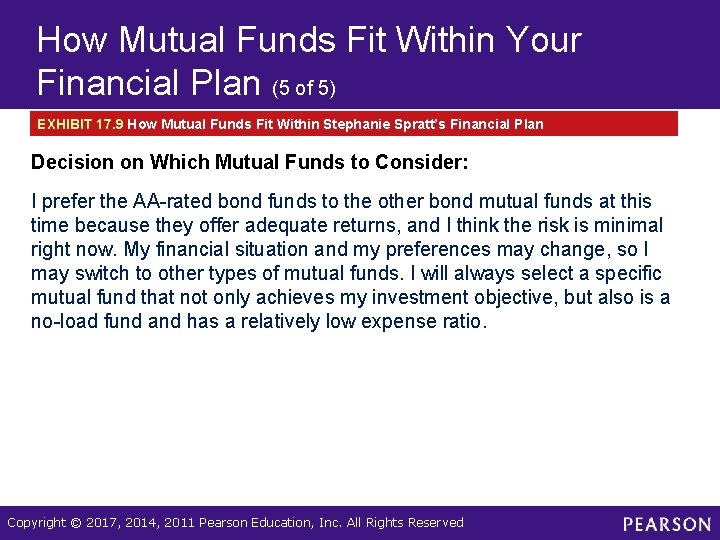
How Mutual Funds Fit Within Your Financial Plan (5 of 5) EXHIBIT 17. 9 How Mutual Funds Fit Within Stephanie Spratt’s Financial Plan Decision on Which Mutual Funds to Consider: I prefer the AA-rated bond funds to the other bond mutual funds at this time because they offer adequate returns, and I think the risk is minimal right now. My financial situation and my preferences may change, so I may switch to other types of mutual funds. I will always select a specific mutual fund that not only achieves my investment objective, but also is a no-load fund and has a relatively low expense ratio. Copyright © 2017, 2014, 2011 Pearson Education, Inc. All Rights Reserved