Inclusion Dependency IND IND is the rule among
- Slides: 10
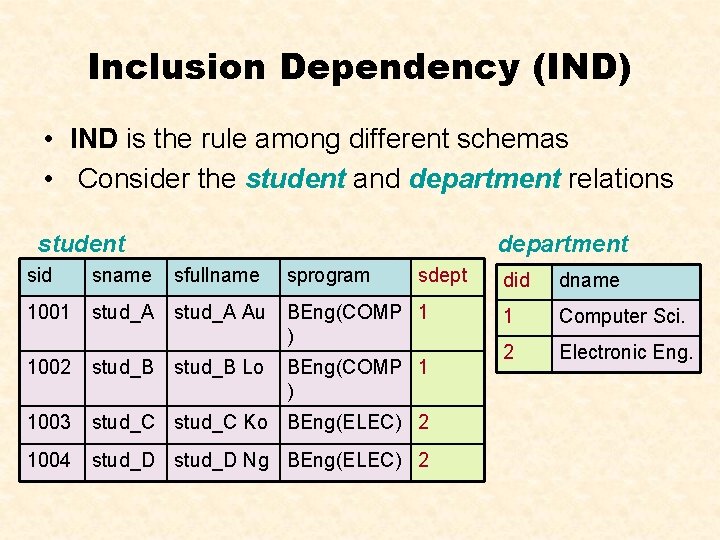
Inclusion Dependency (IND) • IND is the rule among different schemas • Consider the student and department relations student department sid sname sfullname sprogram 1001 stud_A Au BEng(COMP 1 ) stud_B Lo sdept 1002 stud_B BEng(COMP 1 ) 1003 stud_C Ko BEng(ELEC) 2 1004 stud_D Ng BEng(ELEC) 2 did dname 1 Computer Sci. 2 Electronic Eng.
Inclusion Dependency (IND) • In the student relation, we only have the student ID of the student and his/her corresponding department ID number. • Normally every student must belong to a department. • There should not exist that the relation contains a department with an unknown department identity number, or that the department has no identity number.
Inclusion Dependency (IND) • • • Just the same as FD, there is a tool to formulate the IND between schemas This tool is called “Casanova et al. ’s axiom system” We consider the following three rules: – Reflexivity – Projection and Permutation – Transitivity
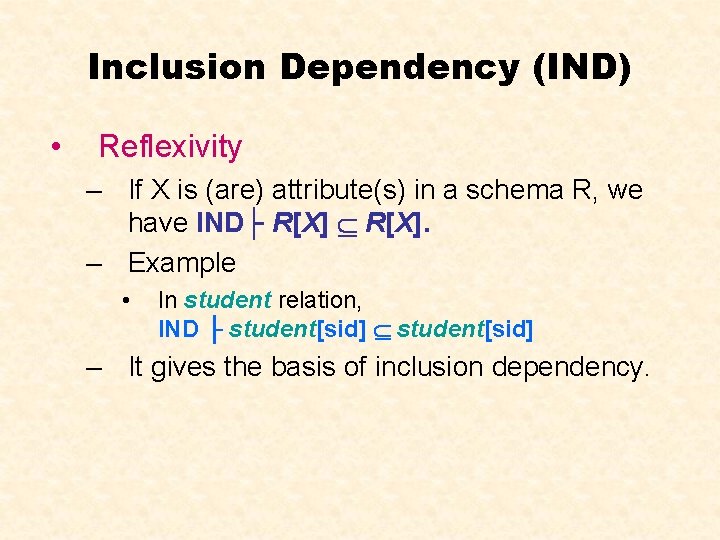
Inclusion Dependency (IND) • Reflexivity – If X is (are) attribute(s) in a schema R, we have IND├ R[X]. – Example • In student relation, IND ├ student[sid] – It gives the basis of inclusion dependency.
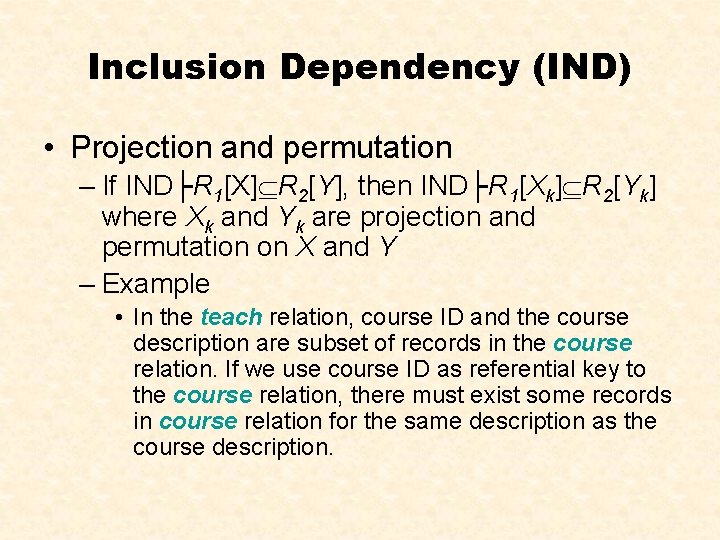
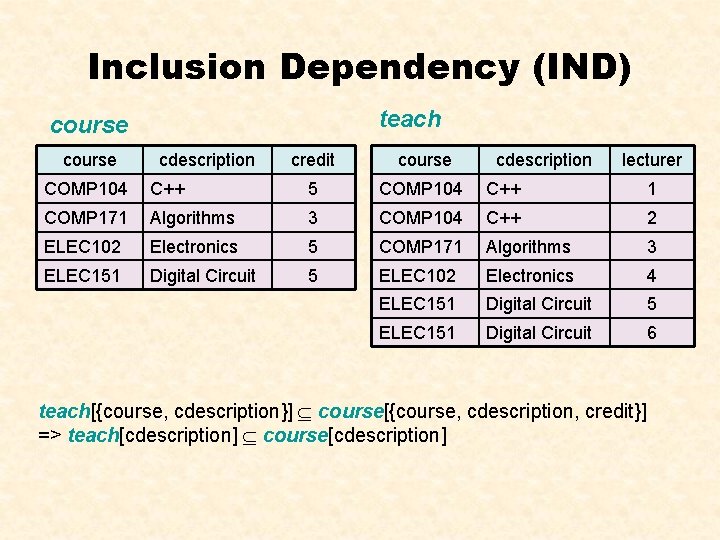
Inclusion Dependency (IND) • Projection and permutation – If IND├R 1[X] R 2[Y], then IND├R 1[Xk] R 2[Yk] where Xk and Yk are projection and permutation on X and Y – Example • In the teach relation, course ID and the course description are subset of records in the course relation. If we use course ID as referential key to the course relation, there must exist some records in course relation for the same description as the course description.
Inclusion Dependency (IND) teach course cdescription credit course cdescription lecturer COMP 104 C++ 5 COMP 104 C++ 1 COMP 171 Algorithms 3 COMP 104 C++ 2 ELEC 102 Electronics 5 COMP 171 Algorithms 3 ELEC 151 Digital Circuit 5 ELEC 102 Electronics 4 ELEC 151 Digital Circuit 5 ELEC 151 Digital Circuit 6 teach[{course, cdescription}] course[{course, cdescription, credit}] => teach[cdescription] course[cdescription]
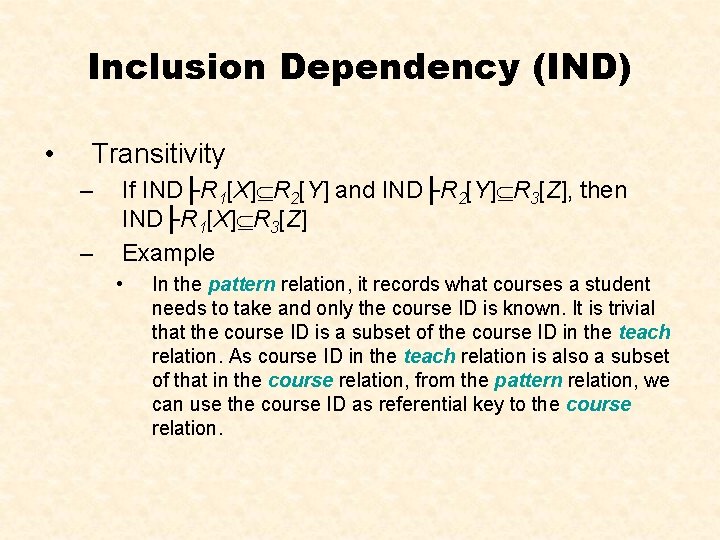
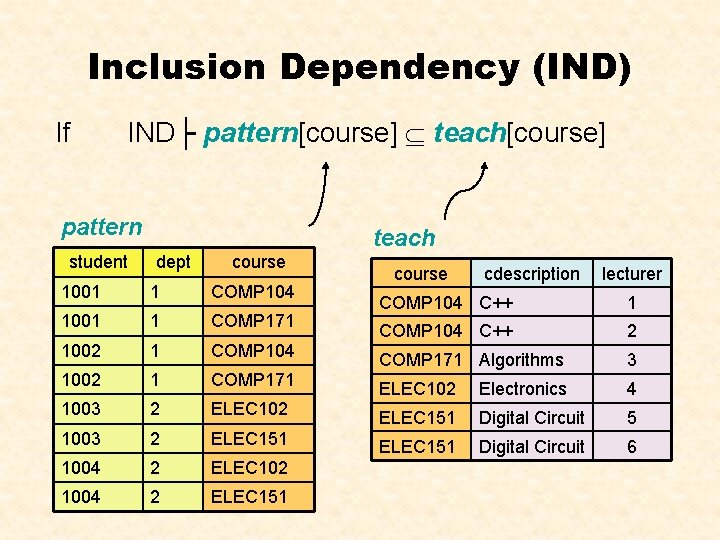
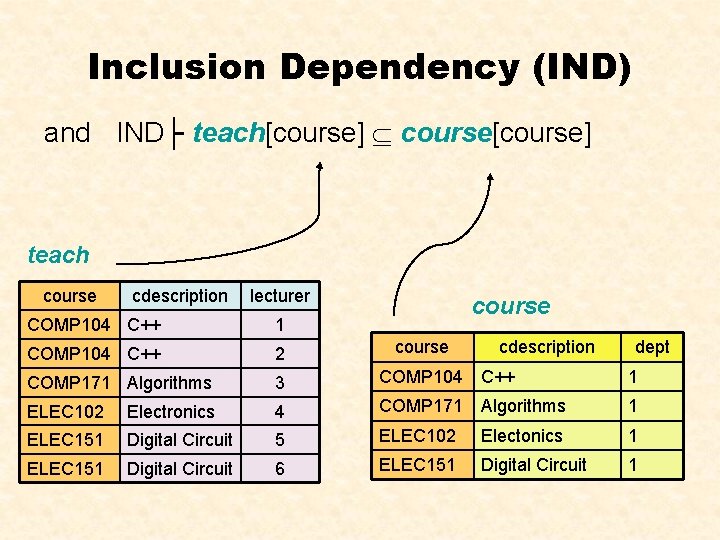
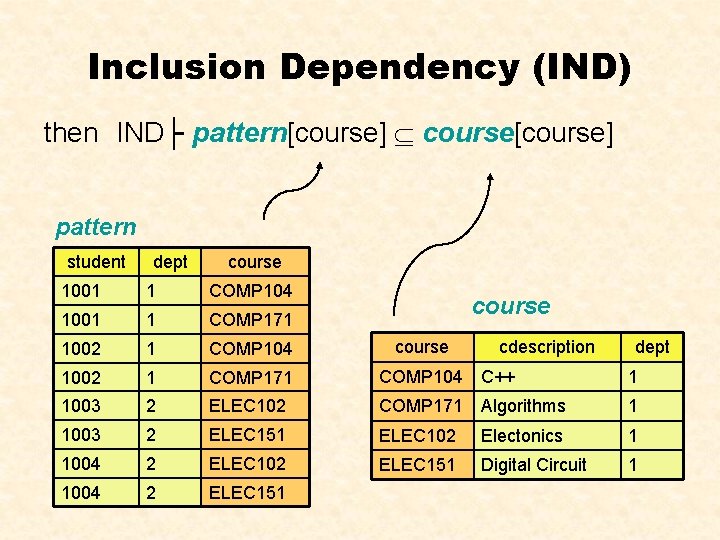
Inclusion Dependency (IND) • Transitivity – – If IND├R 1[X] R 2[Y] and IND├R 2[Y] R 3[Z], then IND├R 1[X] R 3[Z] Example • In the pattern relation, it records what courses a student needs to take and only the course ID is known. It is trivial that the course ID is a subset of the course ID in the teach relation. As course ID in the teach relation is also a subset of that in the course relation, from the pattern relation, we can use the course ID as referential key to the course relation.
Inclusion Dependency (IND) If IND├ pattern[course] teach[course] pattern student teach dept course 1001 1 COMP 104 1001 1 COMP 171 1002 1 COMP 104 1002 1 COMP 171 1003 2 1003 course cdescription lecturer COMP 104 C++ 1 COMP 104 C++ 2 COMP 171 Algorithms 3 ELEC 102 Electronics 4 ELEC 102 ELEC 151 Digital Circuit 5 2 ELEC 151 Digital Circuit 6 1004 2 ELEC 102 1004 2 ELEC 151
Inclusion Dependency (IND) and IND├ teach[course] course[course] teach course cdescription lecturer course COMP 104 C++ 1 COMP 104 C++ 2 course COMP 171 Algorithms 3 COMP 104 C++ 1 ELEC 102 Electronics 4 COMP 171 Algorithms 1 ELEC 151 Digital Circuit 5 ELEC 102 Electonics 1 ELEC 151 Digital Circuit 6 ELEC 151 Digital Circuit 1 cdescription dept
Inclusion Dependency (IND) then IND├ pattern[course] course[course] pattern student dept course 1001 1 COMP 104 1001 1 COMP 171 1002 1 COMP 104 course 1002 1 COMP 171 COMP 104 C++ 1 1003 2 ELEC 102 COMP 171 Algorithms 1 1003 2 ELEC 151 ELEC 102 Electonics 1 1004 2 ELEC 102 ELEC 151 Digital Circuit 1 1004 2 ELEC 151 course cdescription dept