IEC 61400 15 WG Update Assessment of Wind
- Slides: 13
IEC 61400 -15 WG Update Assessment of Wind Resource, Energy Yield, and Site Suitability Input Conditions for Wind Power Plants Jason Fields, Secretary NREL is a national laboratory of the U. S. Department of Energy, Office of Energy Efficiency and Renewable Energy, operated by the Alliance for Sustainable Energy, LLC.
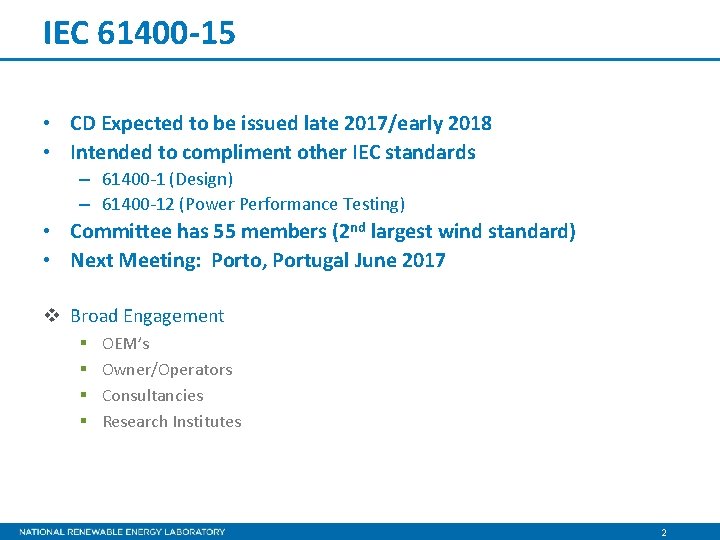
IEC 61400 -15 • CD Expected to be issued late 2017/early 2018 • Intended to compliment other IEC standards – 61400 -1 (Design) – 61400 -12 (Power Performance Testing) • Committee has 55 members (2 nd largest wind standard) • Next Meeting: Porto, Portugal June 2017 v Broad Engagement § § OEM’s Owner/Operators Consultancies Research Institutes 2
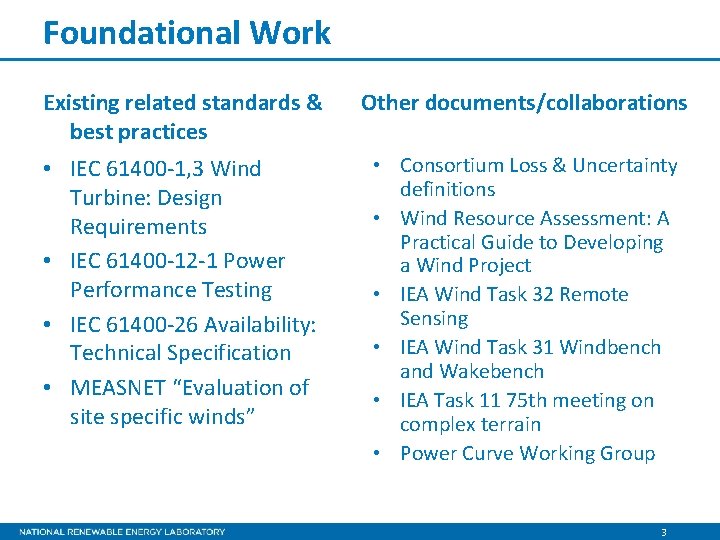
Foundational Work Existing related standards & best practices Other documents/collaborations • IEC 61400 -1, 3 Wind Turbine: Design Requirements • IEC 61400 -12 -1 Power Performance Testing • IEC 61400 -26 Availability: Technical Specification • MEASNET “Evaluation of site specific winds” • Consortium Loss & Uncertainty definitions • Wind Resource Assessment: A Practical Guide to Developing a Wind Project • IEA Wind Task 32 Remote Sensing • IEA Wind Task 31 Windbench and Wakebench • IEA Task 11 75 th meeting on complex terrain • Power Curve Working Group 3
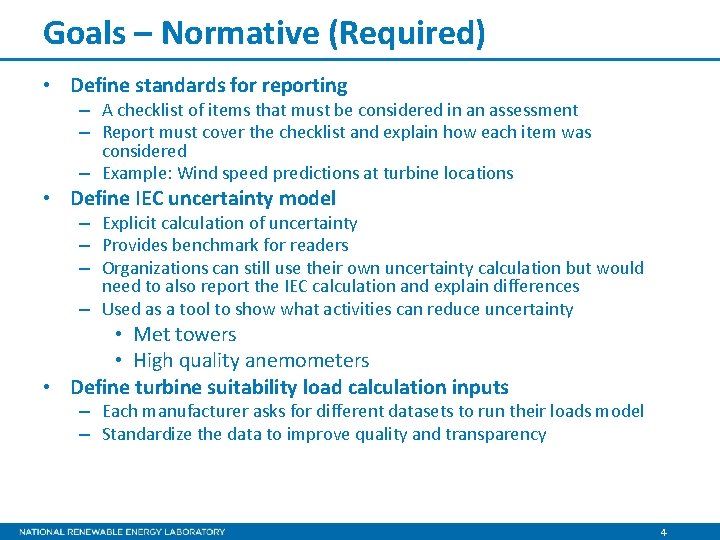
Goals – Normative (Required) • Define standards for reporting – A checklist of items that must be considered in an assessment – Report must cover the checklist and explain how each item was considered – Example: Wind speed predictions at turbine locations • Define IEC uncertainty model – Explicit calculation of uncertainty – Provides benchmark for readers – Organizations can still use their own uncertainty calculation but would need to also report the IEC calculation and explain differences – Used as a tool to show what activities can reduce uncertainty • Met towers • High quality anemometers • Define turbine suitability load calculation inputs – Each manufacturer asks for different datasets to run their loads model – Standardize the data to improve quality and transparency 4
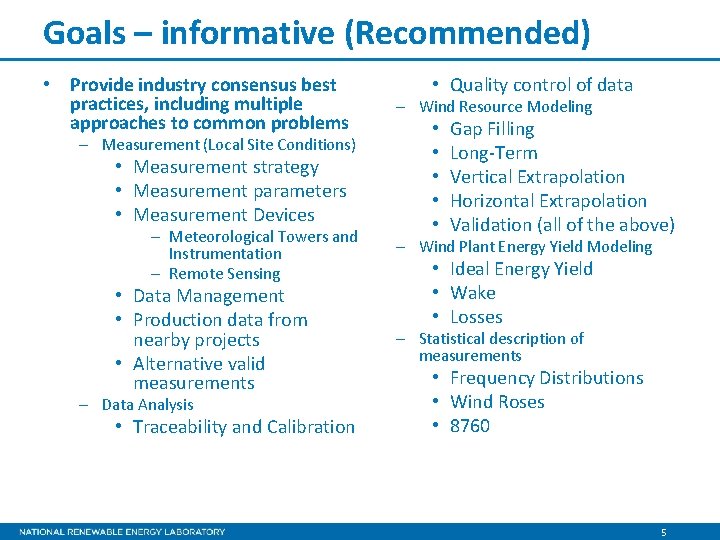
Goals – informative (Recommended) • Provide industry consensus best practices, including multiple approaches to common problems – Measurement (Local Site Conditions) • Measurement strategy • Measurement parameters • Measurement Devices – Meteorological Towers and Instrumentation – Remote Sensing • Data Management • Production data from nearby projects • Alternative valid measurements – Data Analysis • Traceability and Calibration • Quality control of data – Wind Resource Modeling • • • Gap Filling Long-Term Vertical Extrapolation Horizontal Extrapolation Validation (all of the above) – Wind Plant Energy Yield Modeling • Ideal Energy Yield • Wake • Losses – Statistical description of measurements • Frequency Distributions • Wind Roses • 8760 5
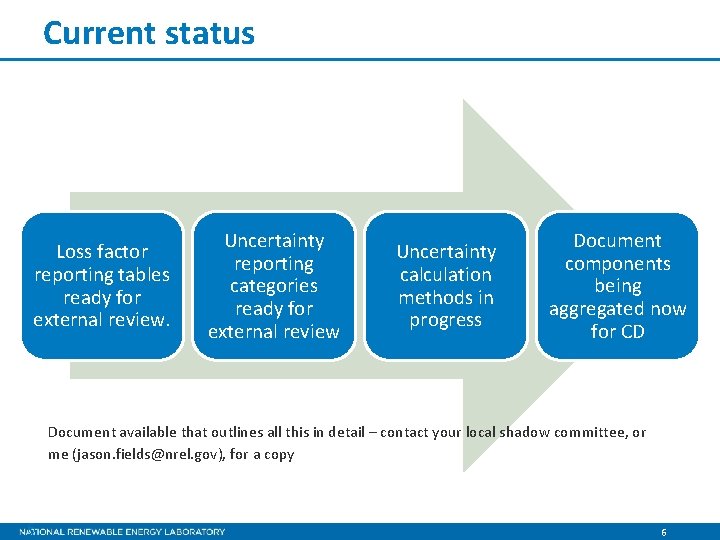
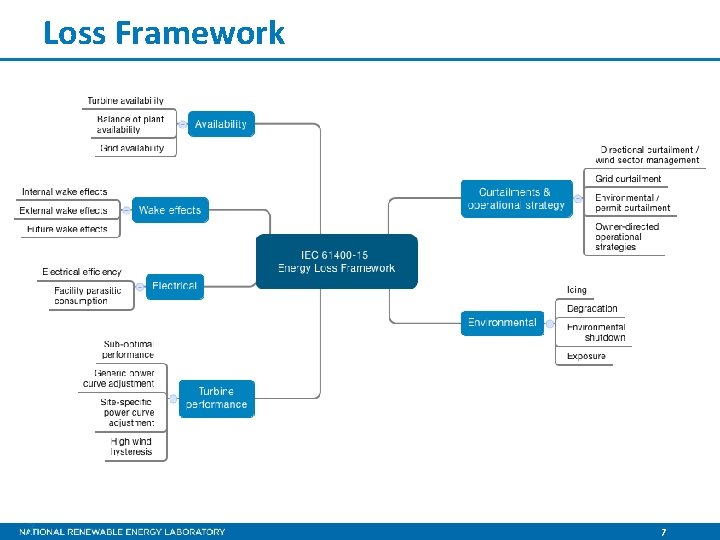
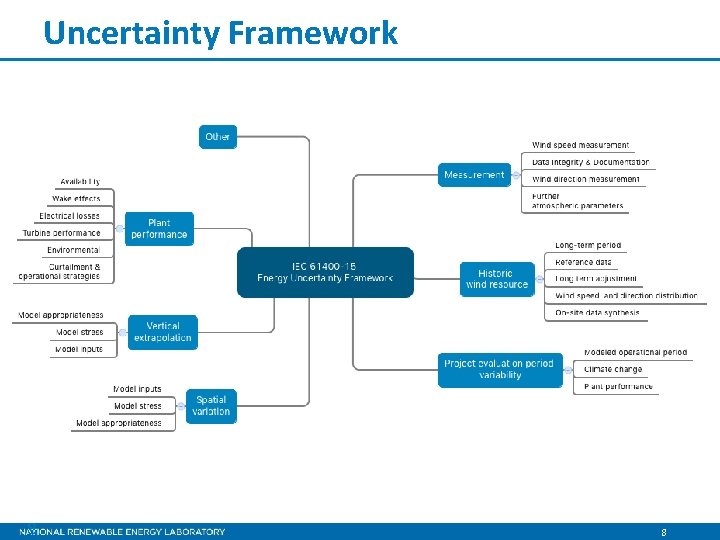
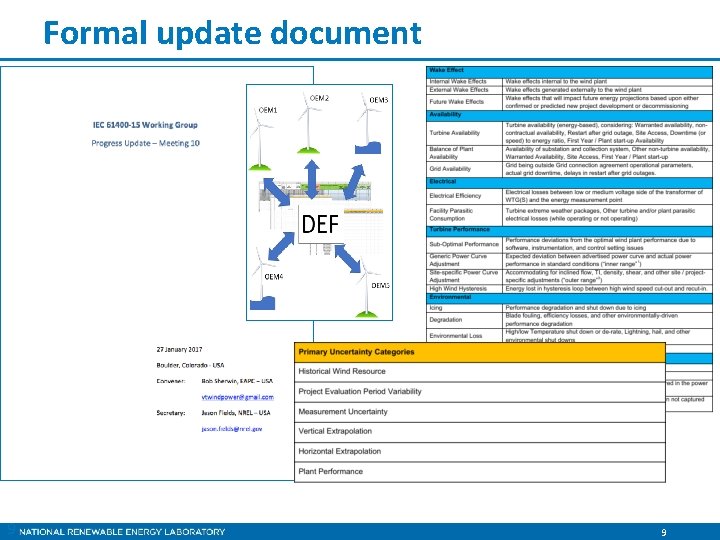
Current status Loss factor reporting tables ready for external review. Uncertainty reporting categories ready for external review Uncertainty calculation methods in progress Document components being aggregated now for CD Document available that outlines all this in detail – contact your local shadow committee, or me (jason. fields@nrel. gov), for a copy 6 6
Loss Framework 7 7
Uncertainty Framework 8 8
Formal update document 9 9
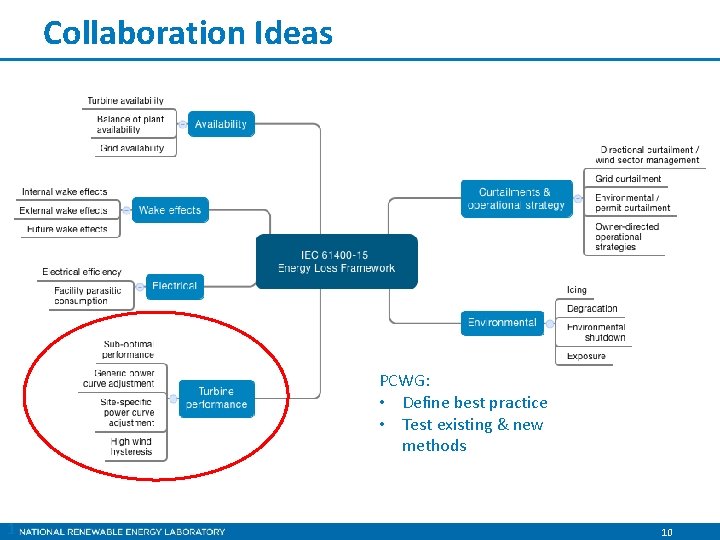
Collaboration Ideas PCWG: • Define best practice • Test existing & new methods 1 10
Appendix
Scope of Standard - Approved The scope of this standard is to define a framework for assessment and reporting of the wind resource, energy yield and site suitability input conditions for both onshore and offshore wind power plants. This includes: • 1. Definition, measurement, and prediction of the long-term meteorological and wind flow characteristics at the site • 2. Integration of the long-term meteorological and wind flow characteristics with wind turbine and balance of plant characteristics to predict net energy yield • 3. Characterizing environmental extremes and other relevant plant design drivers • 4. Assessing the uncertainty associated with each of these steps • 5. Addressing documentation and reporting requirements to help ensure the traceability of the assessment processes The framework will be defined such that applicable national norms are considered and industry best practices are utilized. The meteorological and wind flow characteristics addressed in this document relate to wind conditions, where parameters such as wind speed, wind direction, air density or air temperature are included to the extent that they affect the operation and structural integrity of a wind turbine (WTGS) and energy production analysis. According to IEC 61400 -1 and 61400 -3 the site specific conditions can be broken down into wind conditions, other environmental conditions, soil conditions, ocean/lake conditions and electrical conditions. All of these site conditions other than site specific wind conditions and related documents are out of scope for this standard. This standard is framed to complement and support the scope of related IEC 61400 series standards by defining environmental input conditions. It is not intended to supersede the design and suitability requirements presented in those standards. Specific analytical and modeling procedures as described in IEC 61400 -1, 61400 -2, and 61400 -3 are excluded from this scope. 1 12
Scope of standard, Pt 2 (for document) The basic and fundamental goal is to present consensus methodologies on site assessment and to create a set of standard reporting requirements which detail the measurement campaign, analysis processes, and considerations taken by the author of a wind resource characterization and energy yield assessment. The methodologies presented provide a framework to ensure a high quality set of project data are collected analyzed to support wind resource and site characterization. The standardized reporting process will provide a discrete list of criteria which must be considered and reported on for all projects. These reporting procedures will provide transparency to report readers about the considerations taken during the analysis, and confidence that the analysis considered all of the key criteria and procedures identified by IEC 61400 -15 for wind resource assessment. At a minimum, the document will prescribe standard reporting elements and considerations during the analysis process, and recommend practices to reduce uncertainty for all elements of the assessment and campaign. Two additional goals of the standard which should be explored by the committee: • Develop a standard uncertainty calculation to be used for benchmarking • Provide standardized inputs for turbine loads calculations The document will not: • Qualify or disqualify projects • Qualify or disqualify consultants/Independent Engineers 1 13