Human Relations Approach Chapter 2 LippertCOM 329 1

- Slides: 16
Human Relations Approach Chapter 2 Lippert-COM 329 1
Reacting to the Classical Approach Although many in industry were quick to embrace the classic theoretical approach, its implementation commonly left employees unfulfilled. n The Hawthorne Studies only served to raise further questions concerning the employee’s role in the organization. n These events then set the stage for the emergence of another organizational communication approach: the Human Relations (HR) approach. n Lippert-COM 329 2
Classical Approach Doesn’t: n Account for individual needs of employees n Non-financial n Social reward interaction Lippert-COM 329 3
Making a Case for Human Needs: The Hawthorne Studies entail a research program conducted by Elton Mayo and his colleagues at the Western Electric Plant in Cicero, Illinois from 1927 to 1933. n The plant’s manager asked Mayo and his team of researchers to help increase employee morale and overall productivity at the Hawthorne Plant. n Their findings asserted that employee morale and productivity improved when workers were allowed to interact and an overseer was present. Lippert-COM 329 4 n
Hawthorne Studies n Influenced transitions from classical approach to human relations approach – Illumination Studies • Mayo interested in how changes in work environment would impact productivity • Found unexpected results – Hawthorne Effect • The more attention given to someone, the more likely their behavior will change • Social factors influence productivity Lippert-COM 329 5
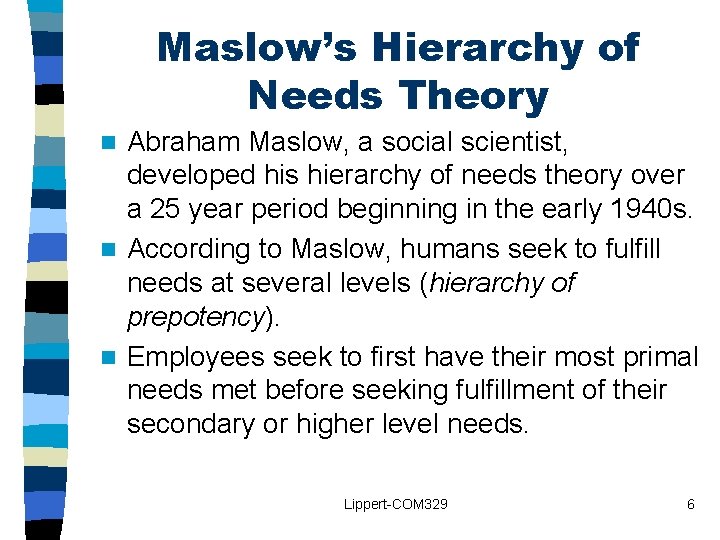
Maslow’s Hierarchy of Needs Theory Abraham Maslow, a social scientist, developed his hierarchy of needs theory over a 25 year period beginning in the early 1940 s. n According to Maslow, humans seek to fulfill needs at several levels (hierarchy of prepotency). n Employees seek to first have their most primal needs met before seeking fulfillment of their secondary or higher level needs. n Lippert-COM 329 6
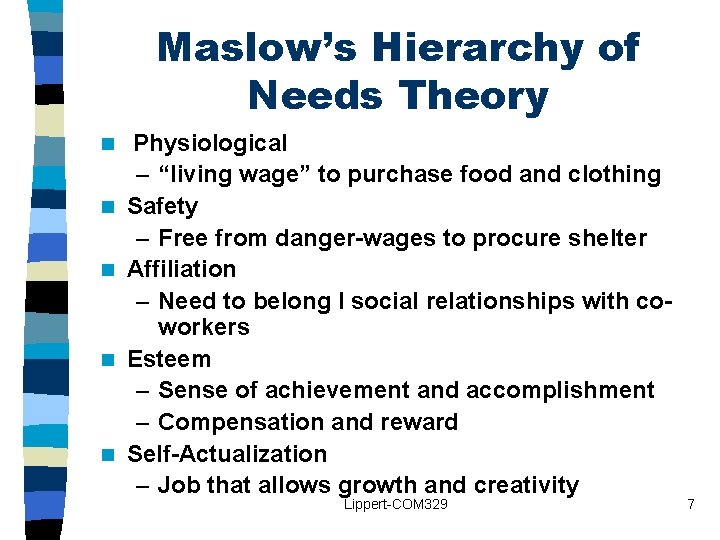
Maslow’s Hierarchy of Needs Theory n n n Physiological – “living wage” to purchase food and clothing Safety – Free from danger-wages to procure shelter Affiliation – Need to belong I social relationships with coworkers Esteem – Sense of achievement and accomplishment – Compensation and reward Self-Actualization – Job that allows growth and creativity Lippert-COM 329 7
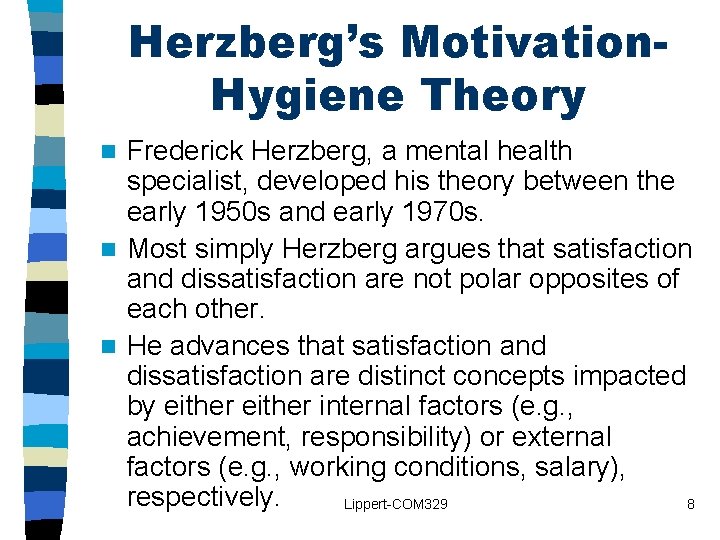
Herzberg’s Motivation. Hygiene Theory Frederick Herzberg, a mental health specialist, developed his theory between the early 1950 s and early 1970 s. n Most simply Herzberg argues that satisfaction and dissatisfaction are not polar opposites of each other. n He advances that satisfaction and dissatisfaction are distinct concepts impacted by either internal factors (e. g. , achievement, responsibility) or external factors (e. g. , working conditions, salary), respectively. Lippert-COM 329 8 n
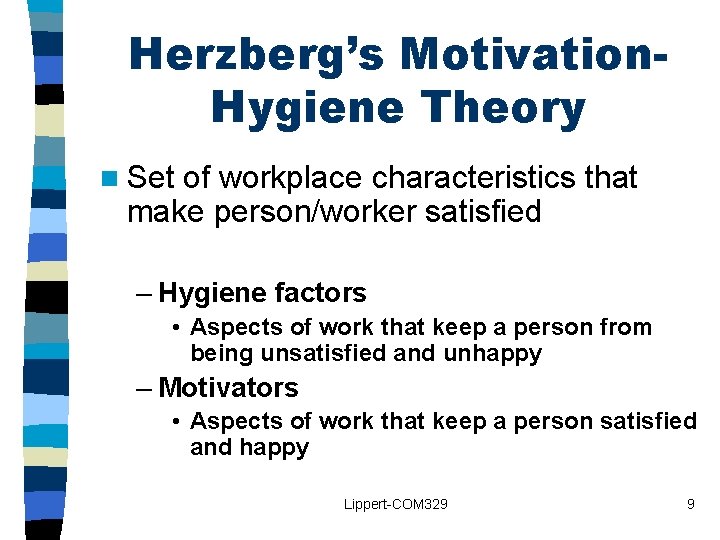
Herzberg’s Motivation. Hygiene Theory n Set of workplace characteristics that make person/worker satisfied – Hygiene factors • Aspects of work that keep a person from being unsatisfied and unhappy – Motivators • Aspects of work that keep a person satisfied and happy Lippert-COM 329 9
Mc. Gregor’s Theory X and Theory Y Douglas Mc. Gregor, a professor at MIT, developed these theories to explain two divergent schools of managerial thought. n Theory X has three propositions: a. Management has the greatest organizational responsibility. b. Management must control and motivate employees by modifying employee behavior. c. Employees are passive entities that must be controlled. n Lippert-COM 329 10
Theory X then advances the following postulates: § § § The average human is lazy. The average human lacks ambition. The average human is self-centered. The average human resists change. The average human is not bright. Lippert-COM 329 11
In contrast, Theory Y advances the following five assumptions § Humans desire to exert physical and mental effort. § External control is not the only way to direct employees. § Commitment to a goal is based on rewards for achievement. § Most everyone can be creative. § Most employee potential is only minimally tapped. Lippert-COM 329 12
Human Relations Approach n Need for attention n Social interaction n Individual achievement n Intended as a move away from the “organization as machine” metaphor n Management recognizes employees as humans with needs rather than cogs of a machine Lippert-COM 329 13
Communication Implications n Content-task related but includes maintenance n Direction-vertical but horizontal is encouraged n Channel-emphasizes variety n Style-informal, less informal Lippert-COM 329 14
Summary n Hawthorne effect- social factors influence productivity. n Maslow’s theory- 5 levels, lower needs must be met before higher needs. n Herzberg’s theory- hygiene factors & motivators. n Mc. Gregor’s theory of X & Y n Human Relations approach- employees are valued. Lippert-COM 329 15
Case Study: Motivation at Healthtime Fitness Club If you were Jenny, what would you say to Matt? n What Factors have led to his difficulty in motivating his employees? n How would human relations theorists analyze Matt’s problem (needs, m/h factors, assumptions)? n What communication strategy would you recommend to Matt to deal with the situation? n Lippert-COM 329 16