How fast do you think DNA Polymerase can




- Slides: 24
How fast do you think DNA Polymerase can add nitrogen bases (A, T, G, or C) during DNA Replication (in base pairs per minute)? DNA Polymerase can replicate DNA at a rate of 50, 000 base pairs per minute! That’s pretty fast – do you think it ever makes mistakes?
Mutations
Mutations • Changes in the genetic code • They come from mistakes that cells have made in copying their own DNA. – If a cell has a mutation, all of its daughter cells will inherit the same mutation!
How many cells have the mutation? A. B. C. D. 1 6 7 8 7!
Types of Mutations • Gene Mutation: produces a change in a single gene • Chromosomal Mutations: produce changes in whole chromosomes & affect many genes – Can change the locations of genes on chromosomes!
Gene Mutations • Point Mutation: involve changes in 1 or a few nucleotides at 1 point in the DNA sequence – Substitutions – Frameshift Mutations
THE DOG BIT THE CAT Point Mutation THE DOG BIT THE CAR
Point Mutations – Substitutions • 1 base is changed into another – Usually affect only 1 amino acid
Point Mutations – Substitutions
Point Mutations – Frameshift Mutations • Insertions or Deletions: an extra base is added or removed – These usually affect a large part of the protein! Remember! Bases are read in groups of 3, but if 1 base is added or removed, this shifts the “reading frame” of the genetic code & can change all amino acids after the site of the mutation!
Deletion The original: THE DOG BIT THE CAT Deletion: THE DOG BIT HEC AT
Insertion The original: THE DOG BIT THE CAT Insertion: THE DOE GBI TTH ECA T
Point Mutations – Frameshift Mutations
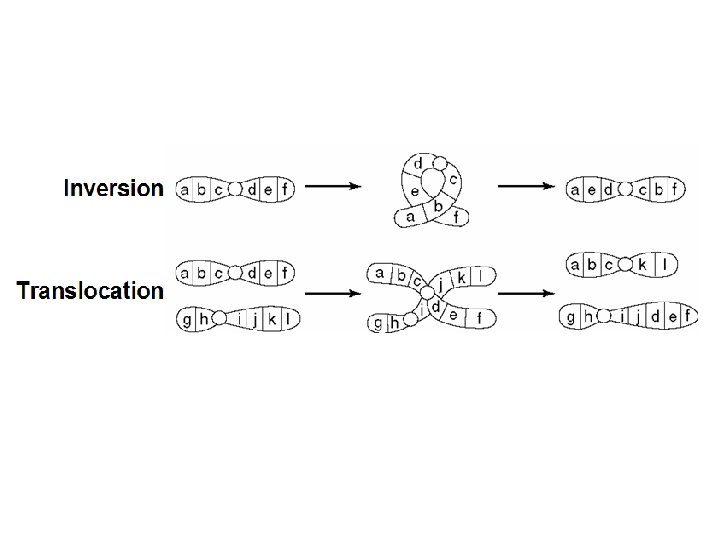
Chromosomal Mutations - Inversion • Reverses the direction of parts of the chromosomes
Chromosomal Mutations - Translocation • Part of 1 chromosome breaks off & attaches to another
Chromosomal Mutations – Deletions & Duplications • Deletion: part of the chromosome is lost • Duplication: there is an extra copy of part of the chromosome
What type of chromosome mutation does Brenden have? A. B. C. D. Inversion Translocation Deletion Duplication Inversion!
Effects of Mutations • An amino acid may or may not change! – For example, the codons GCC & GCA both code for the same amino acid, alanine! – However, mutating AGC to AGA will change the amino acid from serine to arginine!
All mutations are harmful. A. True B. False!
Effects of Mutations • Any new trait in a population, good or bad, is a result of a mutation! • Neutral: no effect on protein function • Harmful: cause genetic diseases • Beneficial: gives the organism a better chance of survival
Examples • Neutral: Blue eyes was caused by a mutation that first appeared 6 -10 thousand years ago! • Harmful: An albino person has a frameshift mutation in melanin producing genes. Albinism makes organisms more susceptible to skin cancer. • Beneficial: Mutations in the CCR 5 gene in humans makes them almost immune to HIV!
Which type of mutations are more likely to be harmful? A. B. C. D. E. Substitutions Insertions Deletions A&C B&C Insertions & Deletions! These mutations will always cause a frameshift mutation, which will change the reading frame & the amino acid sequence! This will give you a completely different protein! Substitutions could change the amino acid sequence, but it may not.
Exit Ticket – Before you leave, answer the following question on a sheet of paper (share!): The majority of plants & animals are able to make their own Vitamin C. Some animals, including humans, guinea pigs, & some birds, have lost their ability to make Vitamin C due to a mutation. Would you consider this mutation to be harmful, neutral, or beneficial? Why?