hoto Street in Jaipur u Photo via Getty

- Slides: 7
hoto: Street in Jaipur. u. Photo via Getty Images Ensuring a Post. COVID Economic Agenda Tackles Global Biodiversity Loss Dr. Pamela Mc. Elwee Rutgers University Material for presentation from: P. Mc. Elwee, E. Turnout, M. Chiroleu-Assouline, J. Clapp, C. Isenhour, T. Jackson, E. Kelemen, D. Miller, G. Rusch, J. Spangenberg, A. Waldron, R. Baumgartner, B. Bleys, M. Howard, E. Mungatana, H. Ngo, I. Ring, R. dos Santos. 2020. One Earth 3: 448 -461.
Key ideas • Finance and economics ministries have a number of tools for COVID recovery that would at a minimum ‘do no harm’ to biodiversity, and at best, could build a green recovery and tackle drivers of nature loss • Given existing size of COVID packages in the trillions of US dollars, this represents an important opportunity to align with post-2020 global biodiversity framework • Yet we don’t yet see much emphasis on biodiversity and nature in recovery plans (slightly better for climate change)
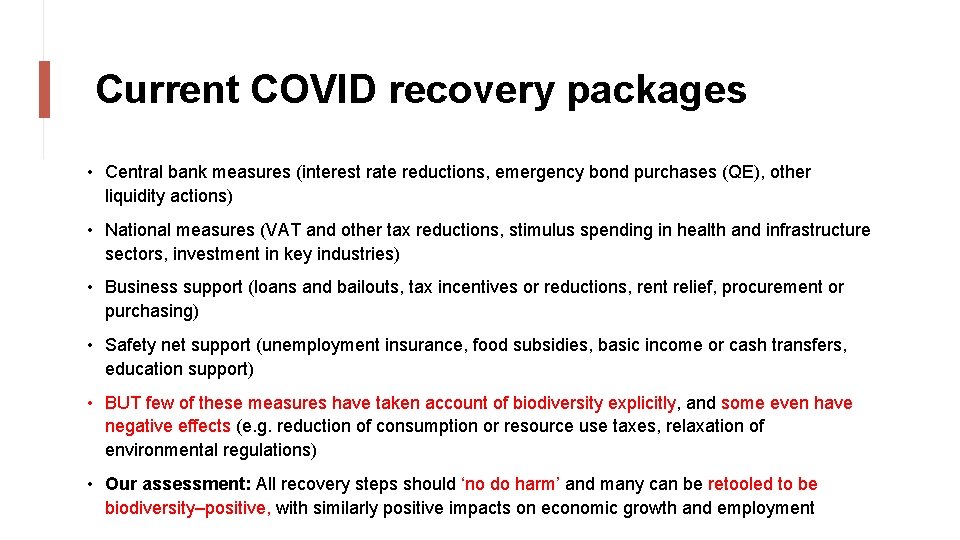
Current COVID recovery packages • Central bank measures (interest rate reductions, emergency bond purchases (QE), other liquidity actions) • National measures (VAT and other tax reductions, stimulus spending in health and infrastructure sectors, investment in key industries) • Business support (loans and bailouts, tax incentives or reductions, rent relief, procurement or purchasing) • Safety net support (unemployment insurance, food subsidies, basic income or cash transfers, education support) • BUT few of these measures have taken account of biodiversity explicitly, and some even have negative effects (e. g. reduction of consumption or resource use taxes, relaxation of environmental regulations) • Our assessment: All recovery steps should ‘no do harm’ and many can be retooled to be biodiversity–positive, with similarly positive impacts on economic growth and employment
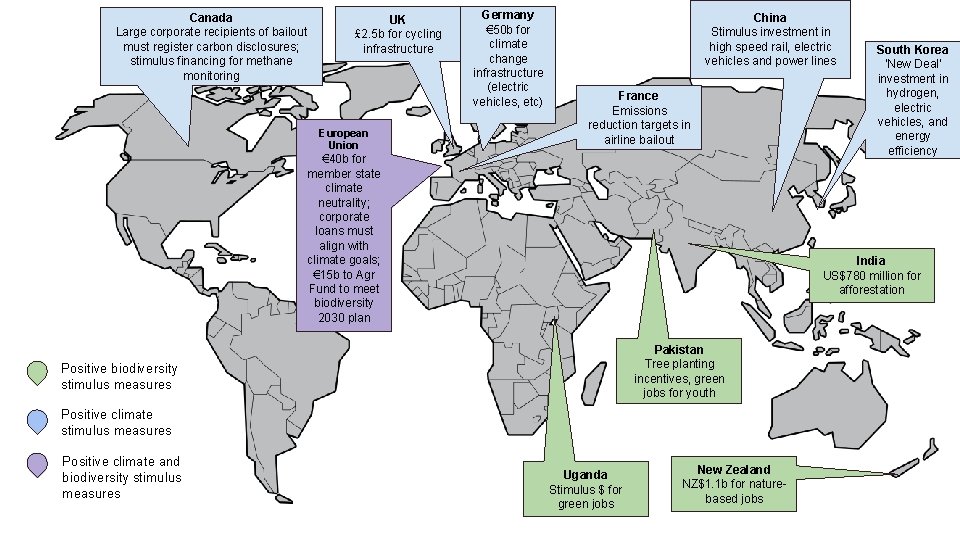
Canada Large corporate recipients of bailout must register carbon disclosures; stimulus financing for methane monitoring UK £ 2. 5 b for cycling infrastructure European Union Germany € 50 b for climate change infrastructure (electric vehicles, etc) China Stimulus investment in high speed rail, electric vehicles and power lines France Emissions reduction targets in airline bailout € 40 b for member state climate neutrality; corporate loans must align with climate goals; € 15 b to Agr Fund to meet biodiversity 2030 plan India US$780 million for afforestation Pakistan Tree planting incentives, green jobs for youth Positive biodiversity stimulus measures Positive climate and biodiversity stimulus measures South Korea ‘New Deal’ investment in hydrogen, electric vehicles, and energy efficiency Uganda Stimulus $ for green jobs New Zealand NZ$1. 1 b for naturebased jobs
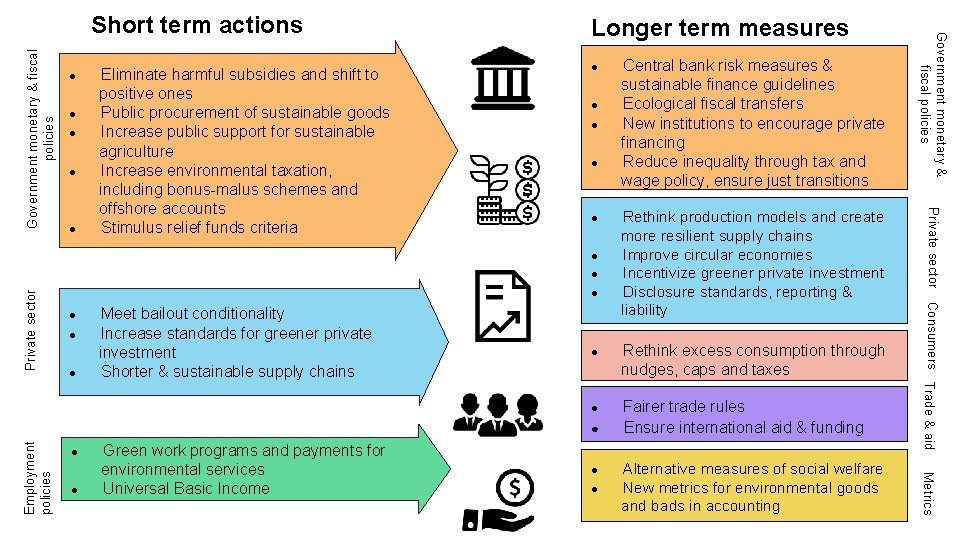
● ● Eliminate harmful subsidies and shift to positive ones Public procurement of sustainable goods Increase public support for sustainable agriculture Increase environmental taxation, including bonus-malus schemes and offshore accounts Stimulus relief funds criteria ● ● ● Private sector ● ● ● Meet bailout conditionality Increase standards for greener private investment Shorter & sustainable supply chains Rethink excess consumption through nudges, caps and taxes ● Fairer trade rules Ensure international aid & funding Employment policies ● ● Alternative measures of social welfare New metrics for environmental goods and bads in accounting Metrics ● Green work programs and payments for environmental services Universal Basic Income Rethink production models and create more resilient supply chains Improve circular economies Incentivize greener private investment Disclosure standards, reporting & liability ● ● ● Central bank risk measures & sustainable finance guidelines Ecological fiscal transfers New institutions to encourage private financing Reduce inequality through tax and wage policy, ensure just transitions Private sector Consumers Trade & aid Government monetary & fiscal policies ● Longer term measures Government monetary & fiscal policies Short term actions
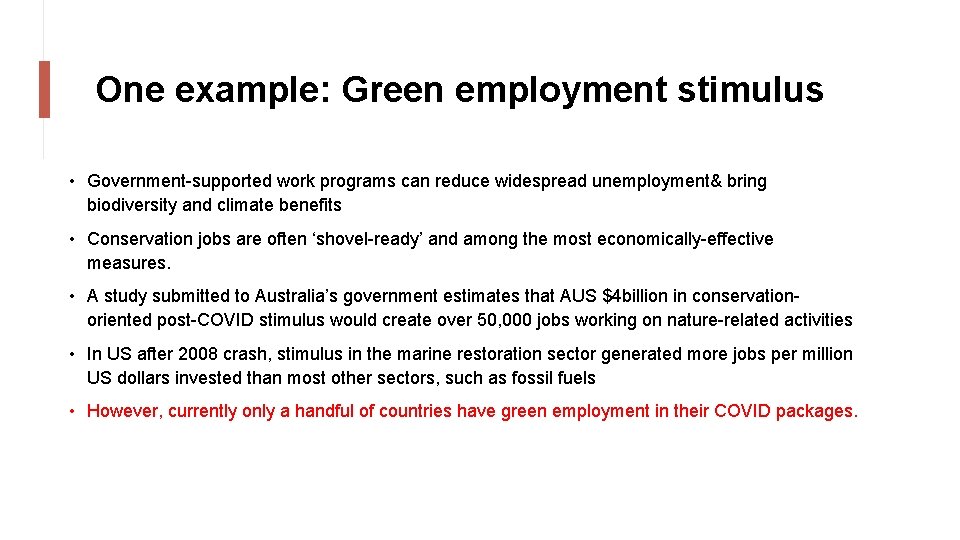
One example: Green employment stimulus • Government-supported work programs can reduce widespread unemployment& bring biodiversity and climate benefits • Conservation jobs are often ‘shovel-ready’ and among the most economically-effective measures. • A study submitted to Australia’s government estimates that AUS $4 billion in conservationoriented post-COVID stimulus would create over 50, 000 jobs working on nature-related activities • In US after 2008 crash, stimulus in the marine restoration sector generated more jobs per million US dollars invested than most other sectors, such as fossil fuels • However, currently only a handful of countries have green employment in their COVID packages.
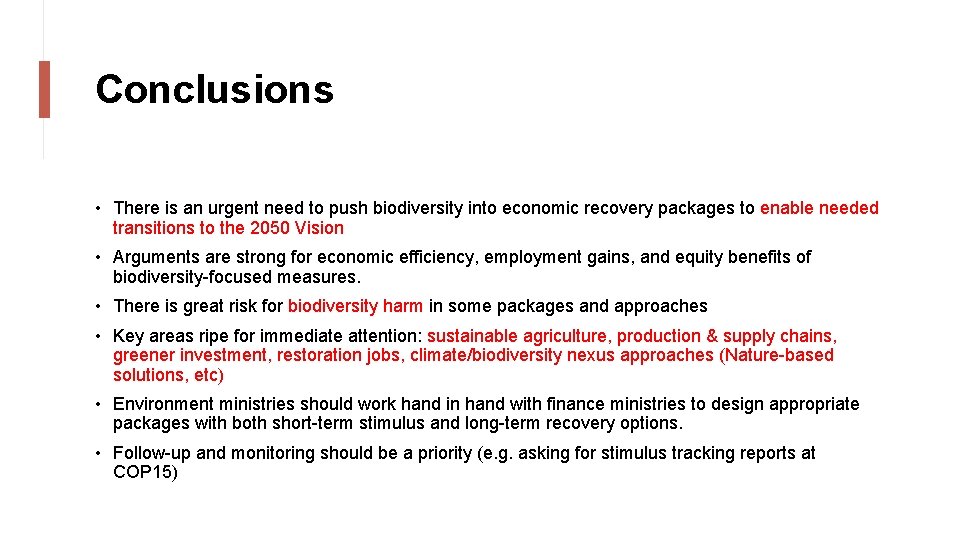
Conclusions • There is an urgent need to push biodiversity into economic recovery packages to enable needed transitions to the 2050 Vision • Arguments are strong for economic efficiency, employment gains, and equity benefits of biodiversity-focused measures. • There is great risk for biodiversity harm in some packages and approaches • Key areas ripe for immediate attention: sustainable agriculture, production & supply chains, greener investment, restoration jobs, climate/biodiversity nexus approaches (Nature-based solutions, etc) • Environment ministries should work hand in hand with finance ministries to design appropriate packages with both short-term stimulus and long-term recovery options. • Follow-up and monitoring should be a priority (e. g. asking for stimulus tracking reports at COP 15)