Homework Your Worldview What is your ontology and
- Slides: 14
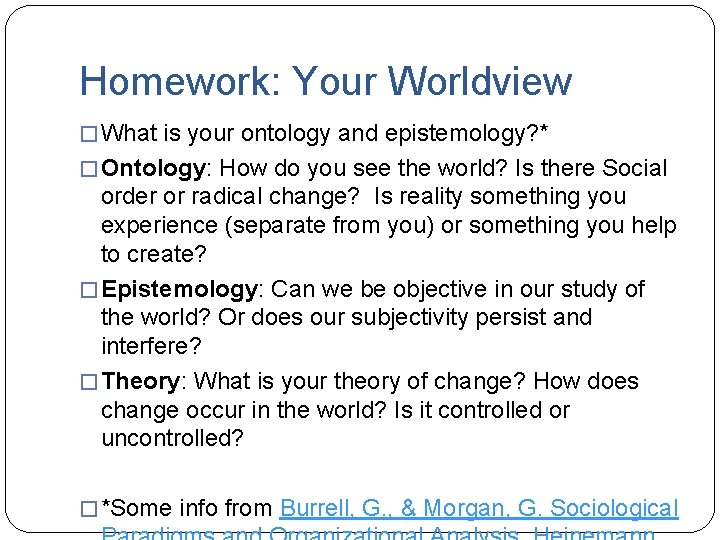
Homework: Your Worldview � What is your ontology and epistemology? * � Ontology: How do you see the world? Is there Social order or radical change? Is reality something you experience (separate from you) or something you help to create? � Epistemology: Can we be objective in our study of the world? Or does our subjectivity persist and interfere? � Theory: What is your theory of change? How does change occur in the world? Is it controlled or uncontrolled? � *Some info from Burrell, G. , & Morgan, G. Sociological
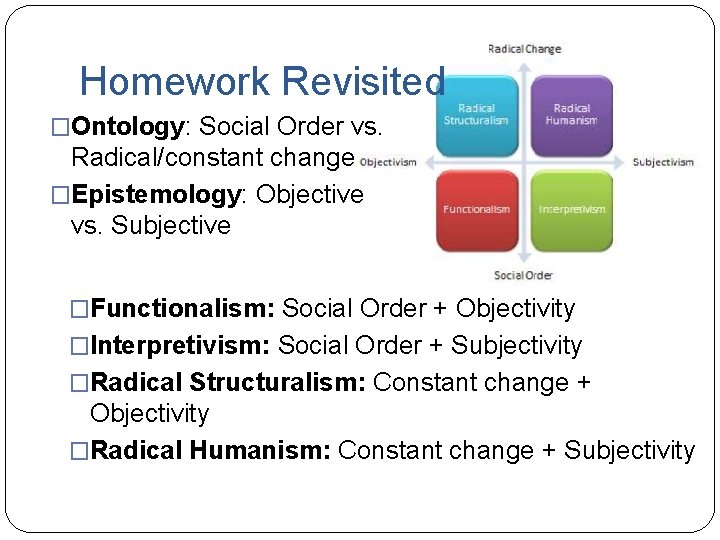
Homework Revisited �Ontology: Social Order vs. Radical/constant change �Epistemology: Objective vs. Subjective �Functionalism: Social Order + Objectivity �Interpretivism: Social Order + Subjectivity �Radical Structuralism: Constant change + Objectivity �Radical Humanism: Constant change + Subjectivity
The Research Process & Types of Research Fall 2015 Research Methods Class 3
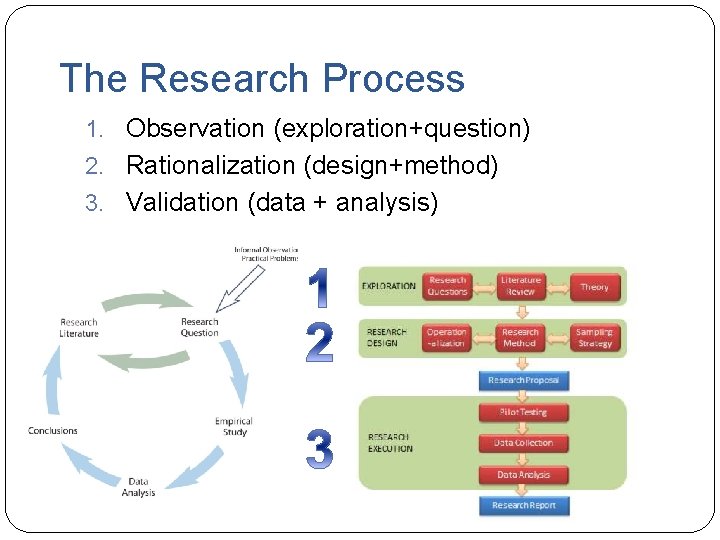
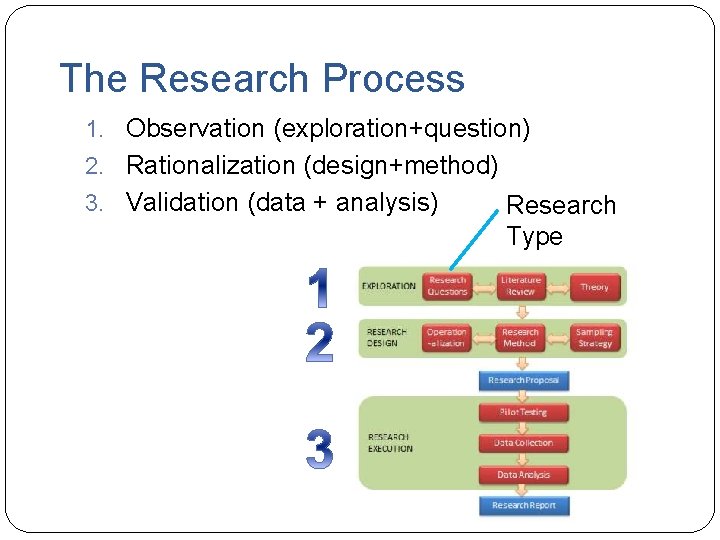
The Research Process 1. Observation (exploration+question) 2. Rationalization (design+method) 3. Validation (data + analysis)
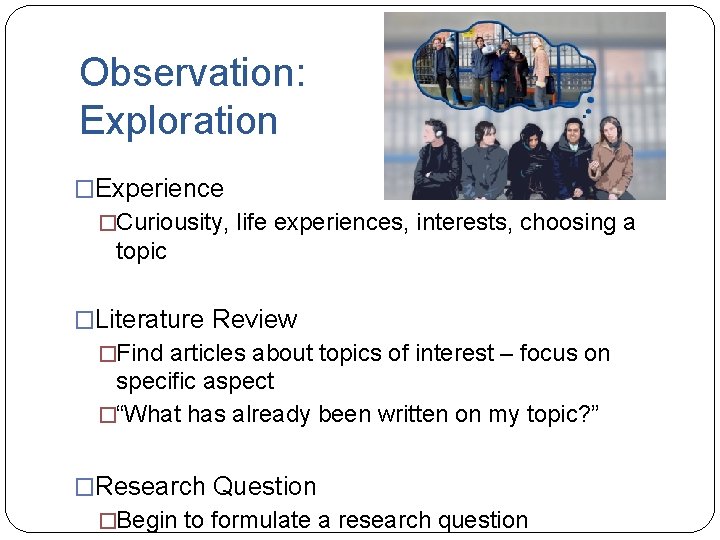
Observation: Exploration �Experience �Curiousity, life experiences, interests, choosing a topic �Literature Review �Find articles about topics of interest – focus on specific aspect �“What has already been written on my topic? ” �Research Question �Begin to formulate a research question
Rationalization: Research Design � Define concepts/variables: operationalization �What concepts are part of my topic? �How do I define these concepts so they can be measured? � Research Question �Refine question with operational definitions � Choose a method + sample �How do you collect data? Who are you asking? �Methods: Surveys, interviews, focus groups, ethnography, case study, participatory action research, secondary data analysis, (experiments) � Research Proposal* �Now you know what you want to do, write it up, get approved ($)
Validation: Data & Analysis �Collect data �Quantitative or Qualitative? Mixed Methods? �Data Analysis �Depends on types of data collected �Research Report* �Conclusion and findings
The Research Process 1. Observation (exploration+question) 2. Rationalization (design+method) 3. Validation (data + analysis) Research Type
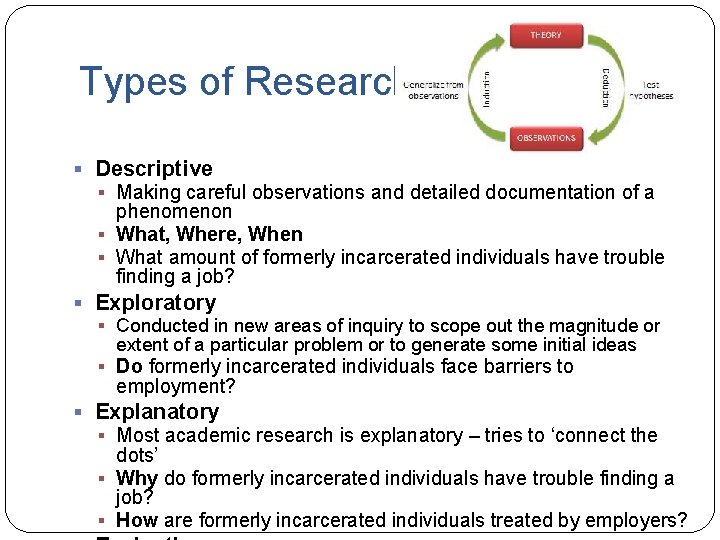
Types of Research § Descriptive § Making careful observations and detailed documentation of a phenomenon § What, Where, When § What amount of formerly incarcerated individuals have trouble finding a job? § Exploratory § Conducted in new areas of inquiry to scope out the magnitude or extent of a particular problem or to generate some initial ideas § Do formerly incarcerated individuals face barriers to employment? § Explanatory § Most academic research is explanatory – tries to ‘connect the dots’ § Why do formerly incarcerated individuals have trouble finding a job? § How are formerly incarcerated individuals treated by employers?
Discuss 1. Criminal justice system: Sentencing, plea 2. 3. 4. 5. 6. 7. 8. bargaining Prison: Reform, Recidivism, Mass incarceration, overcrowding Economic inequality NYPD/Law Enforcement: Hiring process, Racial bias Drugs: Abuse, Legalization, Decriminalization Immigration/Human trafficking Gentrification Social/Political Movements
1. Criminal justice system 1. Prison 2. Economic inequality 3. NYPD/Law Enforcement
1. Drugs 2. Immigration/Human trafficking 3. Gentrification 4. Social/Political Movements
Reading… � Chapter 2: Thinking Like a Researcher (p. 9 -15) �In Social Science Research- Principles Methods and Practices � Sections 2. 1 -2. 2: Basic Concepts & Generating Good Research Questions (p. 23 -38) �In Research Methods in Psychology � Pay attention to: �Unit of Analysis �Concept �Variable �Independent vs. dependent variable �Operational definition �Correlation vs. Causation
Dialectics of Social Research • There are many ways and methods to conduct social research • Idiographic and Nomothetic Explanation • How do we explain a situation, group of people? • Inductive and Deductive Theory • What is your reasoning method? • Quantitative and Qualitative Data • What type of data are you collecting? • Pure and Applied Research • What is the type and purpose of the research you are conducting?