HLA OMT Fundamentals Alessandro Specchia Carnegie Mellon University
- Slides: 16
HLA OMT Fundamentals Alessandro Specchia Carnegie Mellon University
What is it ? HLA Object Model Template (OMT) a common format and syntax for recording the information in HLA Object Models
OMT Objective Facilitate interoperability among simulations and reuse of simulation components. How ? • By providing a commonly understood mechanism for FOM development coordination • By providing a common, standardized means of describing potential federation members • By facilitating the design and application of common tool sets for development of HLA object models
FOM • Federation Object Model (FOM) specification of the exchange of public data among the participants in HLA federation The intent is to describe inter-federate exchange within the system.
SOM • Simulation Object Model (SOM) - a specification the capabilities offered to federations by individual simulations. The intent is to describe the public interface of the federate in terms of an identified set of supported objects and interactions.
OMT Components I There are seven components : • Object model identification: to associate important identifying information with the HLA object model. • Object class structure table: to record the namespace of all simulation/federation object classes and to describe their class-subclass relationship. • Interaction class structure table: to record the namespace of all simulation/federation interaction classes and to describe their class-subclass relationship.
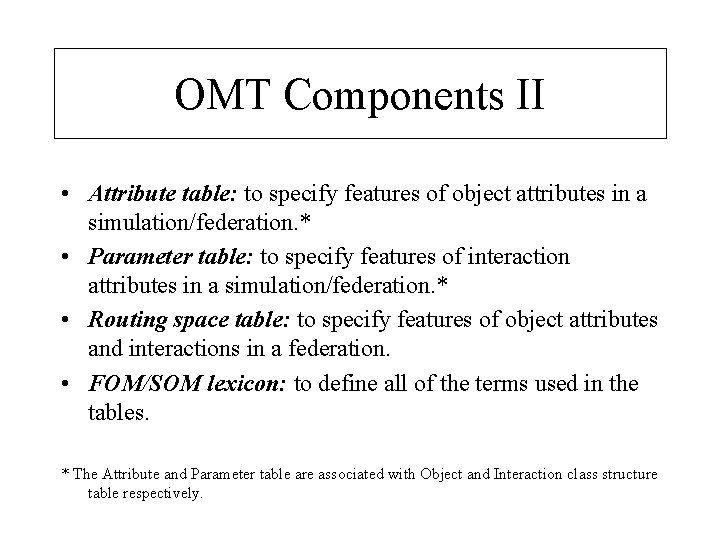
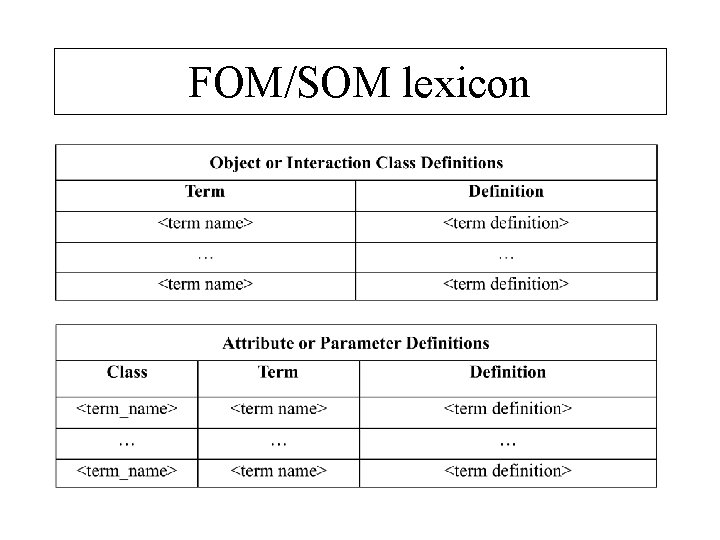
OMT Components II • Attribute table: to specify features of object attributes in a simulation/federation. * • Parameter table: to specify features of interaction attributes in a simulation/federation. * • Routing space table: to specify features of object attributes and interactions in a federation. • FOM/SOM lexicon: to define all of the terms used in the tables. * The Attribute and Parameter table are associated with Object and Interaction class structure table respectively.
Warning In some cases, certain tables may be empty. However all HLA object models shall contain at least one object class or interaction class. Examples : • Some federates might not be involved in interaction (such a Wright. Flyer viewer) => no interaction class structure (=> no parameter table) • For SOMs, the routing space is always empty. • If there is no Data Distribution Management (DDM), the routing space is also empty for FOMs.
Object model identification table
Object class structure table
Interaction class structure table
Attribute table
Parameter table
Routing space table
FOM/SOM lexicon
More Tables. . . There are more tables to included in the OMT for specifying users types: • Enumerated datatype table • Complex datatype table