History Test with solutions Class 8 th Civilizing

- Slides: 8
History Test (with solutions) Class 8 th: Civilizing the Native Educating the Nation; Women, Caste and Reform
1. Why did Mahatma Gandhi think that English education has enslaved Indians? Mahatma Gandhi thought so because of the following reasons: i. Mahatma Gandhi argued that english education created a sense of inferiority in the minds of Indians. It made them see Western civilization as superior, and destroyed the pride they had in their own culture. ii. There was poison in this education, said Mahatma Gandhi, it was sinful, it enslaved. Indians, it cast an evil spell on them. iii. Mahatma Gandhi wanted an education that could help Indians recover their sense of dignity and self – respect. iv. During the national movement he urged students to leave educational institutions in order to show the British that Indians are no longer willing to be enslaved. v. He felt that by speaking a foreign tongue and neglecting local culture, the English education could not relate to the masses. vi. Western education, Mahatma Gandhi said, focused on reading and writing rather than oral knowledge; it valued textbooks rather than lived experience and practical knowledge. vii. He argued that education ought to develop a person’s mind and soul.
2. Why did James Mill and Thomas Macaulay think that European education was essential in India? i. James Mill and Thomas Macaulay thought that European education would help Indians in the expansion of trade and commerce with European countries and make them recognize the importance of available resources of the country. ii. They felt that it would change their tastes and desires and create a demand for British goods for better trade prospects. iii. It would also improve the moral character of Indians and make them truthful and honest. Thus supply the company with civil servants who could be trusted and demanded upon. It could also instill in people a sense of duty and commitment to work and develop the skills required for administration. iv. It would make Indians aware of the developments in Western Science and philosophy.
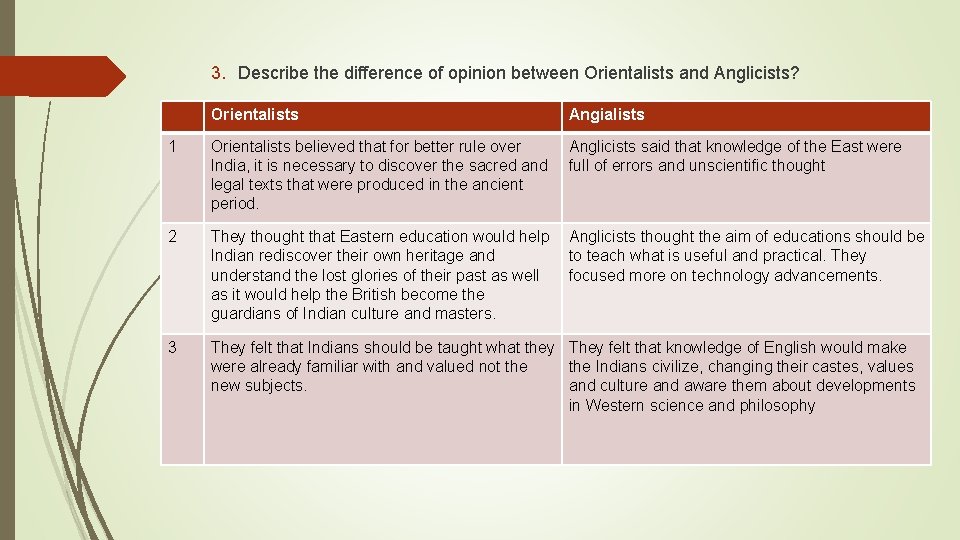
3. Describe the difference of opinion between Orientalists and Anglicists? Orientalists Angialists 1 Orientalists believed that for better rule over India, it is necessary to discover the sacred and legal texts that were produced in the ancient period. Anglicists said that knowledge of the East were full of errors and unscientific thought 2 They thought that Eastern education would help Indian rediscover their own heritage and understand the lost glories of their past as well as it would help the British become the guardians of Indian culture and masters. Anglicists thought the aim of educations should be to teach what is useful and practical. They focused more on technology advancements. 3 They felt that Indians should be taught what they They felt that knowledge of English would make were already familiar with and valued not the Indians civilize, changing their castes, values new subjects. and culture and aware them about developments in Western science and philosophy
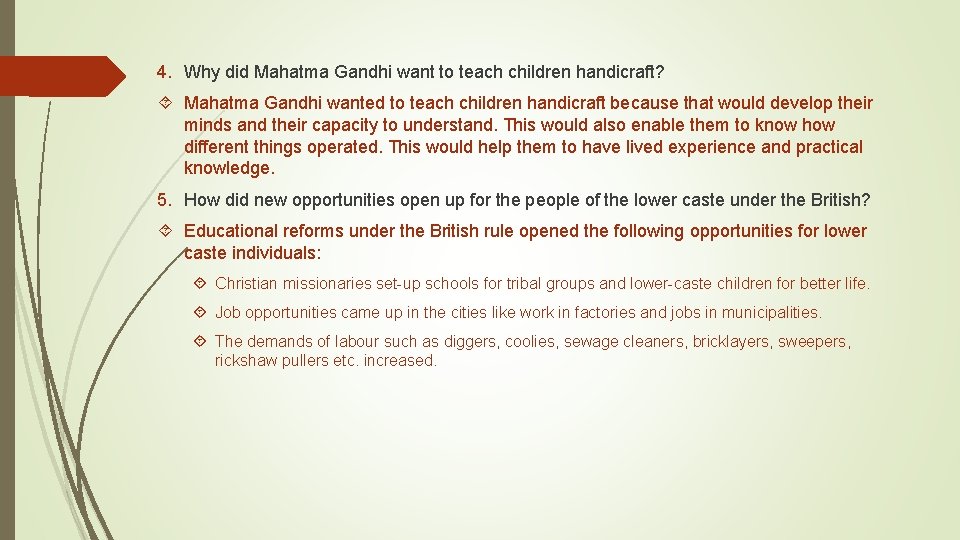
4. Why did Mahatma Gandhi want to teach children handicraft? Mahatma Gandhi wanted to teach children handicraft because that would develop their minds and their capacity to understand. This would also enable them to know how different things operated. This would help them to have lived experience and practical knowledge. 5. How did new opportunities open up for the people of the lower caste under the British? Educational reforms under the British rule opened the following opportunities for lower caste individuals: Christian missionaries set-up schools for tribal groups and lower-caste children for better life. Job opportunities came up in the cities like work in factories and jobs in municipalities. The demands of labour such as diggers, coolies, sewage cleaners, bricklayers, sweepers, rickshaw pullers etc. increased.
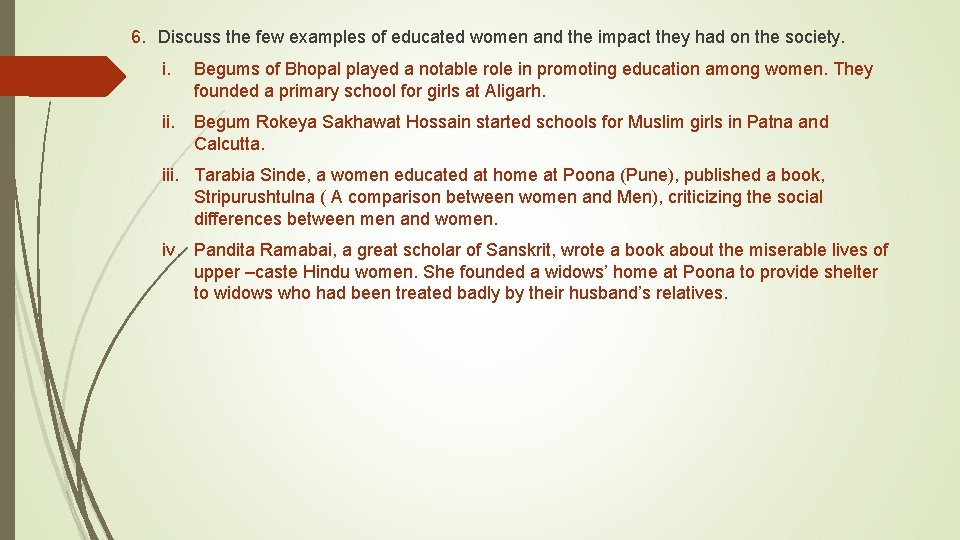
6. Discuss the few examples of educated women and the impact they had on the society. i. Begums of Bhopal played a notable role in promoting education among women. They founded a primary school for girls at Aligarh. ii. Begum Rokeya Sakhawat Hossain started schools for Muslim girls in Patna and Calcutta. iii. Tarabia Sinde, a women educated at home at Poona (Pune), published a book, Stripurushtulna ( A comparison between women and Men), criticizing the social differences between men and women. iv. Pandita Ramabai, a great scholar of Sanskrit, wrote a book about the miserable lives of upper –caste Hindu women. She founded a widows’ home at Poona to provide shelter to widows who had been treated badly by their husband’s relatives.
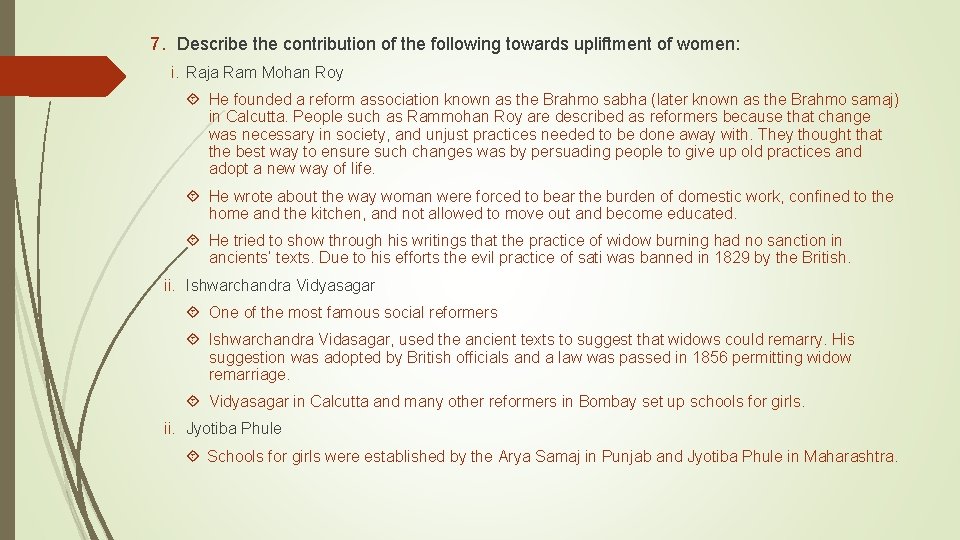
7. Describe the contribution of the following towards upliftment of women: i. Raja Ram Mohan Roy He founded a reform association known as the Brahmo sabha (later known as the Brahmo samaj) in Calcutta. People such as Rammohan Roy are described as reformers because that change was necessary in society, and unjust practices needed to be done away with. They thought that the best way to ensure such changes was by persuading people to give up old practices and adopt a new way of life. He wrote about the way woman were forced to bear the burden of domestic work, confined to the home and the kitchen, and not allowed to move out and become educated. He tried to show through his writings that the practice of widow burning had no sanction in ancients’ texts. Due to his efforts the evil practice of sati was banned in 1829 by the British. ii. Ishwarchandra Vidyasagar One of the most famous social reformers Ishwarchandra Vidasagar, used the ancient texts to suggest that widows could remarry. His suggestion was adopted by British officials and a law was passed in 1856 permitting widow remarriage. Vidyasagar in Calcutta and many other reformers in Bombay set up schools for girls. ii. Jyotiba Phule Schools for girls were established by the Arya Samaj in Punjab and Jyotiba Phule in Maharashtra.
8. Explain in brief the social conditions in earlier times i. Brahmans and Kshatriyas considered themselves as “upper castes”. ii. Other such as traders and moneylenders (often referred to as Vaishyas) were placed after them. iii. Then came peasants and artisans such as weavers and potters (referred to as shudras). iv. At the lowest sung were those who laboured to keep cities and villages clean or worked at jobs that upper castes considered “polluting”, that is it could lead to the loss of caste status. v. The upper castes also treated many of these groups at the bottom as “untouchable”.