GRE 5220 Greek Exegesis Acts 19 11 41
![Greek Exegesis of Acts – Notes K]](https://slidetodoc.com/presentation_image/19353e04e289dd546a5c1b2ef51d0a32/image-3.jpg "Greek Exegesis of Acts – Notes K]")
- Slides: 25
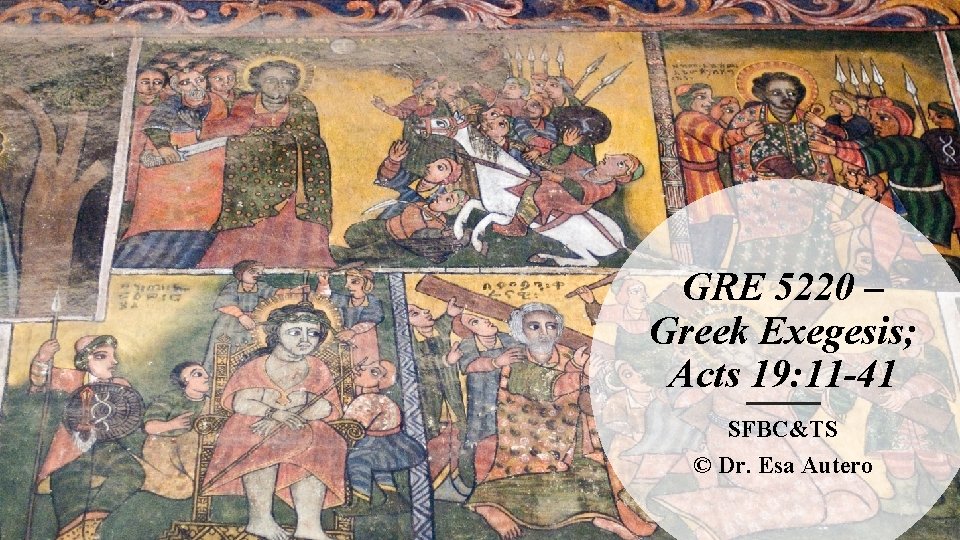
GRE 5220 – Greek Exegesis; Acts 19: 11 -41 SFBC&TS © Dr. Esa Autero
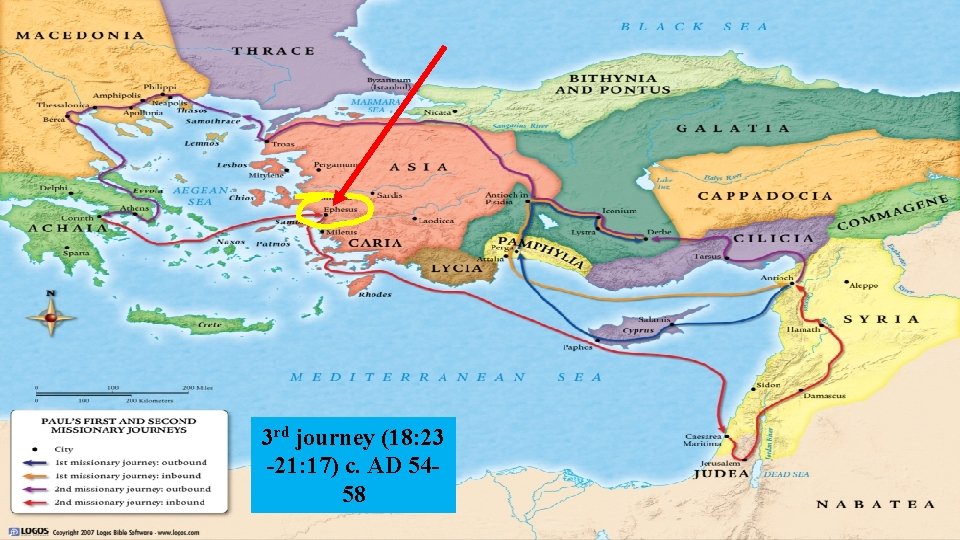
Greek Exegesis of Acts – Notes 1. Exegesis and Commentary on 19: 11 -41 1. 1 Context and Structure of 19: 11 -41 • Context – from Athens to Ephesus (18: 1 -19: 11) • Arrival in Corinth+ 1. 5 yrs. – AD 51/52* (18: 1 -11) to Ephesus (18: 19) • Arrival in Antioch (home base) via Caesarea (18: 22) • Third mission journey “after some time” – no specific motivation given Paul two years • “through Galatian regions and Phrygia” to Ephesus (18: 23; 19: 1) in Ephesus • Paul finds 12 disciples “Did you receive the HS when you believed? ” (19: 1 -6) • Paul in synagogue – then “reasoning daily in the school of Tyrannus” (19: 8 -10)miracles Extraordinary + riot Paul ousted “All who lived in Asia heard the word of the Lord” (19: 10) from the area – was Paul ever able to return?
Greek Exegesis of Acts – Notes K]
Greek Exegesis of Acts – Notes 1. 3 Brief Commentary – Acts 10: 32 -48* • Peter summarizes Jesus’ earthly ministry & forgiveness of sins for those who believe – Spirit as the evidence God’s acceptance • • • Galilee – John’s baptism – anointing of Jesus (baptism + 4: 18) Doing good, healing, deliverance from demons Jerusalem – put to death and hang on the cross Resurrection and appearances to chosen witnesses – commissioning Ascension and role as the Judge of the world – prophetic witness Forgiveness to everyone who believes journey (18: 23 • Peter discovers 3 ardnew revelation – “God shows no partiality” -21: 17) c. AD 54 - by Jesus to marginalized • OT dictum (Deut 10: 17) – applied 58 Now extended to gentiles
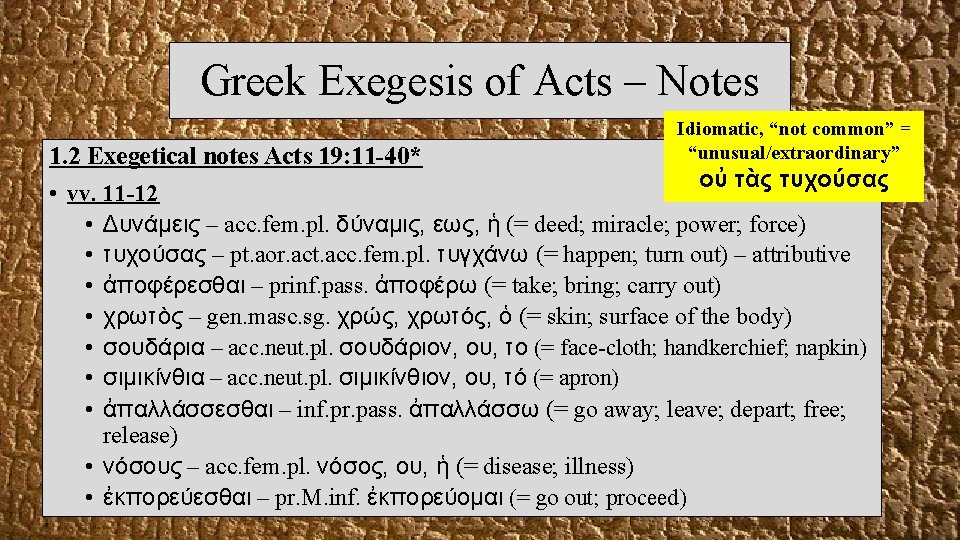
Greek Exegesis of Acts – Notes Idiomatic, “not common” = “unusual/extraordinary” 1. 2 Exegetical notes Acts 19: 11 -40* οὐ τὰς τυχούσας • vv. 11 -12 • Δυνάμεις – acc. fem. pl. δύναμις, εως, ἡ (= deed; miracle; power; force) • τυχούσας – pt. aor. act. acc. fem. pl. τυγχάνω (= happen; turn out) – attributive • ἀποφέρεσθαι – prinf. pass. ἀποφέρω (= take; bring; carry out) • χρωτὸς – gen. masc. sg. χρώς, χρωτός, ὁ (= skin; surface of the body) • σουδάρια – acc. neut. pl. σουδάριον, ου, το (= face-cloth; handkerchief; napkin) • σιμικίνθια – acc. neut. pl. σιμικίνθιον, ου, τό (= apron) • ἀπαλλάσσεσθαι – inf. pr. pass. ἀπαλλάσσω (= go away; leave; depart; free; release) • νόσους – acc. fem. pl. νόσος, ου, ἡ (= disease; illness) • ἐκπορεύεσθαι – pr. M. inf. ἐκπορεύομαι (= go out; proceed)
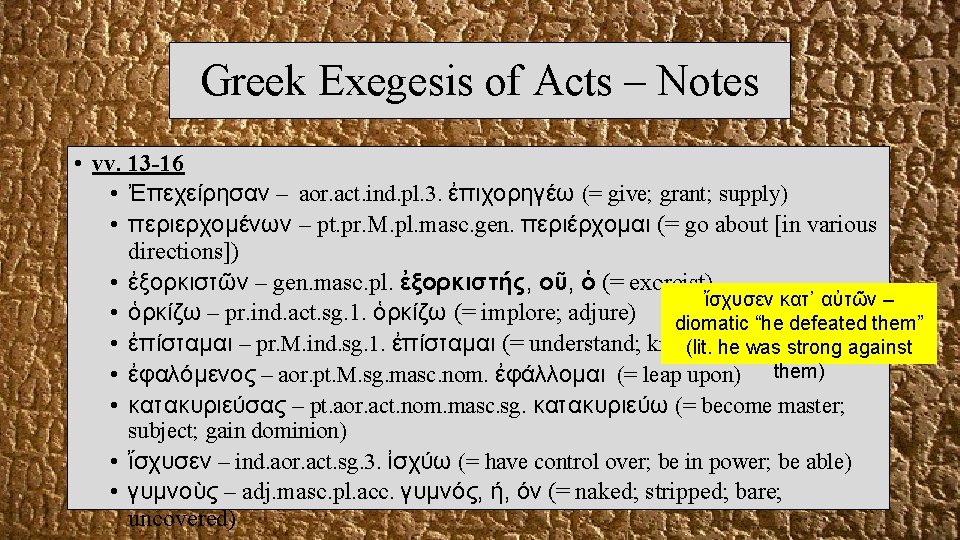
Greek Exegesis of Acts – Notes • vv. 13 -16 • Ἐπεχείρησαν – aor. act. ind. pl. 3. ἐπιχορηγέω (= give; grant; supply) • περιερχομένων – pt. pr. M. pl. masc. gen. περιέρχομαι (= go about [in various directions]) • ἐξορκιστῶν – gen. masc. pl. ἐξορκιστής, οῦ, ὁ (= exorcist) ἴσχυσεν κατ᾽ αὐτῶν – • ὁρκίζω – pr. ind. act. sg. 1. ὁρκίζω (= implore; adjure) diomatic “he defeated them” • ἐπίσταμαι – pr. M. ind. sg. 1. ἐπίσταμαι (= understand; know) (lit. he was strong against • ἐφαλόμενος – aor. pt. M. sg. masc. nom. ἐφάλλομαι (= leap upon) them) • κατακυριεύσας – pt. aor. act. nom. masc. sg. κατακυριεύω (= become master; subject; gain dominion) • ἴσχυσεν – ind. aor. act. sg. 3. ἰσχύω (= have control over; be in power; be able) • γυμνοὺς – adj. masc. pl. acc. γυμνός, ή, όν (= naked; stripped; bare; uncovered)
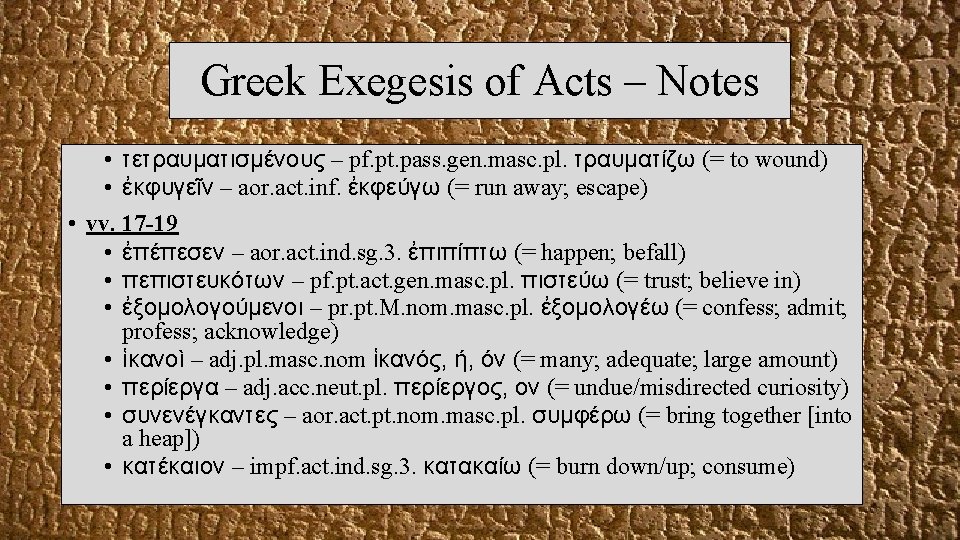
Greek Exegesis of Acts – Notes • τετραυματισμένους – pf. pt. pass. gen. masc. pl. τραυματίζω (= to wound) • ἐκφυγεῖν – aor. act. inf. ἐκφεύγω (= run away; escape) • vv. 17 -19 • ἐπέπεσεν – aor. act. ind. sg. 3. ἐπιπίπτω (= happen; befall) • πεπιστευκότων – pf. pt. act. gen. masc. pl. πιστεύω (= trust; believe in) • ἐξομολογούμενοι – pr. pt. M. nom. masc. pl. ἐξομολογέω (= confess; admit; profess; acknowledge) • ἱκανοὶ – adj. pl. masc. nom ἱκανός, ή, όν (= many; adequate; large amount) • περίεργα – adj. acc. neut. pl. περίεργος, ον (= undue/misdirected curiosity) • συνενέγκαντες – aor. act. pt. nom. masc. pl. συμφέρω (= bring together [into a heap]) • κατέκαιον – impf. act. ind. sg. 3. κατακαίω (= burn down/up; consume)
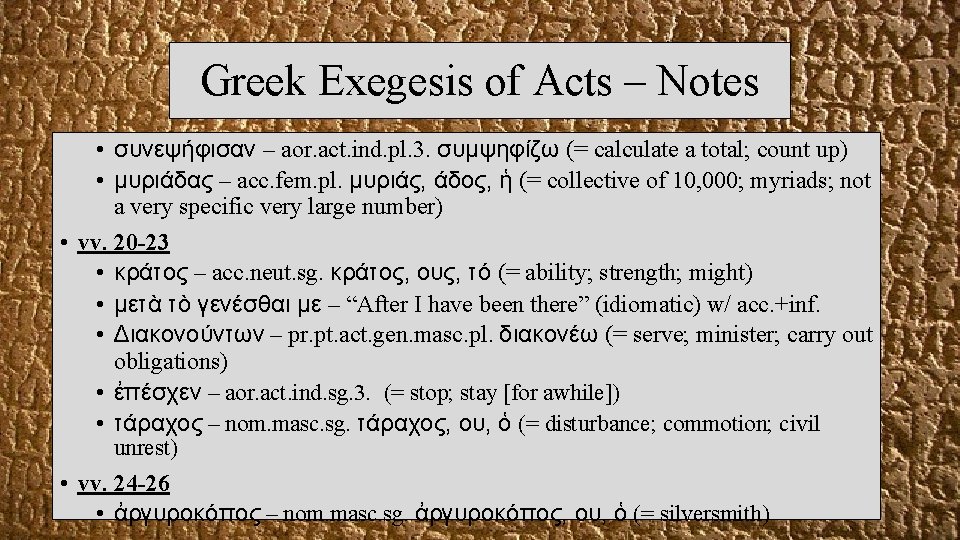
Greek Exegesis of Acts – Notes • συνεψήφισαν – aor. act. ind. pl. 3. συμψηφίζω (= calculate a total; count up) • μυριάδας – acc. fem. pl. μυριάς, άδος, ἡ (= collective of 10, 000; myriads; not a very specific very large number) • vv. 20 -23 • κράτος – acc. neut. sg. κράτος, ους, τό (= ability; strength; might) • μετὰ τὸ γενέσθαι με – “After I have been there” (idiomatic) w/ acc. +inf. • Διακονούντων – pr. pt. act. gen. masc. pl. διακονέω (= serve; minister; carry out obligations) • ἐπέσχεν – aor. act. ind. sg. 3. (= stop; stay [for awhile]) • τάραχος – nom. masc. sg. τάραχος, ου, ὁ (= disturbance; commotion; civil unrest) • vv. 24 -26 • ἀργυροκόπος – nom. masc. sg. ἀργυροκόπος, ου, ὁ (= silversmith)
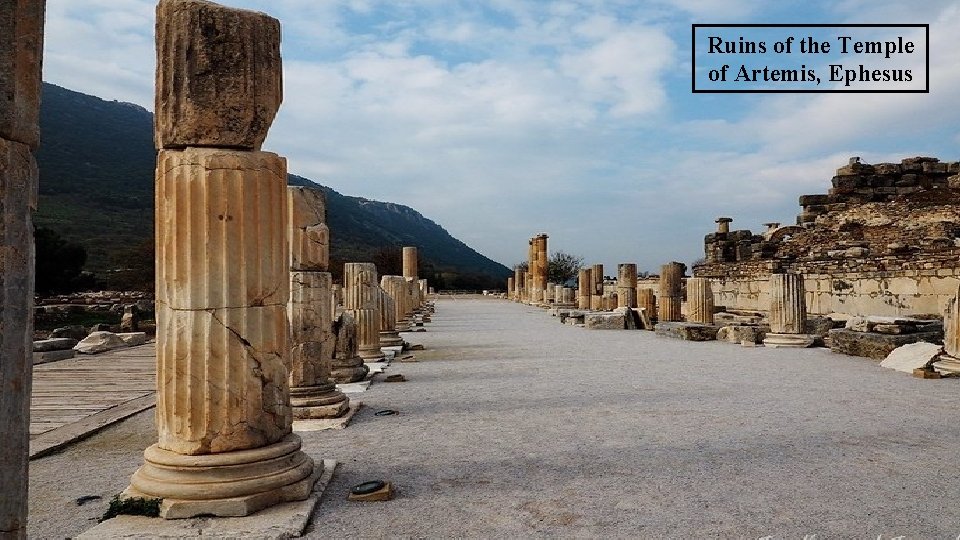
Ruins of the Temple of Artemis, Ephesus Greek Exegesis of Acts – Notes
Greek Exegesis of Acts – Notes • παρείχετο – ind. impf. M. sg. 3. παρέχω (= bring about; cause; make happen) • τεχνίταις – masc. pl. dat. τεχνίτης, ου, ὁ (= craft person; artisan) • ἐργασίαν – fem. sg. acc. ἐργασία, ας, ἡ (= profit; gain; practice; pursuit) • συναθροίσας – aor. pt. act. masc. sg. nom. συναθροίζω (= gather; bring together) • εὐπορία – nom. fem. sg. εὐπορία, ας, ἡ (= prosperity) • σχεδὸν – adv. (= nearly; almost) • πείσας – aor. pt. act. masc. sg. nom. πείθω (= convince; persuade) • μετέστησεν – aor. ind. act. sg. 3 μεθίστημι (= turn away; mislead) • vv. 27 -29 • κινδυνεύει – pr. act. ind. sg. 3. κινδυνεύω (= be in danger; run a risk) • ἀπελεγμὸν – acc. masc. sg. ἀπελεγμός, οῦ, ὁ (= discredit; refutation)
Greek Exegesis of Acts – Notes • θεᾶς – gen. fem. sg. θεά, ᾶς, ἡ (= god/goddess) • οὐθὲν – pronoun. acc. sg. neut. οὐδείς, οὐδεμία, οὐδέν (= nobody; nothing; meaningless; worthless) • λογισθῆναι – aor. pass. inf. λογίζομαι (= reckon; calculate; estimate; consider) • καθαιρεῖσθαι – aor. pass. inf. καθαιρέω (= lower; tear down; destroy) • μεγαλειότητος – gen. fem. sg. μεγαλειότης, ητος, η (= grandeur; sublimity; majesty) • συγχύσεως – gen. fem. sg. σύγχυσις, εως, ἡ (= confusion; tumult) • ὥρμησάν – aor. act. ind. pl. 3. ὁρμάω (= rush) • συναρπάσαντες – aor. act. pt. nom. masc. pl. συναρπάζω (= take hold of forcibly; seize) • συνεκδήμους – acc. masc. pl. συνέκδημος, ου, ὁ (= travelling companion)
Greek Exegesis of Acts – Notes • vv. 30 -34 • δῆμον – acc. masc. sg. δῆμος, ου, ὁ (= popular assembly) • εἴων – impf. act. pl. 3. ἐάω (= let; permit; allow) • Ἀσιαρχῶν – gen. pl. masc. Ἀσιάρχης, ου, ὁ (= Asiarch; deputy) • ἄλλοι μὲν οὖν ἄλλο – • συγκεχυμένη – pf. pass. pt. nom. fem. sg. συγχέω (= confuse; confound; trouble; stir up) • πλείους – adj. comp. masc. pl. acc. πολύς, πολλή, πολύ, gen. πολλου (= many; great number; here: majority) • ᾔδεισαν – plu. pf. act. ind. pl. 3. οἶδα (= know; understand) • συνεληλύθεισαν – plu. pf. act. ind. pl. 3. συνέρχομαι (= assemble; gather) • συνεβίβασαν – aor. ind. act. pl. 3. συμβιβάζω (= instruct; teach; advise; unite)
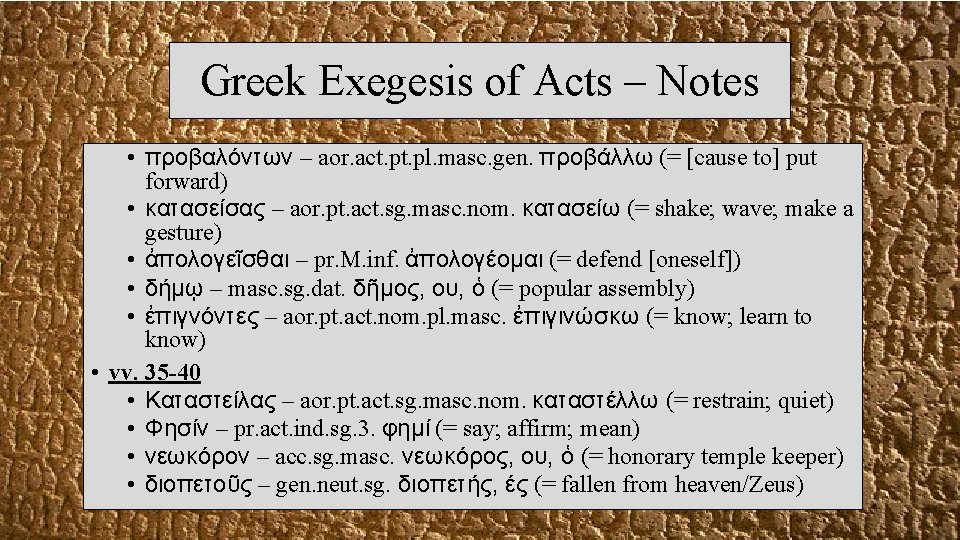
Greek Exegesis of Acts – Notes • προβαλόντων – aor. act. pl. masc. gen. προβάλλω (= [cause to] put forward) • κατασείσας – aor. pt. act. sg. masc. nom. κατασείω (= shake; wave; make a gesture) • ἀπολογεῖσθαι – pr. M. inf. ἀπολογέομαι (= defend [oneself]) • δήμῳ – masc. sg. dat. δῆμος, ου, ὁ (= popular assembly) • ἐπιγνόντες – aor. pt. act. nom. pl. masc. ἐπιγινώσκω (= know; learn to know) • vv. 35 -40 • Καταστείλας – aor. pt. act. sg. masc. nom. καταστέλλω (= restrain; quiet) • Φησίν – pr. act. ind. sg. 3. φημί (= say; affirm; mean) • νεωκόρον – acc. sg. masc. νεωκόρος, ου, ὁ (= honorary temple keeper) • διοπετοῦς – gen. neut. sg. διοπετής, ές (= fallen from heaven/Zeus)
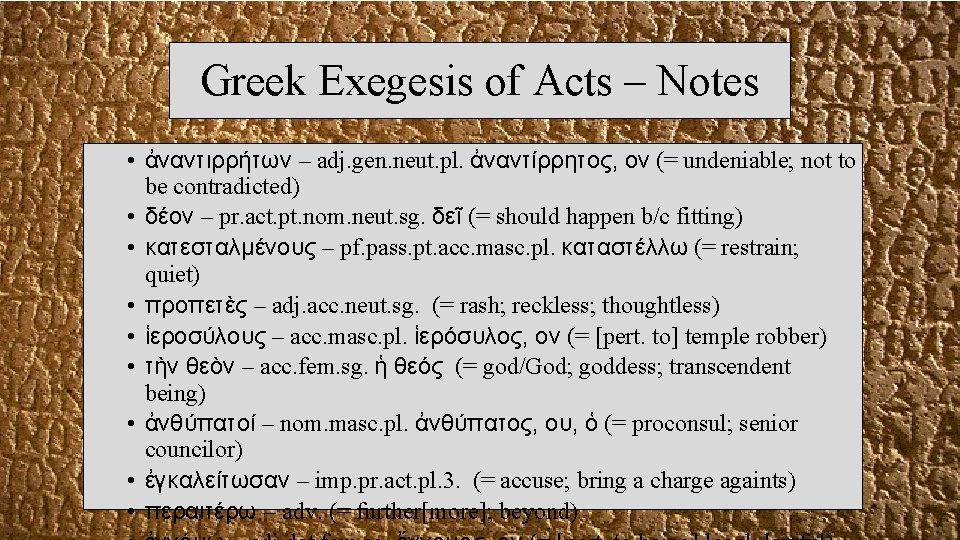
Greek Exegesis of Acts – Notes • ἀναντιρρήτων – adj. gen. neut. pl. ἀναντίρρητος, ον (= undeniable; not to be contradicted) • δέον – pr. act. pt. nom. neut. sg. δεῖ (= should happen b/c fitting) • κατεσταλμένους – pf. pass. pt. acc. masc. pl. καταστέλλω (= restrain; quiet) • προπετὲς – adj. acc. neut. sg. (= rash; reckless; thoughtless) • ἱεροσύλους – acc. masc. pl. ἱερόσυλος, ον (= [pert. to] temple robber) • τὴν θεὸν – acc. fem. sg. ἡ θεός (= god/God; goddess; transcendent being) • ἀνθύπατοί – nom. masc. pl. ἀνθύπατος, ου, ὁ (= proconsul; senior councilor) • ἐγκαλείτωσαν – imp. pr. act. pl. 3. (= accuse; bring a charge againts) • περαιτέρω – adv. (= further[more]; beyond)
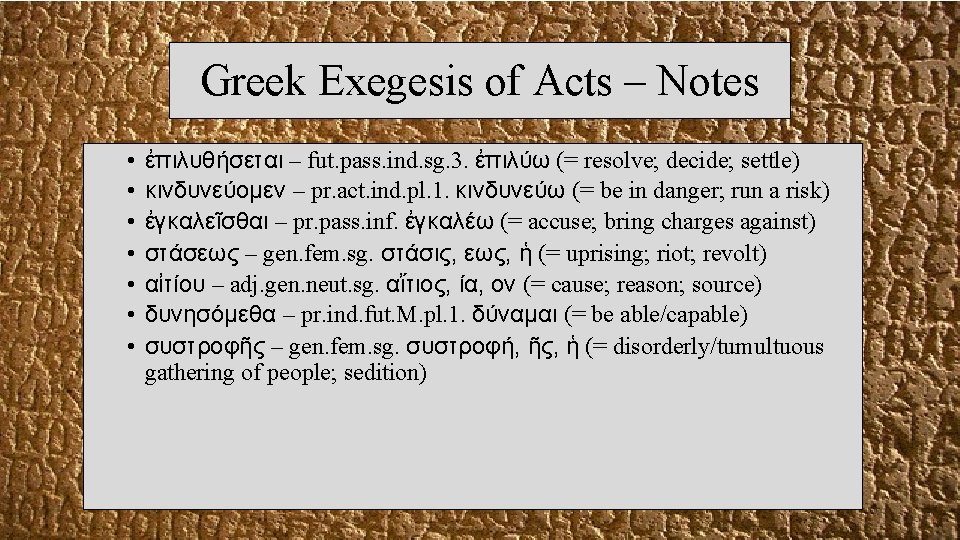
Greek Exegesis of Acts – Notes • • ἐπιλυθήσεται – fut. pass. ind. sg. 3. ἐπιλύω (= resolve; decide; settle) κινδυνεύομεν – pr. act. ind. pl. 1. κινδυνεύω (= be in danger; run a risk) ἐγκαλεῖσθαι – pr. pass. inf. ἐγκαλέω (= accuse; bring charges against) στάσεως – gen. fem. sg. στάσις, εως, ἡ (= uprising; riot; revolt) αἰτίου – adj. gen. neut. sg. αἴτιος, ία, ον (= cause; reason; source) δυνησόμεθα – pr. ind. fut. M. pl. 1. δύναμαι (= be able/capable) συστροφῆς – gen. fem. sg. συστροφή, ῆς, ἡ (= disorderly/tumultuous gathering of people; sedition)
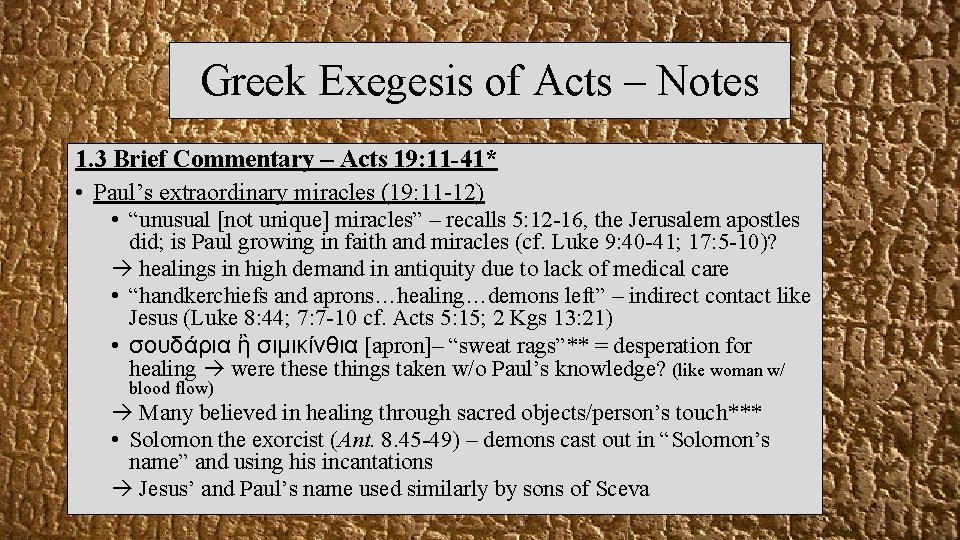
Greek Exegesis of Acts – Notes 1. 3 Brief Commentary – Acts 19: 11 -41* • Paul’s extraordinary miracles (19: 11 -12) • “unusual [not unique] miracles” – recalls 5: 12 -16, the Jerusalem apostles did; is Paul growing in faith and miracles (cf. Luke 9: 40 -41; 17: 5 -10)? healings in high demand in antiquity due to lack of medical care • “handkerchiefs and aprons…healing…demons left” – indirect contact like Jesus (Luke 8: 44; 7: 7 -10 cf. Acts 5: 15; 2 Kgs 13: 21) • σουδάρια ἢ σιμικίνθια [apron]– “sweat rags”** = desperation for healing were these things taken w/o Paul’s knowledge? (like woman w/ blood flow) Many believed in healing through sacred objects/person’s touch*** • Solomon the exorcist (Ant. 8. 45 -49) – demons cast out in “Solomon’s name” and using his incantations Jesus’ and Paul’s name used similarly by sons of Sceva
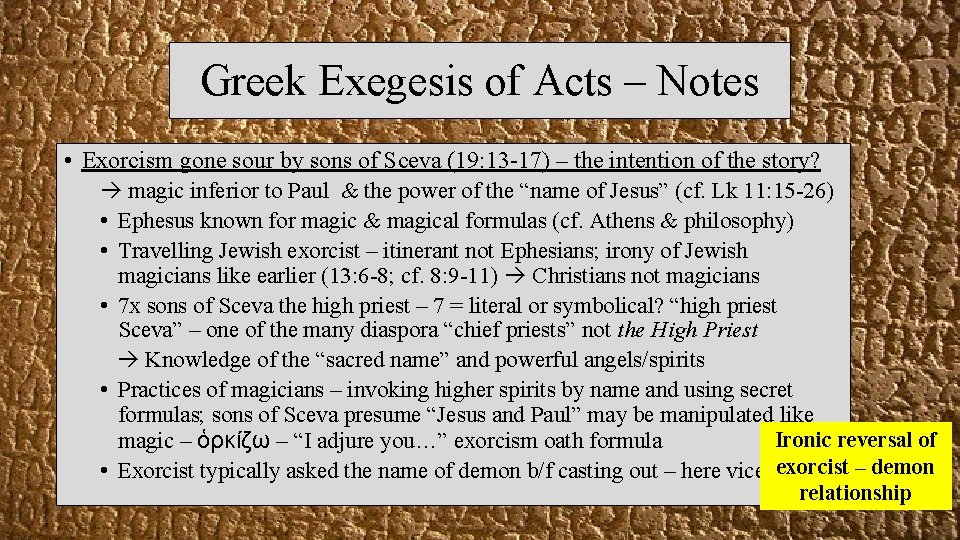
Greek Exegesis of Acts – Notes • Exorcism gone sour by sons of Sceva (19: 13 -17) – the intention of the story? magic inferior to Paul & the power of the “name of Jesus” (cf. Lk 11: 15 -26) • Ephesus known for magic & magical formulas (cf. Athens & philosophy) • Travelling Jewish exorcist – itinerant not Ephesians; irony of Jewish magicians like earlier (13: 6 -8; cf. 8: 9 -11) Christians not magicians • 7 x sons of Sceva the high priest – 7 = literal or symbolical? “high priest Sceva” – one of the many diaspora “chief priests” not the High Priest Knowledge of the “sacred name” and powerful angels/spirits • Practices of magicians – invoking higher spirits by name and using secret formulas; sons of Sceva presume “Jesus and Paul” may be manipulated like Ironic reversal of magic – ὁρκίζω – “I adjure you…” exorcism oath formula exorcist – demon • Exorcist typically asked the name of demon b/f casting out – here vice versa relationship
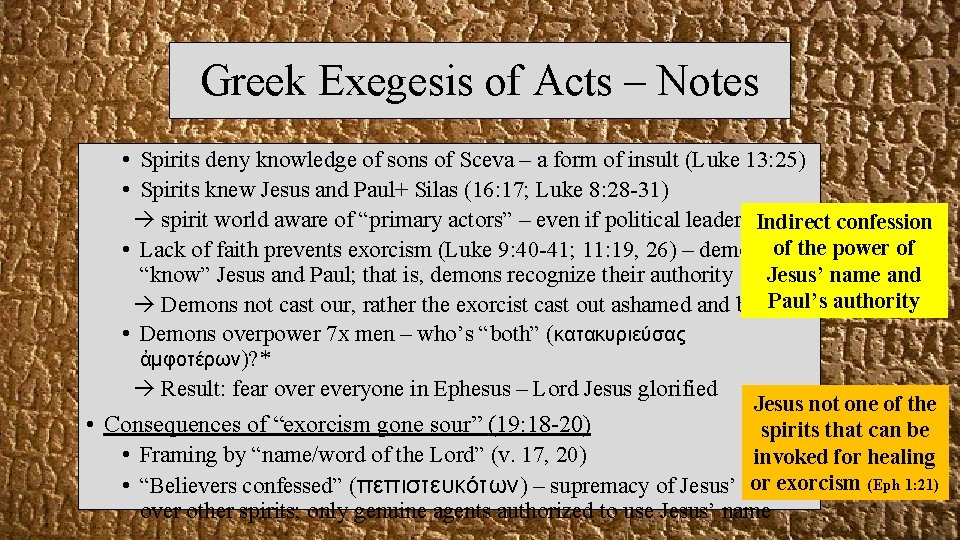
Greek Exegesis of Acts – Notes • Spirits deny knowledge of sons of Sceva – a form of insult (Luke 13: 25) • Spirits knew Jesus and Paul+ Silas (16: 17; Luke 8: 28 -31) spirit world aware of “primary actors” – even if political leaders Indirect not confession • Lack of faith prevents exorcism (Luke 9: 40 -41; 11: 19, 26) – demons of the power of “know” Jesus and Paul; that is, demons recognize their authority Jesus’ name and Paul’s authority Demons not cast our, rather the exorcist cast out ashamed and bloody • Demons overpower 7 x men – who’s “both” (κατακυριεύσας ἀμφοτέρων)? * Result: fear over everyone in Ephesus – Lord Jesus glorified Jesus not one of the • Consequences of “exorcism gone sour” (19: 18 -20) spirits that can be • Framing by “name/word of the Lord” (v. 17, 20) invoked for healing or exorcism (Eph 1: 21) • “Believers confessed” (πεπιστευκότων) – supremacy of Jesus’ name over other spirits; only genuine agents authorized to use Jesus’ name
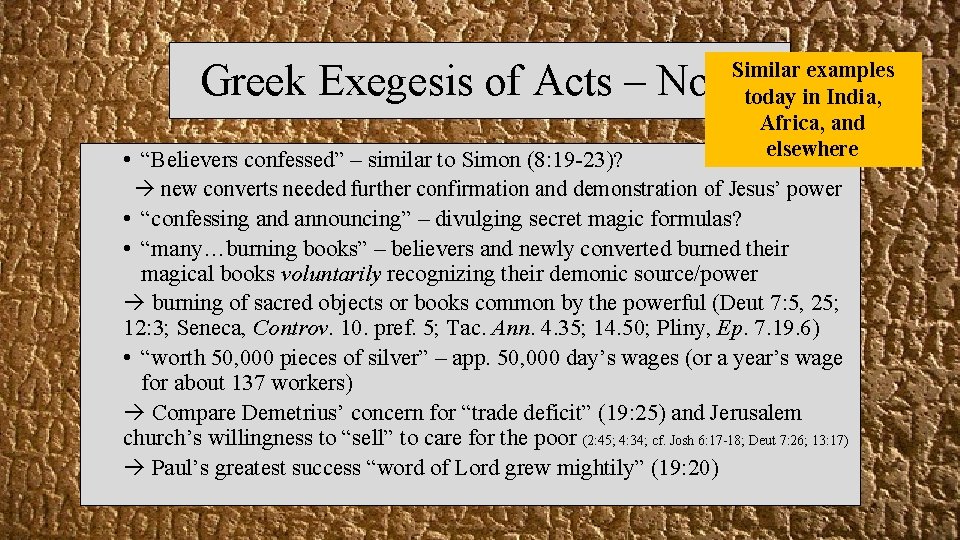
Greek Exegesis of Acts – Notes • “Believers confessed” – similar to Simon (8: 19 -23)? Similar examples today in India, Africa, and elsewhere new converts needed further confirmation and demonstration of Jesus’ power • “confessing and announcing” – divulging secret magic formulas? • “many…burning books” – believers and newly converted burned their magical books voluntarily recognizing their demonic source/power burning of sacred objects or books common by the powerful (Deut 7: 5, 25; 12: 3; Seneca, Controv. 10. pref. 5; Tac. Ann. 4. 35; 14. 50; Pliny, Ep. 7. 19. 6) • “worth 50, 000 pieces of silver” – app. 50, 000 day’s wages (or a year’s wage for about 137 workers) Compare Demetrius’ concern for “trade deficit” (19: 25) and Jerusalem church’s willingness to “sell” to care for the poor (2: 45; 4: 34; cf. Josh 6: 17 -18; Deut 7: 26; 13: 17) Paul’s greatest success “word of Lord grew mightily” (19: 20)
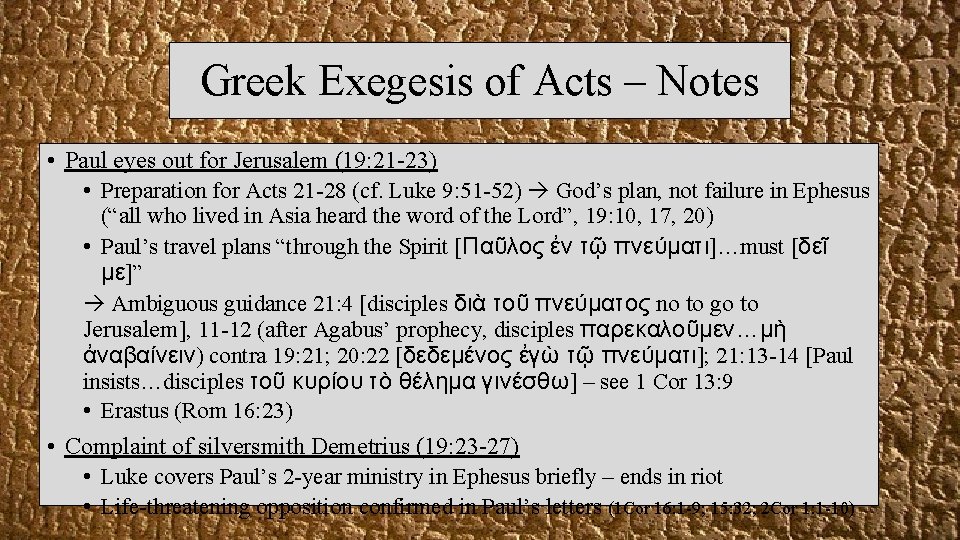
Greek Exegesis of Acts – Notes • Paul eyes out for Jerusalem (19: 21 -23) • Preparation for Acts 21 -28 (cf. Luke 9: 51 -52) God’s plan, not failure in Ephesus (“all who lived in Asia heard the word of the Lord”, 19: 10, 17, 20) • Paul’s travel plans “through the Spirit [Παῦλος ἐν τῷ πνεύματι]…must [δεῖ με]” Ambiguous guidance 21: 4 [disciples διὰ τοῦ πνεύματος no to go to Jerusalem], 11 -12 (after Agabus’ prophecy, disciples παρεκαλοῦμεν…μὴ ἀναβαίνειν) contra 19: 21; 20: 22 [δεδεμένος ἐγὼ τῷ πνεύματι]; 21: 13 -14 [Paul insists…disciples τοῦ κυρίου τὸ θέλημα γινέσθω] – see 1 Cor 13: 9 • Erastus (Rom 16: 23) • Complaint of silversmith Demetrius (19: 23 -27) • Luke covers Paul’s 2 -year ministry in Ephesus briefly – ends in riot • Life-threatening opposition confirmed in Paul’s letters (1 Cor 16: 1 -9; 15: 32; 2 Cor 1: 1 -10)
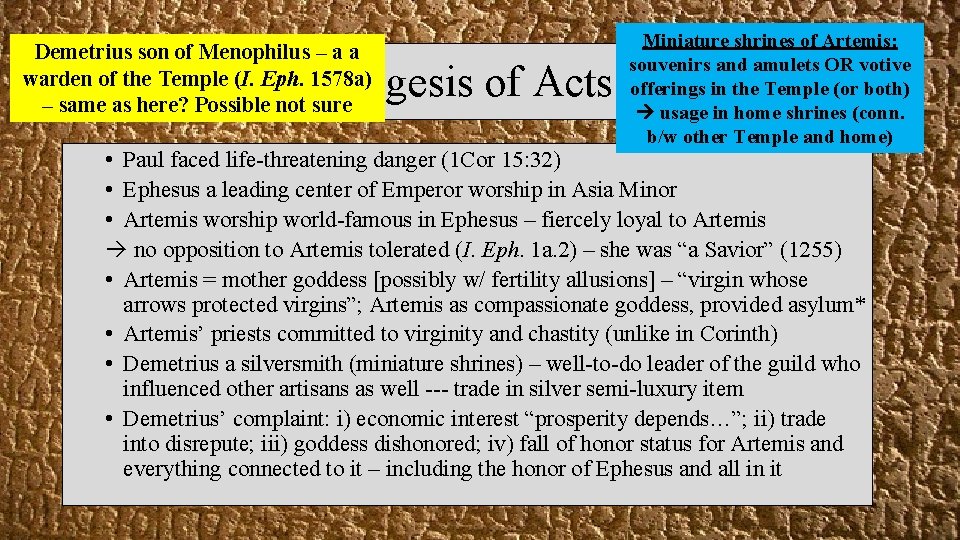
Demetrius son of Menophilus – a a warden of the Temple (I. Eph. 1578 a) – same as here? Possible not sure Miniature shrines of Artemis: souvenirs and amulets OR votive offerings in the Temple (or both) usage in home shrines (conn. b/w other Temple and home) Greek Exegesis of Acts – Notes • Paul faced life-threatening danger (1 Cor 15: 32) • Ephesus a leading center of Emperor worship in Asia Minor • Artemis worship world-famous in Ephesus – fiercely loyal to Artemis no opposition to Artemis tolerated (I. Eph. 1 a. 2) – she was “a Savior” (1255) • Artemis = mother goddess [possibly w/ fertility allusions] – “virgin whose arrows protected virgins”; Artemis as compassionate goddess, provided asylum* • Artemis’ priests committed to virginity and chastity (unlike in Corinth) • Demetrius a silversmith (miniature shrines) – well-to-do leader of the guild who influenced other artisans as well --- trade in silver semi-luxury item • Demetrius’ complaint: i) economic interest “prosperity depends…”; ii) trade into disrepute; iii) goddess dishonored; iv) fall of honor status for Artemis and everything connected to it – including the honor of Ephesus and all in it
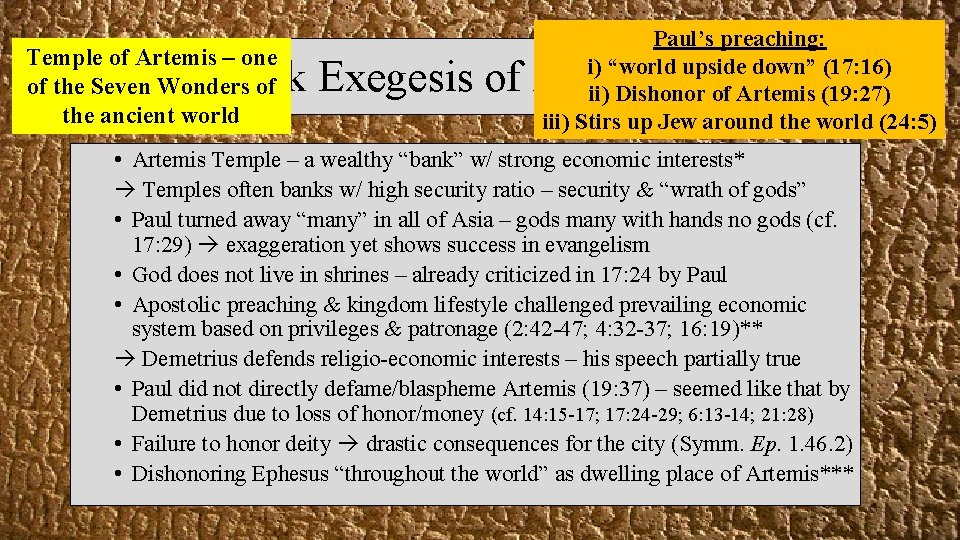
Temple of Artemis – one of the Seven Wonders of the ancient world Paul’s preaching: i) “world upside down” (17: 16) ii) Dishonor of Artemis (19: 27) iii) Stirs up Jew around the world (24: 5) Greek Exegesis of Acts – Notes • Artemis Temple – a wealthy “bank” w/ strong economic interests* Temples often banks w/ high security ratio – security & “wrath of gods” • Paul turned away “many” in all of Asia – gods many with hands no gods (cf. 17: 29) exaggeration yet shows success in evangelism • God does not live in shrines – already criticized in 17: 24 by Paul • Apostolic preaching & kingdom lifestyle challenged prevailing economic system based on privileges & patronage (2: 42 -47; 4: 32 -37; 16: 19)** Demetrius defends religio-economic interests – his speech partially true • Paul did not directly defame/blaspheme Artemis (19: 37) – seemed like that by Demetrius due to loss of honor/money (cf. 14: 15 -17; 17: 24 -29; 6: 13 -14; 21: 28) • Failure to honor deity drastic consequences for the city (Symm. Ep. 1. 46. 2) • Dishonoring Ephesus “throughout the world” as dwelling place of Artemis***
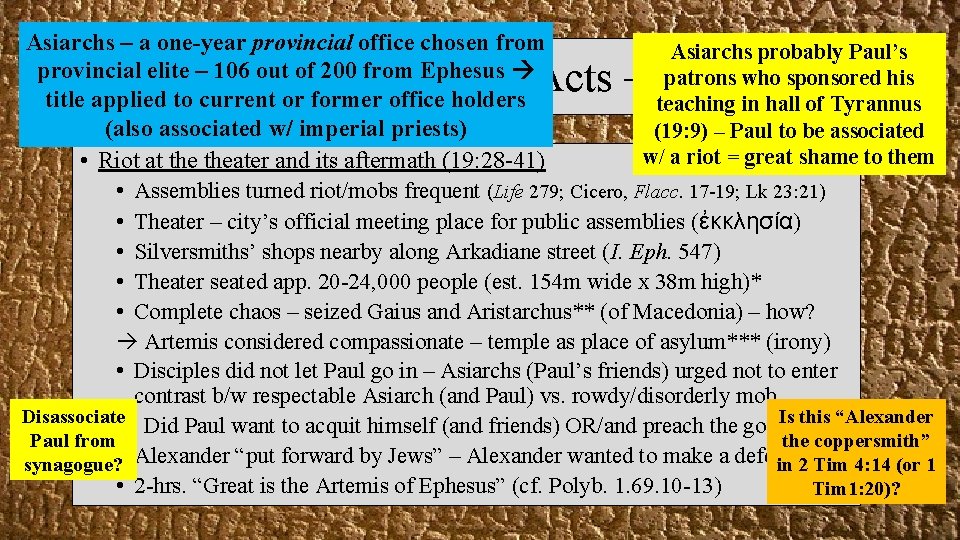
Asiarchs – a one-year provincial office chosen from Asiarchs probably Paul’s provincial elite – 106 out of 200 from Ephesus patrons who sponsored his title applied to current or former office holders teaching in hall of Tyrannus (also associated w/ imperial priests) (19: 9) – Paul to be associated w/ a riot = great shame to them • Riot at theater and its aftermath (19: 28 -41) • Assemblies turned riot/mobs frequent (Life 279; Cicero, Flacc. 17 -19; Lk 23: 21) • Theater – city’s official meeting place for public assemblies (ἐκκλησία) • Silversmiths’ shops nearby along Arkadiane street (I. Eph. 547) • Theater seated app. 20 -24, 000 people (est. 154 m wide x 38 m high)* • Complete chaos – seized Gaius and Aristarchus** (of Macedonia) – how? Artemis considered compassionate – temple as place of asylum*** (irony) • Disciples did not let Paul go in – Asiarchs (Paul’s friends) urged not to enter contrast b/w respectable Asiarch (and Paul) vs. rowdy/disorderly mob Disassociate Is this “Alexander Did Paul want to acquit himself (and friends) OR/and preach the gospel? Paul from the coppersmith” synagogue? • Alexander “put forward by Jews” – Alexander wanted to make a defense in 2 Tim 4: 14 (or 1 • 2 -hrs. “Great is the Artemis of Ephesus” (cf. Polyb. 1. 69. 10 -13) Tim 1: 20)? Greek Exegesis of Acts – Notes
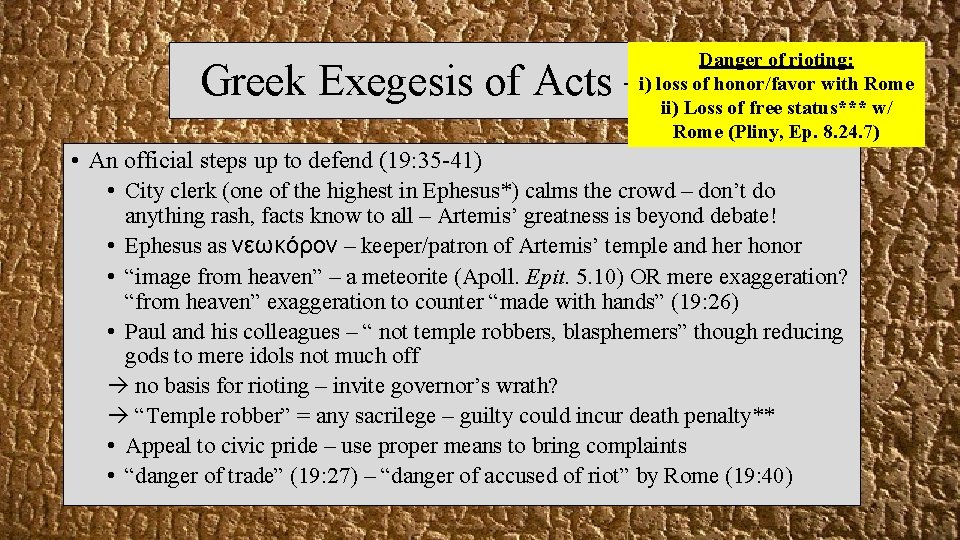
Danger of rioting: i) loss of honor/favor with Rome ii) Loss of free status*** w/ Rome (Pliny, Ep. 8. 24. 7) Greek Exegesis of Acts – Notes • An official steps up to defend (19: 35 -41) • City clerk (one of the highest in Ephesus*) calms the crowd – don’t do anything rash, facts know to all – Artemis’ greatness is beyond debate! • Ephesus as νεωκόρον – keeper/patron of Artemis’ temple and her honor • “image from heaven” – a meteorite (Apoll. Epit. 5. 10) OR mere exaggeration? “from heaven” exaggeration to counter “made with hands” (19: 26) • Paul and his colleagues – “ not temple robbers, blasphemers” though reducing gods to mere idols not much off no basis for rioting – invite governor’s wrath? “Temple robber” = any sacrilege – guilty could incur death penalty** • Appeal to civic pride – use proper means to bring complaints • “danger of trade” (19: 27) – “danger of accused of riot” by Rome (19: 40)
Greek Exegesis of Acts – Notes • “Seek God…grope for