GPU production workloads in WLCG Andrea Valassi CERN

- Slides: 14
GPU production workloads in WLCG? Andrea Valassi (CERN IT-DI) Benchmarking Pre-GDB, 8 October 2019 – CERN https: //indico. cern. ch/event/739897 A. Valassi – GPU production workloads in WLCG Benchmarking Pre-GDB, CERN – 8 Oct 2019 1
Disclaimers! • I am not an expert in GPU software development or execution – Please excuse any factual mistake or misconception in what I discuss • I did not have the time to contact many relevant experts… apologies – Also because we were a bit late in organizing this session • I will mainly report from the conclusion of a cross-experiment HPC meeting in May – Including ATLAS, CMS and LHCb feedback on software and computing for HPCs – Complementing this with my current understanding of other ongoing activities on GPUs • This talk is mainly meant to stir up thoughts and introduce the following talks A. Valassi – GPU production workloads in WLCG Benchmarking Pre-GDB, CERN – 8 Oct 2019 2
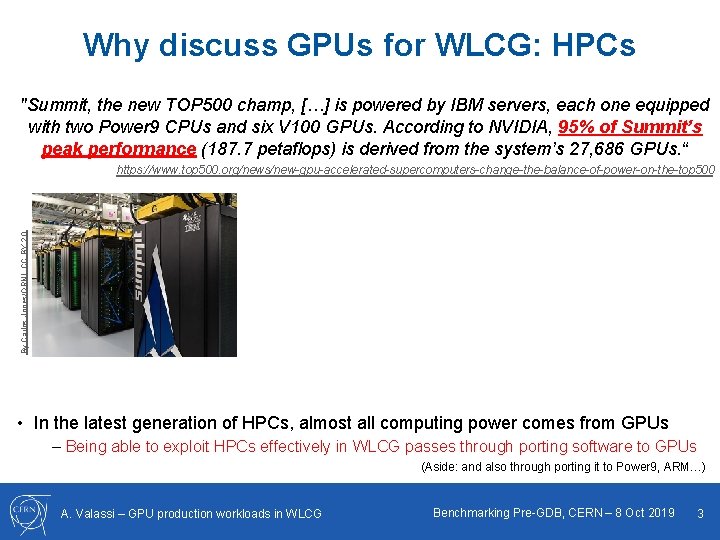
Why discuss GPUs for WLCG: HPCs "Summit, the new TOP 500 champ, […] is powered by IBM servers, each one equipped with two Power 9 CPUs and six V 100 GPUs. According to NVIDIA, 95% of Summit’s peak performance (187. 7 petaflops) is derived from the system’s 27, 686 GPUs. “ By Carlos Jones/ORNL, CC BY 2. 0 https: //www. top 500. org/news/new-gpu-accelerated-supercomputers-change-the-balance-of-power-on-the-top 500 • In the latest generation of HPCs, almost all computing power comes from GPUs – Being able to exploit HPCs effectively in WLCG passes through porting software to GPUs (Aside: and also through porting it to Power 9, ARM…). . A. Valassi – GPU production workloads in WLCG Benchmarking Pre-GDB, CERN – 8 Oct 2019 3
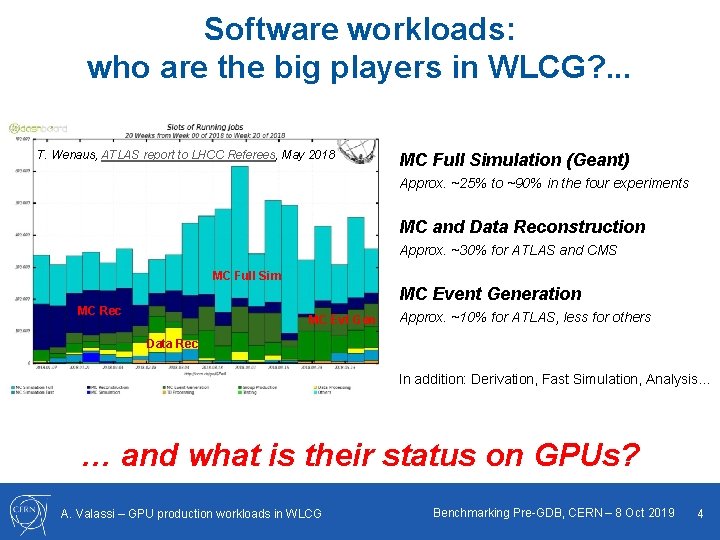
Software workloads: who are the big players in WLCG? . . . T. Wenaus, ATLAS report to LHCC Referees, May 2018 MC Full Simulation (Geant) Approx. ~25% to ~90% in the four experiments MC and Data Reconstruction Approx. ~30% for ATLAS and CMS MC Full Sim MC Event Generation MC Rec MC Evt Gen Approx. ~10% for ATLAS, less for others Data Rec In addition: Derivation, Fast Simulation, Analysis… … and what is their status on GPUs? A. Valassi – GPU production workloads in WLCG Benchmarking Pre-GDB, CERN – 8 Oct 2019 4
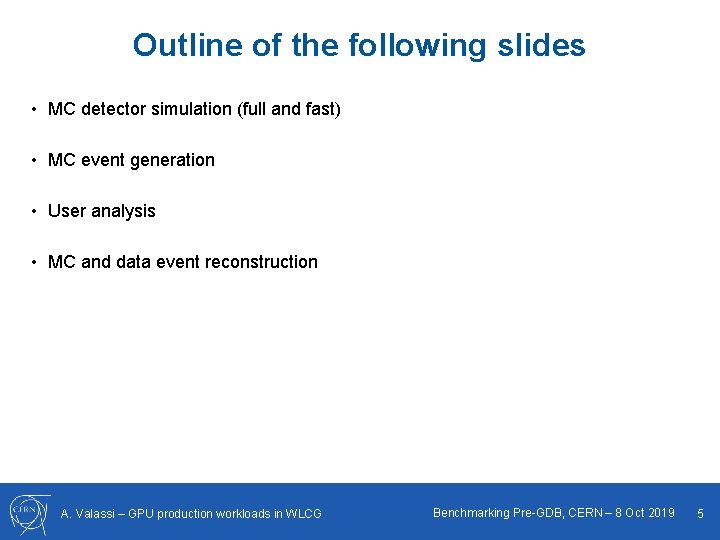
Outline of the following slides • MC detector simulation (full and fast) • MC event generation • User analysis • MC and data event reconstruction A. Valassi – GPU production workloads in WLCG Benchmarking Pre-GDB, CERN – 8 Oct 2019 5
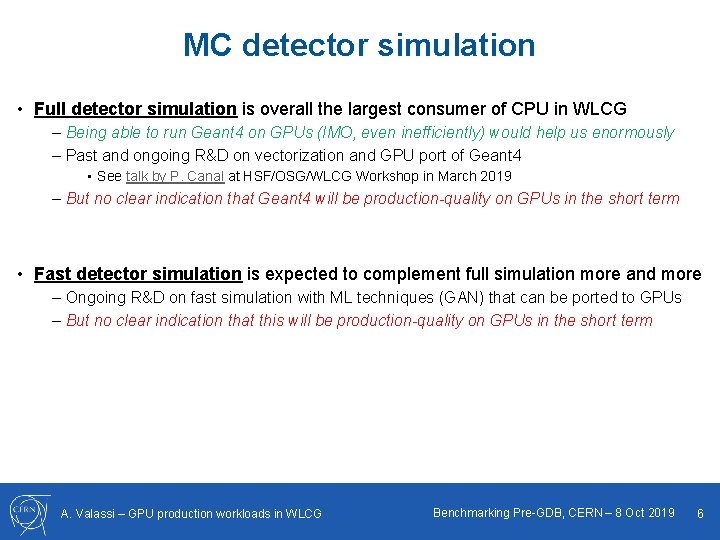
MC detector simulation • Full detector simulation is overall the largest consumer of CPU in WLCG – Being able to run Geant 4 on GPUs (IMO, even inefficiently) would help us enormously – Past and ongoing R&D on vectorization and GPU port of Geant 4 • See talk by P. Canal at HSF/OSG/WLCG Workshop in March 2019 – But no clear indication that Geant 4 will be production-quality on GPUs in the short term • Fast detector simulation is expected to complement full simulation more and more – Ongoing R&D on fast simulation with ML techniques (GAN) that can be ported to GPUs – But no clear indication that this will be production-quality on GPUs in the short term A. Valassi – GPU production workloads in WLCG Benchmarking Pre-GDB, CERN – 8 Oct 2019 6
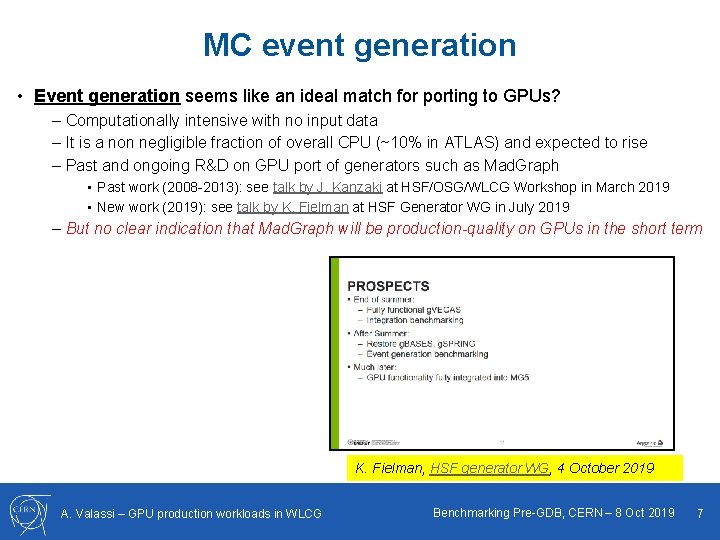
MC event generation • Event generation seems like an ideal match for porting to GPUs? – Computationally intensive with no input data – It is a non negligible fraction of overall CPU (~10% in ATLAS) and expected to rise – Past and ongoing R&D on GPU port of generators such as Mad. Graph • Past work (2008 -2013): see talk by J. Kanzaki at HSF/OSG/WLCG Workshop in March 2019 • New work (2019): see talk by K. Fielman at HSF Generator WG in July 2019 – But no clear indication that Mad. Graph will be production-quality on GPUs in the short term K. Fielman, HSF generator WG, 4 October 2019 A. Valassi – GPU production workloads in WLCG Benchmarking Pre-GDB, CERN – 8 Oct 2019 7
User analysis • User analysis is certainly an area where GPUs can be very useful – Training of Machine Learning and Deep Learning models – Maximum likelihood fits – But fraction of needed compute resources is negligible with respect to other workloads A. Valassi – GPU production workloads in WLCG Benchmarking Pre-GDB, CERN – 8 Oct 2019 8
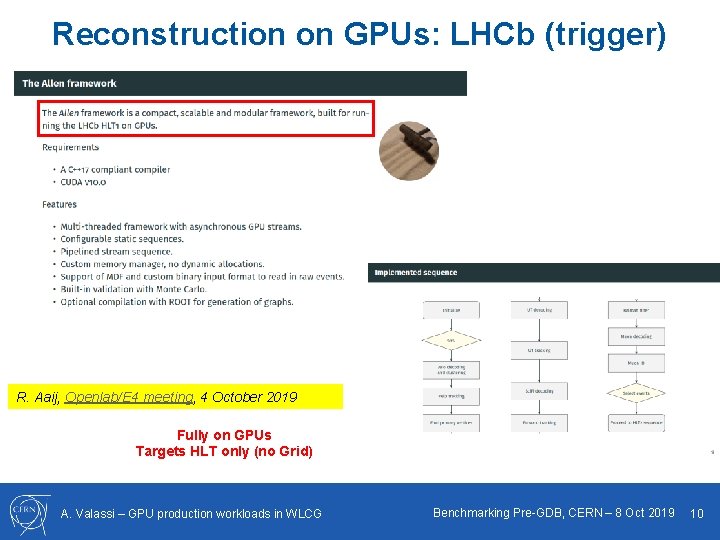
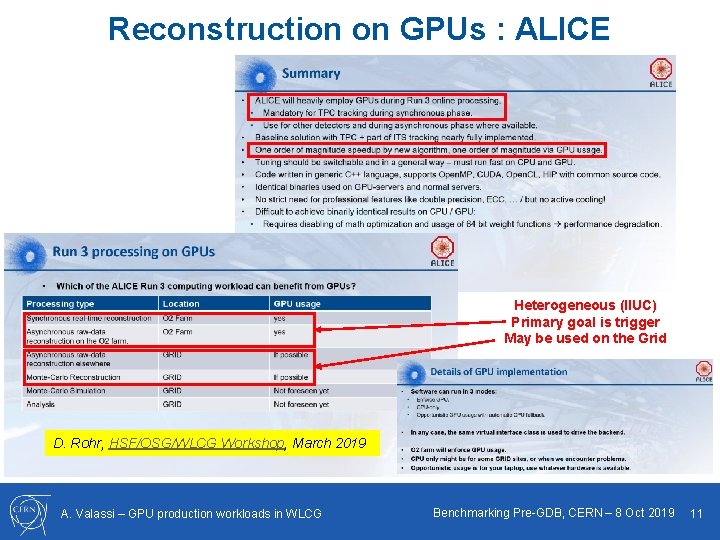
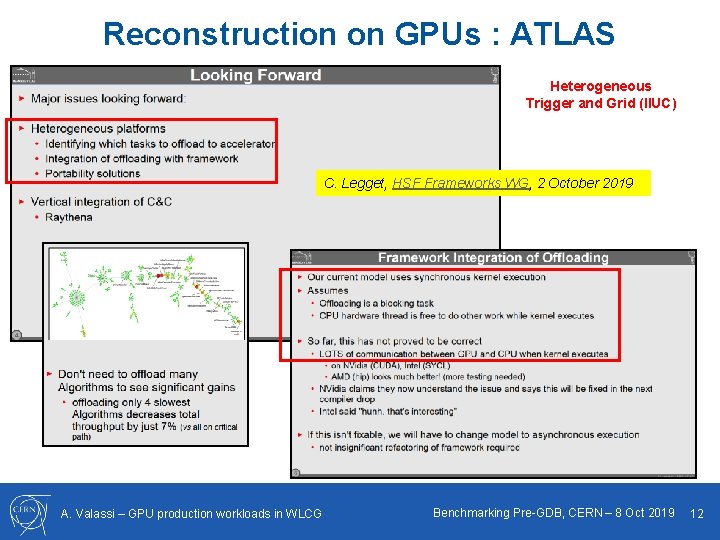
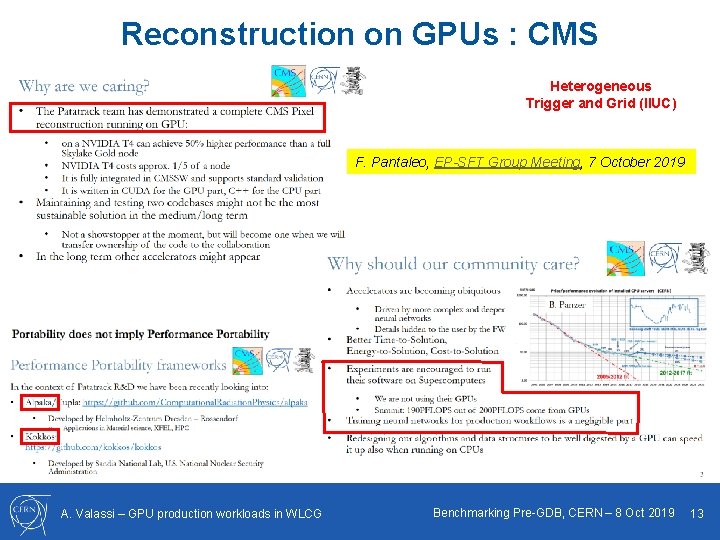
MC and data event reconstruction • Event reconstruction is where all experiments seem most advanced on GPUs – ALICE has a production-quality (IIUC) reconstruction for its online data processing in HLT – LHCb has an advanced prototype of HLT 1 reconstruction, to be further reviewed internally – ATLAS is progressing on an heterogeneous framework to offload some algorithms – CMS has a functional heterogeneous framework, with several algorithms on GPUs • Goals and GPU offload strategies differ in subtle and less subtle ways – LHCb has a standalone GPU application, all others have an heterogeneous framework – ALICE/LHCb focus primarily/exclusively on online reconstruction, unlike ATLAS/CMS • CMS event reconstruction may be IMO the first workload to reach GPUs on the Grid – We identified this workload as our first GPU candidate for the benchmarking suite – See the next two talks by F. Pantaleo and A. Sciaba A. Valassi – GPU production workloads in WLCG Benchmarking Pre-GDB, CERN – 8 Oct 2019 9
Reconstruction on GPUs: LHCb (trigger) R. Aaij, Openlab/E 4 meeting, 4 October 2019 Fully on GPUs Targets HLT only (no Grid) A. Valassi – GPU production workloads in WLCG Benchmarking Pre-GDB, CERN – 8 Oct 2019 10
Reconstruction on GPUs : ALICE Heterogeneous (IIUC) Primary goal is trigger May be used on the Grid D. Rohr, HSF/OSG/WLCG Workshop, March 2019 A. Valassi – GPU production workloads in WLCG Benchmarking Pre-GDB, CERN – 8 Oct 2019 11
Reconstruction on GPUs : ATLAS Heterogeneous Trigger and Grid (IIUC) C. Legget, HSF Frameworks WG, 2 October 2019 A. Valassi – GPU production workloads in WLCG Benchmarking Pre-GDB, CERN – 8 Oct 2019 12
Reconstruction on GPUs : CMS Heterogeneous Trigger and Grid (IIUC) F. Pantaleo, EP-SFT Group Meeting, 7 October 2019 A. Valassi – GPU production workloads in WLCG Benchmarking Pre-GDB, CERN – 8 Oct 2019 13
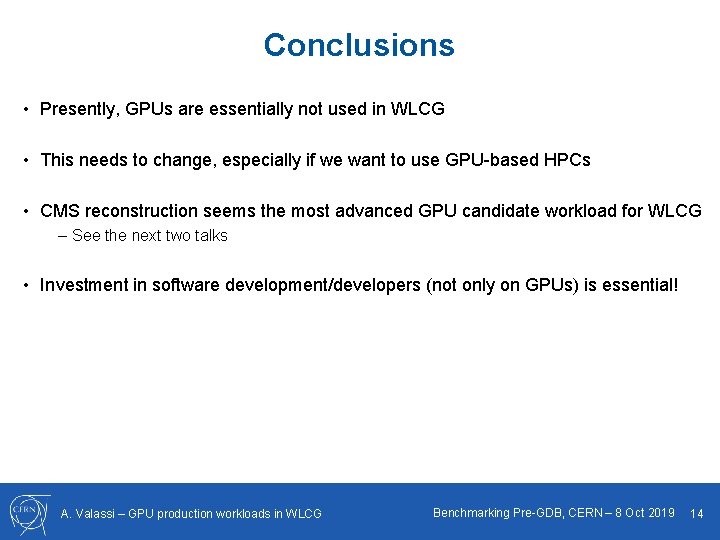
Conclusions • Presently, GPUs are essentially not used in WLCG • This needs to change, especially if we want to use GPU-based HPCs • CMS reconstruction seems the most advanced GPU candidate workload for WLCG – See the next two talks • Investment in software development/developers (not only on GPUs) is essential! A. Valassi – GPU production workloads in WLCG Benchmarking Pre-GDB, CERN – 8 Oct 2019 14