
HEPOSlibs Andrea Valassi ITDILCG WLCG AA Librarian and
HEP_OSlibs Andrea Valassi (IT-DI-LCG) WLCG AA Librarian and Integrators Meeting Workshop 30 th May 2018 See also my talk at the July 2016 LIM and follow-up discussion at the June 2017 LIM Further in the past: see Pere Mato’s and Oliver Keeble’s talks at the June 2009 GDB A. Valassi – HEP_OSlibs LIM Workshop – 30 th May 2018 1
What is HEP_OSlibs? • a meta-package: ‘yum install HEP_OSlibs’ on Red. Hat is equivalent to ‘yum install alsa-lib-devel. x 86_64. . . zsh. x 86_64’ – – – a list of packages without a specific version number taken from the official O/S repos (not from EPEL) “the O/S level dependencies of the LHC experiment software stacks” a more precise definition of what a “supported O/S” is • Initially developed on Red. Hat (SL 5, SL 6, CC 7) – now exists also on Ubuntu (16. 04, 17. 10) • Initial focus was WLCG deployment (runtime packages) – e. g. SL 4 compat – now includes also development packages (build time packages) • See https: //gitlab. cern. ch/linuxsupport/rpms/HEP_OSlibs – source code repo, build and test (CI+koji), documentation (dependency lists) A. Valassi – HEP_OSlibs LIM Workshop – 30 th May 2018 2
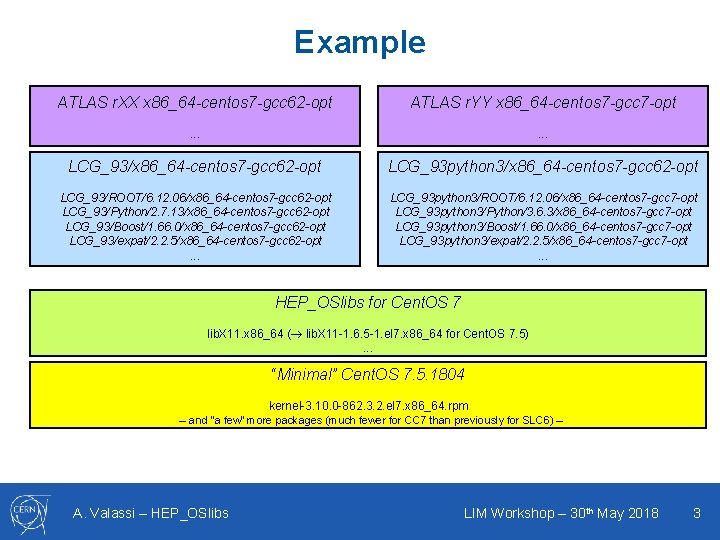
Example ATLAS r. XX x 86_64 -centos 7 -gcc 62 -opt ATLAS r. YY x 86_64 -centos 7 -gcc 7 -opt . . . LCG_93/x 86_64 -centos 7 -gcc 62 -opt LCG_93 python 3/x 86_64 -centos 7 -gcc 62 -opt LCG_93/ROOT/6. 12. 06/x 86_64 -centos 7 -gcc 62 -opt LCG_93/Python/2. 7. 13/x 86_64 -centos 7 -gcc 62 -opt LCG_93/Boost/1. 66. 0/x 86_64 -centos 7 -gcc 62 -opt LCG_93/expat/2. 2. 5/x 86_64 -centos 7 -gcc 62 -opt. . . LCG_93 python 3/ROOT/6. 12. 06/x 86_64 -centos 7 -gcc 7 -opt LCG_93 python 3/Python/3. 6. 3/x 86_64 -centos 7 -gcc 7 -opt LCG_93 python 3/Boost/1. 66. 0/x 86_64 -centos 7 -gcc 7 -opt LCG_93 python 3/expat/2. 2. 5/x 86_64 -centos 7 -gcc 7 -opt. . . HEP_OSlibs for Cent. OS 7 lib. X 11. x 86_64 ( lib. X 11 -1. 6. 5 -1. el 7. x 86_64 for Cent. OS 7. 5). . . “Minimal” Cent. OS 7. 5. 1804 kernel-3. 10. 0 -862. 3. 2. el 7. x 86_64. rpm – and “a few” more packages (much fewer for CC 7 than previously for SLC 6) – A. Valassi – HEP_OSlibs LIM Workshop – 30 th May 2018 3
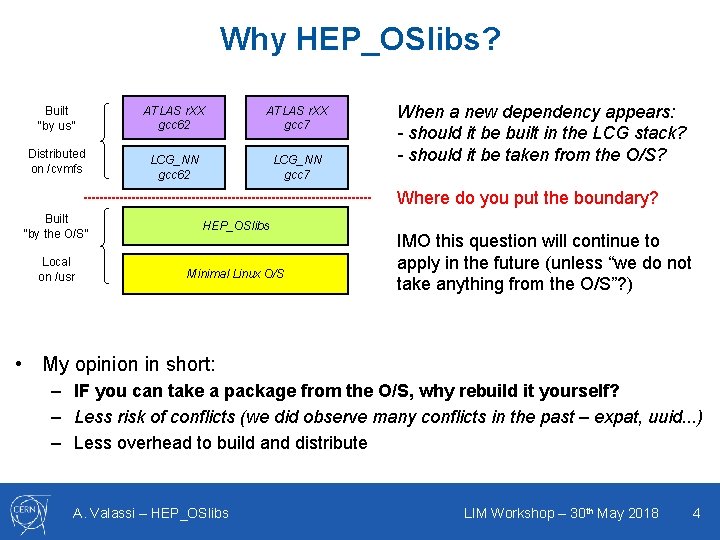
Why HEP_OSlibs? Built “by us” ATLAS r. XX gcc 62 ATLAS r. XX gcc 7 Distributed on /cvmfs LCG_NN gcc 62 LCG_NN gcc 7 When a new dependency appears: - should it be built in the LCG stack? - should it be taken from the O/S? Where do you put the boundary? Built “by the O/S” HEP_OSlibs Local on /usr Minimal Linux O/S IMO this question will continue to apply in the future (unless “we do not take anything from the O/S”? ) • My opinion in short: – IF you can take a package from the O/S, why rebuild it yourself? – Less risk of conflicts (we did observe many conflicts in the past – expat, uuid. . . ) – Less overhead to build and distribute A. Valassi – HEP_OSlibs LIM Workshop – 30 th May 2018 4
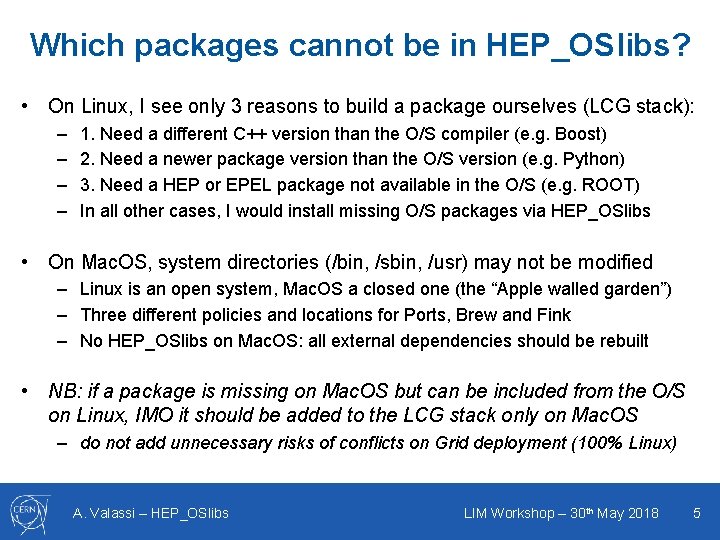
Which packages cannot be in HEP_OSlibs? • On Linux, I see only 3 reasons to build a package ourselves (LCG stack): – – 1. Need a different C++ version than the O/S compiler (e. g. Boost) 2. Need a newer package version than the O/S version (e. g. Python) 3. Need a HEP or EPEL package not available in the O/S (e. g. ROOT) In all other cases, I would install missing O/S packages via HEP_OSlibs • On Mac. OS, system directories (/bin, /sbin, /usr) may not be modified – Linux is an open system, Mac. OS a closed one (the “Apple walled garden”) – Three different policies and locations for Ports, Brew and Fink – No HEP_OSlibs on Mac. OS: all external dependencies should be rebuilt • NB: if a package is missing on Mac. OS but can be included from the O/S on Linux, IMO it should be added to the LCG stack only on Mac. OS – do not add unnecessary risks of conflicts on Grid deployment (100% Linux) A. Valassi – HEP_OSlibs LIM Workshop – 30 th May 2018 5
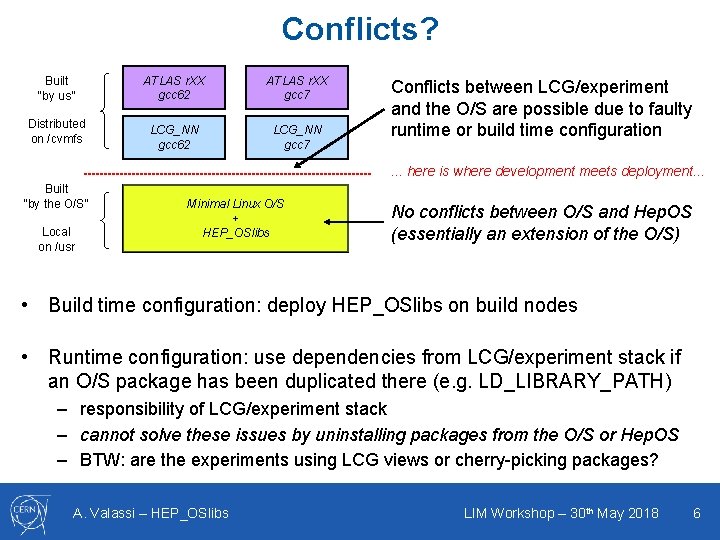
Conflicts? Built “by us” ATLAS r. XX gcc 62 ATLAS r. XX gcc 7 Distributed on /cvmfs LCG_NN gcc 62 LCG_NN gcc 7 Conflicts between LCG/experiment and the O/S are possible due to faulty runtime or build time configuration. . . here is where development meets deployment. . . Built “by the O/S” Local on /usr Minimal Linux O/S + HEP_OSlibs No conflicts between O/S and Hep. OS (essentially an extension of the O/S) • Build time configuration: deploy HEP_OSlibs on build nodes • Runtime configuration: use dependencies from LCG/experiment stack if an O/S package has been duplicated there (e. g. LD_LIBRARY_PATH) – responsibility of LCG/experiment stack – cannot solve these issues by uninstalling packages from the O/S or Hep. OS – BTW: are the experiments using LCG views or cherry-picking packages? A. Valassi – HEP_OSlibs LIM Workshop – 30 th May 2018 6
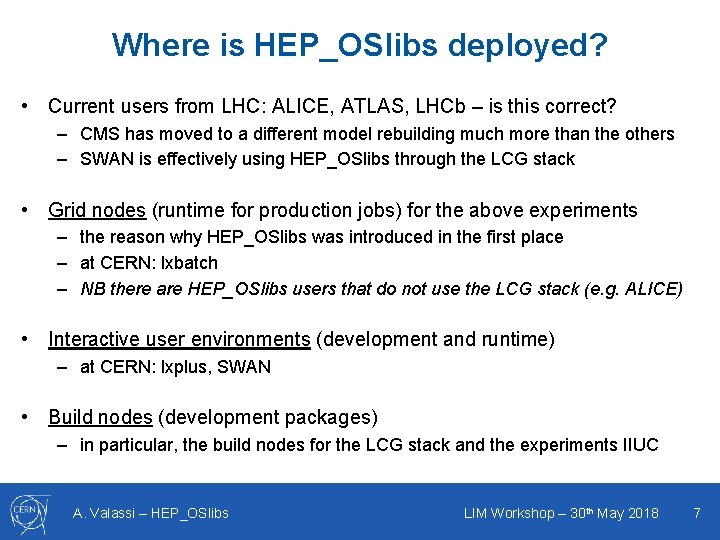
Where is HEP_OSlibs deployed? • Current users from LHC: ALICE, ATLAS, LHCb – is this correct? – CMS has moved to a different model rebuilding much more than the others – SWAN is effectively using HEP_OSlibs through the LCG stack • Grid nodes (runtime for production jobs) for the above experiments – the reason why HEP_OSlibs was introduced in the first place – at CERN: lxbatch – NB there are HEP_OSlibs users that do not use the LCG stack (e. g. ALICE) • Interactive user environments (development and runtime) – at CERN: lxplus, SWAN • Build nodes (development packages) – in particular, the build nodes for the LCG stack and the experiments IIUC A. Valassi – HEP_OSlibs LIM Workshop – 30 th May 2018 7
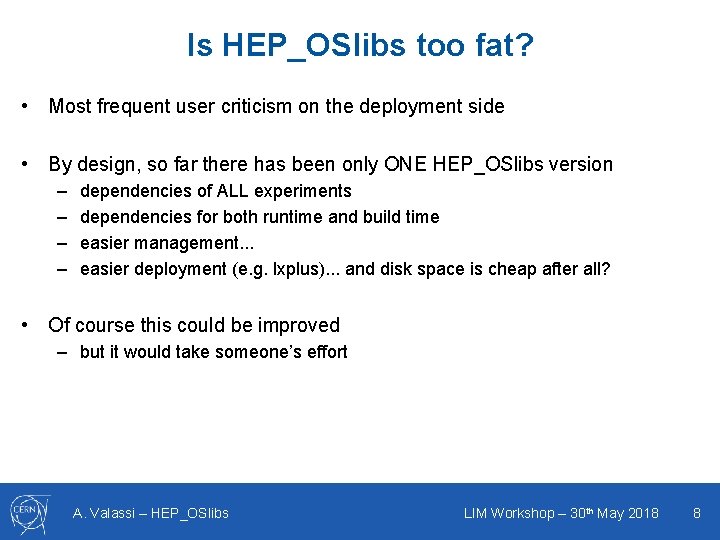
Is HEP_OSlibs too fat? • Most frequent user criticism on the deployment side • By design, so far there has been only ONE HEP_OSlibs version – – dependencies of ALL experiments dependencies for both runtime and build time easier management. . . easier deployment (e. g. lxplus). . . and disk space is cheap after all? • Of course this could be improved – but it would take someone’s effort A. Valassi – HEP_OSlibs LIM Workshop – 30 th May 2018 8
Conclusions • HEP_OSlibs is a meta-package including the runtime and build time O/S dependencies of the LCG and experiment stacks on Linux – a simple way to make the O/S fatter now than it’s thinner by default. . . – a more precise definition of what a “supported O/S” is • Has been used for 10 years – serving its main purpose: runtime environment for Grid jobs – and serving its related purpose: build time environment for software stacks • Infrastructure is now stable and requires minimal maintenance – after quite a bit of work last year (move to gitlab, port to Ubuntu. . . ) – adding new packages is just changing a few lines and launching a CI • Do let me know if you plan to keep using it, or instead no longer need it. . . A. Valassi – HEP_OSlibs LIM Workshop – 30 th May 2018 9
- Slides: 9