Funnel Sort Cache Efficiency and Parallelism Paul Youn






- Slides: 14
Funnel Sort*: Cache Efficiency and Parallelism Paul Youn, 6. 895 Final Project (5689 FPPYaaceijllnnoortuu) * Developed by Frigo, Leiserson, et. al.
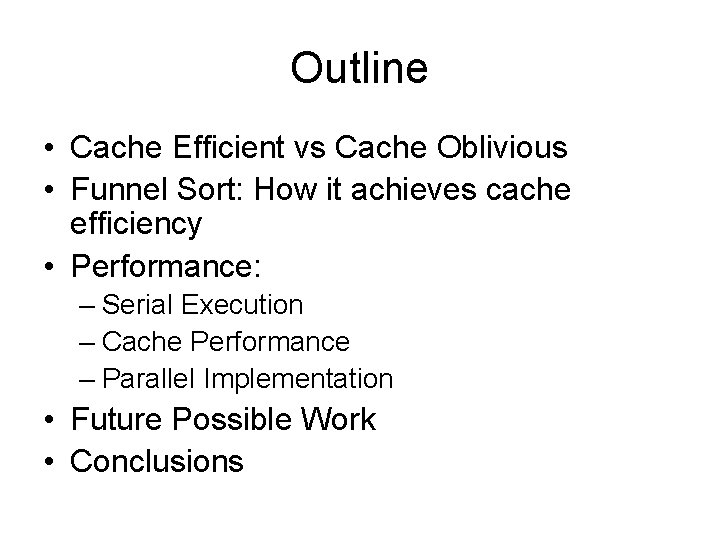
Outline • Cache Efficient vs Cache Oblivious • Funnel Sort: How it achieves cache efficiency • Performance: – Serial Execution – Cache Performance – Parallel Implementation • Future Possible Work • Conclusions
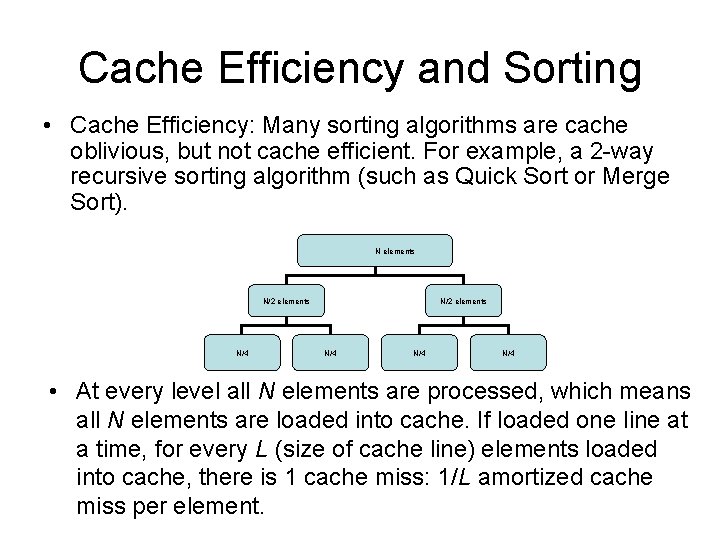
Cache Efficiency and Sorting • Cache Efficiency: Many sorting algorithms are cache oblivious, but not cache efficient. For example, a 2 -way recursive sorting algorithm (such as Quick Sort or Merge Sort). N elements N/2 elements N/4 N/4 • At every level all N elements are processed, which means all N elements are loaded into cache. If loaded one line at a time, for every L (size of cache line) elements loaded into cache, there is 1 cache miss: 1/L amortized cache miss per element.
Cache Performance • Implies an O(n/L lg n) cache miss bound. • If Z is the number of lines in a cache, Professor Bender’s lecture showed cache aware O(n/L * (log n)/(log Z)) cache miss sorting algorithm by doing an O(Z)-way merge sort. • Works by decreasing the height of the tree. • Can we achieve this bound with a cacheoblivious algorithm? Yes!
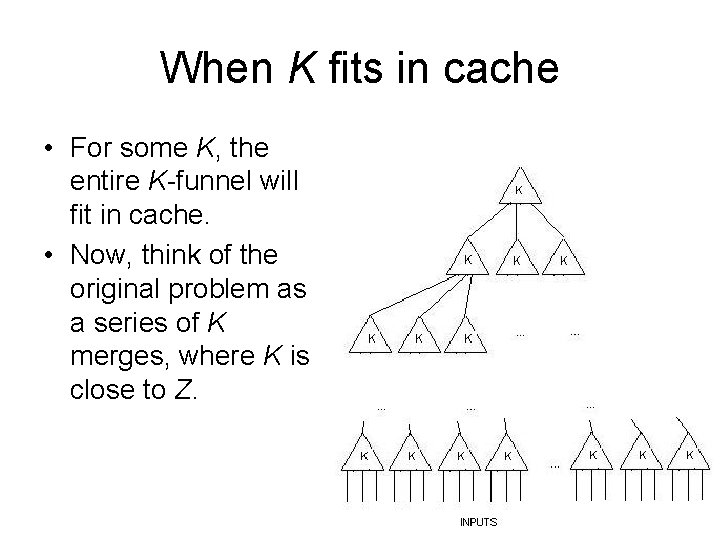
Funnel Sort • Try to get as close to a Z-way merge as possible. • Intuition: Want to recursively lay out a Kway merge (lets call it a K-funnel) to consist of smaller funnels. • Important that all K-funnels be the same size no matter what location in the sort tree!
• Note that all K-funnels will be of the same size regardless of the size of inputs. • At some point, K is small enough that the Kway merge fits into cache.
When K fits in cache • For some K, the entire K-funnel will fit in cache. • Now, think of the original problem as a series of K merges, where K is close to Z.
Funnel Sort cache efficiency • For the appropriate constants for the size of buffers, achieve O(n/L * (log n)/(log Z)) cache misses for this cache-oblivious sorting algorithm. • Provable that no better cache-oblivious bound exists.
Performance: Serial Execution • Actual implementation performed poorly! • Runs significantly slower than Quicksort (about 4 x as slow).
Why? Possible Reasons • Bad implementation. • Runtime not dominated by cache misses. • Much more memory management than Quick Sort (not in place). • Lots of calculations to keep track of buffers and how full they are. • Cache dominated by the internal buffers of a funnel, for a K-funnel, K^2 memory used for internal buffers, 2*K used for input buffers. • Rounding errors! Funnel sort relies on taking square roots, and cube roots often, which in practice yields an imbalanced funnel.
Cache Performance • Tested by changing type of item being sorted from int to long. Should approximately double the number of cache misses! • Change in performance is less than 5% slower in a 4 -way merge sort (Cilk Sort, implemented by Matteo Frigo), implying perhaps that cache misses are not a large cost. • Appears that Funnel Sort suffers the smallest slowdown from increasing the size of data (versus Quick Sort and Cilk Sort), but difficult to say accurately.
Parallelize Funnel. Sort? • Not terribly practical without a fast serial implementation. • Lends well to parallelism. – Recursive merging can be done on separate processors. – Because of buffering, final merge shortly after inputs start being processed. – Could use locks on the circular buffers so that simultaneous reads from the head and writes to the tail are possible. – With log(n)/log(Z) processors, possibly O(n) sorting?
Conclusions • Possible to create a cache-oblivious sorting algorithm that has cache misses on the order of a cache-aware algorithm. • In practice, difficult to implement correctly. • Extra overhead difficult to recover with the reduced cache misses. • Potentially very parallelizable.