Fundamentals of Physics 8e 26 Ohms Law D
- Slides: 14
Fundamentals of Physics 8/e 26 - Ohm's Law D. Halliday, R. Resnick, and J. Walker 國立彰化師大教學卓越計畫 理學院普通物理整合型教材 主持人:郭艷光院長
Outline n 26 -1 What Is Physics? n 26 -2 Electric Current n 26 -3 Current Density n 26 -4 Resistance and Resistivity n 26 -5 Ohm’s Law n 26 -6 A Microscopic View of Ohm’s Law n 26 -7 Power in Electric Circuits n 26 -8 Semiconductors n 26 -9 Superconductors 彰化師大教學卓越-普物教材-理學院長郭艷光主持 2
26 -1 What Is Physics? n In this and the next chapter, we discuss the physics of electric currents —that is, charges in motion. 彰化師大教學卓越-普物教材-理學院長郭艷光主持 3
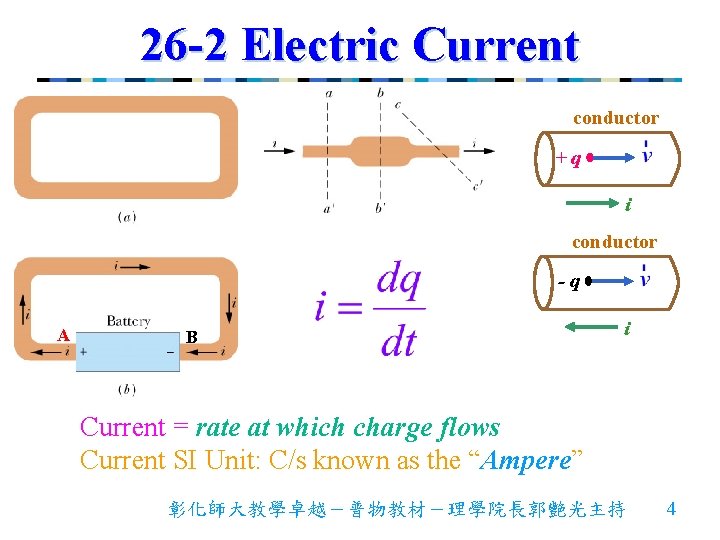
26 -2 Electric Current conductor +q i conductor -q A B i Current = rate at which charge flows Current SI Unit: C/s known as the “Ampere” 彰化師大教學卓越-普物教材-理學院長郭艷光主持 4
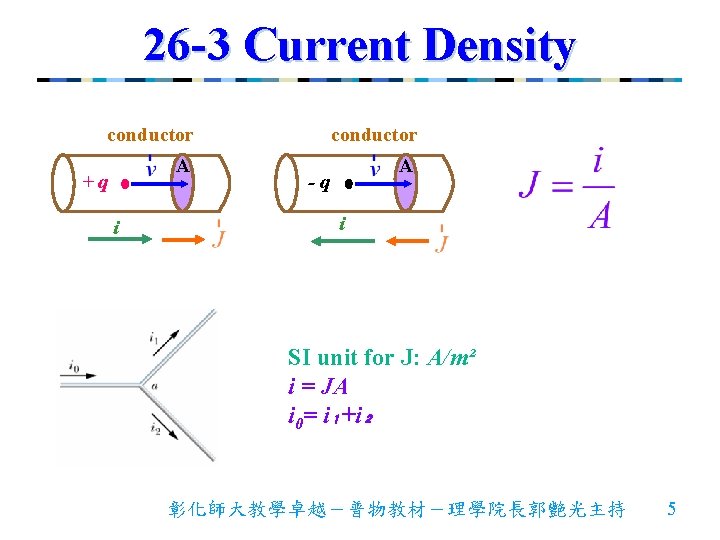
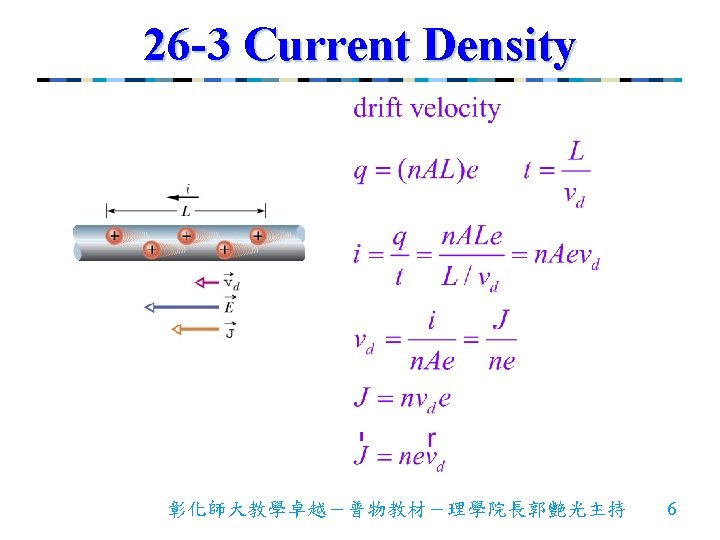
26 -3 Current Density conductor A +q i conductor A -q i SI unit for J: A/m² i = JA i 0= i₁+i₂ 彰化師大教學卓越-普物教材-理學院長郭艷光主持 5
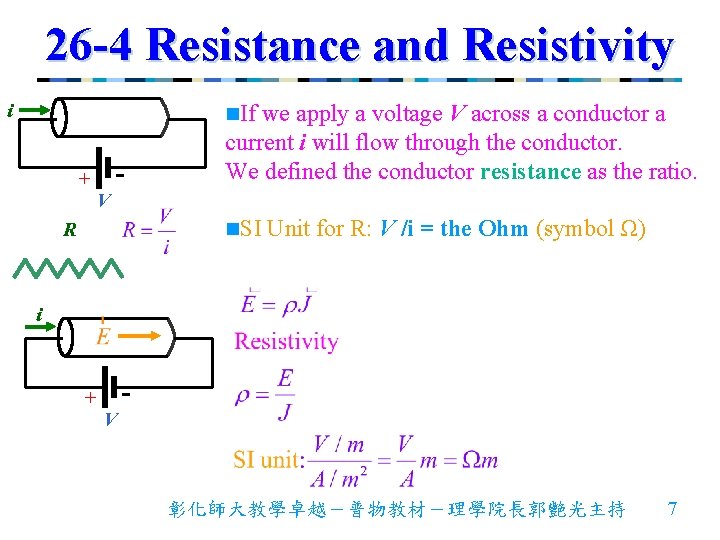
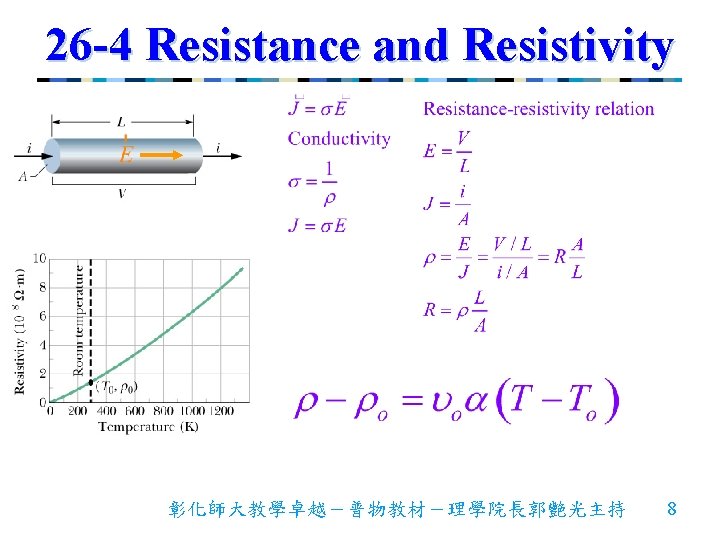
26 -4 Resistance and Resistivity i n. If + V - we apply a voltage V across a conductor a current i will flow through the conductor. We defined the conductor resistance as the ratio. n. SI R Unit for R: V /i = the Ohm (symbol Ω) i + V - 彰化師大教學卓越-普物教材-理學院長郭艷光主持 7
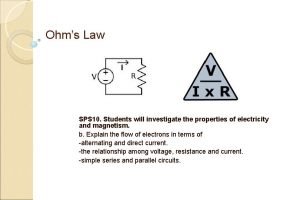
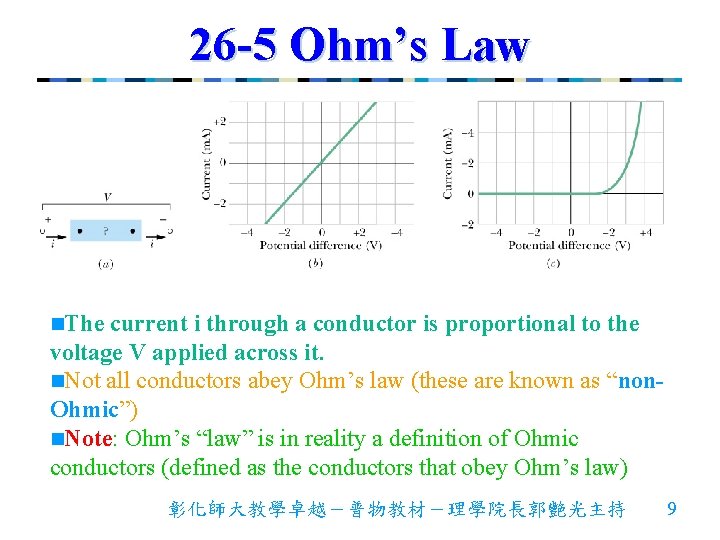
26 -5 Ohm’s Law n. The current i through a conductor is proportional to the voltage V applied across it. n. Not all conductors abey Ohm’s law (these are known as “non. Ohmic”) n. Note: Ohm’s “law” is in reality a definition of Ohmic conductors (defined as the conductors that obey Ohm’s law) 彰化師大教學卓越-普物教材-理學院長郭艷光主持 9
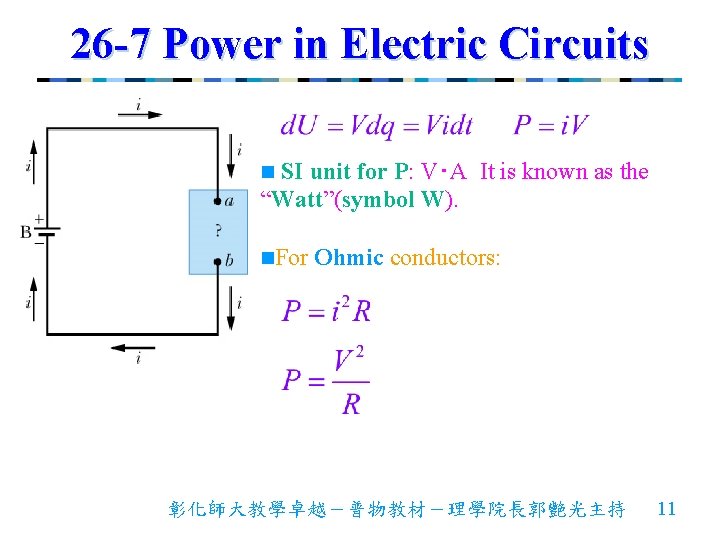
26 -7 Power in Electric Circuits SI unit for P: V‧A It is known as the “Watt”(symbol W). n n. For Ohmic conductors: 彰化師大教學卓越-普物教材-理學院長郭艷光主持 11
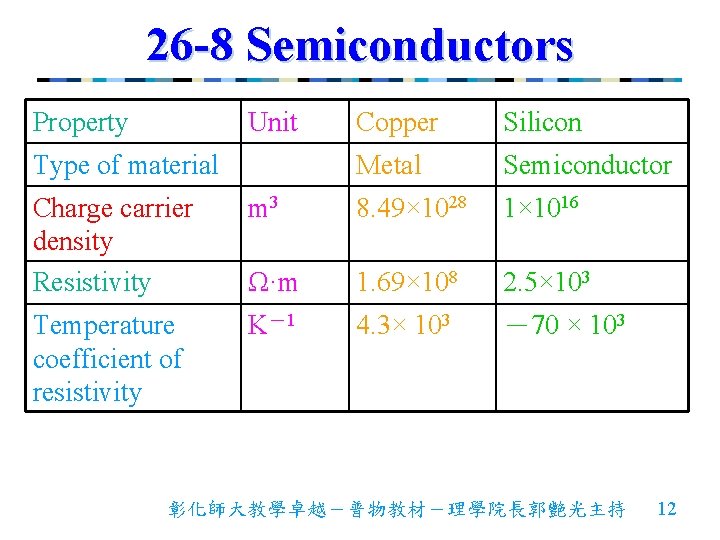
26 -8 Semiconductors Property Unit Type of material Copper Silicon Metal Semiconductor Charge carrier density Resistivity m 3 8. 49× 1028 1× 10¹⁶ Ω·m 1. 69× 108 2. 5× 10³ Temperature coefficient of resistivity K-1 4. 3× 10³ -70 × 103 彰化師大教學卓越-普物教材-理學院長郭艷光主持 12
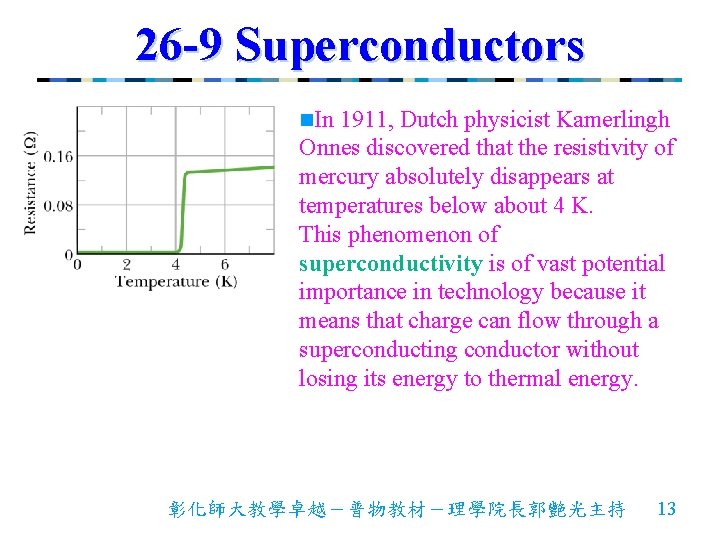
26 -9 Superconductors n. In 1911, Dutch physicist Kamerlingh Onnes discovered that the resistivity of mercury absolutely disappears at temperatures below about 4 K. This phenomenon of superconductivity is of vast potential importance in technology because it means that charge can flow through a superconducting conductor without losing its energy to thermal energy. 彰化師大教學卓越-普物教材-理學院長郭艷光主持 13