Foundations of Cognitive Psychology Part 2 History of
- Slides: 12
Foundations of Cognitive Psychology Part 2 – History of Cognitive Psychology
Contributors to the History of Psychology
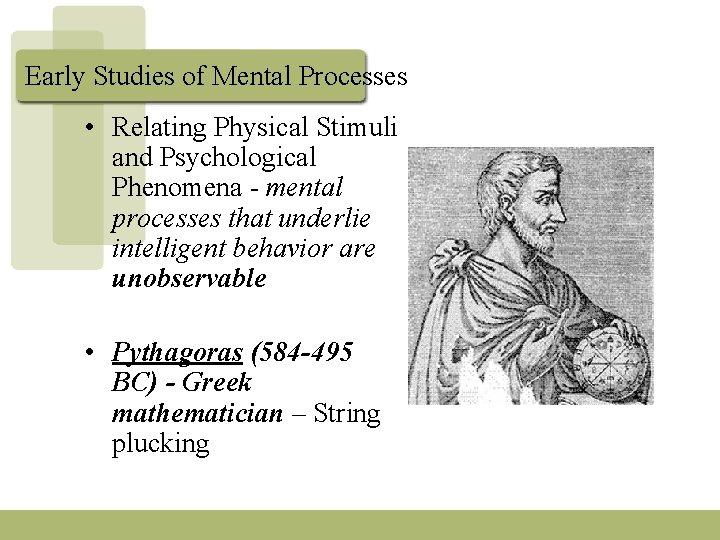
Early Studies of Mental Processes • Relating Physical Stimuli and Psychological Phenomena - mental processes that underlie intelligent behavior are unobservable • Pythagoras (584 -495 BC) - Greek mathematician – String plucking
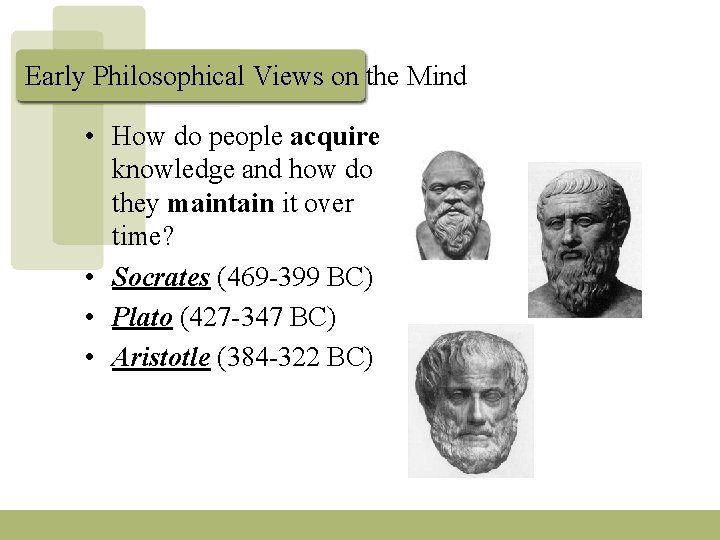
Early Philosophical Views on the Mind • How do people acquire knowledge and how do they maintain it over time? • Socrates (469 -399 BC) • Plato (427 -347 BC) • Aristotle (384 -322 BC)
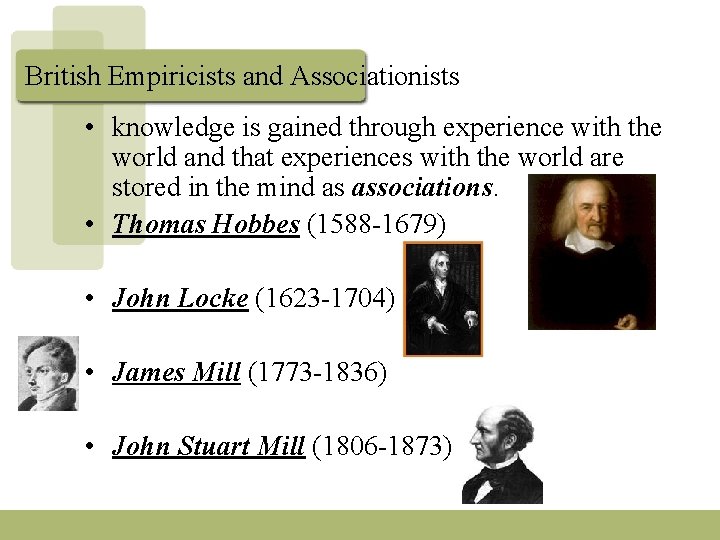
British Empiricists and Associationists • knowledge is gained through experience with the world and that experiences with the world are stored in the mind as associations. • Thomas Hobbes (1588 -1679) • John Locke (1623 -1704) • James Mill (1773 -1836) • John Stuart Mill (1806 -1873)
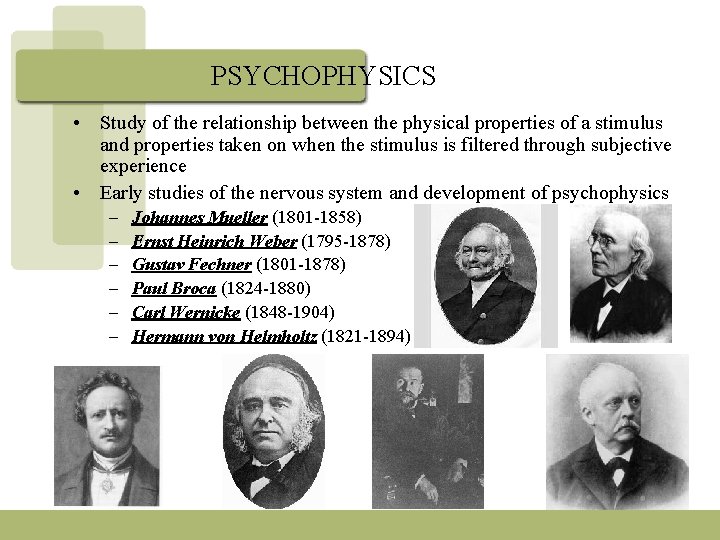
PSYCHOPHYSICS • Study of the relationship between the physical properties of a stimulus and properties taken on when the stimulus is filtered through subjective experience • Early studies of the nervous system and development of psychophysics – – – Johannes Mueller (1801 -1858) Ernst Heinrich Weber (1795 -1878) Gustav Fechner (1801 -1878) Paul Broca (1824 -1880) Carl Wernicke (1848 -1904) Hermann von Helmholtz (1821 -1894)
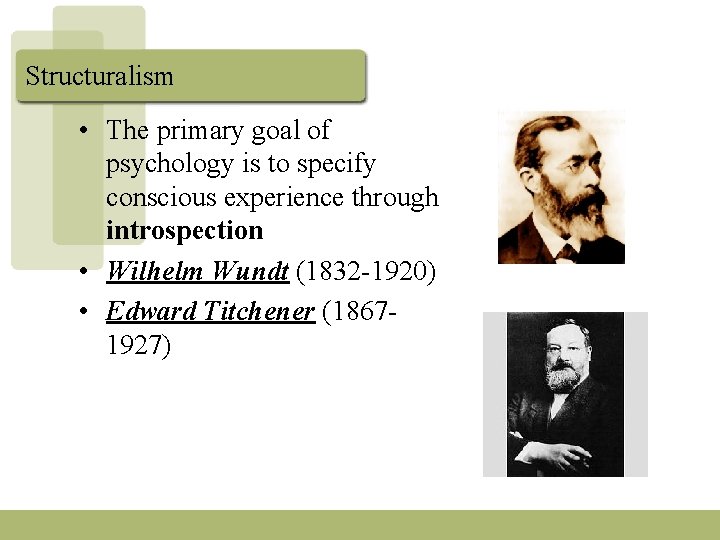
Structuralism • The primary goal of psychology is to specify conscious experience through introspection • Wilhelm Wundt (1832 -1920) • Edward Titchener (18671927)
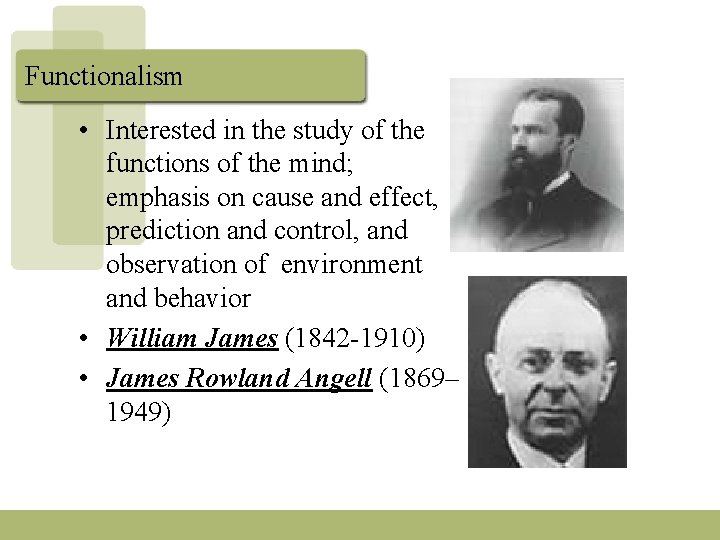
Functionalism • Interested in the study of the functions of the mind; emphasis on cause and effect, prediction and control, and observation of environment and behavior • William James (1842 -1910) • James Rowland Angell (1869– 1949)
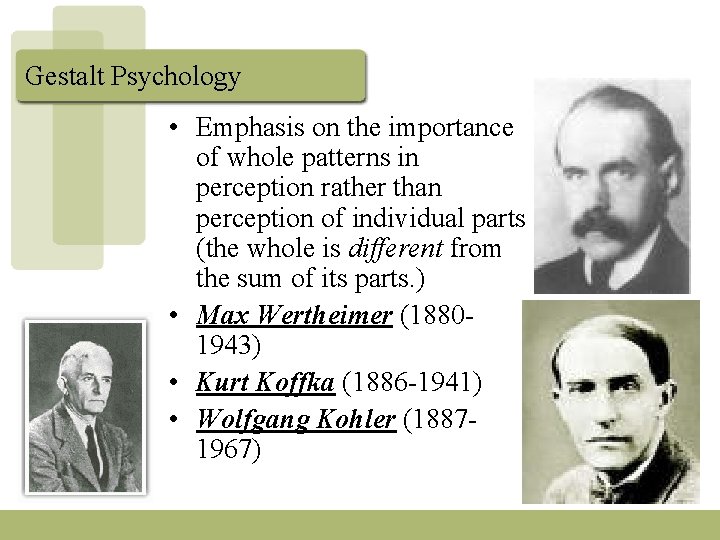
Gestalt Psychology • Emphasis on the importance of whole patterns in perception rather than perception of individual parts (the whole is different from the sum of its parts. ) • Max Wertheimer (18801943) • Kurt Koffka (1886 -1941) • Wolfgang Kohler (18871967)
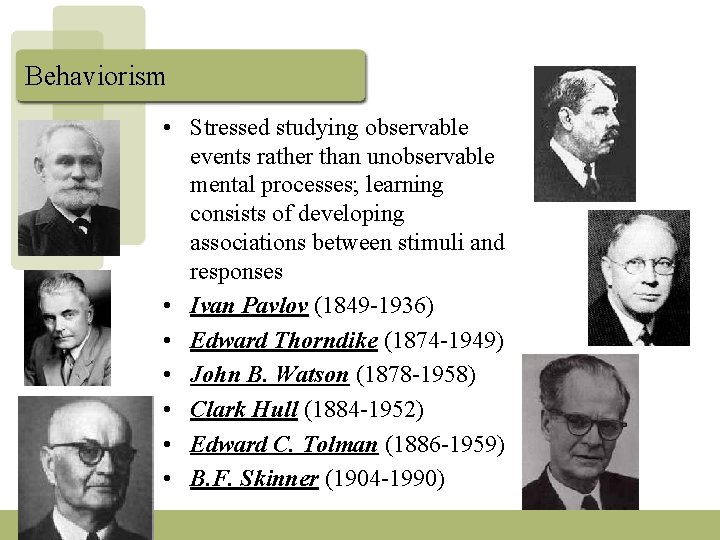
Behaviorism • Stressed studying observable events rather than unobservable mental processes; learning consists of developing associations between stimuli and responses • Ivan Pavlov (1849 -1936) • Edward Thorndike (1874 -1949) • John B. Watson (1878 -1958) • Clark Hull (1884 -1952) • Edward C. Tolman (1886 -1959) • B. F. Skinner (1904 -1990)
History of Cognitive Psychology – Love/Hate Relationships
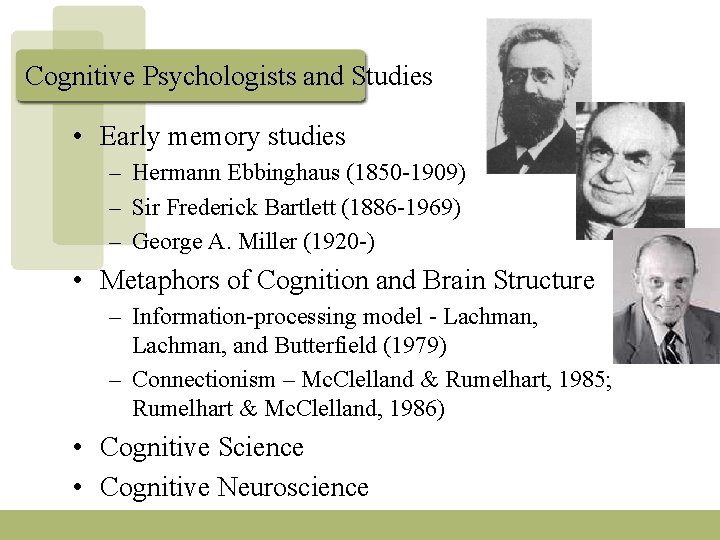
Cognitive Psychologists and Studies • Early memory studies – Hermann Ebbinghaus (1850 -1909) – Sir Frederick Bartlett (1886 -1969) – George A. Miller (1920 -) • Metaphors of Cognition and Brain Structure – Information-processing model - Lachman, and Butterfield (1979) – Connectionism – Mc. Clelland & Rumelhart, 1985; Rumelhart & Mc. Clelland, 1986) • Cognitive Science • Cognitive Neuroscience