Foundations of Addictions Counseling 3E David Capuzzi Mark
- Slides: 17
Foundations of Addictions Counseling, 3/E David Capuzzi & Mark D. Stauffer Chapter 13 Maintenance and Relapse Prevention Updated by Melinda Haley, Walden University Copyright © 2016, 2012, 2008 by Pearson Education, Inc. All Rights Reserved
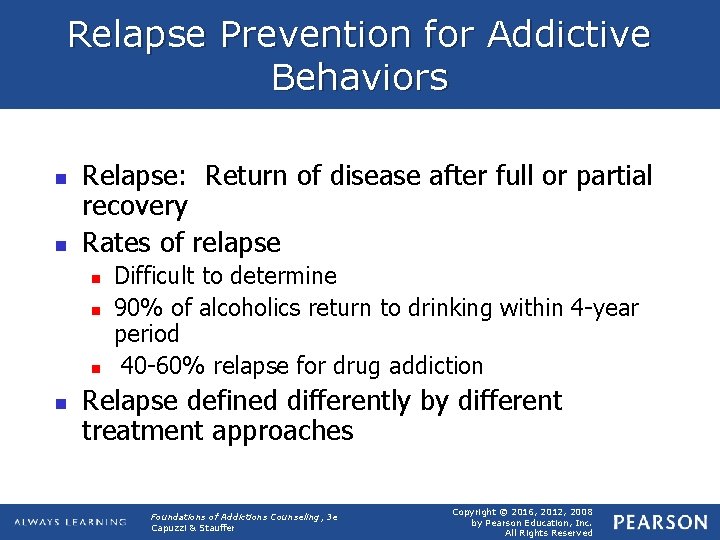
Relapse Prevention for Addictive Behaviors n n Relapse: Return of disease after full or partial recovery Rates of relapse n n Difficult to determine 90% of alcoholics return to drinking within 4 -year period 40 -60% relapse for drug addiction Relapse defined differently by different treatment approaches Foundations of Addictions Counseling, 3 e Capuzzi & Stauffer Copyright © 2016, 2012, 2008 by Pearson Education, Inc. All Rights Reserved
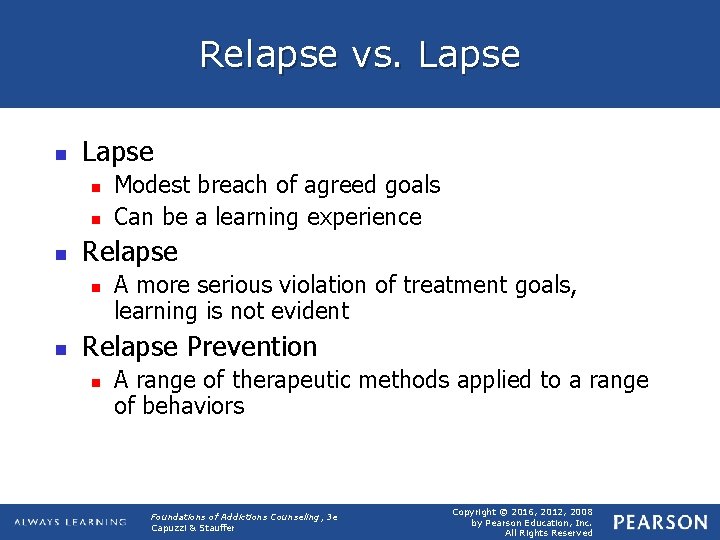
Relapse vs. Lapse n n n Relapse n n Modest breach of agreed goals Can be a learning experience A more serious violation of treatment goals, learning is not evident Relapse Prevention n A range of therapeutic methods applied to a range of behaviors Foundations of Addictions Counseling, 3 e Capuzzi & Stauffer Copyright © 2016, 2012, 2008 by Pearson Education, Inc. All Rights Reserved
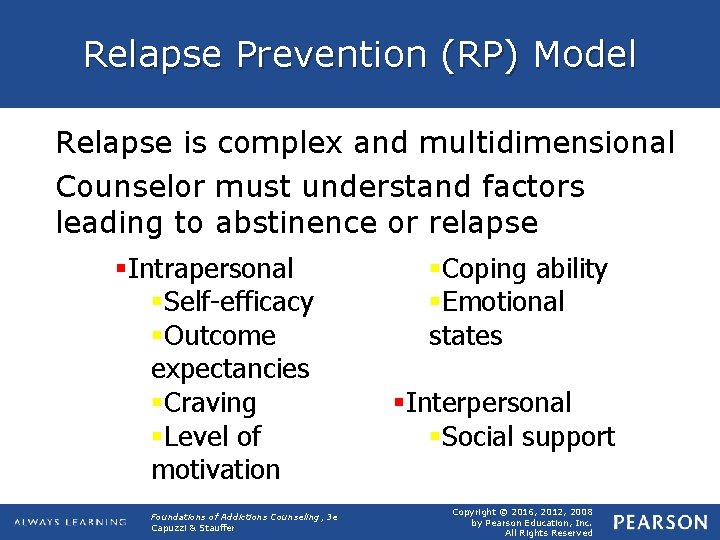
Relapse Prevention (RP) Model Relapse is complex and multidimensional Counselor must understand factors leading to abstinence or relapse §Intrapersonal §Self-efficacy §Outcome expectancies §Craving §Level of motivation Foundations of Addictions Counseling, 3 e Capuzzi & Stauffer §Coping ability §Emotional states §Interpersonal §Social support Copyright © 2016, 2012, 2008 by Pearson Education, Inc. All Rights Reserved
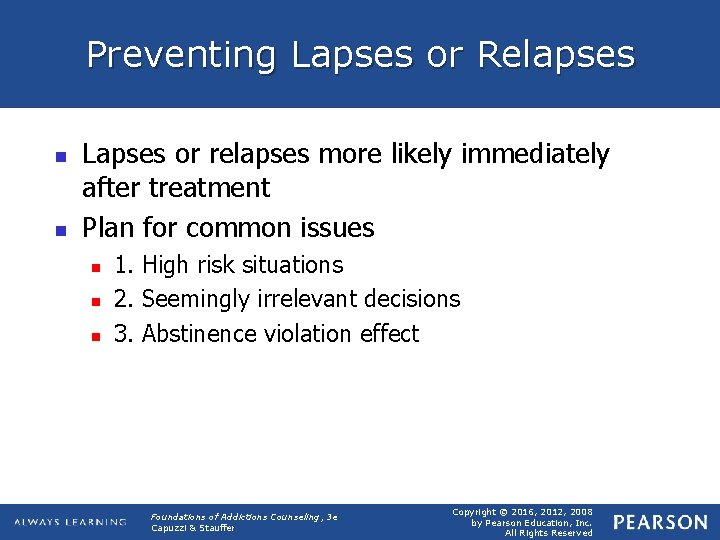
Preventing Lapses or Relapses n n Lapses or relapses more likely immediately after treatment Plan for common issues n n n 1. High risk situations 2. Seemingly irrelevant decisions 3. Abstinence violation effect Foundations of Addictions Counseling, 3 e Capuzzi & Stauffer Copyright © 2016, 2012, 2008 by Pearson Education, Inc. All Rights Reserved
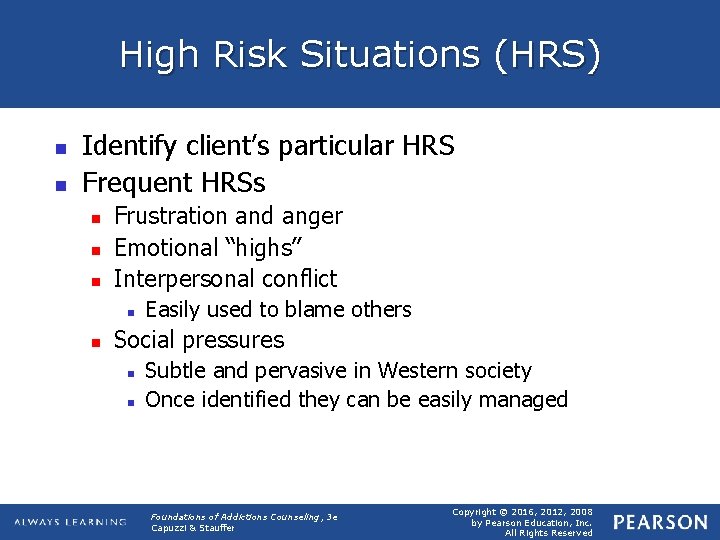
High Risk Situations (HRS) n n Identify client’s particular HRS Frequent HRSs n n n Frustration and anger Emotional “highs” Interpersonal conflict n n Easily used to blame others Social pressures n n Subtle and pervasive in Western society Once identified they can be easily managed Foundations of Addictions Counseling, 3 e Capuzzi & Stauffer Copyright © 2016, 2012, 2008 by Pearson Education, Inc. All Rights Reserved
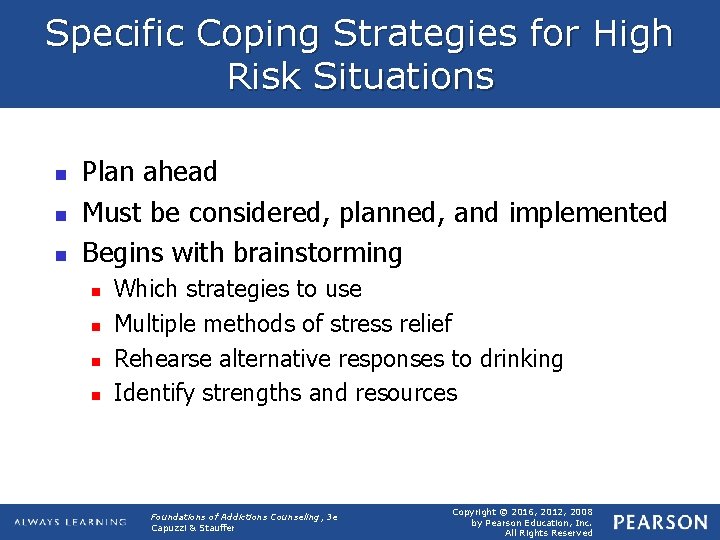
Specific Coping Strategies for High Risk Situations n n n Plan ahead Must be considered, planned, and implemented Begins with brainstorming n n Which strategies to use Multiple methods of stress relief Rehearse alternative responses to drinking Identify strengths and resources Foundations of Addictions Counseling, 3 e Capuzzi & Stauffer Copyright © 2016, 2012, 2008 by Pearson Education, Inc. All Rights Reserved
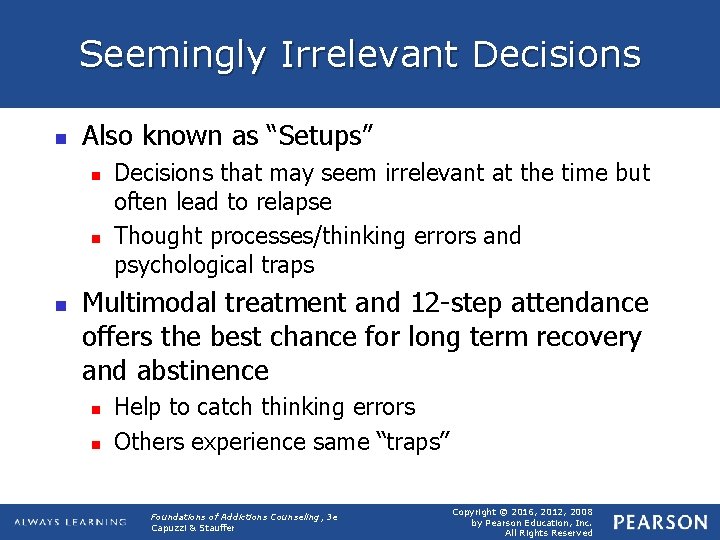
Seemingly Irrelevant Decisions n Also known as “Setups” n n n Decisions that may seem irrelevant at the time but often lead to relapse Thought processes/thinking errors and psychological traps Multimodal treatment and 12 -step attendance offers the best chance for long term recovery and abstinence n n Help to catch thinking errors Others experience same “traps” Foundations of Addictions Counseling, 3 e Capuzzi & Stauffer Copyright © 2016, 2012, 2008 by Pearson Education, Inc. All Rights Reserved
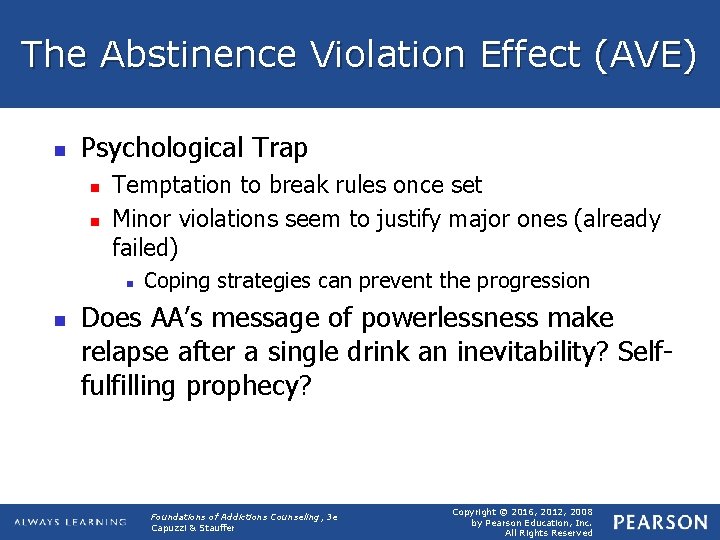
The Abstinence Violation Effect (AVE) n Psychological Trap n n Temptation to break rules once set Minor violations seem to justify major ones (already failed) n n Coping strategies can prevent the progression Does AA’s message of powerlessness make relapse after a single drink an inevitability? Selffulfilling prophecy? Foundations of Addictions Counseling, 3 e Capuzzi & Stauffer Copyright © 2016, 2012, 2008 by Pearson Education, Inc. All Rights Reserved
Lifestyle Change n n Restoring balance to life – work/leisure Balancing “shoulds” and “wants” Foundations of Addictions Counseling, 3 e Capuzzi & Stauffer Copyright © 2016, 2012, 2008 by Pearson Education, Inc. All Rights Reserved
Developing a Management Plan n n n n Stabilization plan Assessment Relapse education Identify warming signs Identify problem solving strategies Recovery planning Inventory training Family involvement Follow up Foundations of Addictions Counseling, 3 e Capuzzi & Stauffer Copyright © 2016, 2012, 2008 by Pearson Education, Inc. All Rights Reserved
Case Study of Relapse Prevention n n n n Thomas, 27 -year old male Married, father of 2 -year old daughter Employed as salesman Cannot keep a job Frequent angry outbursts Anxiety attacks Considering suicide Long time drinker/case of beer daily Foundations of Addictions Counseling, 3 e Capuzzi & Stauffer Copyright © 2016, 2012, 2008 by Pearson Education, Inc. All Rights Reserved
Case Study: Recovery Phase Begins n n n Anti-depressant and anti-anxiety medications Withdrawal and stabilization Identify HRS’s and self-monitor Develop coping strategies Education about lapse and relapses n n Therapeutic contract/time out for relapse Reminder cards Foundations of Addictions Counseling, 3 e Capuzzi & Stauffer Copyright © 2016, 2012, 2008 by Pearson Education, Inc. All Rights Reserved
Case Study: Support Systems n Involvement of family n n Marital relationship System of non-using friends n n Social modeling Disengaging from using friends Foundations of Addictions Counseling, 3 e Capuzzi & Stauffer Copyright © 2016, 2012, 2008 by Pearson Education, Inc. All Rights Reserved
Case Study: Other Lifestyle Changes n n n Change unhealthy environments Body awareness techniques Confront relapse possibilities n n Job/major stressor Financial Strains Foundations of Addictions Counseling, 3 e Capuzzi & Stauffer Copyright © 2016, 2012, 2008 by Pearson Education, Inc. All Rights Reserved
Final Points to Remember n n n Pacing is important Don’t overwhelm client with too many interventions at once Set realistic goals Go slow Balance “shoulds” with pleasure Foundations of Addictions Counseling, 3 e Capuzzi & Stauffer Copyright © 2016, 2012, 2008 by Pearson Education, Inc. All Rights Reserved
Useful Web Sites n About. com: Alcoholism & Substance Abuse n n www. alcoholism. about. com/od/relapse/Relapse_Pr evention. htm Information for Individuals and Families n www. addictionsandrecovery. com Foundations of Addictions Counseling, 3 e Capuzzi & Stauffer Copyright © 2016, 2012, 2008 by Pearson Education, Inc. All Rights Reserved