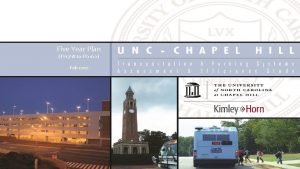
Five Year Plan FY 1718 to FY 2122
- Slides: 20
Five Year Plan (FY 17/18 to FY 21/22) - Feb 2017 - 1
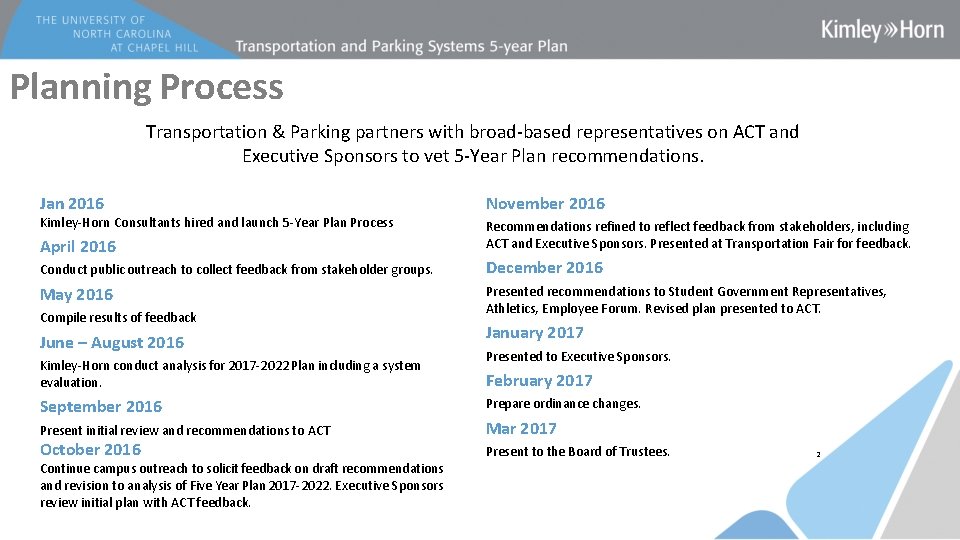
Planning Process Transportation & Parking partners with broad-based representatives on ACT and Executive Sponsors to vet 5 -Year Plan recommendations. Jan 2016 November 2016 April 2016 Recommendations refined to reflect feedback from stakeholders, including ACT and Executive Sponsors. Presented at Transportation Fair for feedback. Kimley-Horn Consultants hired and launch 5 -Year Plan Process Conduct public outreach to collect feedback from stakeholder groups. December 2016 May 2016 Presented recommendations to Student Government Representatives, Athletics, Employee Forum. Revised plan presented to ACT. Compile results of feedback June – August 2016 Kimley-Horn conduct analysis for 2017 -2022 Plan including a system evaluation. September 2016 Present initial review and recommendations to ACT October 2016 Continue campus outreach to solicit feedback on draft recommendations and revision to analysis of Five Year Plan 2017 -2022. Executive Sponsors review initial plan with ACT feedback. January 2017 Presented to Executive Sponsors. February 2017 Prepare ordinance changes. Mar 2017 Present to the Board of Trustees. 2
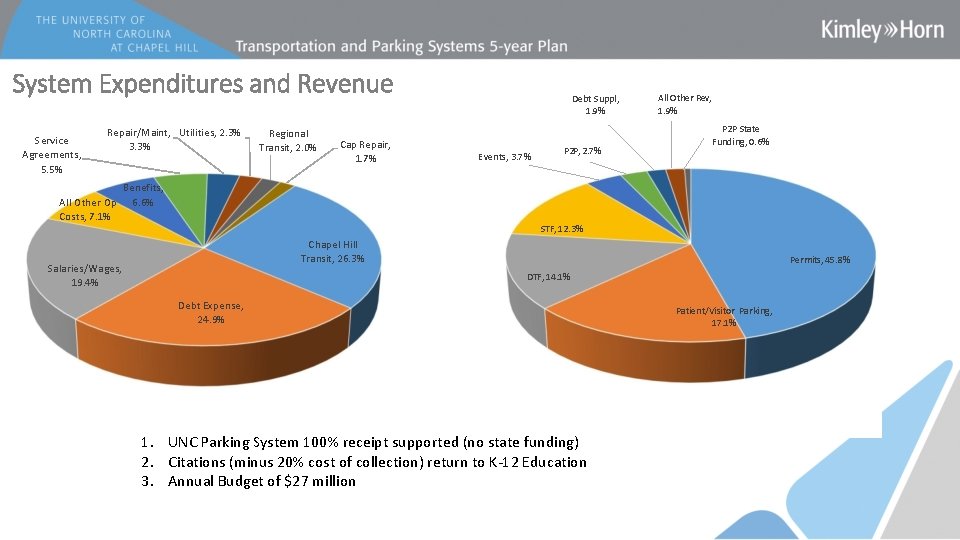
System Expenditures and Revenue Service Agreements, 5. 5% Repair/Maint, Utilities, 2. 3% 3. 3% Regional Transit, 2. 0% Cap Repair, 1. 7% Benefits, All Other Op 6. 6% Costs, 7. 1% Debt Suppl, 1. 9% Events, 3. 7% P 2 P, 2. 7% All Other Rev, 1. 9% P 2 P State Funding, 0. 6% STF, 12. 3% Chapel Hill Transit, 26. 3% Salaries/Wages, 19. 4% Permits, 45. 8% DTF, 14. 1% Debt Expense, 24. 9% 1. UNC Parking System 100% receipt supported (no state funding) 2. Citations (minus 20% cost of collection) return to K-12 Education 3. Annual Budget of $27 million Patient/Visitor Parking, 17. 1%
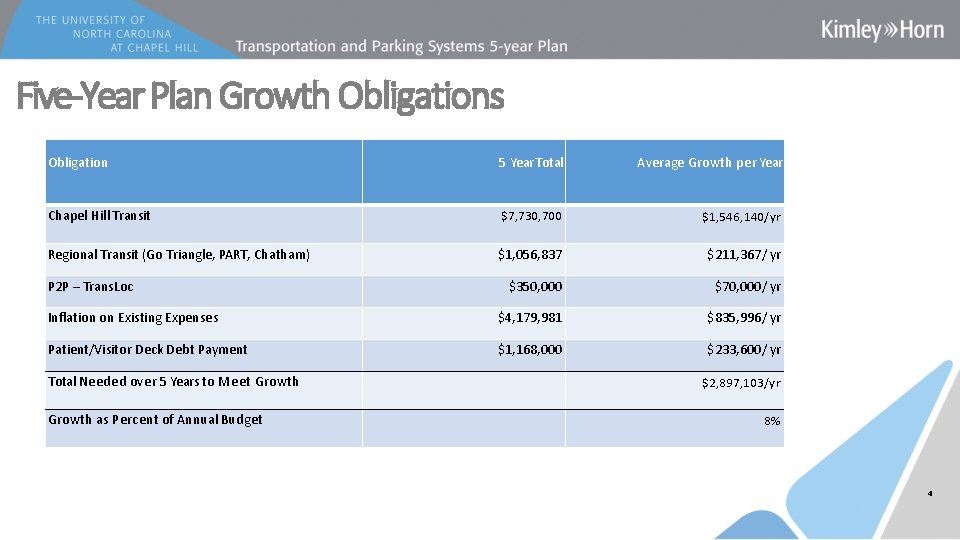
Five-Year Plan Growth Obligations Obligation 5 Year Total Average Growth per Year Chapel Hill Transit $7, 730, 700 $1, 546, 140/yr Regional Transit (Go Triangle, PART, Chatham) $1, 056, 837 $211, 367/ yr $350, 000 $70, 000/ yr Inflation on Existing Expenses $4, 179, 981 $835, 996/ yr Patient/Visitor Deck Debt Payment $1, 168, 000 $233, 600/ yr P 2 P – Trans. Loc Total Needed over 5 Years to Meet Growth as Percent of Annual Budget $2, 897, 103/yr 8% 4
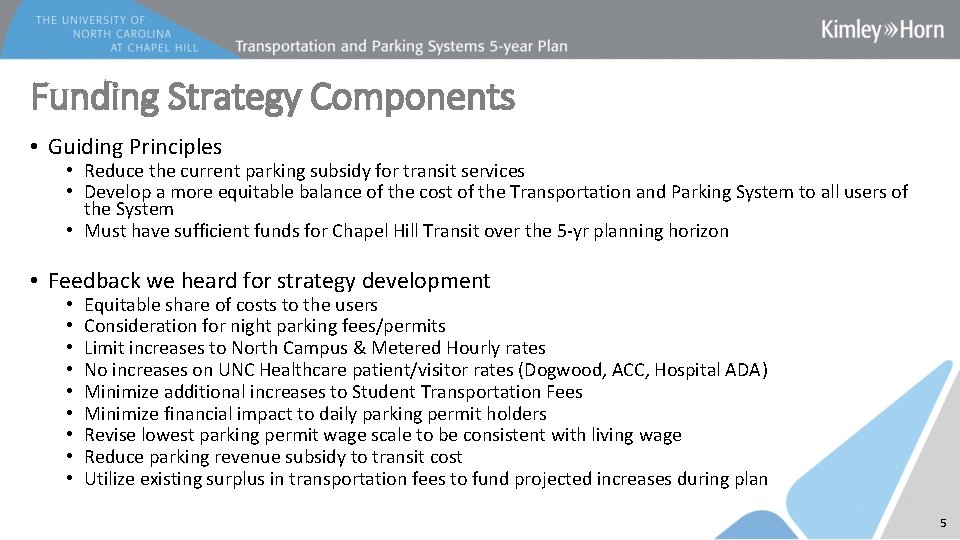
Funding Strategy Components • Guiding Principles • Reduce the current parking subsidy for transit services • Develop a more equitable balance of the cost of the Transportation and Parking System to all users of the System • Must have sufficient funds for Chapel Hill Transit over the 5 -yr planning horizon • Feedback we heard for strategy development • • • Equitable share of costs to the users Consideration for night parking fees/permits Limit increases to North Campus & Metered Hourly rates No increases on UNC Healthcare patient/visitor rates (Dogwood, ACC, Hospital ADA) Minimize additional increases to Student Transportation Fees Minimize financial impact to daily parking permit holders Revise lowest parking permit wage scale to be consistent with living wage Reduce parking revenue subsidy to transit cost Utilize existing surplus in transportation fees to fund projected increases during plan 5
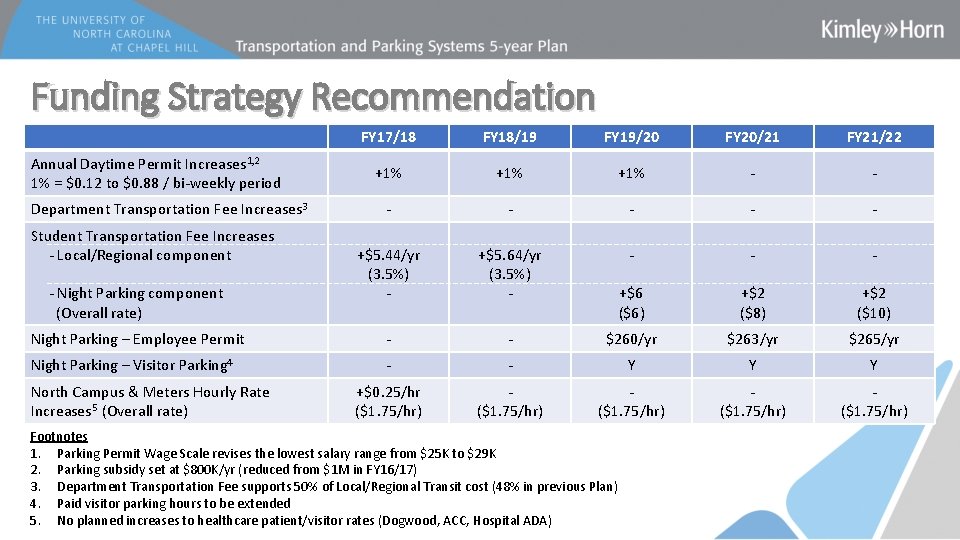
Funding Strategy Recommendation FY 17/18 FY 18/19 FY 19/20 FY 20/21 FY 21/22 +1% +1% - - - - +$5. 44/yr (3. 5%) - +$5. 64/yr (3. 5%) - - +$6 ($6) +$2 ($8) +$2 ($10) Night Parking – Employee Permit - - $260/yr $263/yr $265/yr Night Parking – Visitor Parking 4 - - Y Y Y +$0. 25/hr ($1. 75/hr) Annual Daytime Permit Increases 1, 2 1% = $0. 12 to $0. 88 / bi-weekly period Department Transportation Fee Increases 3 Student Transportation Fee Increases - Local/Regional component - Night Parking component (Overall rate) North Campus & Meters Hourly Rate Increases 5 (Overall rate) Footnotes 1. Parking Permit Wage Scale revises the lowest salary range from $25 K to $29 K 2. Parking subsidy set at $800 K/yr (reduced from $1 M in FY 16/17) 3. Department Transportation Fee supports 50% of Local/Regional Transit cost (48% in previous Plan) 4. Paid visitor parking hours to be extended 5. No planned increases to healthcare patient/visitor rates (Dogwood, ACC, Hospital ADA)
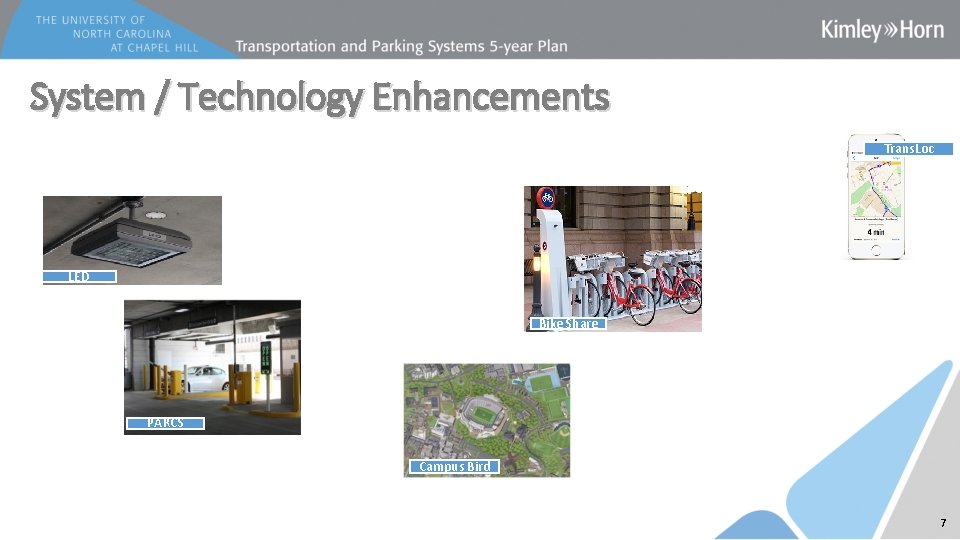
System / Technology Enhancements Trans. Loc LED Bike Share PARCS Campus Bird 7
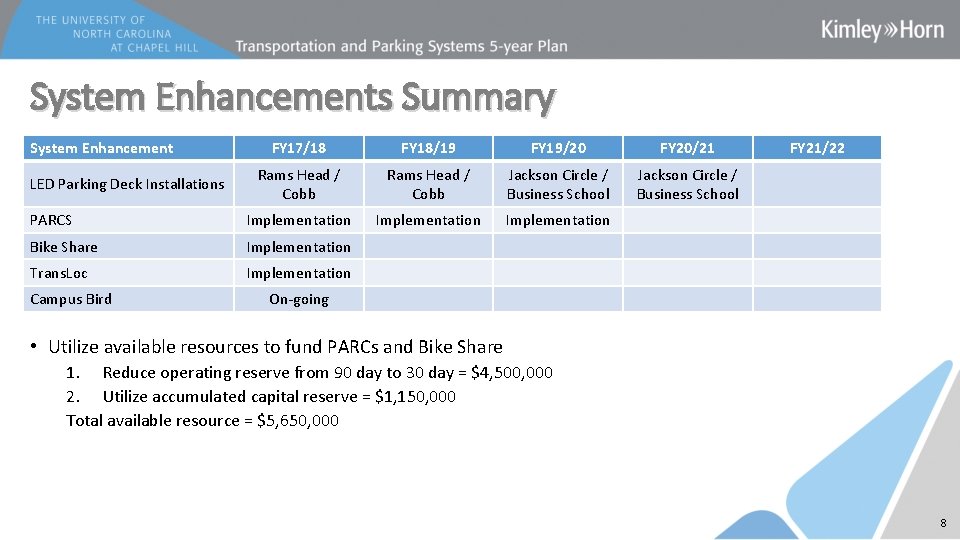
System Enhancements Summary System Enhancement FY 17/18 FY 18/19 FY 19/20 FY 20/21 Rams Head / Cobb Jackson Circle / Business School PARCS Implementation Bike Share Implementation Trans. Loc Implementation LED Parking Deck Installations Campus Bird FY 21/22 On-going • Utilize available resources to fund PARCs and Bike Share 1. Reduce operating reserve from 90 day to 30 day = $4, 500, 000 2. Utilize accumulated capital reserve = $1, 150, 000 Total available resource = $5, 650, 000 8
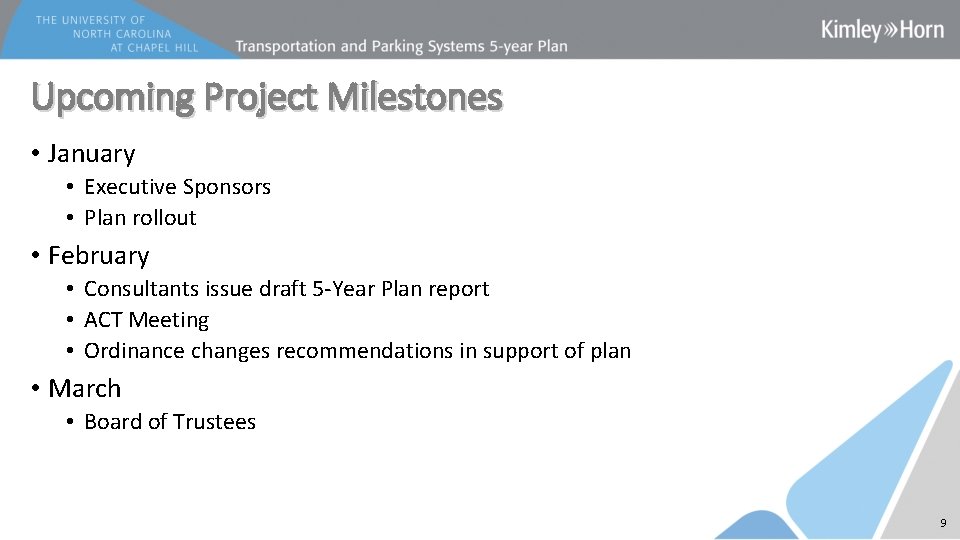
Upcoming Project Milestones • January • Executive Sponsors • Plan rollout • February • Consultants issue draft 5 -Year Plan report • ACT Meeting • Ordinance changes recommendations in support of plan • March • Board of Trustees 9
Questions? 10
**Appendix** 11
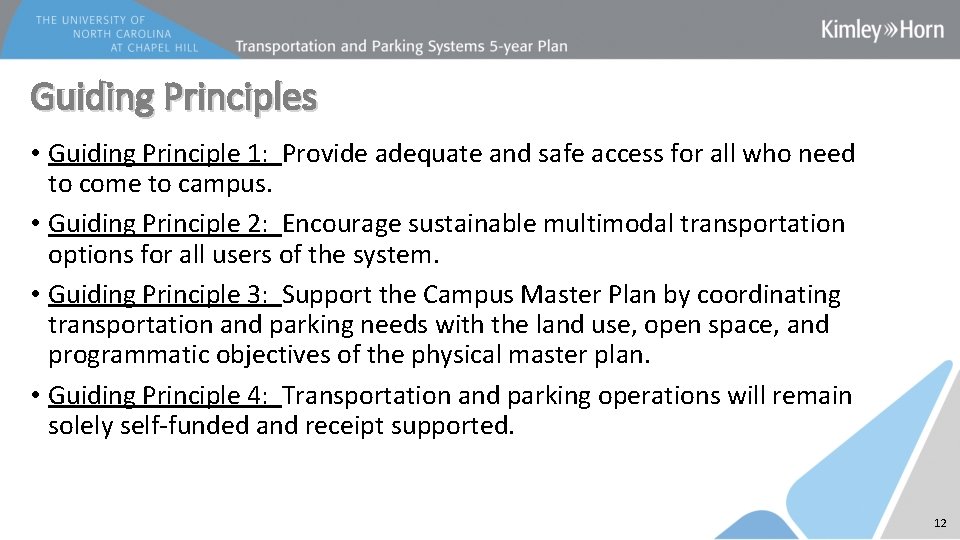
Guiding Principles • Guiding Principle 1: Provide adequate and safe access for all who need to come to campus. • Guiding Principle 2: Encourage sustainable multimodal transportation options for all users of the system. • Guiding Principle 3: Support the Campus Master Plan by coordinating transportation and parking needs with the land use, open space, and programmatic objectives of the physical master plan. • Guiding Principle 4: Transportation and parking operations will remain solely self-funded and receipt supported. 12
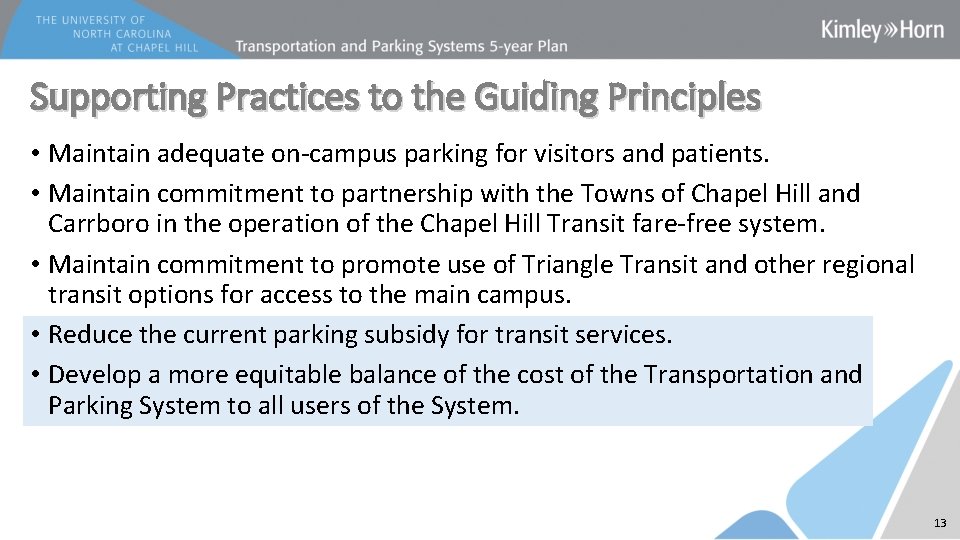
Supporting Practices to the Guiding Principles • Maintain adequate on-campus parking for visitors and patients. • Maintain commitment to partnership with the Towns of Chapel Hill and Carrboro in the operation of the Chapel Hill Transit fare-free system. • Maintain commitment to promote use of Triangle Transit and other regional transit options for access to the main campus. • Reduce the current parking subsidy for transit services. • Develop a more equitable balance of the cost of the Transportation and Parking System to all users of the System. 13
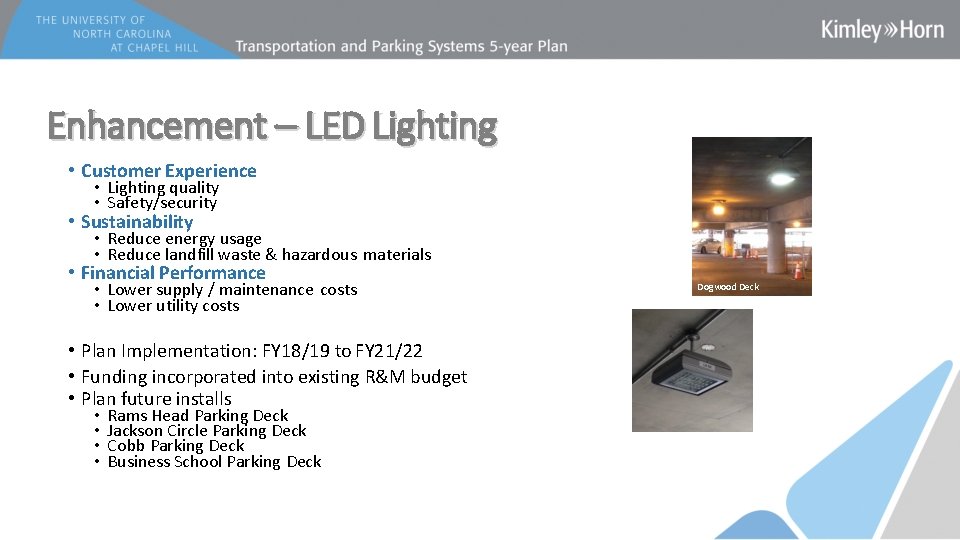
Enhancement – LED Lighting • Customer Experience • Lighting quality • Safety/security • Sustainability • Reduce energy usage • Reduce landfill waste & hazardous materials • Financial Performance • Lower supply / maintenance costs • Lower utility costs • Plan Implementation: FY 18/19 to FY 21/22 • Funding incorporated into existing R&M budget • Plan future installs • • Rams Head Parking Deck Jackson Circle Parking Deck Cobb Parking Deck Business School Parking Deck Dogwood Deck
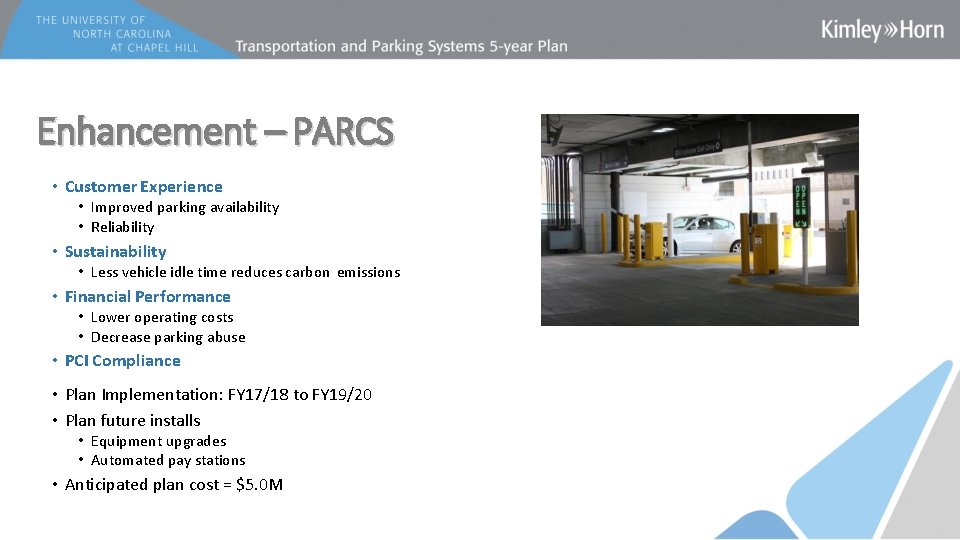
Enhancement – PARCS • Customer Experience • Improved parking availability • Reliability • Sustainability • Less vehicle idle time reduces carbon emissions • Financial Performance • Lower operating costs • Decrease parking abuse • PCI Compliance • Plan Implementation: FY 17/18 to FY 19/20 • Plan future installs • Equipment upgrades • Automated pay stations • Anticipated plan cost = $5. 0 M
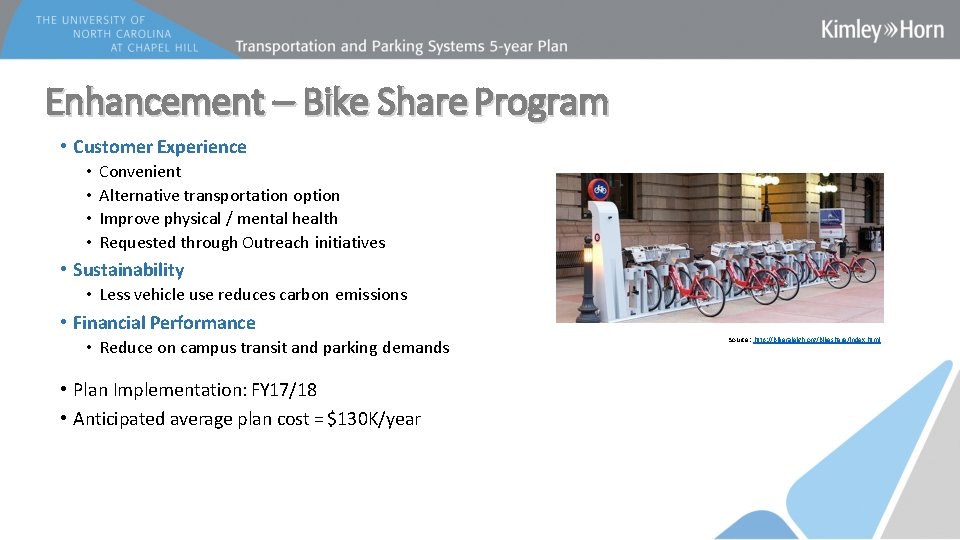
Enhancement – Bike Share Program • Customer Experience • • Convenient Alternative transportation option Improve physical / mental health Requested through Outreach initiatives • Sustainability • Less vehicle use reduces carbon emissions • Financial Performance • Reduce on campus transit and parking demands • Plan Implementation: FY 17/18 • Anticipated average plan cost = $130 K/year Source: http: //bikeraleigh. org/bikeshare/index. html
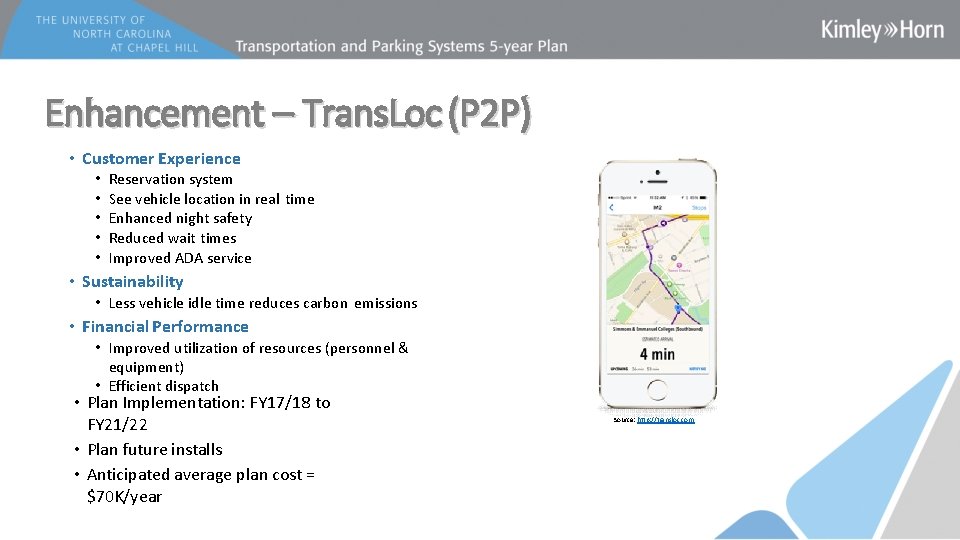
Enhancement – Trans. Loc (P 2 P) • Customer Experience • • • Reservation system See vehicle location in real time Enhanced night safety Reduced wait times Improved ADA service • Sustainability • Less vehicle idle time reduces carbon emissions • Financial Performance • Improved utilization of resources (personnel & equipment) • Efficient dispatch • Plan Implementation: FY 17/18 to FY 21/22 • Plan future installs • Anticipated average plan cost = $70 K/year Source: http: //transloc. com
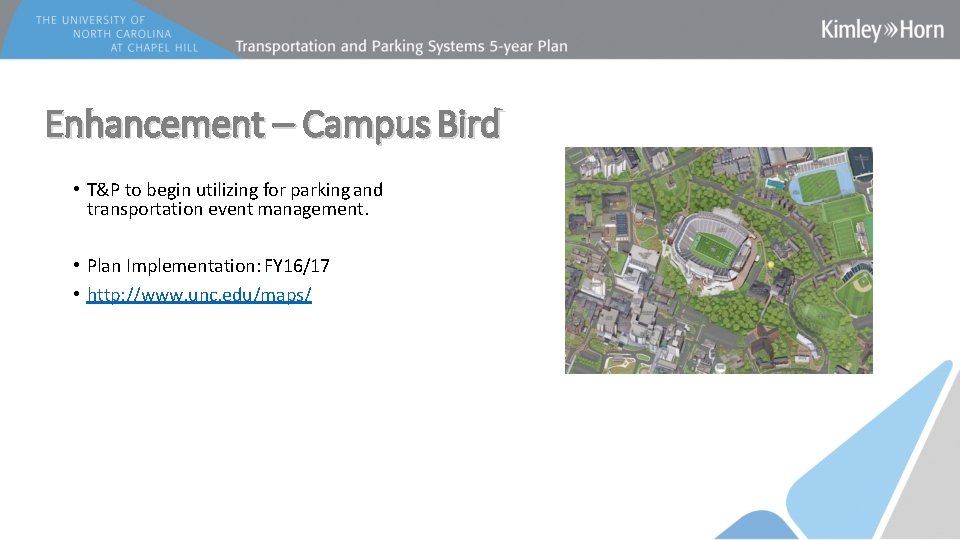
Enhancement – Campus Bird • T&P to begin utilizing for parking and transportation event management. • Plan Implementation: FY 16/17 • http: //www. unc. edu/maps/
Night Parking – Program Details • • Night parking program: Monday - Friday, 5 PM – 7: 30 AM Daytime and Park & Ride permits honored at night Employees purchase/register permits through department All undergraduate (excluding first-year) and graduate students eligible for permit • Students pay annual fee for program • First-year students do not pay fee and do not receive a permit • Paid visitor/metered parking hours extended in areas not currently operating 24 hours • Parking is not zoned • Employee/student permits allow parking on a first-come, first-serve basis in most lots throughout campus • Freedom to park in available proximate parking to destination • Lots throughout campus will be designated for online/mobile permits to increase availability to public or infrequent users • Continued work with Advisory Group and campus partners to address issues prior to implementation • Implementation Date = FY 19/20
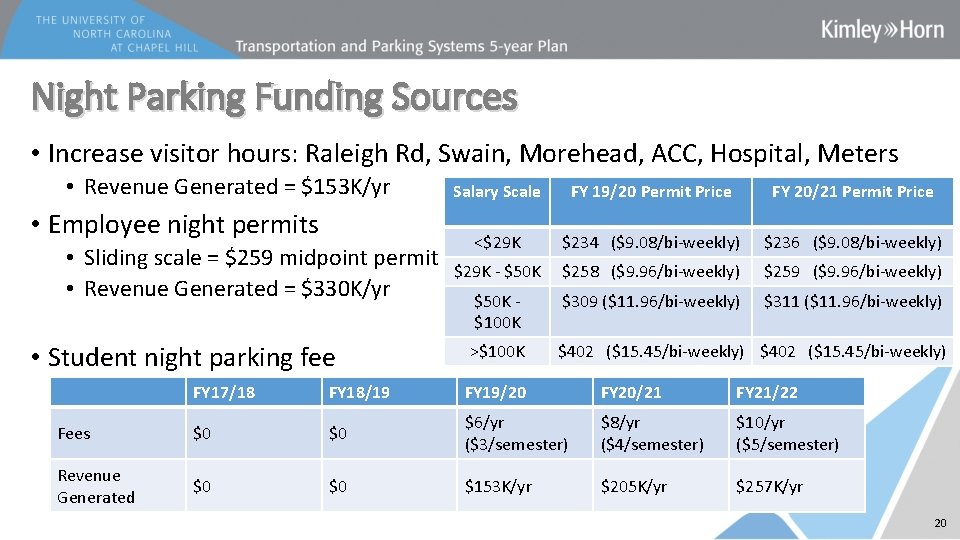
Night Parking Funding Sources • Increase visitor hours: Raleigh Rd, Swain, Morehead, ACC, Hospital, Meters • Revenue Generated = $153 K/yr • Employee night permits • Sliding scale = $259 midpoint permit • Revenue Generated = $330 K/yr • Student night parking fee Salary Scale FY 19/20 Permit Price FY 20/21 Permit Price <$29 K $234 ($9. 08/bi-weekly) $236 ($9. 08/bi-weekly) $29 K - $50 K $258 ($9. 96/bi-weekly) $259 ($9. 96/bi-weekly) $50 K $100 K $309 ($11. 96/bi-weekly) $311 ($11. 96/bi-weekly) >$100 K $402 ($15. 45/bi-weekly) FY 17/18 FY 18/19 FY 19/20 FY 20/21 FY 21/22 Fees $0 $0 $6/yr ($3/semester) $8/yr ($4/semester) $10/yr ($5/semester) Revenue Generated $0 $0 $153 K/yr $205 K/yr $257 K/yr 20