
Summary of Five year Plans First Plan1951 56
- Slides: 6
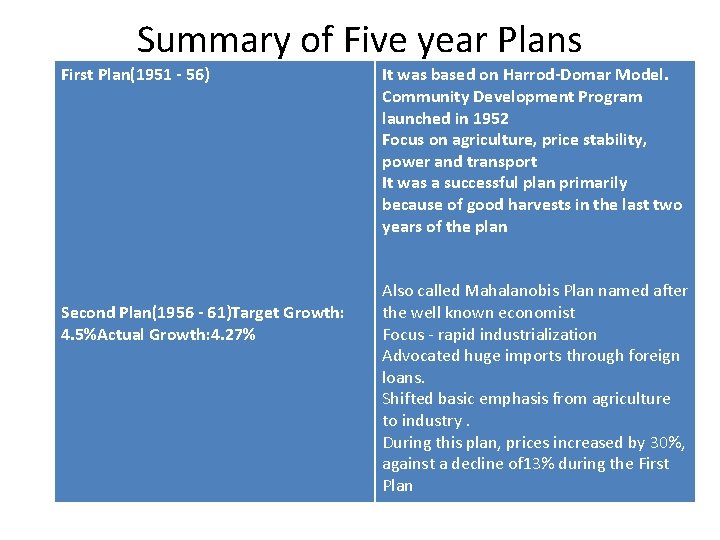
Summary of Five year Plans First Plan(1951 - 56) Second Plan(1956 - 61)Target Growth: 4. 5%Actual Growth: 4. 27% It was based on Harrod-Domar Model. Community Development Program launched in 1952 Focus on agriculture, price stability, power and transport It was a successful plan primarily because of good harvests in the last two years of the plan Also called Mahalanobis Plan named after the well known economist Focus - rapid industrialization Advocated huge imports through foreign loans. Shifted basic emphasis from agriculture to industry. During this plan, prices increased by 30%, against a decline of 13% during the First Plan
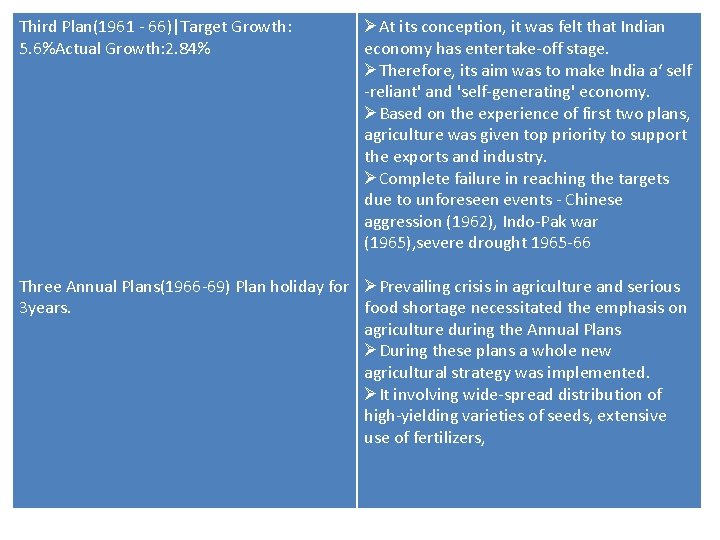
Third Plan(1961 - 66)|Target Growth: 5. 6%Actual Growth: 2. 84% ØAt its conception, it was felt that Indian economy has entertake-off stage. ØTherefore, its aim was to make India a‘ self -reliant' and 'self-generating' economy. ØBased on the experience of first two plans, agriculture was given top priority to support the exports and industry. ØComplete failure in reaching the targets due to unforeseen events - Chinese aggression (1962), Indo-Pak war (1965), severe drought 1965 -66 Three Annual Plans(1966 -69) Plan holiday for ØPrevailing crisis in agriculture and serious 3 years. food shortage necessitated the emphasis on agriculture during the Annual Plans ØDuring these plans a whole new agricultural strategy was implemented. ØIt involving wide-spread distribution of high-yielding varieties of seeds, extensive use of fertilizers,
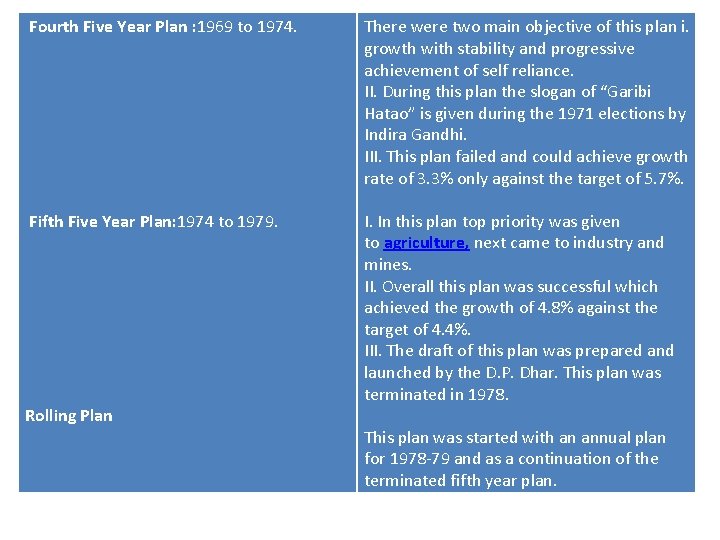
Fourth Five Year Plan : 1969 to 1974. There were two main objective of this plan i. growth with stability and progressive achievement of self reliance. II. During this plan the slogan of “Garibi Hatao” is given during the 1971 elections by Indira Gandhi. III. This plan failed and could achieve growth rate of 3. 3% only against the target of 5. 7%. Fifth Five Year Plan: 1974 to 1979. I. In this plan top priority was given to agriculture, next came to industry and mines. II. Overall this plan was successful which achieved the growth of 4. 8% against the target of 4. 4%. III. The draft of this plan was prepared and launched by the D. P. Dhar. This plan was terminated in 1978. Rolling Plan This plan was started with an annual plan for 1978 -79 and as a continuation of the terminated fifth year plan.
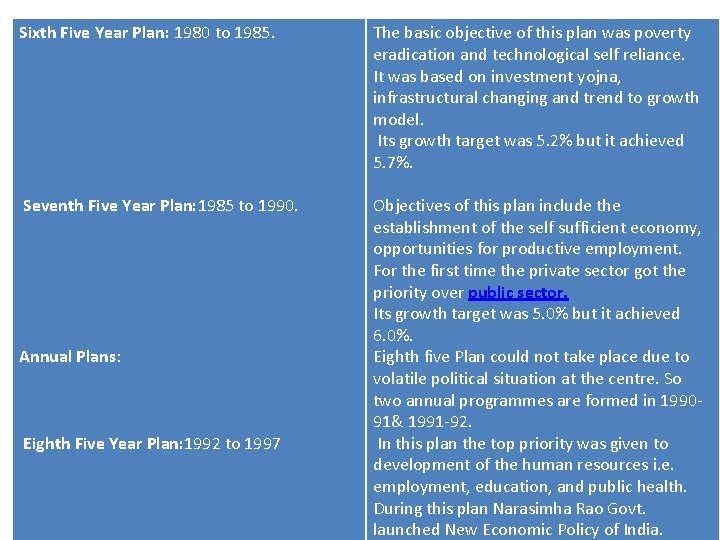
Sixth Five Year Plan: 1980 to 1985. The basic objective of this plan was poverty eradication and technological self reliance. It was based on investment yojna, infrastructural changing and trend to growth model. Its growth target was 5. 2% but it achieved 5. 7%. Seventh Five Year Plan: 1985 to 1990. Objectives of this plan include the establishment of the self sufficient economy, opportunities for productive employment. For the first time the private sector got the priority over public sector. Its growth target was 5. 0% but it achieved 6. 0%. Eighth five Plan could not take place due to volatile political situation at the centre. So two annual programmes are formed in 199091& 1991 -92. In this plan the top priority was given to development of the human resources i. e. employment, education, and public health. During this plan Narasimha Rao Govt. launched New Economic Policy of India. Annual Plans: Eighth Five Year Plan: 1992 to 1997
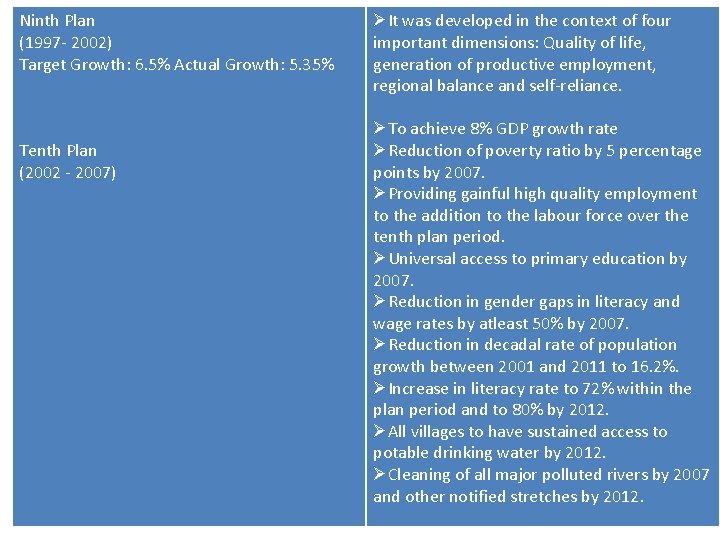
Ninth Plan (1997 - 2002) Target Growth: 6. 5% Actual Growth: 5. 35% Tenth Plan (2002 - 2007) ØIt was developed in the context of four important dimensions: Quality of life, generation of productive employment, regional balance and self-reliance. ØTo achieve 8% GDP growth rate ØReduction of poverty ratio by 5 percentage points by 2007. ØProviding gainful high quality employment to the addition to the labour force over the tenth plan period. ØUniversal access to primary education by 2007. ØReduction in gender gaps in literacy and wage rates by atleast 50% by 2007. ØReduction in decadal rate of population growth between 2001 and 2011 to 16. 2%. ØIncrease in literacy rate to 72% within the plan period and to 80% by 2012. ØAll villages to have sustained access to potable drinking water by 2012. ØCleaning of all major polluted rivers by 2007 and other notified stretches by 2012.
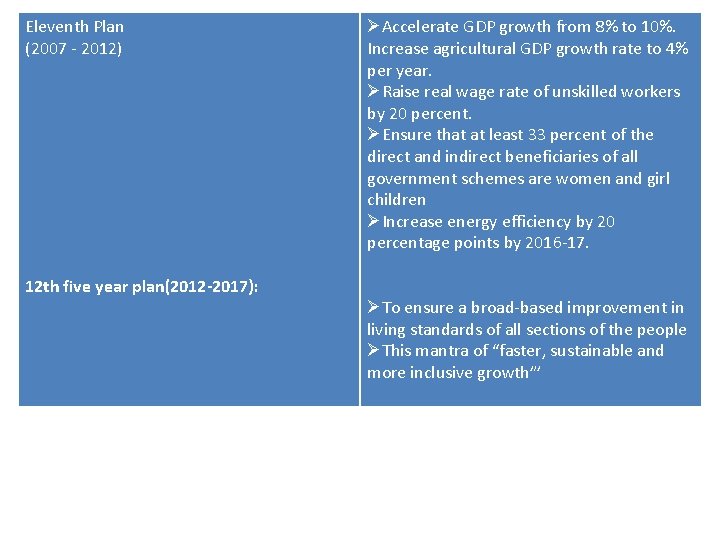
Eleventh Plan (2007 - 2012) 12 th five year plan(2012 -2017): ØAccelerate GDP growth from 8% to 10%. Increase agricultural GDP growth rate to 4% per year. ØRaise real wage rate of unskilled workers by 20 percent. ØEnsure that at least 33 percent of the direct and indirect beneficiaries of all government schemes are women and girl children ØIncrease energy efficiency by 20 percentage points by 2016 -17. ØTo ensure a broad-based improvement in living standards of all sections of the people ØThis mantra of “faster, sustainable and more inclusive growth”’