Five Themes 1 2 3 4 5 Listening



- Slides: 18
Five “Themes” 1. 2. 3. 4. 5. Listening Critically (terminology) Music and Identity Music and Technology Music is a Business Music has “Centers” and “Peripheries” (places)
Music Centers & Peripheries • “Centers” – money, power and control - NYC, LA, Nashville (? !) - aims at the mass (= urban, white) market • “Peripheries” – the edges - physically remote - lacking in power or influence - stylistically unique or “different” (often) • Peripheries influence and change Centers
Streams of Traditions • Three main sources of American Pop Music • European - chiefly white (Anglo) Northern Europe - British Isles (Scotch, Welsh, Irish, etc. ) • African - chiefly from West Central Africa - imported slaves (mostly) to Southern regions • Latin America - Caribbean, Mexican, Brazil, etc. - often mixes African w/ indigenous elements
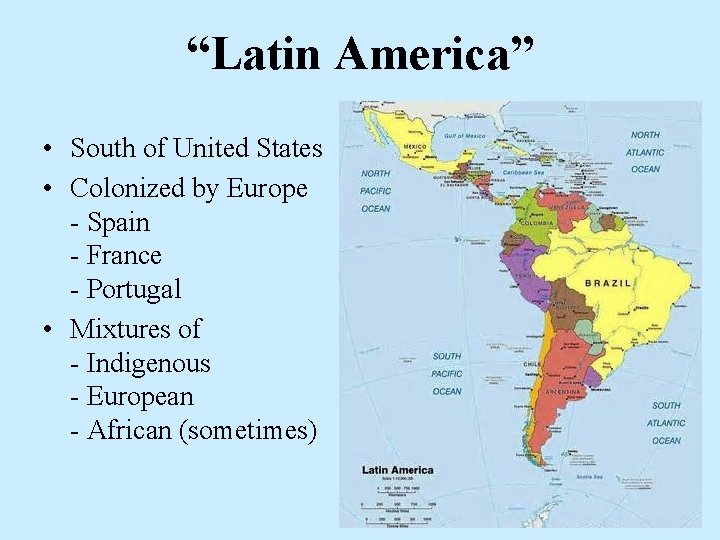
“Latin America” • South of United States • Colonized by Europe - Spain - France - Portugal • Mixtures of - Indigenous - European - African (sometimes)
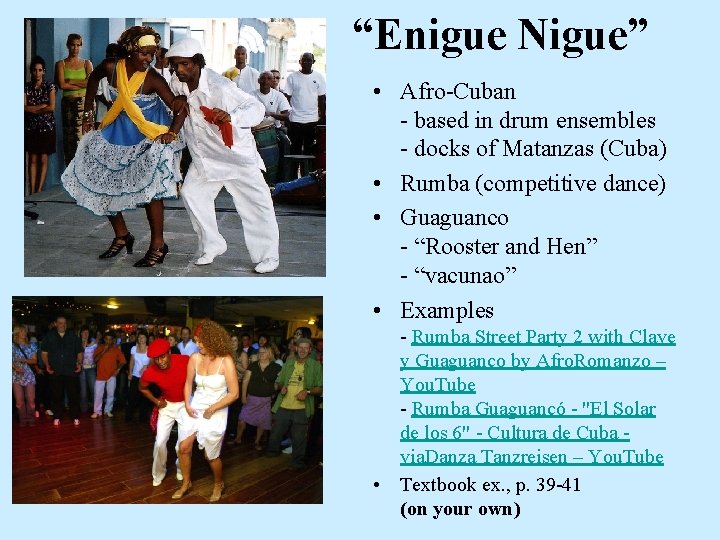
“Enigue Nigue” • Afro-Cuban - based in drum ensembles - docks of Matanzas (Cuba) • Rumba (competitive dance) • Guaguanco - “Rooster and Hen” - “vacunao” • Examples - Rumba Street Party 2 with Clave y Guaguanco by Afro. Romanzo – You. Tube - Rumba Guaguancó - "El Solar de los 6" - Cultura de Cuba via. Danza Tanzreisen – You. Tube • Textbook ex. , p. 39 -41 (on your own)
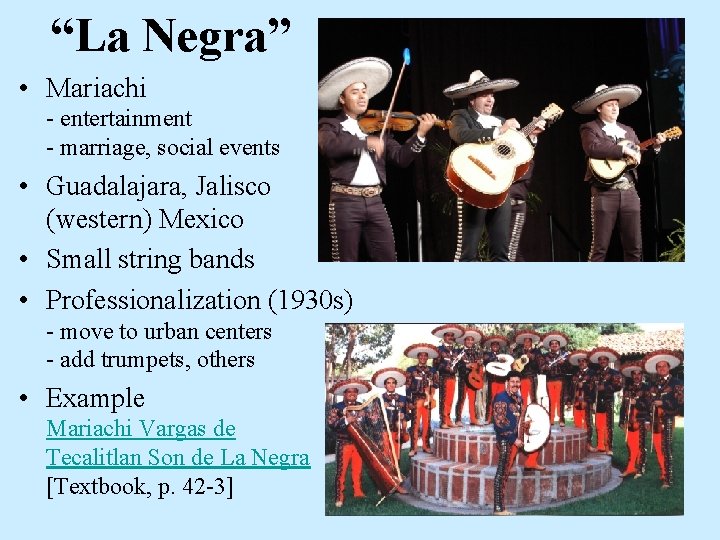
“La Negra” • Mariachi - entertainment - marriage, social events • Guadalajara, Jalisco (western) Mexico • Small string bands • Professionalization (1930 s) - move to urban centers - add trumpets, others • Example Mariachi Vargas de Tecalitlan Son de La Negra [Textbook, p. 42 -3]
TEST # 1 Materials END Here Anything on following slides belongs to Test # 2 or later.
Chapter 2 • • Earliest (original) US popular forms (18 th C) Minstrelsy (1840 s-80 s, and beyond) Stephen Foster – 1 st US popular composer Bands – Brass and other Tin Pan Alley – the Sheet Music Industry Ragtime (1880 s-1910 s) – syncopated piano Phonograph – modern technology
Early American (U. S. ) Music • No “native” music in the colonies • European immigrant culture (first of the “three traditions” – Chapter 1) • English, Irish, Scots genres and forms • Religious music (Pilgrims & others) • Dance Music • Others: Italian operatic, German orchestral, etc. • Examples - Henry Russell, “Woodman Spare that Tree” woodman spare that tree (1837) The first environmental song? - You. Tube - Henry Bishop, “Home Sweet home” Richard Conrad singing "Home, Sweet Home" - You. Tube
Minstrelsy (defined) • • Uniquely US popular form Widespread from 1840 s to 1880 s (& beyond) Origins in NYC (& elsewhere) “Variety show” format - song & dance - jokes & comic dialogue/monologues • Blackface (“covers”)
George Washington Dixon (1801? -1861) • • • First (? ) important US blackface performer Working class background (NYC) Circus act – singer & reciter of poems “Ethiopean songs” 1829 – “Coal Black Rose” (NYC, Bowery) - Coal Black Rose – You. Tube (solo banjo) - Coal Black Rose [364] (274) (vocal) • Political satire & commentary • 1834 – “Long Tail Blue” (see following slide) - Long Tail Blue. wmv – You. Tube (solo banjo) - Long Tail Blue (banjo w/ voice)
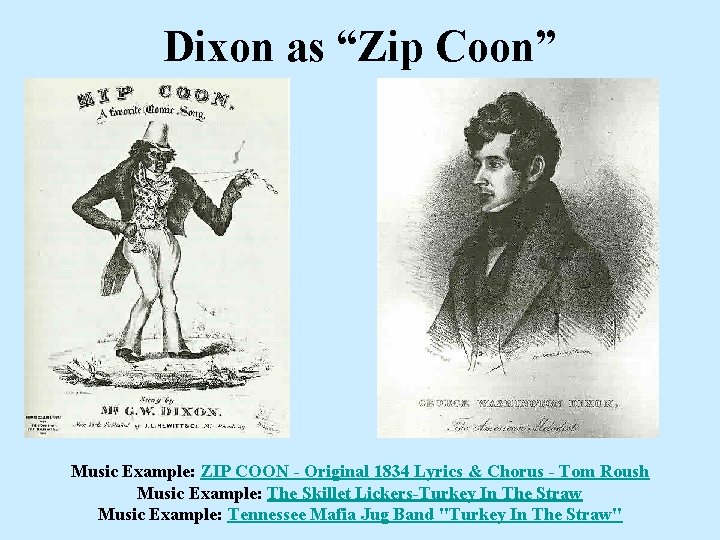
Dixon as “Zip Coon” Music Example: ZIP COON - Original 1834 Lyrics & Chorus - Tom Roush Music Example: The Skillet Lickers-Turkey In The Straw Music Example: Tennessee Mafia Jug Band "Turkey In The Straw"
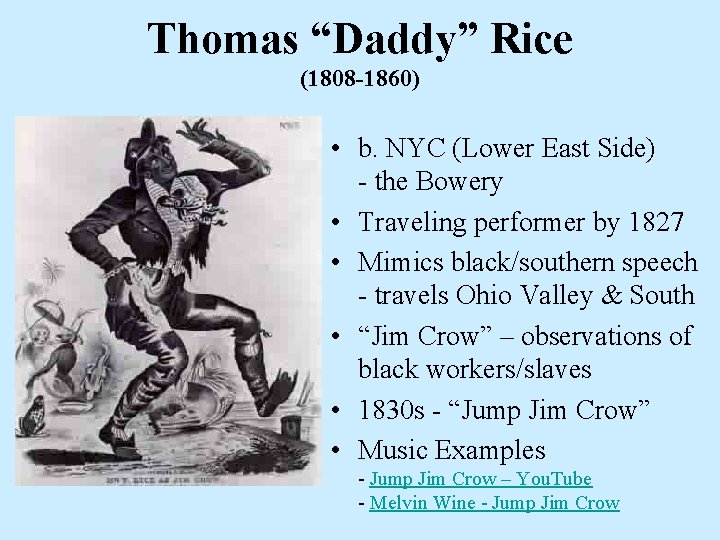
Thomas “Daddy” Rice (1808 -1860) • b. NYC (Lower East Side) - the Bowery • Traveling performer by 1827 • Mimics black/southern speech - travels Ohio Valley & South • “Jim Crow” – observations of black workers/slaves • 1830 s - “Jump Jim Crow” • Music Examples - Jump Jim Crow – You. Tube - Melvin Wine - Jump Jim Crow
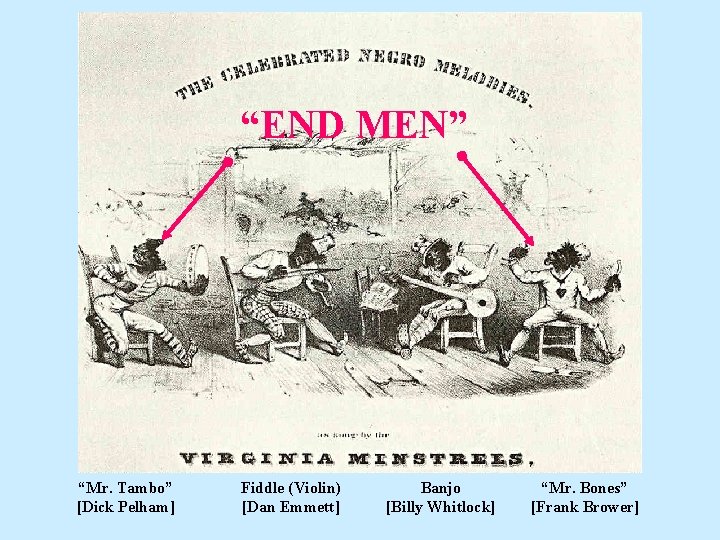
Virginia Minstrels • • • 1843 – 1 st performances in the Bowery Dan Emmett (fiddle) and three co-performers GROUP performance in blackface & costume Extended “concert” w/ songs, dialect, etc. “Jimmy Crack Corn” - Jimmy crack Corn played by Brad Sondahl - You. Tube • “Old Dan Tucker” - The Skillet Lickers-Old Dan Tucker - Grandpa Jones - Old Dan Tucker – You. Tube (start c. 0: 30) - Bruce Springsteen - Old Dan Tucker (Live 2006) • “The Boatman Dance” - "The Boatman Dance" with banjo & fiddle – You. Tube - Boatman Dance. – You. Tube - De Boatman's Dance (1843, credited to Dan Emmett)
“END MEN” “Mr. Tambo” [Dick Pelham] Fiddle (Violin) [Dan Emmett] Banjo [Billy Whitlock] “Mr. Bones” [Frank Brower]
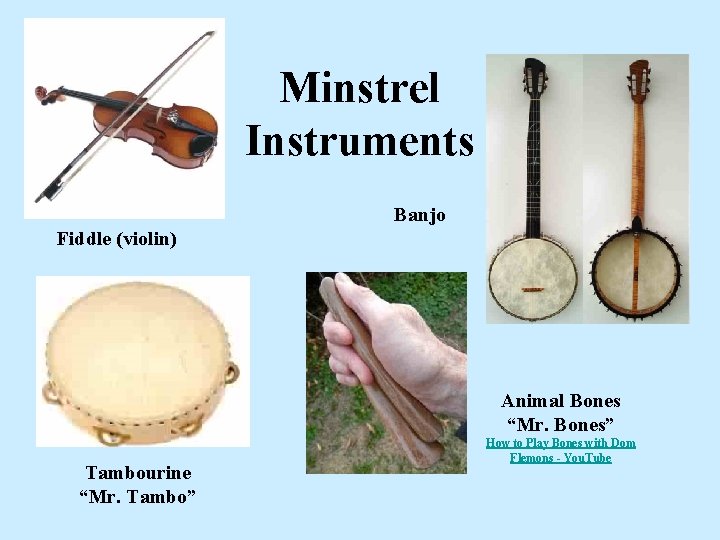
Minstrel Instruments Banjo Fiddle (violin) Animal Bones “Mr. Bones” Tambourine “Mr. Tambo” How to Play Bones with Dom Flemons - You. Tube
The Minstrel Show • “Mr. Interlocutor” and the “End Men” - M. C. and jokes - dialect (“stump speech”) [see online resources] • Original Two-Part Structure (1840 s) - Northern Black characters - “Plantation” sketch • Later Three-Part Format (1850 s & later) - sentimental songs, genteel tradition (“white”) - Olio – “variety show” (music, dance, stories, jokes) - “walk-around” (“Cakewalk”) Exs. (both c. 1900, i. e. , recreations after the era passed) - Minstrel Cakewalk Cake Walk Dancing – You. Tube - Uncle Tom's Cabin - Group and Solo Cakewalk dance (1903) - You. Tube
Friendly Warning Test # 1 - next meeting 4 February (THURSDAY) covers Chapter 1 & Terminology (Review Sheets now on Course Website) NB. Test begins at 12: 30 pm, short lecture (on chapter 2) precedes