Fatigue Marcus de Guingand Managing Director The 3

- Slides: 29
Fatigue Marcus de Guingand Managing Director The 3 rd Pillar of Health
Fatigue FTA Van Excellence March 2019 Twitter: @3 rd. Pillar. Health © Third Pillar of Health Ltd 2019
Introduction “Tiredness reduces reaction time, vigilance, alertness and concentration so the ability to perform attentionbased activities (such as driving) is impaired. The speed at which information is processed is also reduced by tiredness and the quality of decision making may also be affected. ” Ro. SPA Twitter: @3 rd. Pillar. Health © Third Pillar of Health Ltd 2019
Why is sleep important? Twitter: @3 rd. Pillar. Health © Third Pillar of Health Ltd 2019
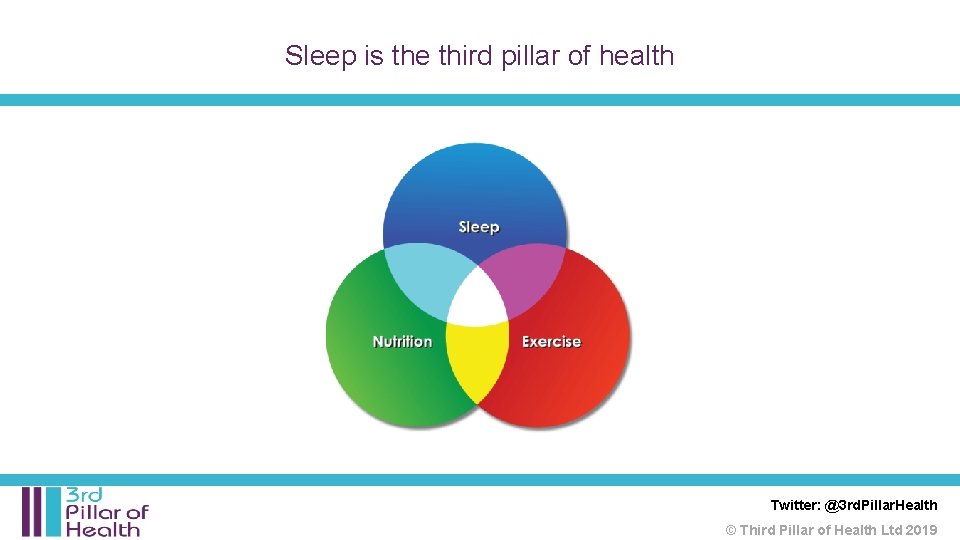
Sleep is the third pillar of health Twitter: @3 rd. Pillar. Health © Third Pillar of Health Ltd 2019
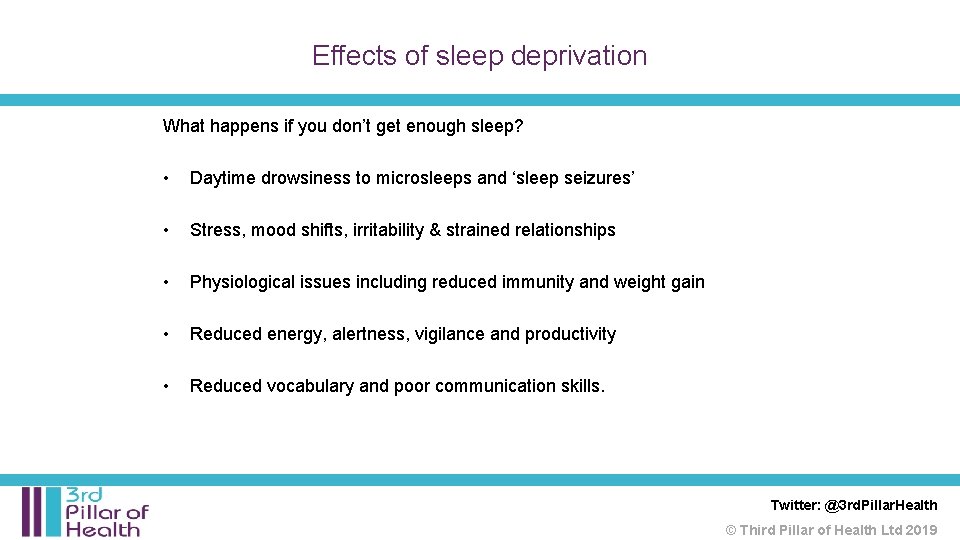
Effects of sleep deprivation What happens if you don’t get enough sleep? • Daytime drowsiness to microsleeps and ‘sleep seizures’ • Stress, mood shifts, irritability & strained relationships • Physiological issues including reduced immunity and weight gain • Reduced energy, alertness, vigilance and productivity • Reduced vocabulary and poor communication skills. Twitter: @3 rd. Pillar. Health © Third Pillar of Health Ltd 2019
Are we getting enough sleep? Twitter: @3 rd. Pillar. Health © Third Pillar of Health Ltd 2019
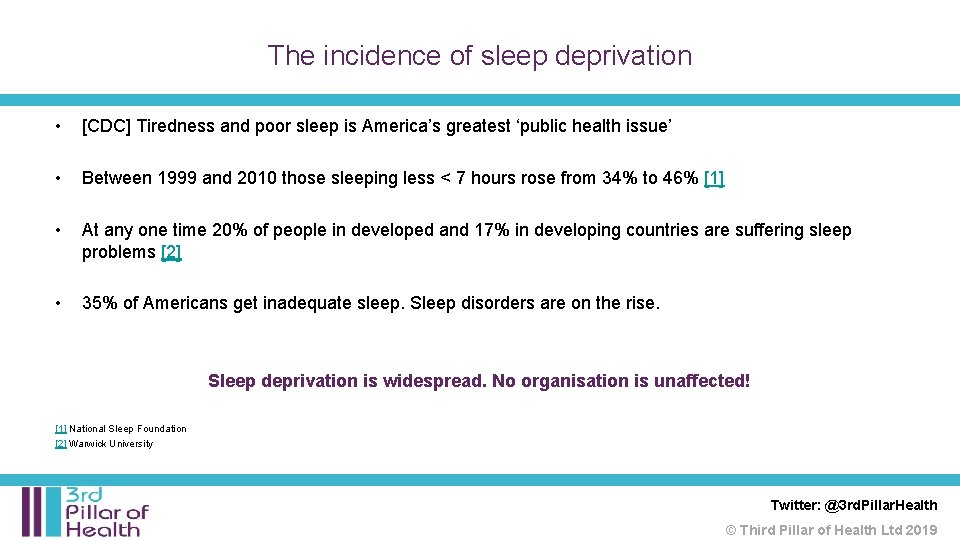
The incidence of sleep deprivation • [CDC] Tiredness and poor sleep is America’s greatest ‘public health issue’ • Between 1999 and 2010 those sleeping less < 7 hours rose from 34% to 46% [1] • At any one time 20% of people in developed and 17% in developing countries are suffering sleep problems [2] • 35% of Americans get inadequate sleep. Sleep disorders are on the rise. Sleep deprivation is widespread. No organisation is unaffected! [1] National Sleep Foundation [2] Warwick University Twitter: @3 rd. Pillar. Health © Third Pillar of Health Ltd 2019
What we’ve found Twitter: @3 rd. Pillar. Health © Third Pillar of Health Ltd 2019
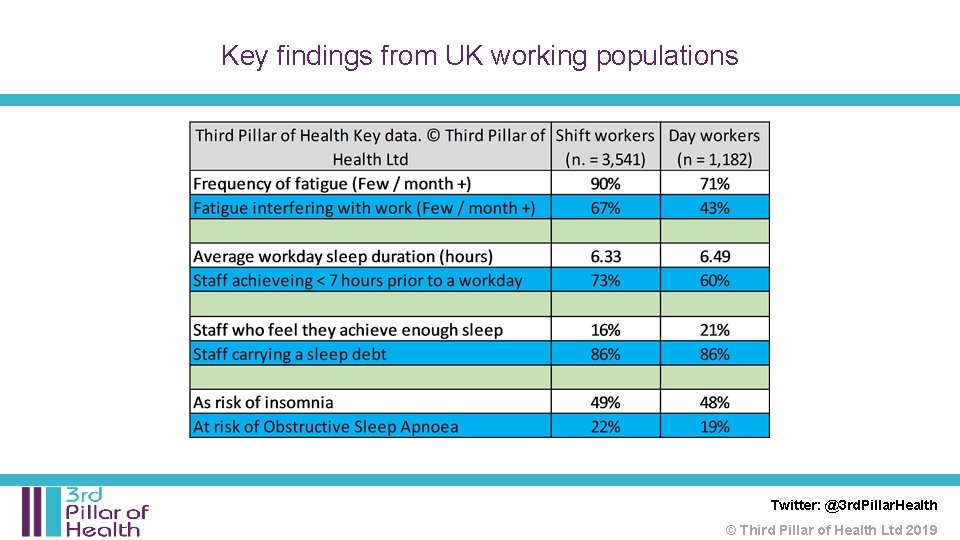
Key findings from UK working populations Twitter: @3 rd. Pillar. Health © Third Pillar of Health Ltd 2019
Implications of poor sleep to the individual Twitter: @3 rd. Pillar. Health © Third Pillar of Health Ltd 2019
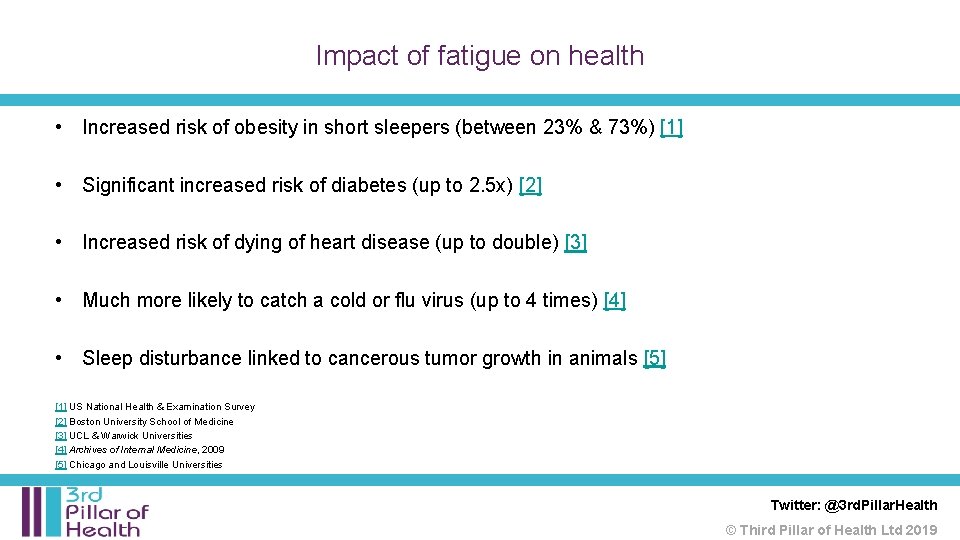
Impact of fatigue on health • Increased risk of obesity in short sleepers (between 23% & 73%) [1] • Significant increased risk of diabetes (up to 2. 5 x) [2] • Increased risk of dying of heart disease (up to double) [3] • Much more likely to catch a cold or flu virus (up to 4 times) [4] • Sleep disturbance linked to cancerous tumor growth in animals [5] [1] US National Health & Examination Survey [2] Boston University School of Medicine [3] UCL & Warwick Universities [4] Archives of Internal Medicine, 2009 [5] Chicago and Louisville Universities Twitter: @3 rd. Pillar. Health © Third Pillar of Health Ltd 2019
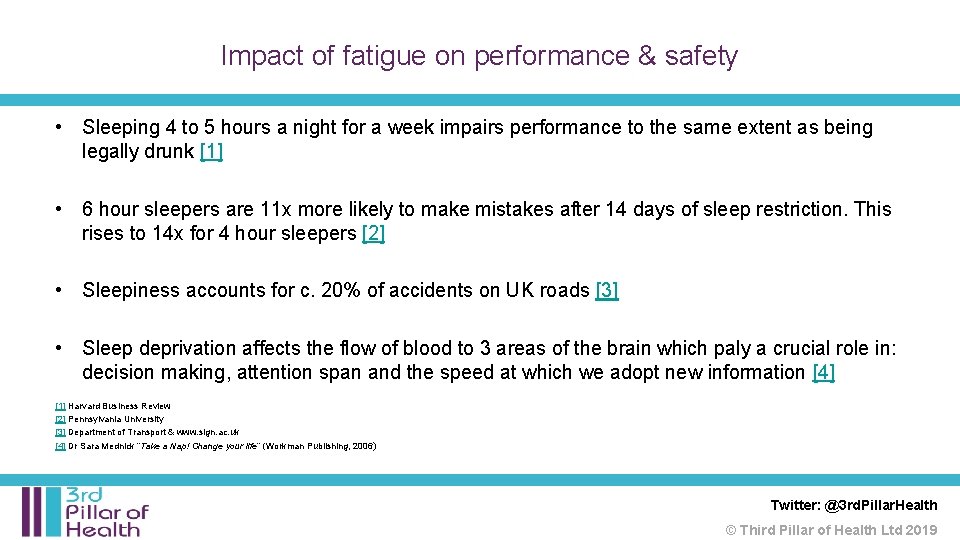
Impact of fatigue on performance & safety • Sleeping 4 to 5 hours a night for a week impairs performance to the same extent as being legally drunk [1] • 6 hour sleepers are 11 x more likely to make mistakes after 14 days of sleep restriction. This rises to 14 x for 4 hour sleepers [2] • Sleepiness accounts for c. 20% of accidents on UK roads [3] • Sleep deprivation affects the flow of blood to 3 areas of the brain which paly a crucial role in: decision making, attention span and the speed at which we adopt new information [4] [1] Harvard Business Review [2] Pennsylvania University [3] Department of Transport & www. sign. ac. uk [4] Dr Sara Mednick “Take a Nap! Change your life” (Workman Publishing, 2006) Twitter: @3 rd. Pillar. Health © Third Pillar of Health Ltd 2019
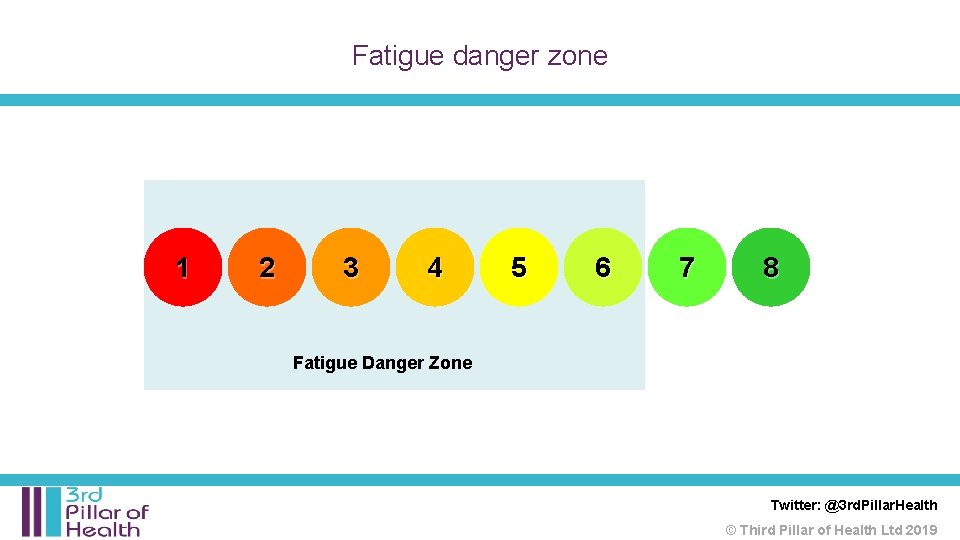
Fatigue danger zone 1 2 3 4 5 6 7 8 Fatigue Danger Zone Twitter: @3 rd. Pillar. Health © Third Pillar of Health Ltd 2019
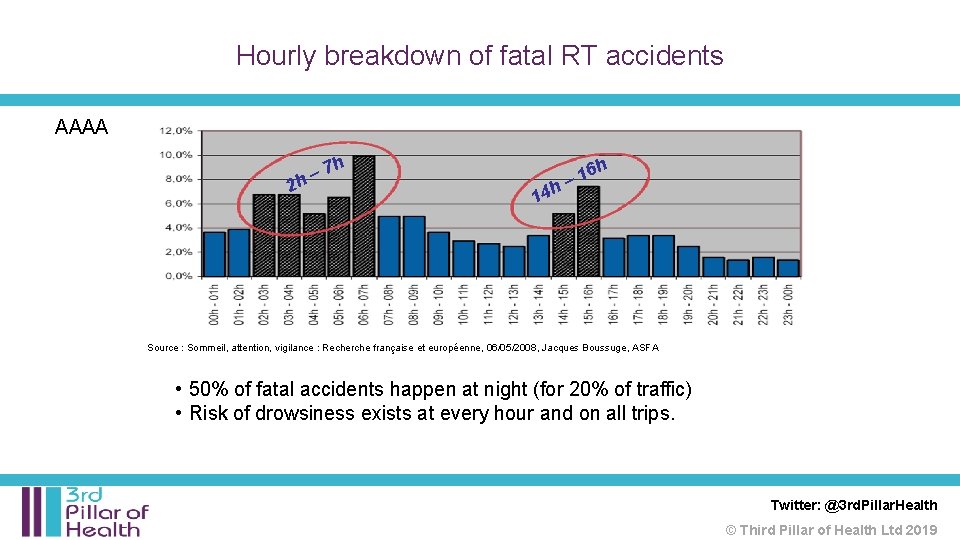
Hourly breakdown of fatal RT accidents AAAA h 7 – h 2 14 h 6 h 1 – Source : Sommeil, attention, vigilance : Recherche française et européenne, 06/05/2008, Jacques Boussuge, ASFA • 50% of fatal accidents happen at night (for 20% of traffic) • Risk of drowsiness exists at every hour and on all trips. Twitter: @3 rd. Pillar. Health © Third Pillar of Health Ltd 2019
Relationship between sleep and drowsy driving • The quantity and quality of sleep we obtain is intrinsically linked to our alertness • The general consensus is that we need 7 to 9 hours of quality sleep to function at our best the next day • Our in-built biomechanical mechanism sends signals to the brain that we need sleep – which causes sleepiness • Total time awake makes a difference. 18 straight hours is equivalent to BAC of 0. 05 and 24 hours to 0. 1 BAC • There is an increase in the incidence of sleep disorders – particularly insomnia and sleep apnoea. Twitter: @3 rd. Pillar. Health © Third Pillar of Health Ltd 2019
Driver fatigue Twitter: @3 rd. Pillar. Health © Third Pillar of Health Ltd 2019
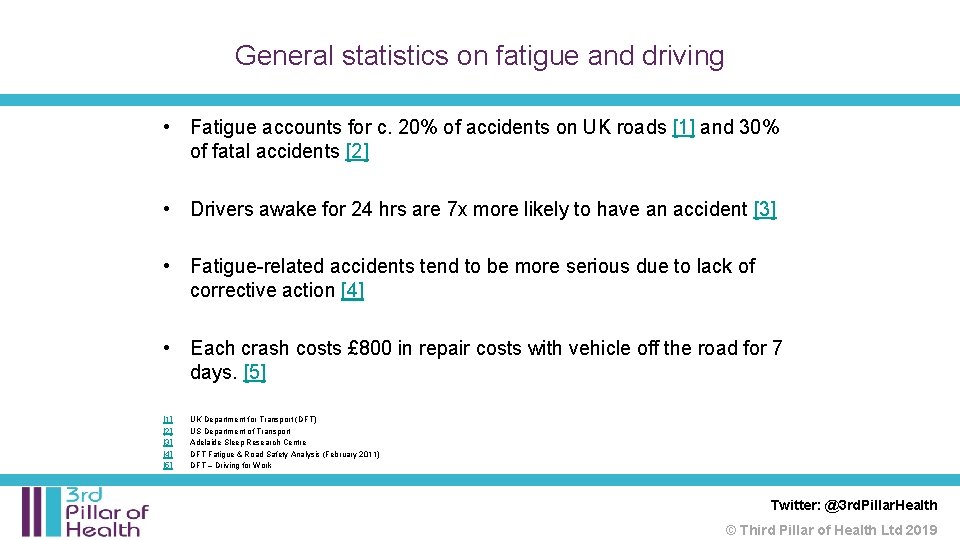
General statistics on fatigue and driving • Fatigue accounts for c. 20% of accidents on UK roads [1] and 30% of fatal accidents [2] • Drivers awake for 24 hrs are 7 x more likely to have an accident [3] • Fatigue-related accidents tend to be more serious due to lack of corrective action [4] • Each crash costs £ 800 in repair costs with vehicle off the road for 7 days. [5] [1] [2] [3] [4] [5] UK Department for Transport (DFT) US Department of Transport Adelaide Sleep Research Centre DFT Fatigue & Road Safety Analysis (February 2011) DFT – Driving for Work Twitter: @3 rd. Pillar. Health © Third Pillar of Health Ltd 2019
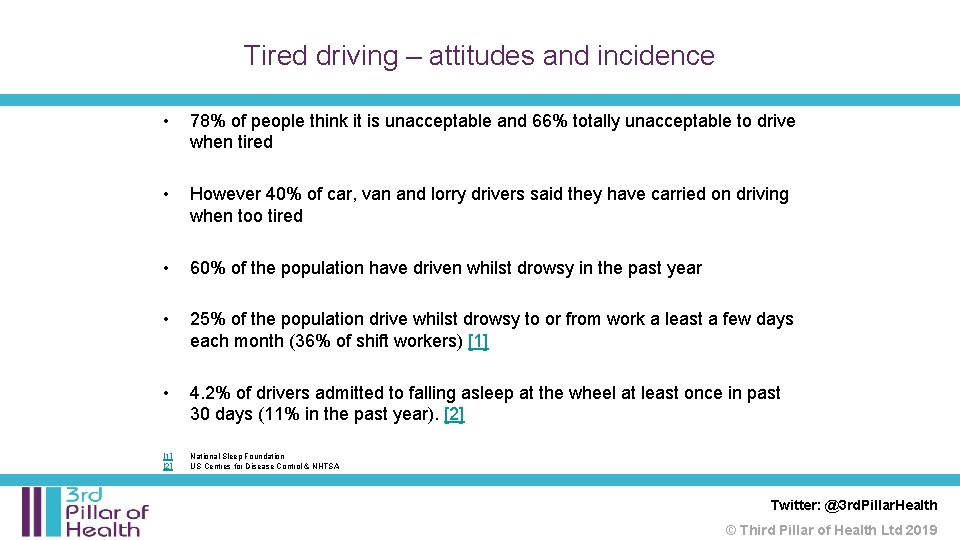
Tired driving – attitudes and incidence • 78% of people think it is unacceptable and 66% totally unacceptable to drive when tired • However 40% of car, van and lorry drivers said they have carried on driving when too tired • 60% of the population have driven whilst drowsy in the past year • 25% of the population drive whilst drowsy to or from work a least a few days each month (36% of shift workers) [1] • 4. 2% of drivers admitted to falling asleep at the wheel at least once in past 30 days (11% in the past year). [2] [1] [2] National Sleep Foundation US Centres for Disease Control & NHTSA Twitter: @3 rd. Pillar. Health © Third Pillar of Health Ltd 2019
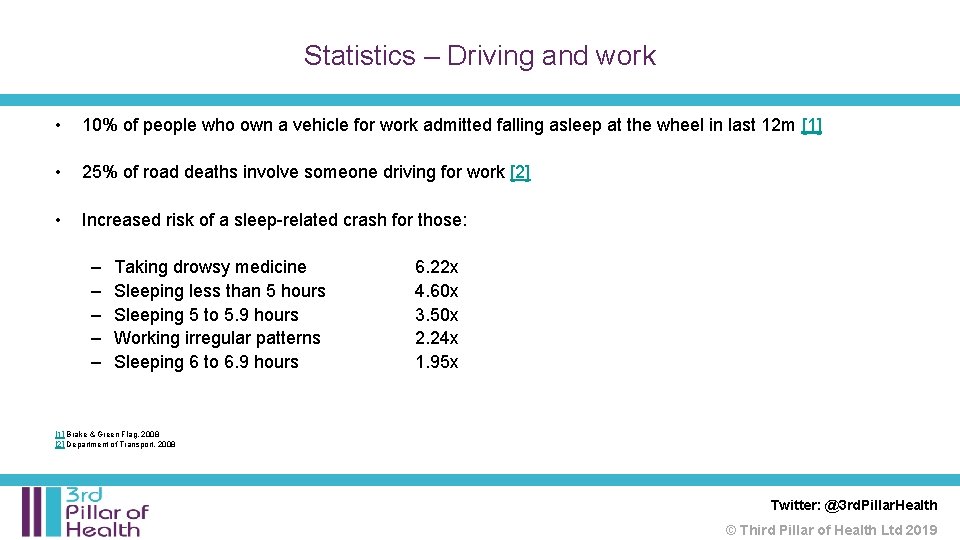
Statistics – Driving and work • 10% of people who own a vehicle for work admitted falling asleep at the wheel in last 12 m [1] • 25% of road deaths involve someone driving for work [2] • Increased risk of a sleep-related crash for those: – – – Taking drowsy medicine Sleeping less than 5 hours Sleeping 5 to 5. 9 hours Working irregular patterns Sleeping 6 to 6. 9 hours 6. 22 x 4. 60 x 3. 50 x 2. 24 x 1. 95 x [1] Brake & Green Flag, 2008 [2] Department of Transport, 2008 Twitter: @3 rd. Pillar. Health © Third Pillar of Health Ltd 2019
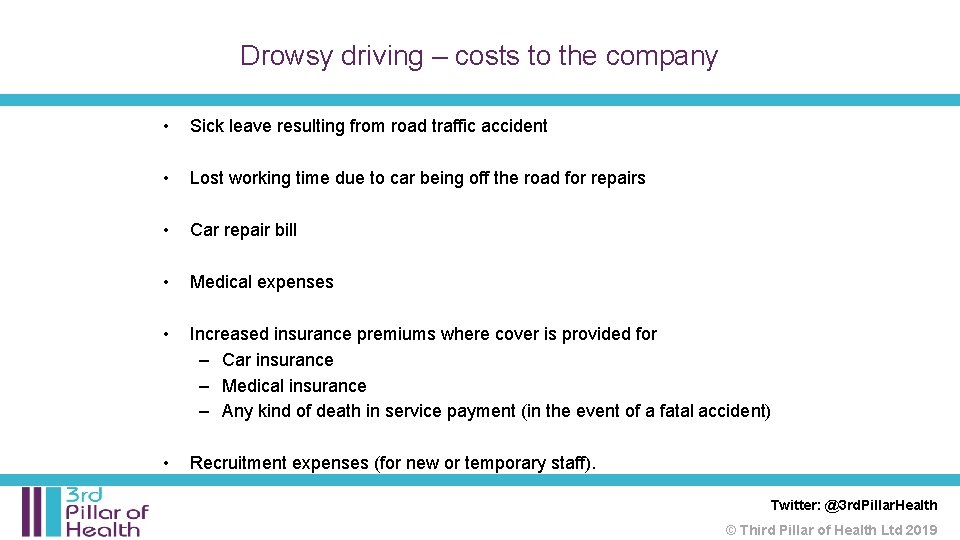
Drowsy driving – costs to the company • Sick leave resulting from road traffic accident • Lost working time due to car being off the road for repairs • Car repair bill • Medical expenses • Increased insurance premiums where cover is provided for – Car insurance – Medical insurance – Any kind of death in service payment (in the event of a fatal accident) • Recruitment expenses (for new or temporary staff). Twitter: @3 rd. Pillar. Health © Third Pillar of Health Ltd 2019
Tell-tale signs of drowsy driving • Frequent yawning and Eyelids drooping • Straining your eyes to focus on the road • Memory lapses or frequently hitting the rumble strips • If you experience any of these signs you are at risk of a microsleep – A microsleep can last from fractions of a second up to 2 seconds and result in a total loss of alertness – At 56 miles per hour (90 Km / hr) a vehicle will travel 25 metres per second – The good news is tiredness does not suddenly come upon us. As indicated there are warning signs Twitter: @3 rd. Pillar. Health © Third Pillar of Health Ltd 2019
Strategies to avoid drowsy driving Common but ineffective countermeasures include: • • Winding down the window Turning up the music Stopping to take a quick walk Talking to a passenger Stopping to splash cold water on your face Adjusting the seat so it is uncomfortable Changing lanes more frequently. In laboratory tests NONE of these countermeasures were shown to reduce drowsiness and increase alertness. Twitter: @3 rd. Pillar. Health © Third Pillar of Health Ltd 2019
Effective countermeasures • Obtain adequate sleep before a journey • Take a nap before a journey • Avoid driving in the early morning • Pull over to a roadside hotel to sleep • Drink a caffeinated drink and immediately take a 15 to 20 minute nap • Change drivers (providing the new driver is alert). Twitter: @3 rd. Pillar. Health © Third Pillar of Health Ltd 2019
Why WTRs and HOS rules are not enough Working Time Regulations and Hours of Service rules are not in themselves enough to protect your staff because: • The fail to take into account undiagnosed sleep disorders • They fail to take account of poor sleep habits (widespread across society) • The fail to take into account the consequences of rotating shifts patterns • They fail to take into account parents with young children who suffer from frequent sleep disruption • They often fail to take into account commuting times, which do not allow for sufficient rest between shifts. Twitter: @3 rd. Pillar. Health © Third Pillar of Health Ltd 2019
How you can address this issue? Twitter: @3 rd. Pillar. Health © Third Pillar of Health Ltd 2019
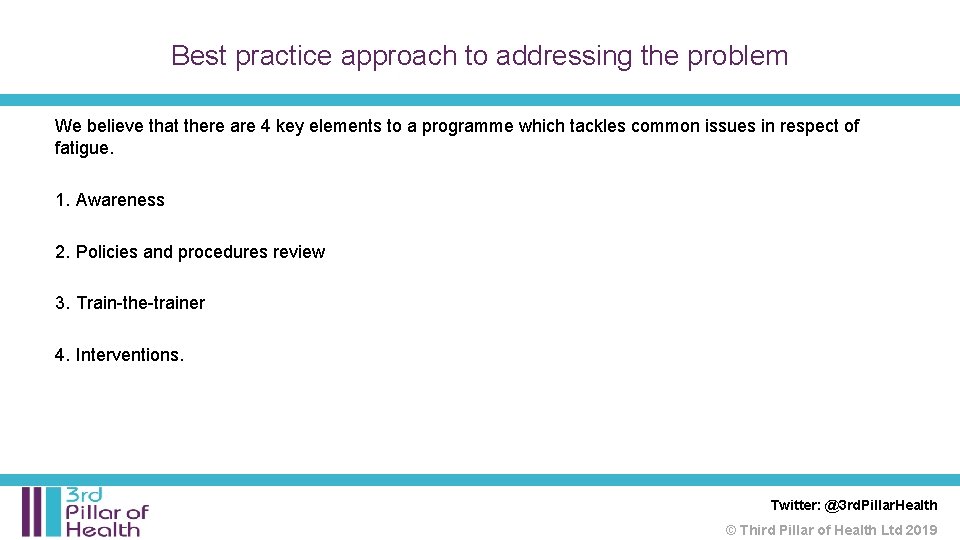
Best practice approach to addressing the problem We believe that there are 4 key elements to a programme which tackles common issues in respect of fatigue. 1. Awareness 2. Policies and procedures review 3. Train-the-trainer 4. Interventions. Twitter: @3 rd. Pillar. Health © Third Pillar of Health Ltd 2019
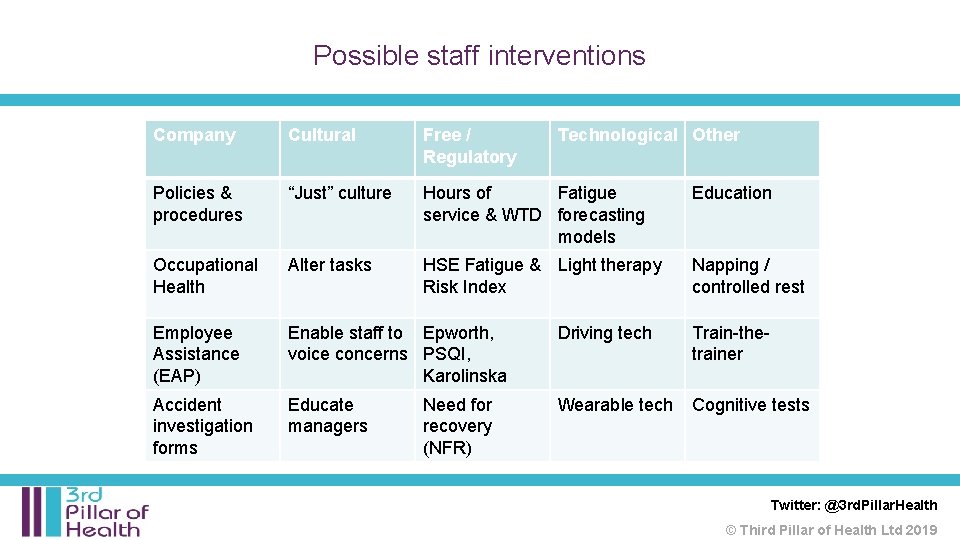
Possible staff interventions Company Cultural Free / Regulatory Policies & procedures “Just” culture Hours of Fatigue service & WTD forecasting models Education Occupational Health Alter tasks HSE Fatigue & Light therapy Risk Index Napping / controlled rest Employee Assistance (EAP) Enable staff to Epworth, voice concerns PSQI, Karolinska Driving tech Train-thetrainer Accident investigation forms Educate managers Wearable tech Cognitive tests Need for recovery (NFR) Technological Other Twitter: @3 rd. Pillar. Health © Third Pillar of Health Ltd 2019
Contact details Marcus de Guingand Managing Director, Third Pillar of Health Connect with me on Linked. In: https: //uk. linkedin. com/in/marcusdeguingand Email: marcus@thirdpillarofhealth. com Office: +44 (0)845 686 0022 Website: www. thirdpillarofhealth. com Twitter: @3 rd. Pillar. Health © Third Pillar of Health Ltd 2019