
From Corrections Fatigue to Fulfillment For Probation Parole
From Corrections Fatigue to Fulfillment™ For Probation & Parole / Field Agents IACTP 2016 Commercial Product Award of Excellence © Copyright, Caterina Spinaris, Ph. D. , 2001 -2016 All Rights Reserved Version 2016. Dec. 31
Objectives Describe the nature and causes of Corrections Fatigue. Identify strategies to increase fulfillment as a corrections professional. Identify strategies to manage stress associated with corrections work. Identify organizational strategies to cultivate a positive organizational climate. Course draws from material presented in the Constructivist Self Development Theory by L. A. . Pearlman, l. Mc. Cann, and K. Saakvitne. 2001 -2016 Copyright Caterina Spinaris. All rights reserved.
Part One - CORRECTIONS FATIGUE 2001 -2016 Copyright Caterina Spinaris. All rights reserved.
PROBATION & PAROLE STAFF STORIES • Writing details about crimes against children is getting to me. • I have worked out a way to protect my children’s identity and safety when in public places. • I’ve been physically attacked and threatened by my clients. • I get yelled at and blamed by everyone in the system. • I’m haunted by details of sex crimes I hear from sex offender clients I supervise. • My workload has exploded, yet no one seems to care. 2001 -2016 Copyright Caterina Spinaris. All rights reserved.
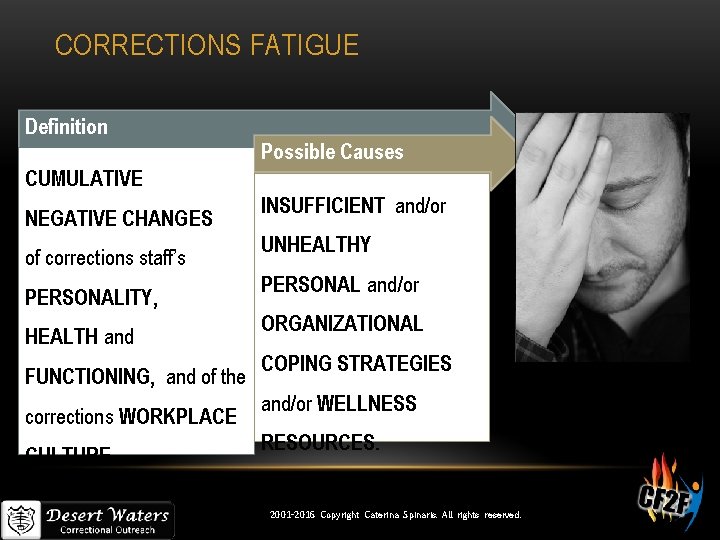
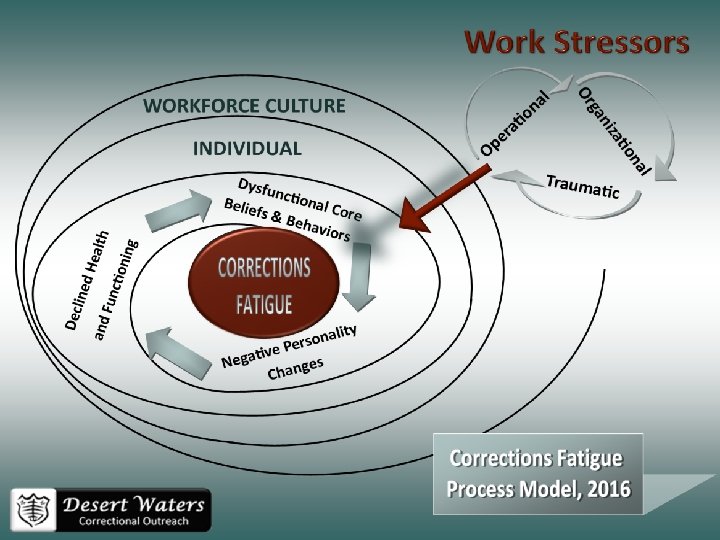
CORRECTIONS FATIGUE Definition Possible Causes CUMULATIVE NEGATIVE CHANGES of corrections staff’s PERSONALITY, HEALTH and FUNCTIONING, and of the corrections WORKPLACE CULTURE. INSUFFICIENT and/or UNHEALTHY PERSONAL and/or ORGANIZATIONAL COPING STRATEGIES and/or WELLNESS RESOURCES. 2001 -2016 Copyright Caterina Spinaris. All rights reserved.
METAL FATIGUE & RUBBER BAND ANALOGIES “What I come across at work wounds my soul. ” Anonymous Corrections Professional 2001 -2016 Copyright Caterina Spinaris. All rights reserved.
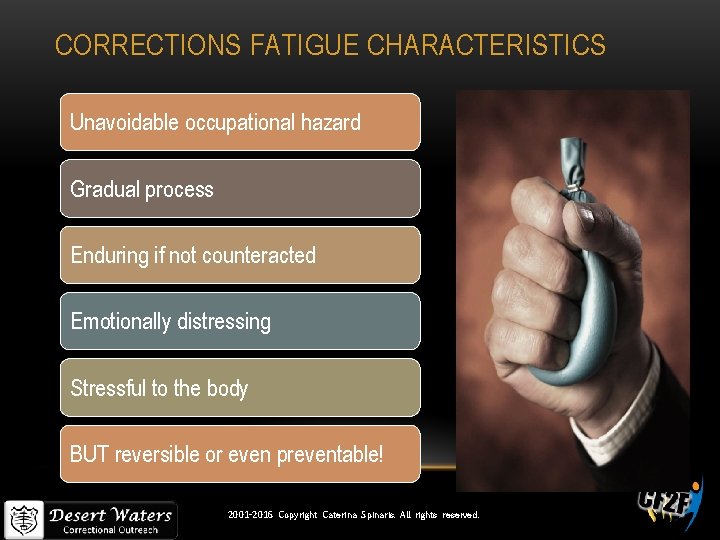
CORRECTIONS FATIGUE CHARACTERISTICS Unavoidable occupational hazard Gradual process Enduring if not counteracted Emotionally distressing Stressful to the body BUT reversible or even preventable! 2001 -2016 Copyright Caterina Spinaris. All rights reserved.
CORRECTIONS FATIGUE CONSEQUENCES Morale Work performance Staff retention Staff health and wellness Relationships at work Relationships at home 2001 -2016 Copyright Caterina Spinaris. All rights reserved.
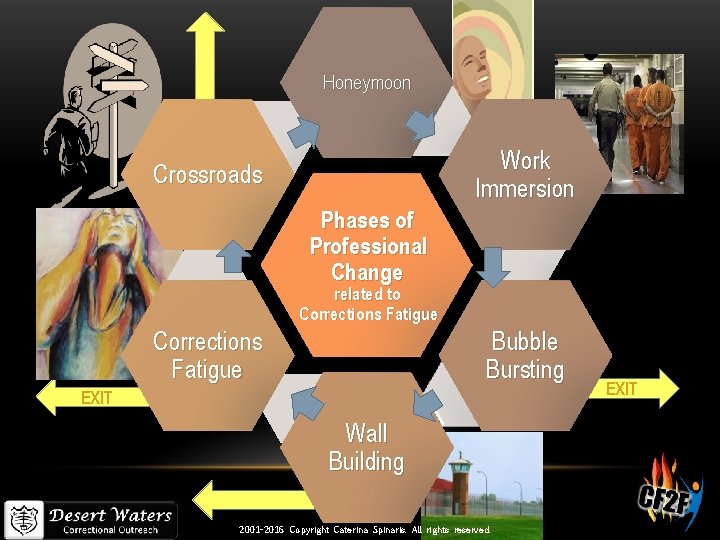
Honeymoon Work Immersion Crossroads Phases of Professional Change related to Corrections Fatigue Bubble Bursting Corrections Fatigue EXIT Wall Building 2001 -2016 Copyright Caterina Spinaris. All rights reserved. EXIT
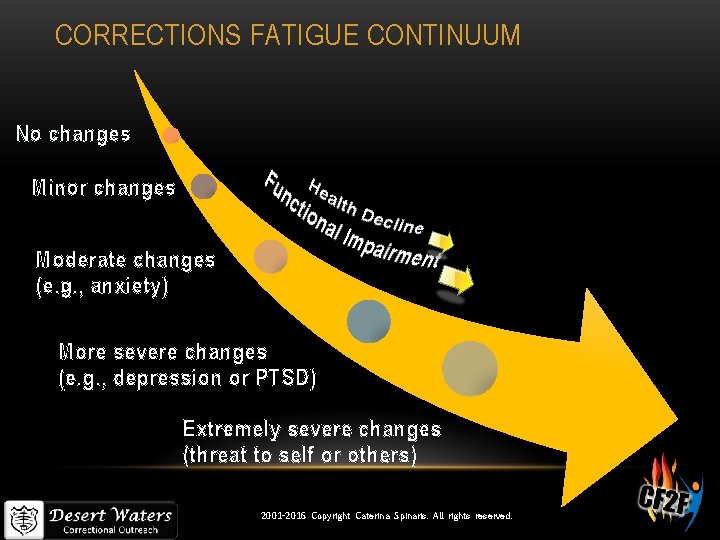
CORRECTIONS FATIGUE CONTINUUM No changes Minor changes Moderate changes (e. g. , anxiety) More severe changes (e. g. , depression or PTSD) Extremely severe changes (threat to self or others) 2001 -2016 Copyright Caterina Spinaris. All rights reserved.
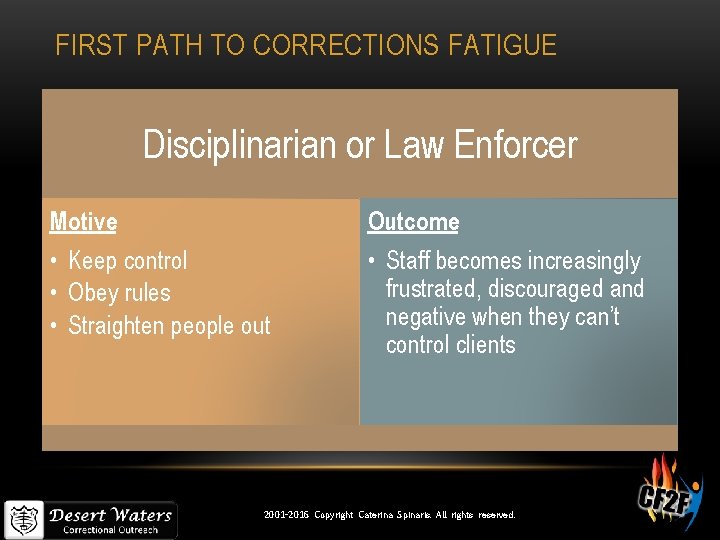
FIRST PATH TO CORRECTIONS FATIGUE Disciplinarian or Law Enforcer Motive • Keep control • Obey rules • Straighten people out Outcome • Staff becomes increasingly frustrated, discouraged and negative when they can’t control clients 2001 -2016 Copyright Caterina Spinaris. All rights reserved.
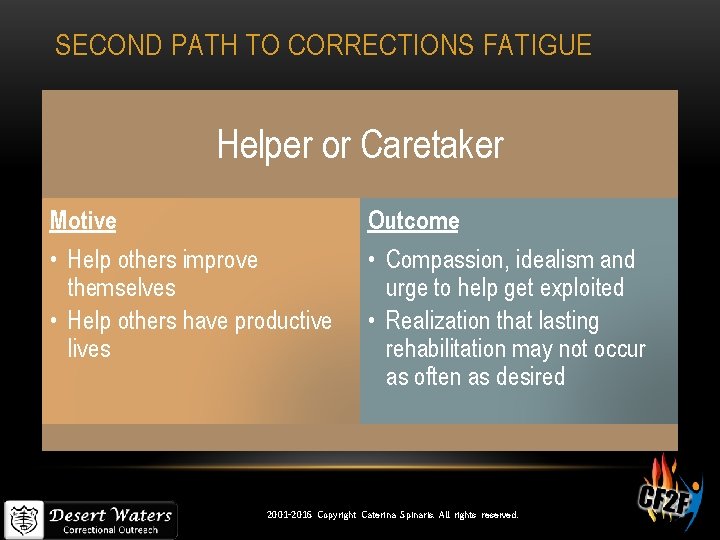
SECOND PATH TO CORRECTIONS FATIGUE Helper or Caretaker Motive • Help others improve themselves • Help others have productive lives Outcome • Compassion, idealism and urge to help get exploited • Realization that lasting rehabilitation may not occur as often as desired 2001 -2016 Copyright Caterina Spinaris. All rights reserved.
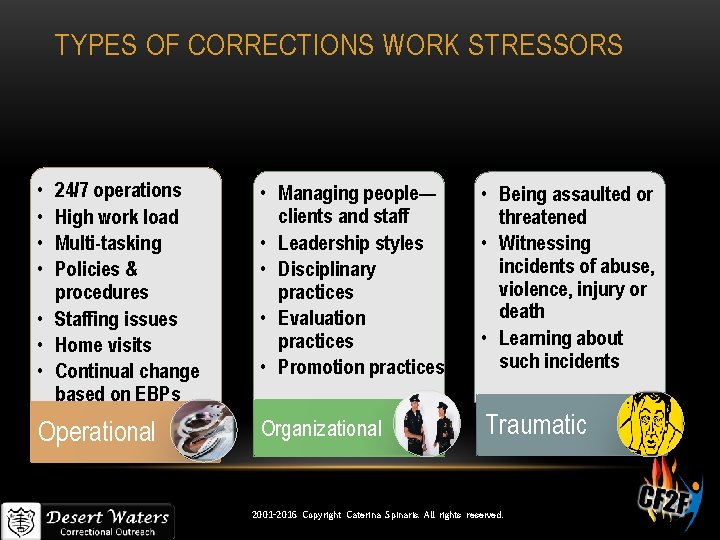
TYPES OF CORRECTIONS WORK STRESSORS • • 24/7 operations High work load Multi-tasking Policies & procedures • Staffing issues • Home visits • Continual change based on EBPs • Managing people— clients and staff • Leadership styles • Disciplinary practices • Evaluation practices • Promotion practices • Being assaulted or threatened • Witnessing incidents of abuse, violence, injury or death • Learning about such incidents Operational Organizational Traumatic 2001 -2016 Copyright Caterina Spinaris. All rights reserved.
CHALLENGES - CORRECTIONS FATIGUE 7. Work overload 1. Nature of the job 2. Negative work environment 8. Training complexities 9. Client violations and revocations 3. Role complexity 4. Nature of the clients 10. Witnessing staff policy violations 5. Traumatic exposure 6. Nature of corrections organizations 11. Public image 12. Political context 2001 -2016 Copyright Caterina Spinaris. All rights reserved.
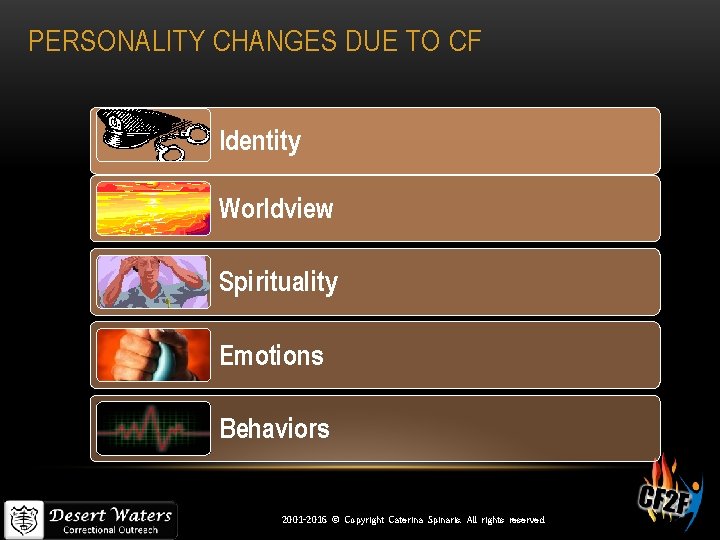
PERSONALITY CHANGES DUE TO CF Identity Worldview Spirituality Emotions Behaviors 2001 -2016 © Copyright Caterina Spinaris. All rights reserved.
CF - IDENTITY CHANGES Viewing oneself primarily or exclusively in terms of the job. • “I’m a warrior. ” • “I’m a savior. ” Losing positive identification with the profession. • “I’m a glorified babysitter / human doormat. ” Feeling defeated, like a failure. • “I’m not cut out for this. ” • “I’m a coward. ” 2001 -2016 © Copyright Caterina Spinaris. All rights reserved.
CF - WORLDVIEW CHANGES Assuming the worst about others, and adopting a negative worldview. • “They lie whenever they move their lips. ” • “Watch out or they'll game you. ” • “They're all cons. ” • “They’re the scum of the earth!” • “It’s me against them. ” 2001 -2016 © Copyright Caterina Spinaris. All rights reserved.
CF - SPIRITUALITY CHANGES • Expecting the worst • Losing passion for life • Losing capacity to trust • Difficulty feeling joy, tenderness or love • Losing capacity to enjoy beauty • Feeling unlovable • Dehumanizing clients • Feeling emotionally disconnected and alone 2001 -2016 Copyright Caterina Spinaris. All rights reserved.
CF - EMOTIONS • Irritability • “Emotional Numbing” • Frustration • Indifference • Anger • Guilt • Anxiety • Fear • Sadness • Helplessness • Shame • Disillusionment • Loss of pride in job 2001 -2016 Copyright Caterina Spinaris. All rights reserved.
CF – BEHAVIORS • Impatience • Hostility • Aggression • Social isolation and withdrawal • Substance abuse and other addictions • Difficulty showing compassion • High degree of controlling others 2001 -2016 Copyright Caterina Spinaris. All rights reserved.
CF – WORKPLACE CULTURE • Glorification of toughness o o • • • Suppression and rejection of “soft” emotions Considering kindness to be weakness Harassment and/or shunning of those who appear to be “weak” or who seek help Denial of effects of traumatic exposure Distrust of other staff and administrators Divisions among staff Intolerance of differences “Dehumanization” of clients Abuses of power Other types of misconduct 2001 -2016 Copyright Caterina Spinaris. All rights reserved.
Exercise: Silent Witness Anonymously, write on the index card provided three negative personality changes you have observed in yourself that you think may be examples of Corrections Fatigue. • After you finish, I’ll collect your cards and I will lay them out for you to walk by silently and read. The cards will be shredded after the training. Adapted from Saakvitne, Gamble, Pearlman, and Lev (2000) 2001 -2016 Copyright Caterina Spinaris. All rights reserved.
Part Two - From Fatigue to Fulfillment 2001 -2016 Copyright Caterina Spinaris. All rights reserved.
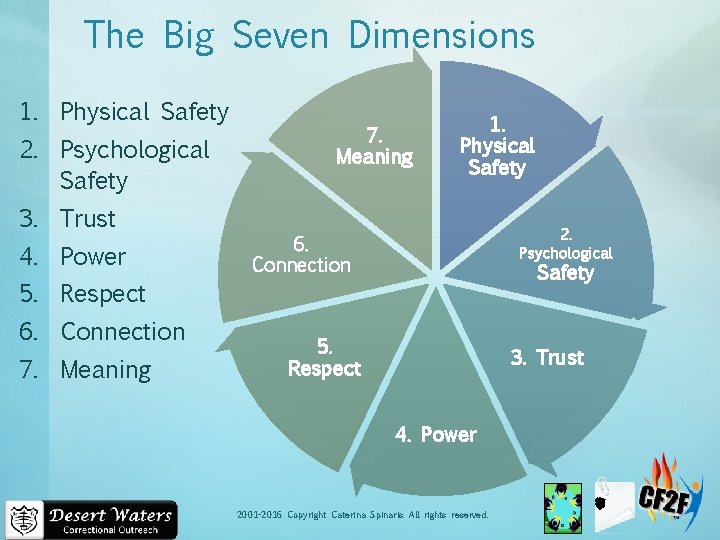
The Big Seven Dimensions 1. Physical Safety 2. Psychological Safety 3. Trust 4. Power 5. Respect 6. Connection 7. Meaning 1. Physical Safety 2. Psychological 6. Connection Safety 5. Respect 3. Trust 4. Power 2001 -2016 Copyright Caterina Spinaris. All rights reserved.
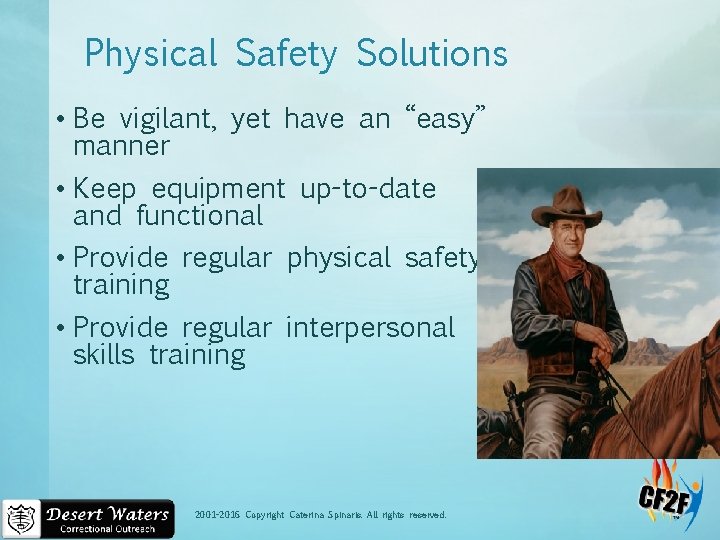
Physical Safety Solutions • Be vigilant, yet have an “easy” manner • Keep equipment up-to-date and functional • Provide regular physical safety training • Provide regular interpersonal skills training 2001 -2016 Copyright Caterina Spinaris. All rights reserved.
Psychological Safety Solutions • Provide encouragement and help to struggling coworkers • Honor confidences, except when they violate policy • Give corrective feedback constructively, with suggestions for improvement • Maintain professional boundaries • Discourage and/or confront bullying behaviors or mean -spirited comments • Confront a sexualized workplace • Get professional help for anxiety or depression 2001 -2016 Copyright Caterina Spinaris. All rights reserved.
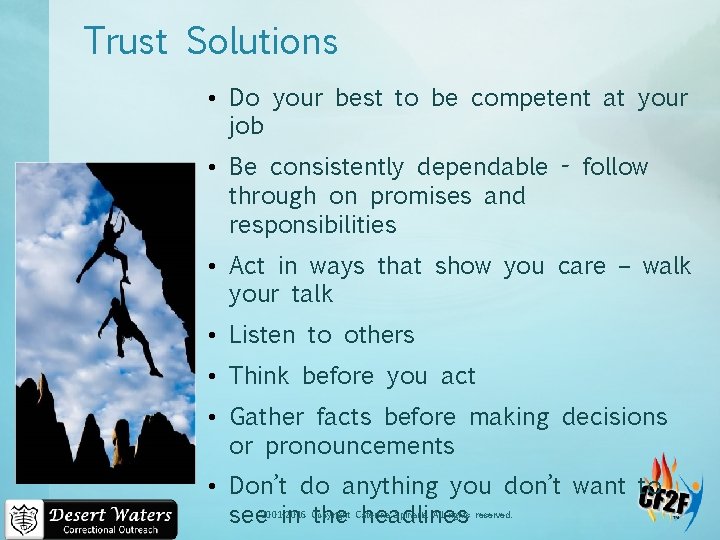
Trust Solutions • Do your best to be competent at your job • Be consistently dependable - follow through on promises and responsibilities • Act in ways that show you care – walk your talk • Listen to others • Think before you act • Gather facts before making decisions or pronouncements • Don’t do anything you don’t want to see in the headlines 2001 -2016 Copyright Caterina Spinaris. All rights reserved.
Power Solutions • Realize that self-control is a form of power • Allow staff to develop their style • Avoid “micromanaging” • Realize the power of being fair, caring and respectful • Give staff choices when possible • Ask staff for their input when appropriate • Have an “open door” policy 2001 -2016 Copyright Caterina Spinaris. All rights reserved.
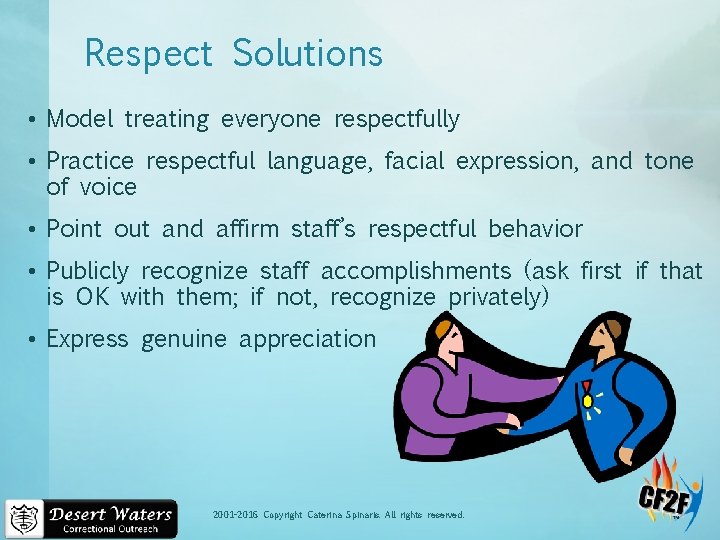
Respect Solutions • Model treating everyone respectfully • Practice respectful language, facial expression, and tone of voice • Point out and affirm staff’s respectful behavior • Publicly recognize staff accomplishments (ask first if that is OK with them; if not, recognize privately) • Express genuine appreciation 2001 -2016 Copyright Caterina Spinaris. All rights reserved.
Connection Solutions • Learn to manage your own emotions • Learn to listen well • Learn to let go of grudges • Point out others’ strengths and accomplishments • Express appreciation • Maintain sound professional boundaries • Use light humor in non-threatening ways • Supervisors, stay visible and accessible • Supervisors, encourage teamwork 2001 -2016 Copyright Caterina Spinaris. All rights reserved.
Meaning Solutions • Focus on developing your character and skill sets • Assist co-workers to grow and develop their skill sets • Pursue acts of courage, civility, helpfulness and integrity • Identify every shred of progress in both clients and staff • Remind yourself and others that even one success story matters • Daily, leave your workplace better than how you found it 2001 -2016 Copyright Caterina Spinaris. All rights reserved.
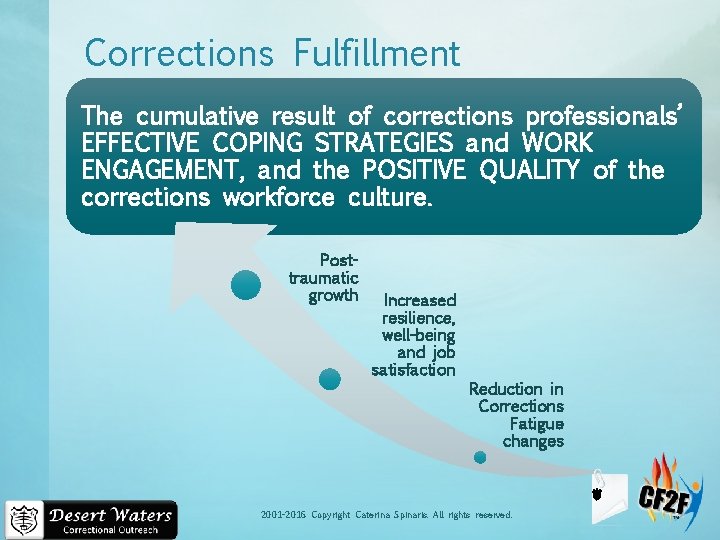
Corrections Fulfillment The cumulative result of corrections professionals’ EFFECTIVE COPING STRATEGIES and WORK ENGAGEMENT, and the POSITIVE QUALITY of the corrections workforce culture. Posttraumatic growth Increased resilience, well-being and job satisfaction Reduction in Corrections Fatigue changes 2001 -2016 Copyright Caterina Spinaris. All rights reserved.
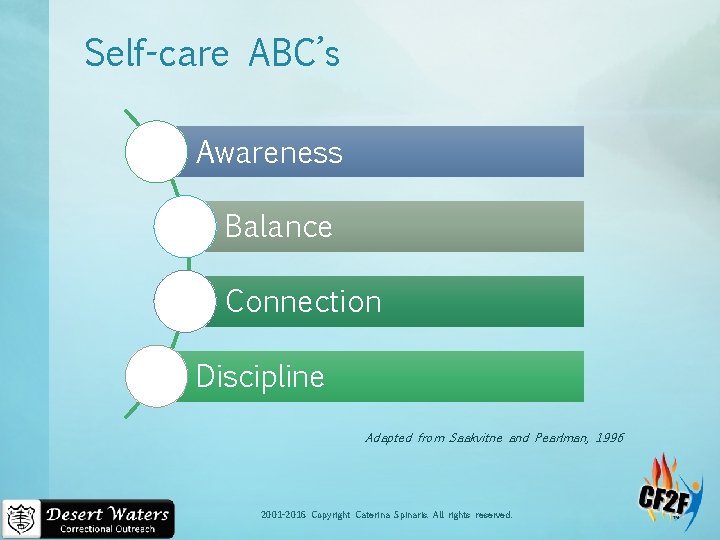
Self-care ABC’s Awareness Balance Connection Discipline Adapted from Saakvitne and Pearlman, 1996 2001 -2016 Copyright Caterina Spinaris. All rights reserved.
Awareness of… what your true needs are at any particular moment what you are thinking what emotions you are experiencing when something is a traumatic trigger the need to process emotionally distressing material what is working well in your life what gives you joy 2001 -2016 Copyright Caterina Spinaris. All rights reserved.
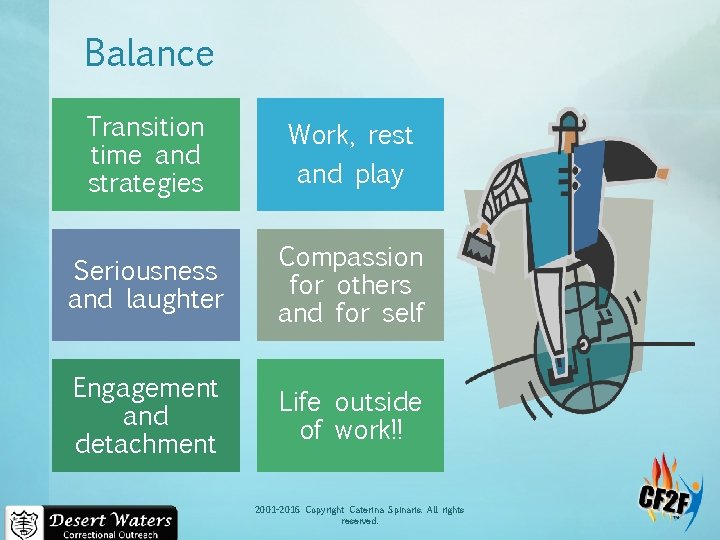
Balance Transition time and strategies Work, rest and play Seriousness and laughter Compassion for others and for self Engagement and detachment Life outside of work!! 2001 -2016 Copyright Caterina Spinaris. All rights reserved.
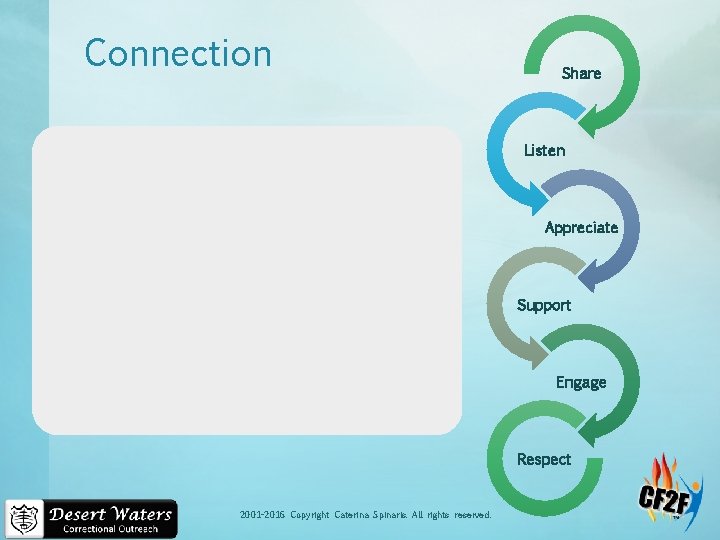
Connection Share Listen Appreciate Support Engage Respect 2001 -2016 Copyright Caterina Spinaris. All rights reserved.
Discipline PRACTICAL DISCIPLINE: MAKE TIME for ABC’s of self-care. MAKE TIME to tend to your needs. COGNITIVE & “HEART” DISCIPLINE: Interpret challenges as opportunities. Practice positive and optimistic thinking. Correct thought distortions related to Corrections Fatigue. 2001 -2016 Copyright Caterina Spinaris. All rights reserved.
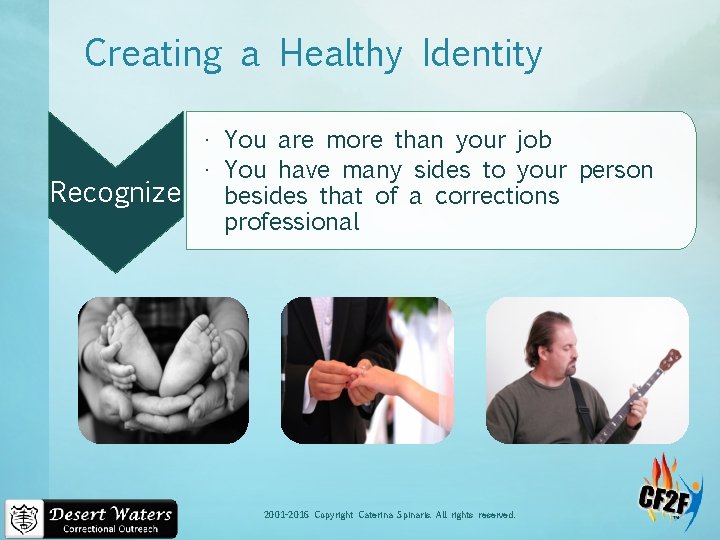
Creating a Healthy Identity • You are more than your job • You have many sides to your person Recognize besides that of a corrections professional 2001 -2016 Copyright Caterina Spinaris. All rights reserved.
• Rem embe r: N • Do ot ev Creating a Healthy Worldview not o eryon ver-ge concl e is a n e u ralize sions crimin • Clie / f d r raw om a al nts m few t ay be • The o ma free w telling ny orld assum y o u the o p p e tions rates truth • Sho t o h an th n diff w res e cor erent pect • The for o rectio re AR t ns wo hers ’ E goo • Peo point r d peo ple C ld s AN c hange ple out th of view ere for th e bet ter 2001 - 2016 Copyr ight C ater ina S pina ris. A ll righ ts reserv ed.
Creating a Healthy Spirituality • Adopt positive principles to live by • Risk depending on something bigger than yourself • Adopt a spiritual framework and have a hopeful outlook • Indulge in the joys of giving, loving and helping 2001 -2016 Copyright Caterina Spinaris. All rights reserved.
Positive Leadership Positive leaders emphasize: • What is good • What inspires • What motivates • What encourages • What works well • What strengths people bring to the team Adapted from Cameron, 2008 2001 -2016 Copyright Caterina Spinaris. All rights reserved.
Positive Organizational Climate • Optimism • Encouragement • Empathy • Compassion • Gratitude • Forgiveness Adapted from Cameron, 2008 2001 -2016 Copyright Caterina Spinaris. All rights reserved.
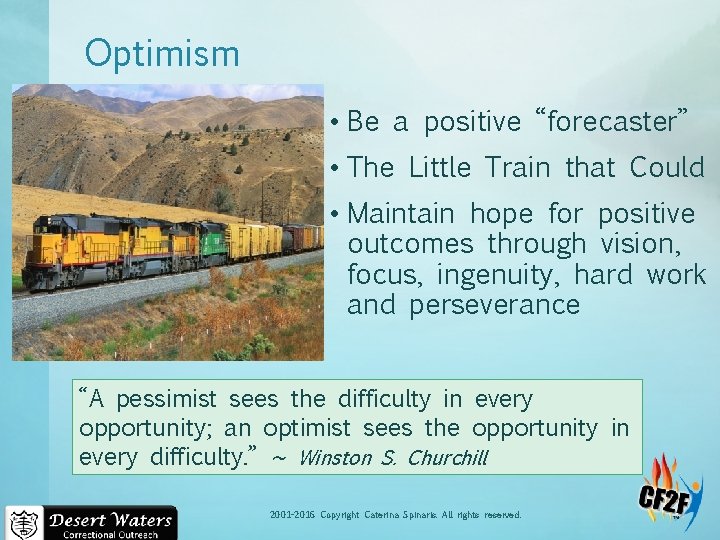
Optimism • Be a positive “forecaster” • The Little Train that Could • Maintain hope for positive outcomes through vision, focus, ingenuity, hard work and perseverance “A pessimist sees the difficulty in every opportunity; an optimist sees the opportunity in every difficulty. ” ~ Winston S. Churchill 2001 -2016 Copyright Caterina Spinaris. All rights reserved.
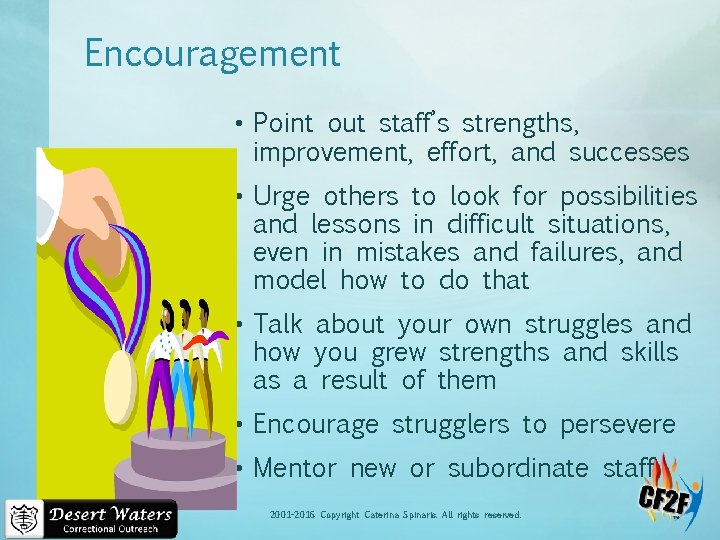
Encouragement • Point out staff’s strengths, improvement, effort, and successes • Urge others to look for possibilities and lessons in difficult situations, even in mistakes and failures, and model how to do that • Talk about your own struggles and how you grew strengths and skills as a result of them • Encourage strugglers to persevere • Mentor new or subordinate staff 2001 -2016 Copyright Caterina Spinaris. All rights reserved.
Empathy • Listen to understand the perspective and emotions of another (even if you don’t agree) • Imagine “putting yourself in another’s shoes, and walking a mile in them” • Imagine how they may be feeling and thinking about a situation • Take these into consideration when interacting with them, to demonstrate that you care 2001 -2016 Copyright Caterina Spinaris. All rights reserved.
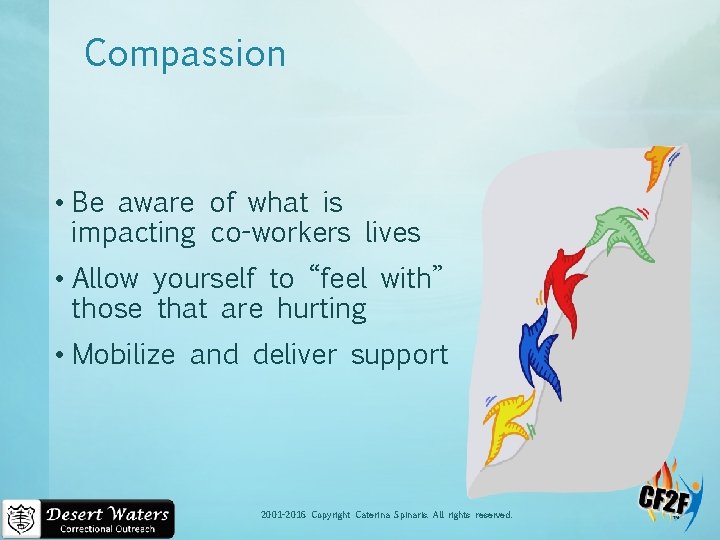
Compassion • Be aware of what is impacting co-workers lives • Allow yourself to “feel with” those that are hurting • Mobilize and deliver support 2001 -2016 Copyright Caterina Spinaris. All rights reserved.
Gratitude “Without gratitude, life can be lonely, depressing and impoverished. Gratitude enriches human life. It elevates, energizes, inspires and transforms. People are moved, opened and humbled through expressions of gratitude. ” - Robert Emmons • Associated with increased resilience, positive mood, and physical and psychological well-being • Identify three things that you are thankful for each day, and why you are thankful for them • Keep a weekly gratitude journal where you record what you are grateful for • Identify people who positively impact your life, and thank them for that Emmons, 2007; Seligman et al. , 2005 2001 -2016 Copyright Caterina Spinaris. All rights reserved.
Forgiveness “Without forgiveness, there is no future. ” - Desmond Tutu • Improves well-being by reducing toxic anger and chronic stress, and by boosting selfesteem • May involve understanding of, and empathy and compassion toward persons to be forgiven • Extend forgiveness by letting go of grudges • Seek forgiveness by acknowledging harm or oversight Toussaint, Worthington, & Williams, 2015 2001 -2016 Copyright Caterina Spinaris. All rights reserved.
Organizational Strategies • Organizational Culture • Organizational Support • Work Environment • Supervision • Education Adapted from Bell, Kulkarni Dalton, 2003 • Resources for and Selfcare 2001 -2016 Copyright Caterina Spinaris. All rights reserved.
Organizational Culture • Continually appraise the safety and efficiency of operations • Recognize individual or team success • Provide opportunities for skill and career development • Ensure the clarity of staff roles • Point out the commonality of goals for the units, teams and organization • Allow team participation in decision making • Recognize and acknowledge the impact of stress on staff • Provide positive and supportive leadership • Ensure efficient and sufficient information flow Adapted in part from Hart and Cotton, 2003, 2011 2001 -2016 Copyright Caterina Spinaris. All rights reserved.
Organizational Support • Periodically thank staff for keeping the facility running well • Offer affordable and adequate health benefits for staff and family • Provide Field Training Officers • Offer peer support programs and/or mentoring programs • Provide critical incident intervention resources • Offer educational materials about the impact of work on staff and their families, and solutions • Offer Family Days at the facility or in the community 2001 -2016 Copyright Caterina Spinaris. All rights reserved.
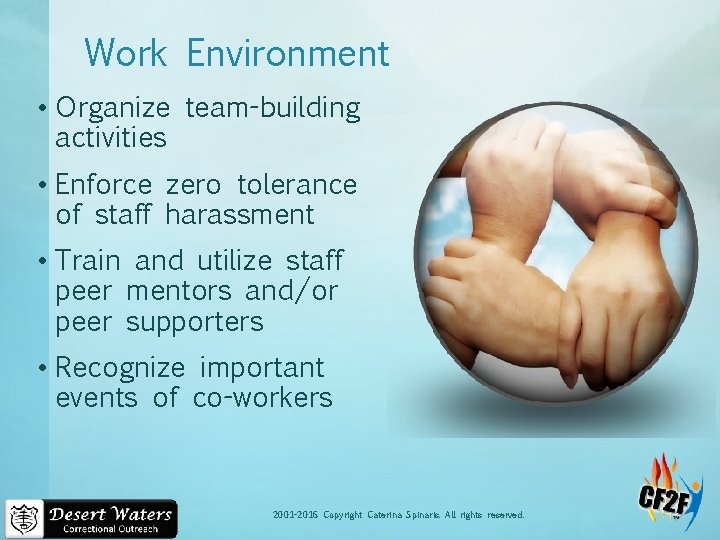
Work Environment • Organize team-building activities • Enforce zero tolerance of staff harassment • Train and utilize staff peer mentors and/or peer supporters • Recognize important events of co-workers 2001 -2016 Copyright Caterina Spinaris. All rights reserved.
Supervisors • Be aware of your emotions and control your behavior/actions • Be accessible • Go where your staff is and talk with them • Learn to LISTEN to your staff • Emphasize you are one team • Model integrity • Model resilience—the ability to bounce back • Show genuine caring, compassion, and appreciation • Model fact-gathering and logical problem-solving 2001 -2016 Copyright Caterina Spinaris. All rights reserved.
Education • Ensure expanded, evidence-based, mission-critical content, with: o Management of special populations o Physical skills and safety training for all staff o Understanding impact of corrections work and ways to counter it through teamwork and other positive organizational concepts o Effective self-care strategies, including work/home transition • Expand skills training to include all interpersonal skills • Ensure that the training experience itself is motivational • Emphasize skill transfer from training to work through supervisors’ application, coaching and reinforcement • Research the impact of training on workplace performance. 2001 -2016 Copyright Caterina Spinaris. All rights reserved.
Resources Employee Assistance Programs Local mental health providers Field Training Officers Peer supporters Mentors Community-based self-help groups • Spiritual advisors and resources • Crisis hotlines • The “Correctional Oasis” e-zine and other resources at • • • www. desertwaters. com 2001 -2016 Copyright Caterina Spinaris. All rights reserved.
Exercise: Professional Vision 1. Complete your “Professional Vision” handout by listing three areas in which you would like to develop (in measurable ways) as a corrections professional in the next 12 months. 2. Repeat a shorter version of your “Professional Vision, on the index card provided to you. • After you finish, I’ll pick up your cards and lay out for us to read. The cards will be shredded at the end of the training. 2001 -2016 Copyright Caterina Spinaris. All rights reserved.
In summary - You are now able to: Describe the nature and causes of Corrections Fatigue. Practice personal strategies to increase fulfillment as a corrections professional. Practice strategies to manage stress associated with corrections work. Identify organizational strategies to cultivate Corrections Fulfillment. 2001 -2016 Copyright Caterina Spinaris. All rights reserved.
- Slides: 58