Failures and fault classification Jrn Vatn NTNU jorn
- Slides: 13
Failures and fault classification Jørn Vatn NTNU jorn. vatn@ntnu. no 1
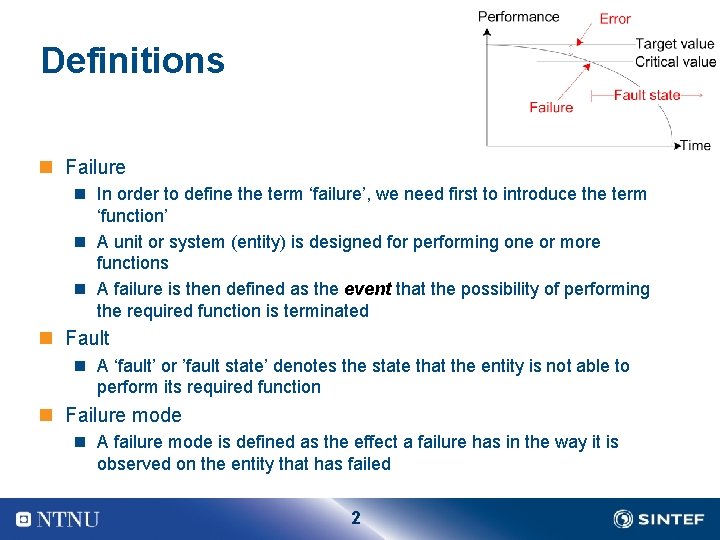
Definitions n Failure n In order to define the term ‘failure’, we need first to introduce the term ‘function’ n A unit or system (entity) is designed for performing one or more functions n A failure is then defined as the event that the possibility of performing the required function is terminated n Fault n A ‘fault’ or ’fault state’ denotes the state that the entity is not able to perform its required function n Failure mode n A failure mode is defined as the effect a failure has in the way it is observed on the entity that has failed 2
Failure classification n There are many principles to choose among for classifying failures. In this section we will consider the following dimensions n Immediate Gradual failure n Hidden Evident failure n Physical Functional failures 3
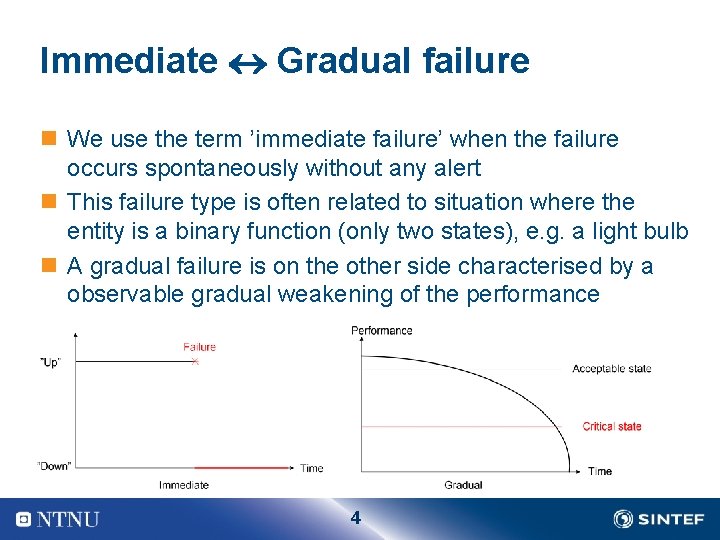
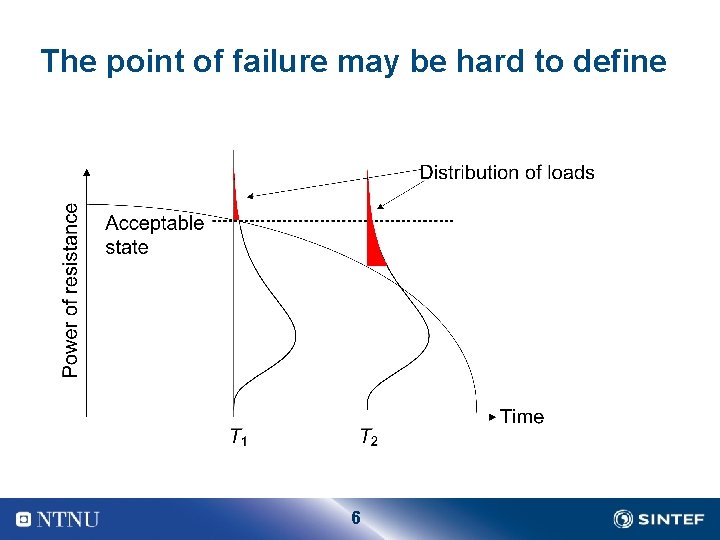
Immediate Gradual failure n We use the term ’immediate failure’ when the failure occurs spontaneously without any alert n This failure type is often related to situation where the entity is a binary function (only two states), e. g. a light bulb n A gradual failure is on the other side characterised by a observable gradual weakening of the performance 4
Exercise n Give examples of immediate and gradual failures n Note that a component may have a gradual failure progression even though the function is binary, e. g. , a crack development prior to a breakage (failure) 5
The point of failure may be hard to define 6
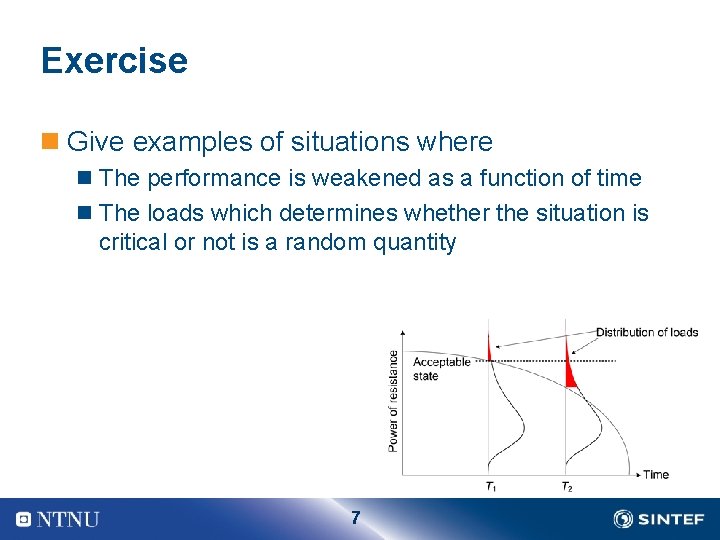
Exercise n Give examples of situations where n The performance is weakened as a function of time n The loads which determines whether the situation is critical or not is a random quantity 7
Hidden Evident failure n We often distinguish between hidden and evident failures n The term ’hidden’ often relates to entities that is not continuously demanded n For example the SIFA valve on a train (bleed of the air pressure by activation) is a hidden function, and a failure will not be detected automatically n The term ‘evident’ relates to entities that are continuously demanded, and a failure will most likely be detected immediately n Note that the same SIFA-valve will also have a evident function (“not bleed of air pressure under normal operation) because an unintended activation immediately will be detected (breaks are activated) 8
More on Hidden Evident failure n Some functions are not evident all the time, but may be verified e. g. , at start-up (e. g. , hand break in a car) n Evident by ”start-up” n Some functions are hidden, but may be detected by ”self-test”, this is typical for detection systems n ”Partial stroke test” is a test that reveals some, but not all failure causes n Some failures will become evident after a while n Failure of a pump for maintaining pressure in an oil pressure container n A filter without throughput will give system effects after a while n On a component level the function is hidden, but on a system level the function is evident n E. g. , we need 3 -out-of-4 bolts to keep a structure in place n One loose bolt is not evident n When the structure falls down, it is evident 9
Exercise n Give examples on n Hidden failures n Evident by ”start-up” n Evident after a while n Evident only on system level 10
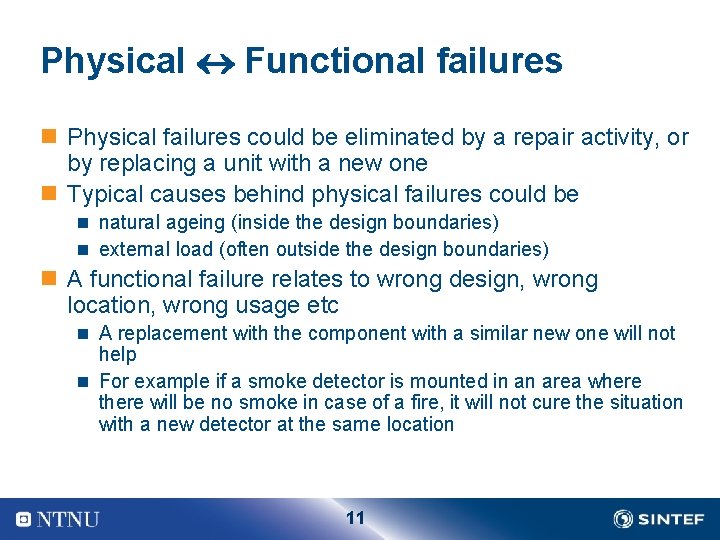
Physical Functional failures n Physical failures could be eliminated by a repair activity, or by replacing a unit with a new one n Typical causes behind physical failures could be n natural ageing (inside the design boundaries) n external load (often outside the design boundaries) n A functional failure relates to wrong design, wrong location, wrong usage etc n A replacement with the component with a similar new one will not help n For example if a smoke detector is mounted in an area where there will be no smoke in case of a fire, it will not cure the situation with a new detector at the same location 11
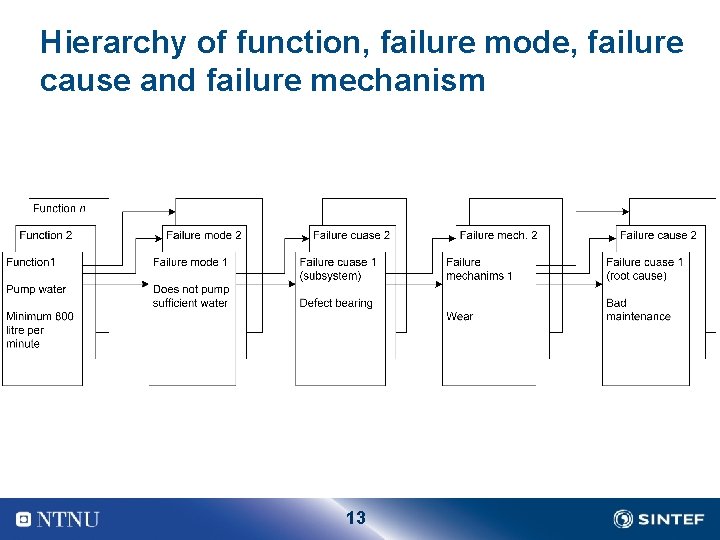
Failure mechanisms and failure causes n Failure mechanisms relates to physical, chemical or other processes that deteriorates the entity, and leads to a failure n The term ‘failure cause’ is often used in two different ways n Failure on a lower level in the system hierarchy, e. g. , a defect bearing in a pump n Root cause, for example bad maintenance, inadequate design etc 12
Hierarchy of function, failure mode, failure cause and failure mechanism 13