Expressions Equations and Inequalities Chapter 1 1 3
- Slides: 13
Expressions, Equations, and Inequalities Chapter 1
1. 3 Algebraic Expressions • Pg. 18 -24 • Obj: Learn how to evaluate and simplify algebraic expressions. • A. SSE. 1. a
1. 3 Algebraic Expressions • Evaluate – substitute a number for each variable in the expression and then simplify using the order of operations • Term – an expression that is a number, a variable, or the product of a number and one or more variables • Coefficient – the numerical factor of a term • Constant Term – a term with no variables • Like Terms – have the same variables raised to the same powers
1. 4 Solving Equations • Pg. 26 -32 • Obj: Learn how to solve equations and solve problems by writing equations. • A. CED. 1, A. CED. 4
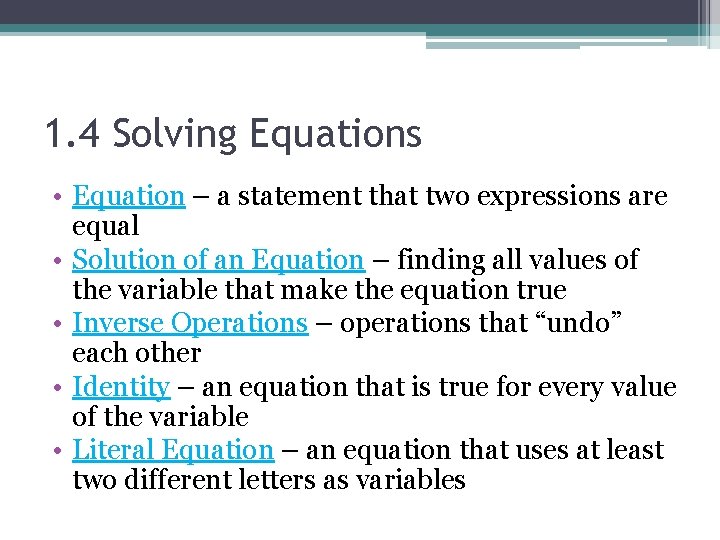
1. 4 Solving Equations • Equation – a statement that two expressions are equal • Solution of an Equation – finding all values of the variable that make the equation true • Inverse Operations – operations that “undo” each other • Identity – an equation that is true for every value of the variable • Literal Equation – an equation that uses at least two different letters as variables
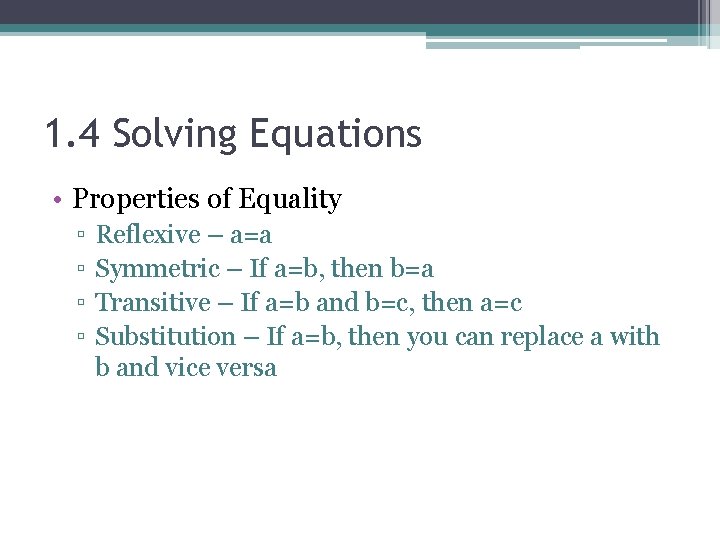
1. 4 Solving Equations • Properties of Equality ▫ ▫ Reflexive – a=a Symmetric – If a=b, then b=a Transitive – If a=b and b=c, then a=c Substitution – If a=b, then you can replace a with b and vice versa
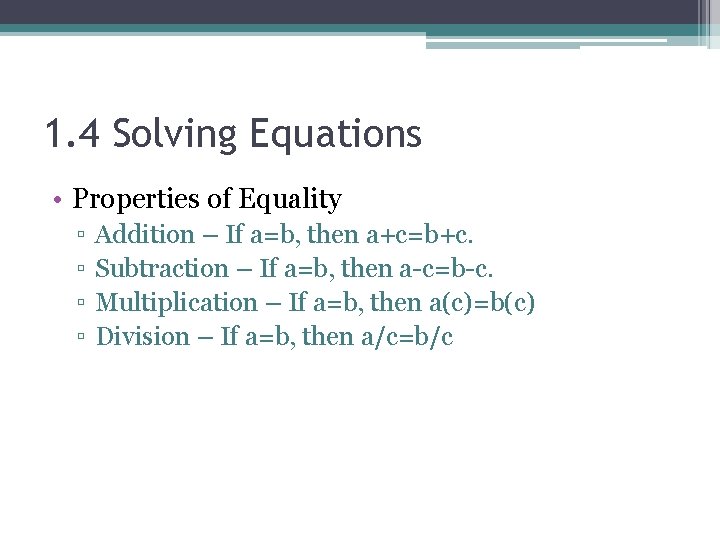
1. 4 Solving Equations • Properties of Equality ▫ ▫ Addition – If a=b, then a+c=b+c. Subtraction – If a=b, then a-c=b-c. Multiplication – If a=b, then a(c)=b(c) Division – If a=b, then a/c=b/c
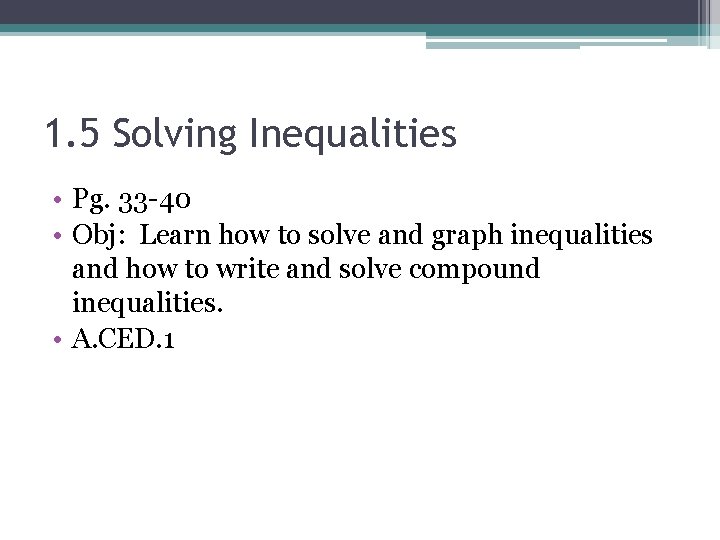
1. 5 Solving Inequalities • Pg. 33 -40 • Obj: Learn how to solve and graph inequalities and how to write and solve compound inequalities. • A. CED. 1
1. 5 Solving Inequalities • Compound Inequality – Two inequalities joined with the words “and” or “or” • Inequality Symbols and Graphing ▫ ▫ Greater Than - > - open circle Greater Than or Equal to - > - closed circle Less Than - < - open circle Less Than or Equal to - < - closed circle
1. 5 Solving Inequalities • Properties of Inequalities ▫ ▫ ▫ Transitive – If a>b and b>c, then a>c Addition – If a>b, then a+c>b+c Subtraction – If a>b, then a-c>b-c Multiplication – If a>b and c>0, then ac>bc Division – If a>b and c>0, then a/c > b/c
1. 6 Absolute Value Equations and Inequalities • Pg. 41 – 48 • Obj: Learn how to write and solve equations and inequalities involving absolute value. • A. SSE. 1. b, A. CED. 1
1. 6 Absolute Value Equations and Inequalities • Absolute Value – the distance of a number from zero – always positive • Extraneous Solution – a solution derived from an original equation that is not a solution of the original equation
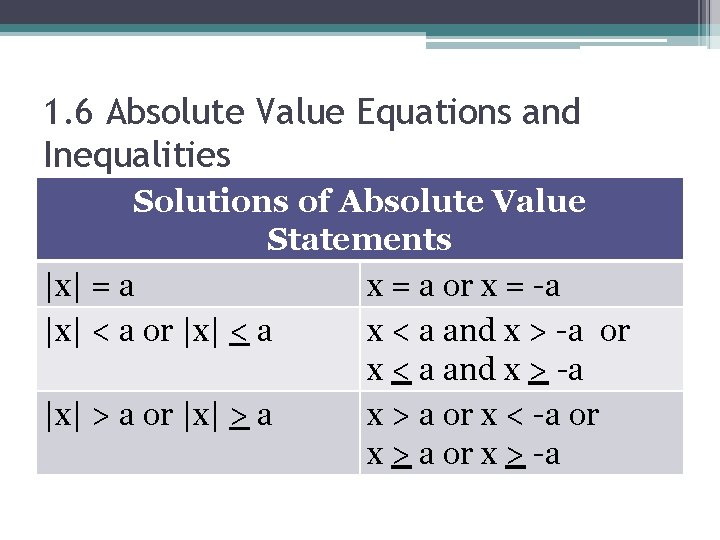
1. 6 Absolute Value Equations and Inequalities Solutions of Absolute Value Statements |x| = a x = a or x = -a |x| < a or |x| < a x < a and x > -a or x < a and x > -a |x| > a or |x| > a x > a or x < -a or x > -a