Explaining pragmatic inference Kuiper and Allan 9 2
- Slides: 10
Explaining pragmatic inference Kuiper and Allan 9. 2. 3
Explicatures • Humans utter sentences but sentences are normally not interpretable without pragmatic inference. – Too much is missing • Utterances are interpretable because they are uttered in context and context is needed for inferring a complete proposition which has truth conditions. – Until we are able to infer who a particular person called John actually is, a hearer can’t decide whether he left by train or not. • • An explicature is a proposition with truth conditions inferred on the basis of an utterance with relevant inference made on the basis of the context in which the utterance was produced. e. g. Utterance: – Can you come and meet me? – Contextual assumptions: • Me is Ophelia • Ophelia is coming tomorrow on the 4. 30 pm train from Milan. • I live in Florence. – Explicature • Can I meet Ophelia at the end of her journey at 4. 30 in Florence.
Implicatures • On the basis of an explicature and contextual assumptions hearers can draw further conclusions in the way of additional contextual assumptions. • Such additional conclusions are termed implicatures. • Take the explicature – Can I meet Ophelia in Florence at the end of her journey on the 4. 30 from Milan? – Further contextual assumptions • Trains arrive at railway stations. – Implicature • Can I meet Ophelia at the Florence railway station when the 4. 30 from Milan gets in? – i. e. the location of the meeting becomes part of an implicature coming from an additional contextual assumption.
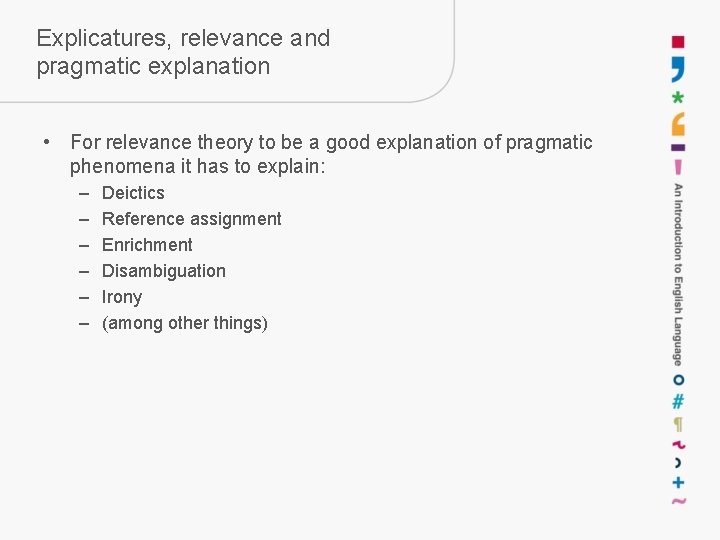
Explicatures, relevance and pragmatic explanation • For relevance theory to be a good explanation of pragmatic phenomena it has to explain: – – – Deictics Reference assignment Enrichment Disambiguation Irony (among other things)
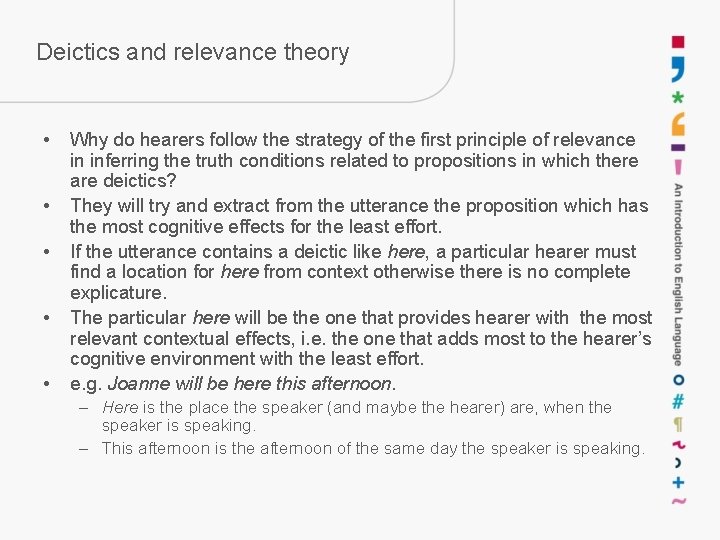
Deictics and relevance theory • • • Why do hearers follow the strategy of the first principle of relevance in inferring the truth conditions related to propositions in which there are deictics? They will try and extract from the utterance the proposition which has the most cognitive effects for the least effort. If the utterance contains a deictic like here, a particular hearer must find a location for here from context otherwise there is no complete explicature. The particular here will be the one that provides hearer with the most relevant contextual effects, i. e. the one that adds most to the hearer’s cognitive environment with the least effort. e. g. Joanne will be here this afternoon. – Here is the place the speaker (and maybe the hearer) are, when the speaker is speaking. – This afternoon is the afternoon of the same day the speaker is speaking.
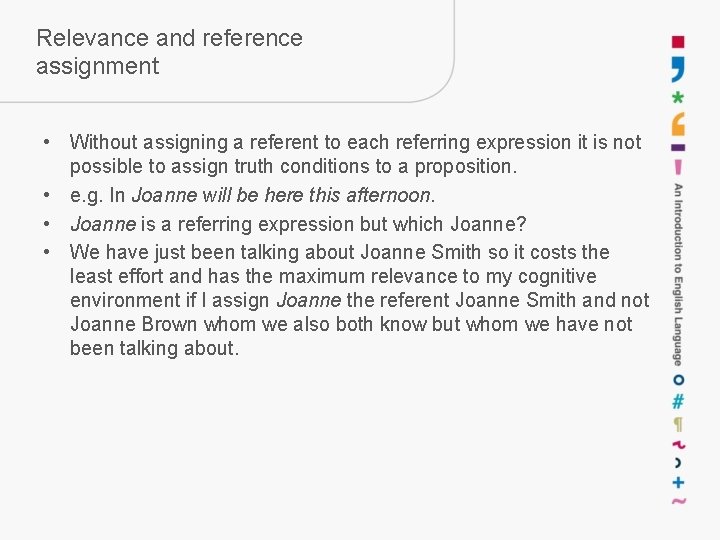
Relevance and reference assignment • Without assigning a referent to each referring expression it is not possible to assign truth conditions to a proposition. • e. g. In Joanne will be here this afternoon. • Joanne is a referring expression but which Joanne? • We have just been talking about Joanne Smith so it costs the least effort and has the maximum relevance to my cognitive environment if I assign Joanne the referent Joanne Smith and not Joanne Brown whom we also both know but whom we have not been talking about.
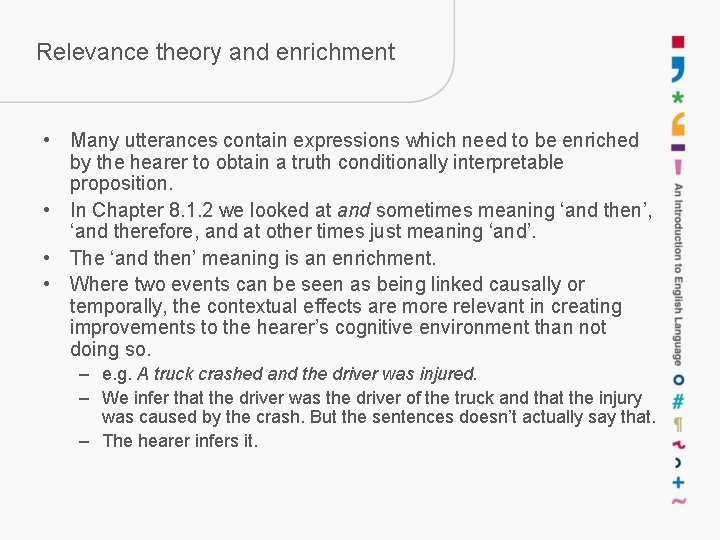
Relevance theory and enrichment • Many utterances contain expressions which need to be enriched by the hearer to obtain a truth conditionally interpretable proposition. • In Chapter 8. 1. 2 we looked at and sometimes meaning ‘and then’, ‘and therefore, and at other times just meaning ‘and’. • The ‘and then’ meaning is an enrichment. • Where two events can be seen as being linked causally or temporally, the contextual effects are more relevant in creating improvements to the hearer’s cognitive environment than not doing so. – e. g. A truck crashed and the driver was injured. – We infer that the driver was the driver of the truck and that the injury was caused by the crash. But the sentences doesn’t actually say that. – The hearer infers it.
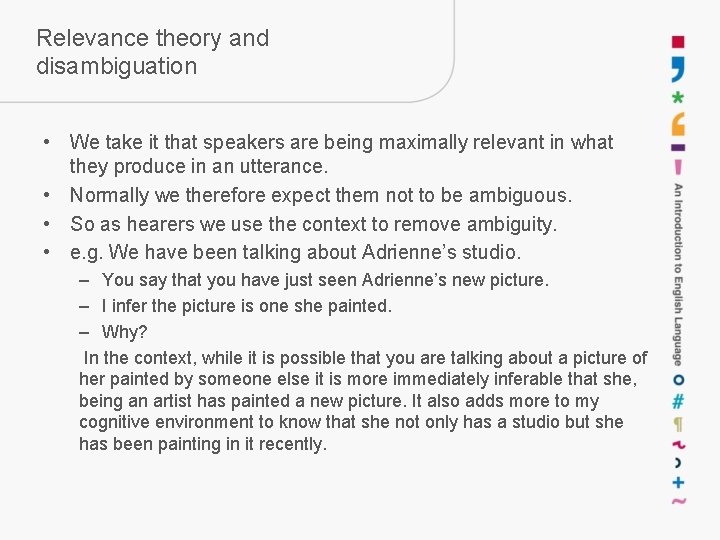
Relevance theory and disambiguation • We take it that speakers are being maximally relevant in what they produce in an utterance. • Normally we therefore expect them not to be ambiguous. • So as hearers we use the context to remove ambiguity. • e. g. We have been talking about Adrienne’s studio. – You say that you have just seen Adrienne’s new picture. – I infer the picture is one she painted. – Why? In the context, while it is possible that you are talking about a picture of her painted by someone else it is more immediately inferable that she, being an artist has painted a new picture. It also adds more to my cognitive environment to know that she not only has a studio but she has been painting in it recently.
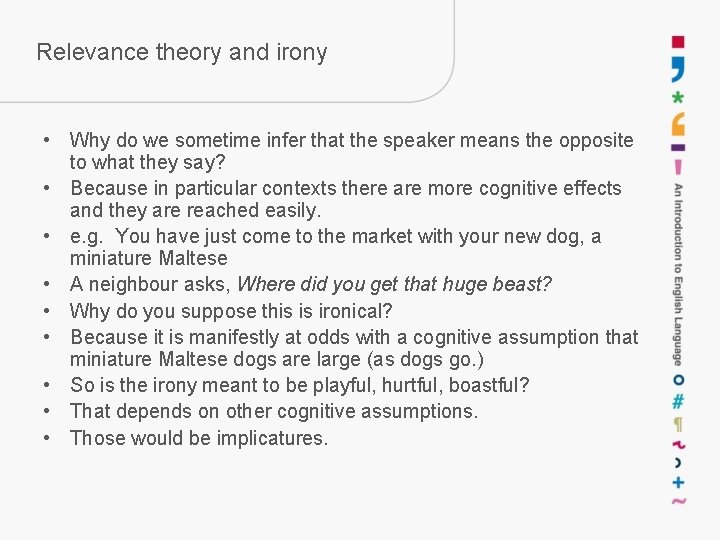
Relevance theory and irony • Why do we sometime infer that the speaker means the opposite to what they say? • Because in particular contexts there are more cognitive effects and they are reached easily. • e. g. You have just come to the market with your new dog, a miniature Maltese • A neighbour asks, Where did you get that huge beast? • Why do you suppose this is ironical? • Because it is manifestly at odds with a cognitive assumption that miniature Maltese dogs are large (as dogs go. ) • So is the irony meant to be playful, hurtful, boastful? • That depends on other cognitive assumptions. • Those would be implicatures.
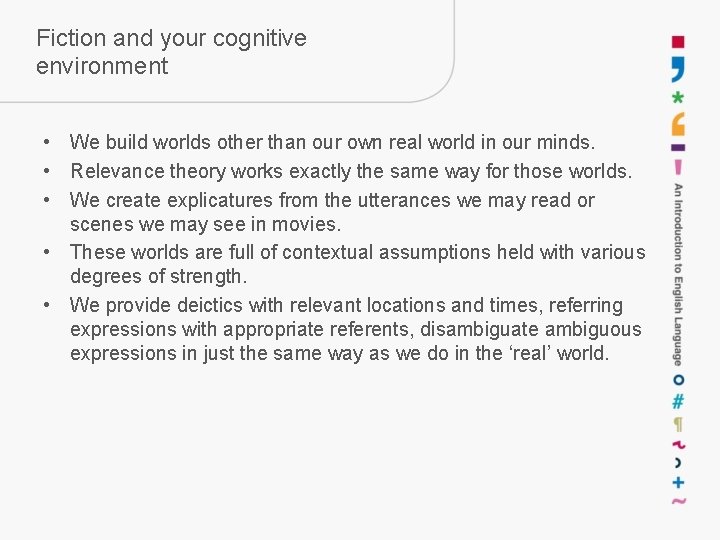
Fiction and your cognitive environment • We build worlds other than our own real world in our minds. • Relevance theory works exactly the same way for those worlds. • We create explicatures from the utterances we may read or scenes we may see in movies. • These worlds are full of contextual assumptions held with various degrees of strength. • We provide deictics with relevant locations and times, referring expressions with appropriate referents, disambiguate ambiguous expressions in just the same way as we do in the ‘real’ world.