EXECUTIVE SUMMARY Vincent Ferretti PurposeContextLiterature The purpose of
- Slides: 11
EXECUTIVE SUMMARY Vincent Ferretti
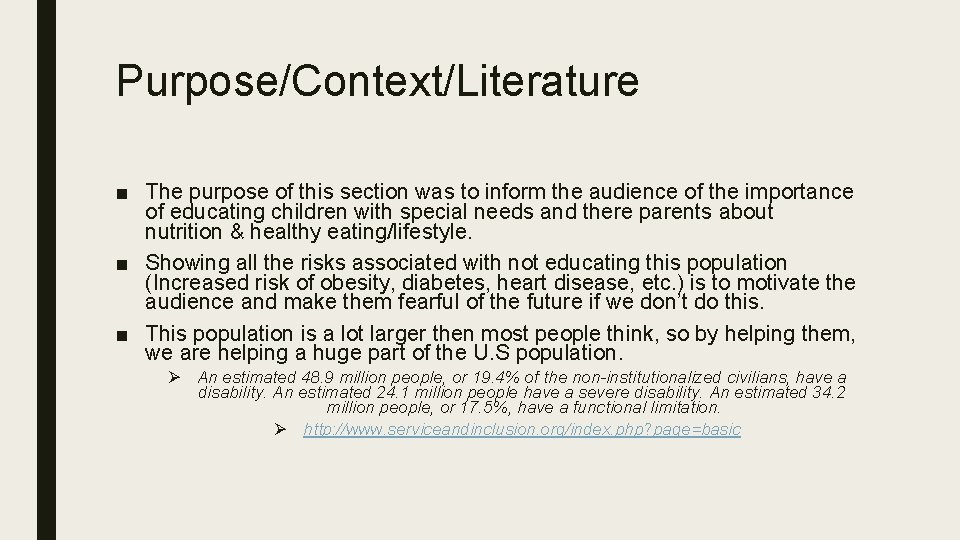
Purpose/Context/Literature ■ The purpose of this section was to inform the audience of the importance of educating children with special needs and there parents about nutrition & healthy eating/lifestyle. ■ Showing all the risks associated with not educating this population (Increased risk of obesity, diabetes, heart disease, etc. ) is to motivate the audience and make them fearful of the future if we don’t do this. ■ This population is a lot larger then most people think, so by helping them, we are helping a huge part of the U. S population. Ø An estimated 48. 9 million people, or 19. 4% of the non-institutionalized civilians, have a disability. An estimated 24. 1 million people have a severe disability. An estimated 34. 2 million people, or 17. 5%, have a functional limitation. Ø http: //www. serviceandinclusion. org/index. php? page=basic
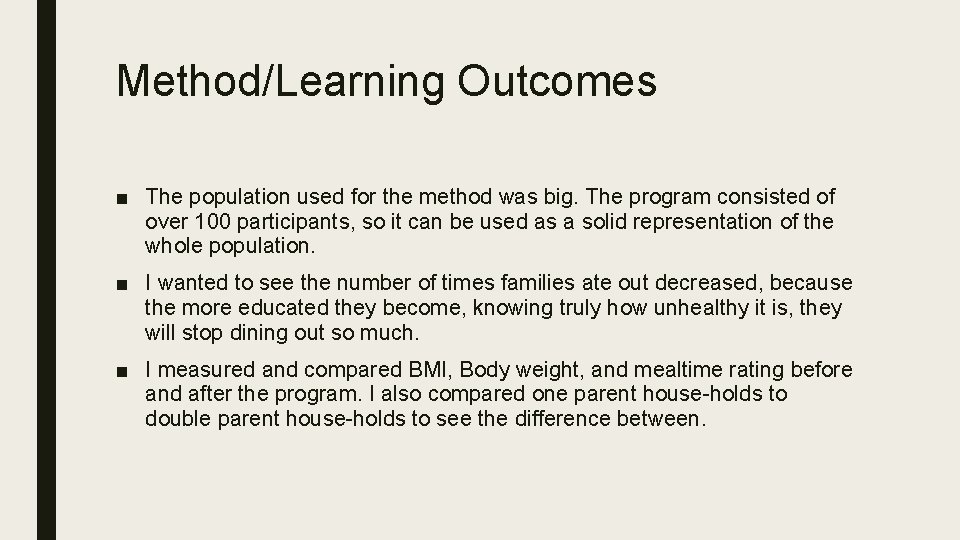
Method/Learning Outcomes ■ The population used for the method was big. The program consisted of over 100 participants, so it can be used as a solid representation of the whole population. ■ I wanted to see the number of times families ate out decreased, because the more educated they become, knowing truly how unhealthy it is, they will stop dining out so much. ■ I measured and compared BMI, Body weight, and mealtime rating before and after the program. I also compared one parent house-holds to double parent house-holds to see the difference between.
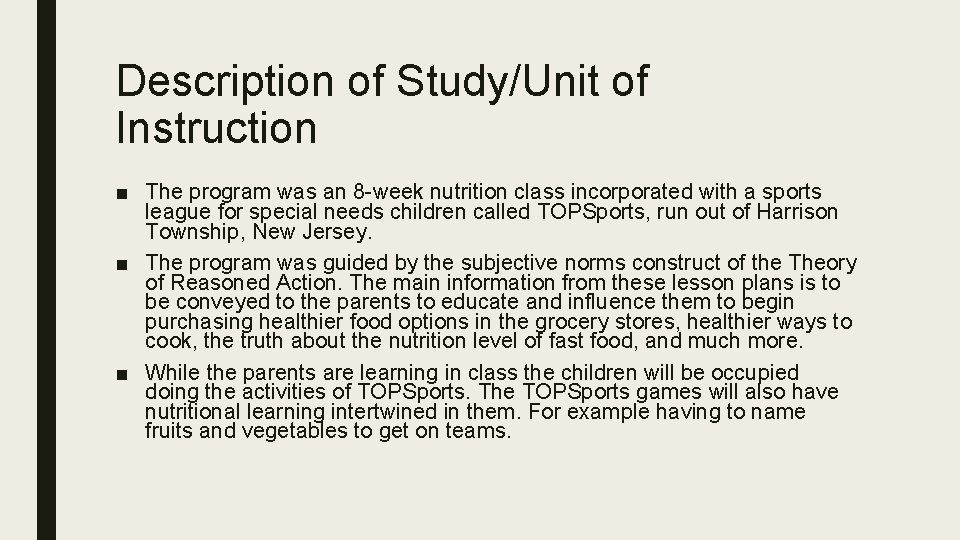
Description of Study/Unit of Instruction ■ The program was an 8 -week nutrition class incorporated with a sports league for special needs children called TOPSports, run out of Harrison Township, New Jersey. ■ The program was guided by the subjective norms construct of the Theory of Reasoned Action. The main information from these lesson plans is to be conveyed to the parents to educate and influence them to begin purchasing healthier food options in the grocery stores, healthier ways to cook, the truth about the nutrition level of fast food, and much more. ■ While the parents are learning in class the children will be occupied doing the activities of TOPSports. The TOPSports games will also have nutritional learning intertwined in them. For example having to name fruits and vegetables to get on teams.
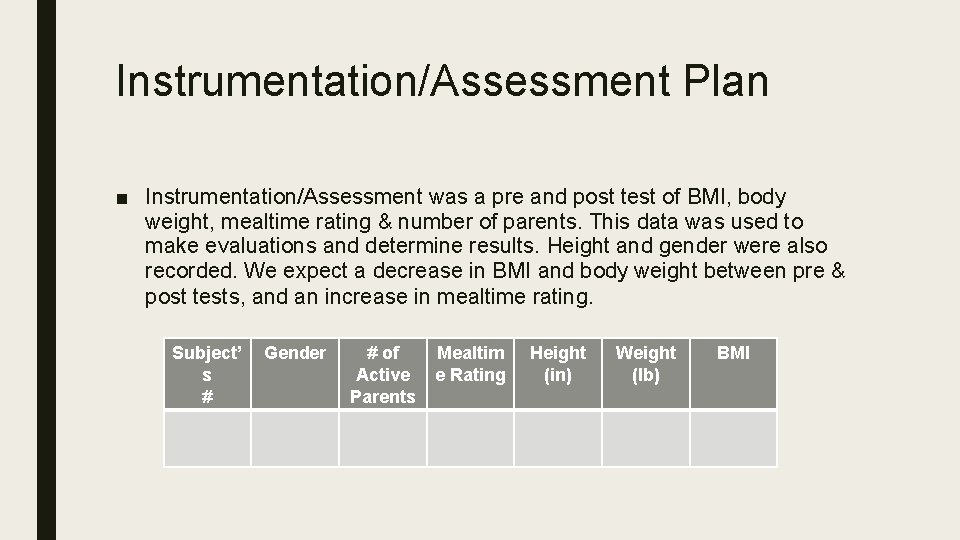
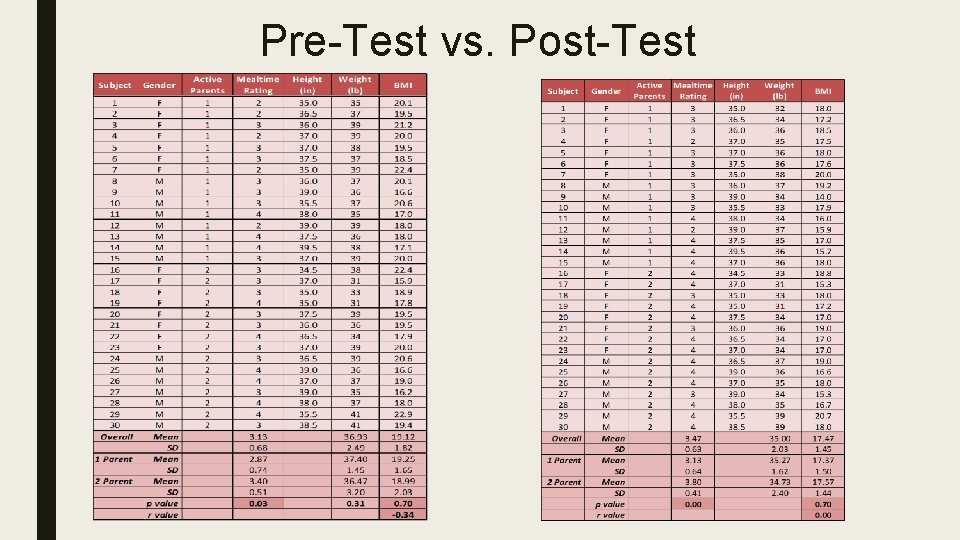
Instrumentation/Assessment Plan ■ Instrumentation/Assessment was a pre and post test of BMI, body weight, mealtime rating & number of parents. This data was used to make evaluations and determine results. Height and gender were also recorded. We expect a decrease in BMI and body weight between pre & post tests, and an increase in mealtime rating. Subject’ s # Gender # of Active Parents Mealtim e Rating Height (in) Weight (lb) BMI
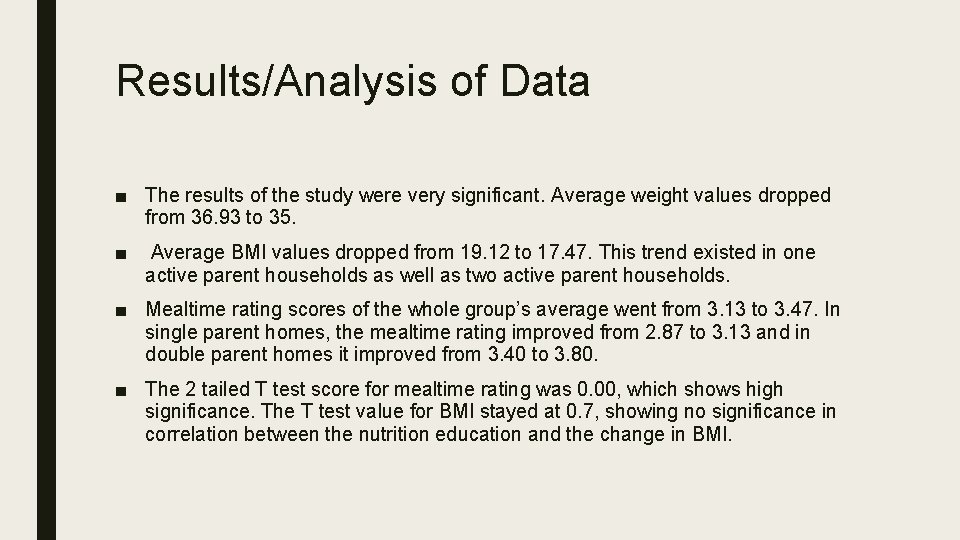
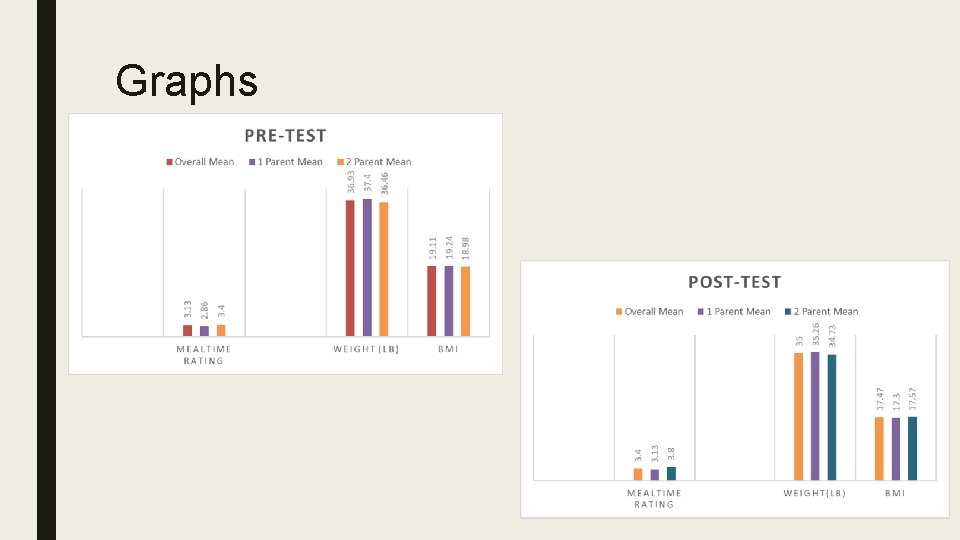
Results/Analysis of Data ■ The results of the study were very significant. Average weight values dropped from 36. 93 to 35. ■ Average BMI values dropped from 19. 12 to 17. 47. This trend existed in one active parent households as well as two active parent households. ■ Mealtime rating scores of the whole group’s average went from 3. 13 to 3. 47. In single parent homes, the mealtime rating improved from 2. 87 to 3. 13 and in double parent homes it improved from 3. 40 to 3. 80. ■ The 2 tailed T test score for mealtime rating was 0. 00, which shows high significance. The T test value for BMI stayed at 0. 7, showing no significance in correlation between the nutrition education and the change in BMI.
Pre-Test vs. Post-Test
Graphs
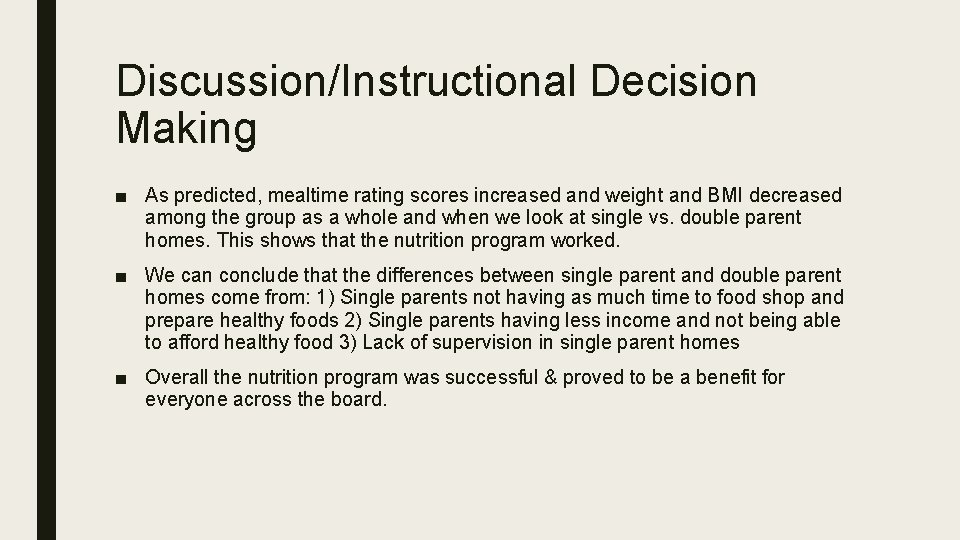
Discussion/Instructional Decision Making ■ As predicted, mealtime rating scores increased and weight and BMI decreased among the group as a whole and when we look at single vs. double parent homes. This shows that the nutrition program worked. ■ We can conclude that the differences between single parent and double parent homes come from: 1) Single parents not having as much time to food shop and prepare healthy foods 2) Single parents having less income and not being able to afford healthy food 3) Lack of supervision in single parent homes ■ Overall the nutrition program was successful & proved to be a benefit for everyone across the board.
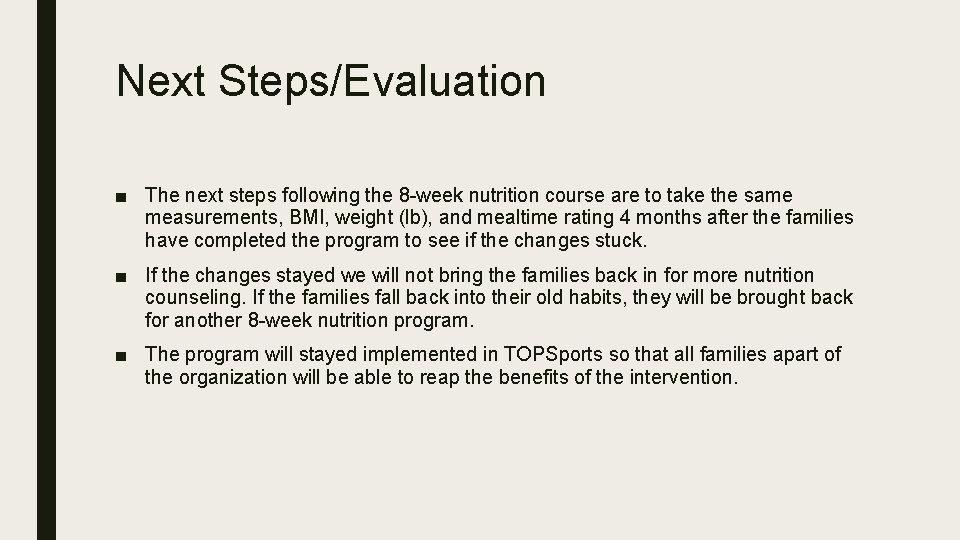
Next Steps/Evaluation ■ The next steps following the 8 -week nutrition course are to take the same measurements, BMI, weight (lb), and mealtime rating 4 months after the families have completed the program to see if the changes stuck. ■ If the changes stayed we will not bring the families back in for more nutrition counseling. If the families fall back into their old habits, they will be brought back for another 8 -week nutrition program. ■ The program will stayed implemented in TOPSports so that all families apart of the organization will be able to reap the benefits of the intervention.
References ■ Batchelder, A. , & Matusitz, J. (2014). “Let's Move” Campaign: Applying the Extended Parallel Process Model. Social Work In Public Health, 29(5), 462 -472. doi: 10. 1080/19371918. 2013. 865110 ■ Grossman, Eric, & Charles O'hara. "POPULATION SPECIFIC FACT SHEETWhat to Know When Assisting a Consumer Who Has a Child or Youth with Special Health Care Needs” (2016): AAHD, NDNRC. Web. ■ Powers, A. R. , Struempler, B. J. , Guarino, A. , & Parmer, S. M. (2005). Effects of a nutrition education program on the dietary behavior and nutrition knowledge of second-grade and third-grade students. Journal of School Health, 75(4), 129133. ■ http: //www. serviceandinclusion. org/index. php? page=basic