Estonian Grid Mario Kadastik mario kadastikcern ch On

- Slides: 13
Estonian Grid Mario Kadastik mario. kadastik@cern. ch On behalf of Estonian Grid Tallinn, Jan '05
In this presentation Brief history of Estonian Grid The current organizational structure of Estonian Grid The technical solution for Estonian Grid Other collaborations that we are part of CERN & Tier 2 plans Ongoing lectures and seminars about Grid in Estonia Cluster building and plans at NICPB Current scientific research projects on Estonian Grid Future plans
Brief history of EG (Estonian Grid) Jan-Dec '03 – some coordinative meetings Jan '04 – first components of EG: EG CA, country level GIIS and first test system enter EG Jan '04 – Nordu. Grid technical meeting in Tallinn Feb '04 – establishment of the Centre of High Energy Physics and Computational Sciences at NICPB to support development of local Grid applications Feb-Mar '04 – some first multiprocessor clusters join EG Apr '04 – CP/CPA draft for EG CA May '04 – first scientific software ported to EG May '04 – Establishment of Grid laboratory at the Institute of Technology of the Tartu University Jun '04 – establishment of EG technical coordination and support group Jun-Jul '04 – first massive test and scientific calculations on EG Nov '04 - EG technical support groups first article about EG is approved for publication and first scientific results produced with EG Q 4 '04 – EG reaches 100 cpus and first 2 TB storage element added Jan '05 – NGN meeting and EU proposal writing
Current organizational structure
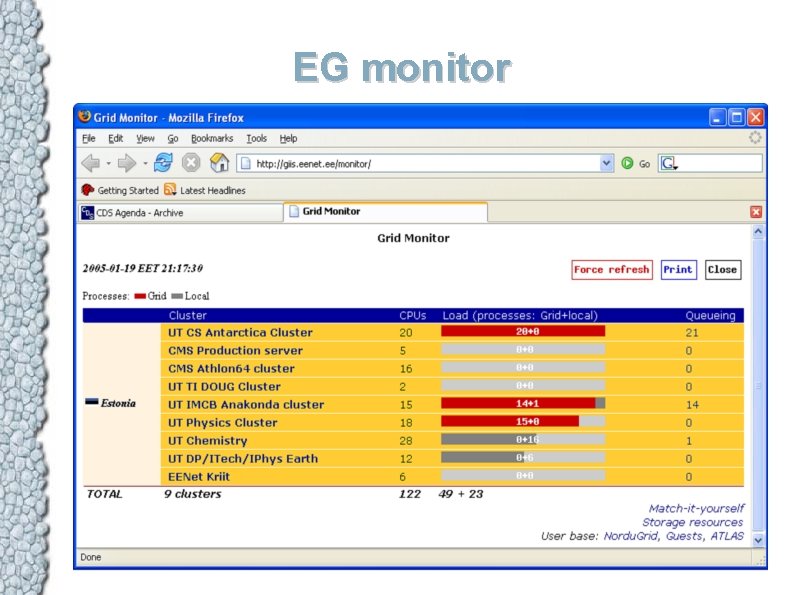
The technical solution of EG Choice of middleware – ARC (aka Nordu. Grid) Middleware choice due to historic and regional reasons At the moment 122 cpus in EG, both AMD and P 4 with varying speeds. Clusters use PBS as local scheduling agent. Geane connection now 622 Mbit/s, connection between Tallinn and Tartu 1 Gbit/s CA has given out 42 user certificates (2 revoked), 30 host/ldap certificates (15 clusters) Our CA is apporved by Nordu. Grid and EGEE and our country level GIIS registers to Nordu. Grids top level GIISes so we are part of NG and trusted by EGEE. In addition to standard Open. SSL generated certificates there have been successful tests to use the national ID card
EG monitor
Other collaborations Nordic Grid Neighbourhood – we are part of the neighbourhood program and also host the website http: //www. nicpb. ee/Nordic. Grid/ Nordu. Grid – we work closely with the middleware developers providing feedback and suggestions for changes. NG technical meetings in Tallinn Jan '04, Jan '05 CERN – as the initiator for LCG CERN is the most important international body to develop Grid at the moment. Estonia is the only Baltic state that has an official relationship with CERN to my knowledge (partnership plans in Lithuania in Oct '04) NICPB is planning to become a Tier-2 center for CERN/LCG although in current plans it is still unshure, if it will be just us or in cooperation with Finland
Ongoing Grid lectures and seminars For one year there have been Grid seminars at Tartu University and now a new series of seminars is starting in Tallinn University of Technology Starting last fall Estonian IT College has taken Grid systems as one of their extra curricular subject and it has received some popularity with practical sessions having up to 20 students actively studying Grid
Clusters Previous clusters have mostly been based on Intel P 4 or P 4 Xeon architecture. Preliminary analysis show that AMD Athlon 64 systems are about 30 -40% faster in scientific calculations than the equivalent P 4 -s already in 32 bit emulated mode and hence the future plans are to use more AMD based clusters NICPB has recently acquired a 16 cpu cluster as a research and study platform for Estonian CERN summer students, UT has acquired a 12 cpu opteron cluster CMS, which NICPB is a member of, has also shown keen interest in using Athlon 64 or Opteron based systems for their performance and has decided to port it's simulation and reconstruction software to 64 bit architecture in Q 1 '05
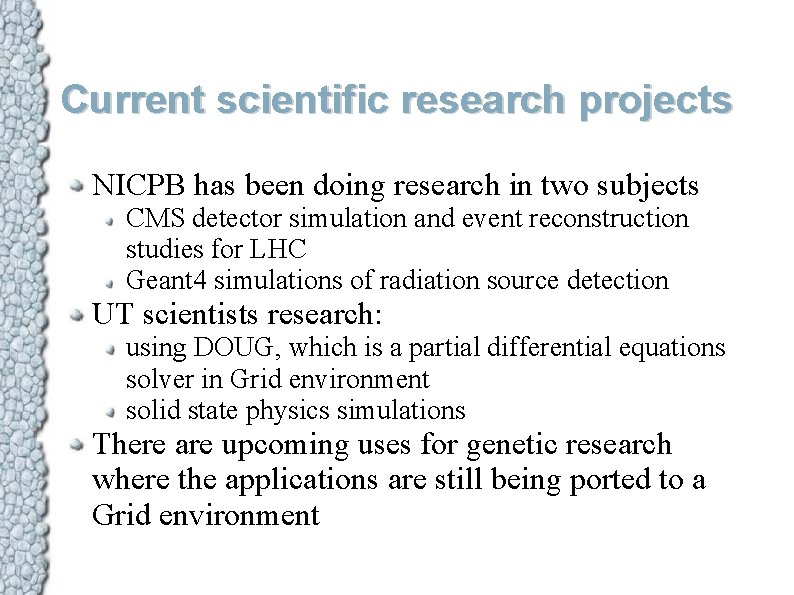
Current scientific research projects NICPB has been doing research in two subjects CMS detector simulation and event reconstruction studies for LHC Geant 4 simulations of radiation source detection UT scientists research: using DOUG, which is a partial differential equations solver in Grid environment solid state physics simulations There are upcoming uses for genetic research where the applications are still being ported to a Grid environment
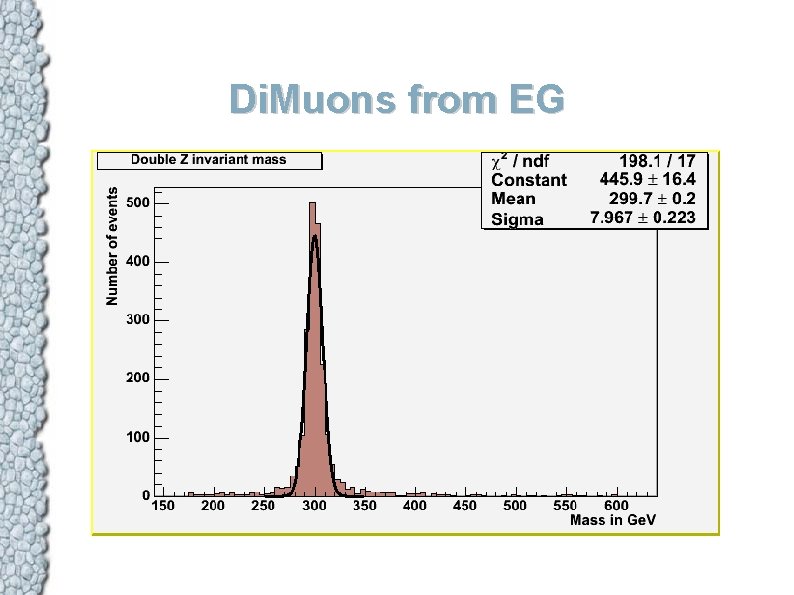
Di. Muons from EG
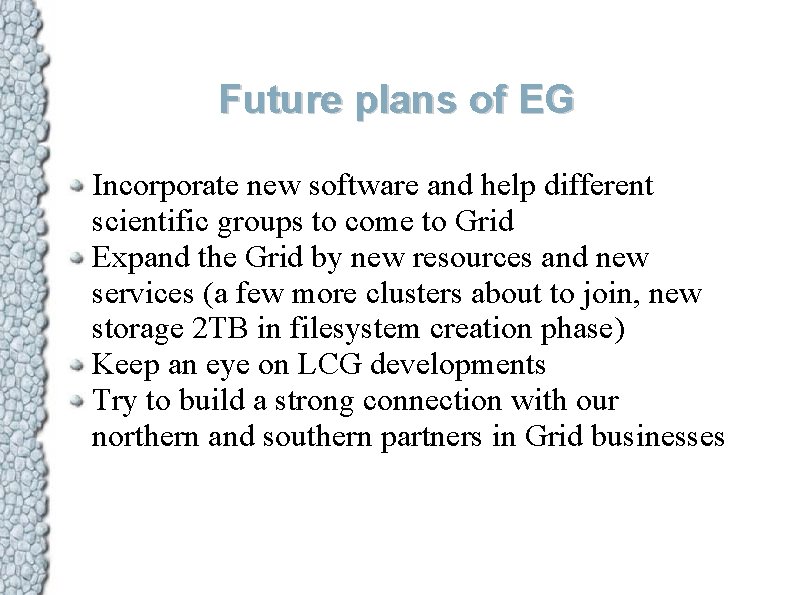
Future plans of EG Incorporate new software and help different scientific groups to come to Grid Expand the Grid by new resources and new services (a few more clusters about to join, new storage 2 TB in filesystem creation phase) Keep an eye on LCG developments Try to build a strong connection with our northern and southern partners in Grid businesses
Q&A