
ESTONIAN NATIONAL DEFENCE COLLEGE Athens 22 27 June
- Slides: 24
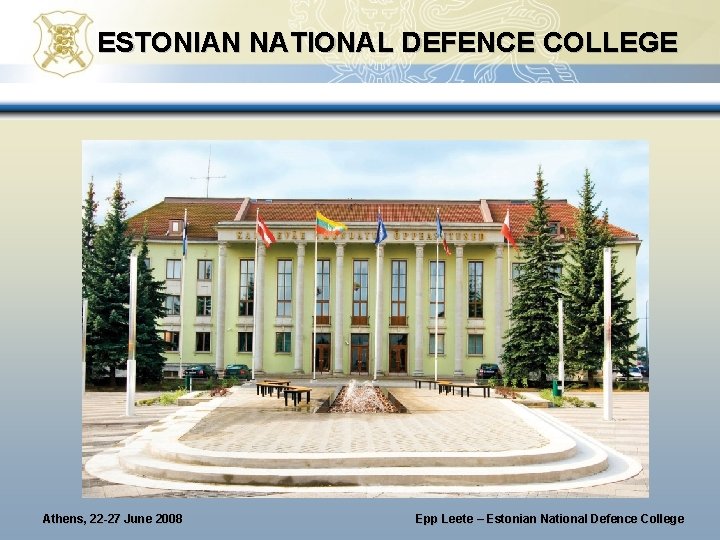
ESTONIAN NATIONAL DEFENCE COLLEGE Athens, 22 -27 June 2008 Epp Leete – Estonian National Defence College
Military Terminology in the Estonian Language Athens, 22 -27 June 2008 Epp Leete – Estonian National Defence College
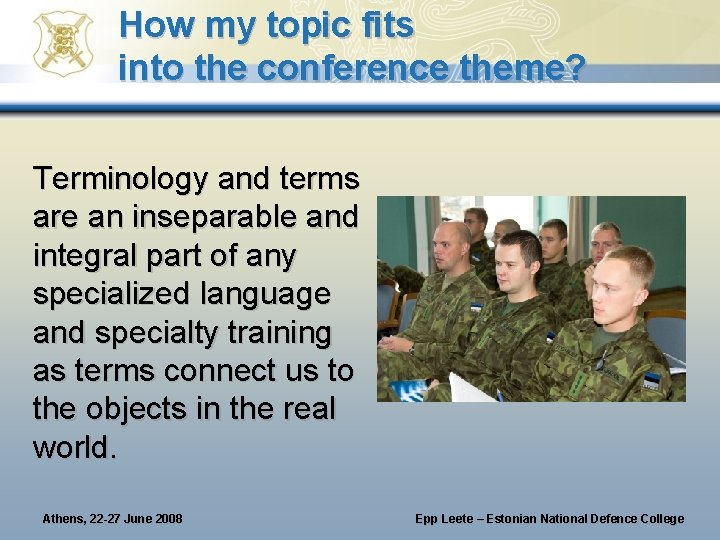
How my topic fits into the conference theme? Terminology and terms are an inseparable and integral part of any specialized language and specialty training as terms connect us to the objects in the real world. Athens, 22 -27 June 2008 Epp Leete – Estonian National Defence College
Military terminology in the Estonian language • During the Soviet occupation (1940 -1991), Estonia did not have any army or armed forces, and consequently there was no military terminology in the Estonian language. • Up to the beginning of the 1990 s, military terminology was influenced mostly by the Russian language, while since then, military terminology has come mostly from English. Athens, 22 -27 June 2008 Epp Leete – Estonian National Defence College
Terminology confusion • concept clusters: engagement area - killing zone • imitating other languages: noncombatant – nonkombatant • translation loans: tactical operation – taktikaline operatsioon Athens, 22 -27 June 2008 Epp Leete – Estonian National Defence College
What is a term? • according to Cabré, concepts are mentally independent and exist before they are named, and it’s only through the standardization of terms that the concepts that mostly do not have a rigidly set border obtain artificially set limits (1999: 42 -43). Athens, 22 -27 June 2008 Epp Leete – Estonian National Defence College
What are the main characteristics of a term? • • • transparency and clarity; appropriateness; linguistic economy; monosemy or carrying one meaning; preference of native language; grammatical aspects - derivability and correctness. Athens, 22 -27 June 2008 Epp Leete – Estonian National Defence College
Transparency and clarity Key element or key characteristics of the concept it signifies: • deploy – siirma (transplant) • engagement – kokkupõrge (clash, crash, collision) Athens, 22 -27 June 2008 Epp Leete – Estonian National Defence College
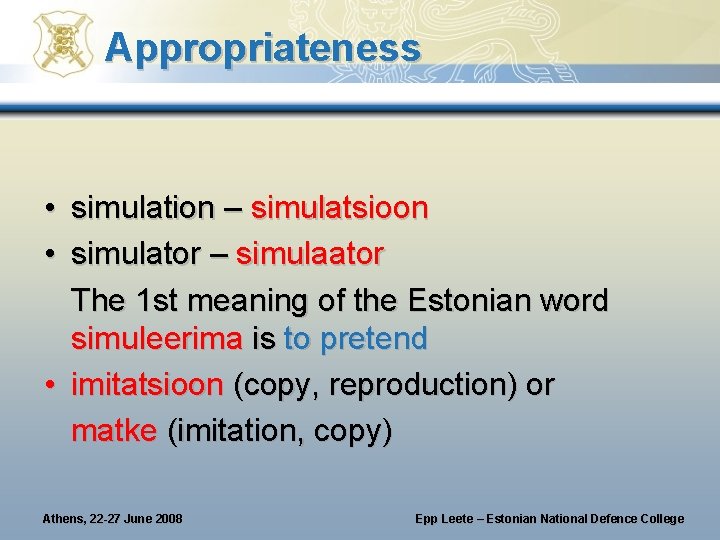
Appropriateness • simulation – simulatsioon • simulator – simulaator The 1 st meaning of the Estonian word simuleerima is to pretend • imitatsioon (copy, reproduction) or matke (imitation, copy) Athens, 22 -27 June 2008 Epp Leete – Estonian National Defence College
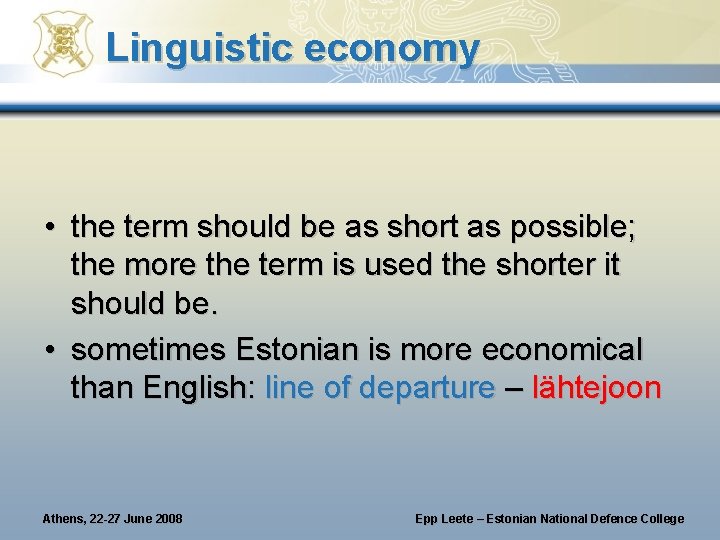
Linguistic economy • the term should be as short as possible; the more the term is used the shorter it should be. • sometimes Estonian is more economical than English: line of departure – lähtejoon Athens, 22 -27 June 2008 Epp Leete – Estonian National Defence College
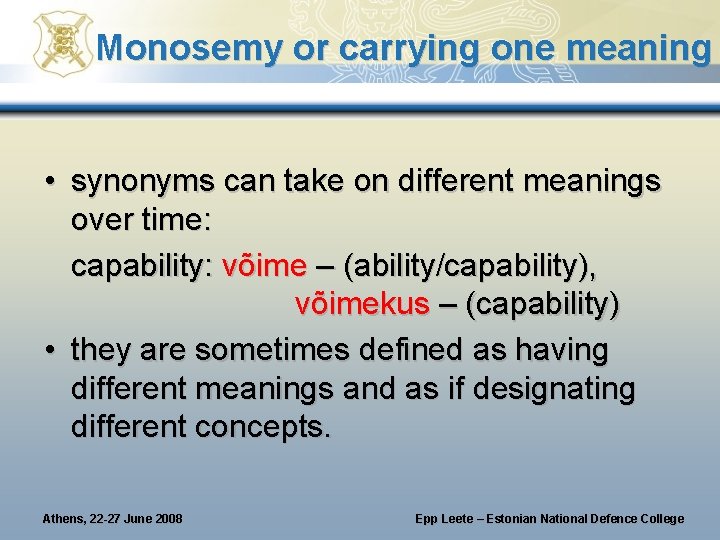
Monosemy or carrying one meaning • synonyms can take on different meanings over time: capability: võime – (ability/capability), võimekus – (capability) • they are sometimes defined as having different meanings and as if designating different concepts. Athens, 22 -27 June 2008 Epp Leete – Estonian National Defence College
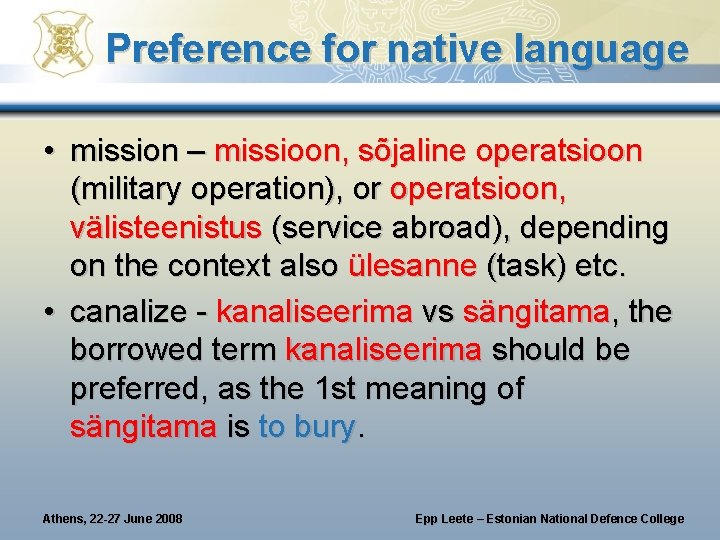
Preference for native language • mission – missioon, sõjaline operatsioon (military operation), or operatsioon, välisteenistus (service abroad), depending on the context also ülesanne (task) etc. • canalize - kanaliseerima vs sängitama, the borrowed term kanaliseerima should be preferred, as the 1 st meaning of sängitama is to bury. Athens, 22 -27 June 2008 Epp Leete – Estonian National Defence College
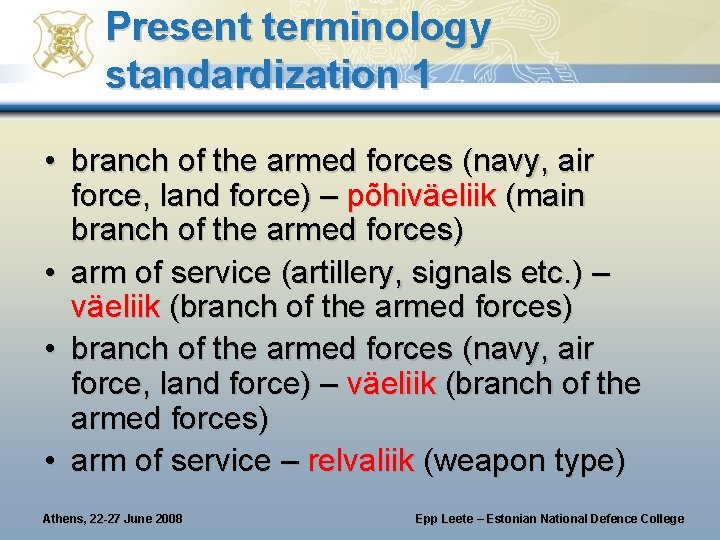
Present terminology standardization 1 • branch of the armed forces (navy, air force, land force) – põhiväeliik (main branch of the armed forces) • arm of service (artillery, signals etc. ) – väeliik (branch of the armed forces) • branch of the armed forces (navy, air force, land force) – väeliik (branch of the armed forces) • arm of service – relvaliik (weapon type) Athens, 22 -27 June 2008 Epp Leete – Estonian National Defence College
Present terminology standardization 2 • Security and Defense Policy and Military Terminology Committee attached to the Ministry of Defence was established in 2003. • Terms are mostly based on the AAP-6 (Allied Administrative Publications) Athens, 22 -27 June 2008 Epp Leete – Estonian National Defence College
Present terminology standardization 3 • specific subject areas, word clusters or the concept systems by taking the English term and its definition and providing all existing Estonian equivalents. • then they fix the Estonian terms within each concept system considering close synonyms etc. Athens, 22 -27 June 2008 Epp Leete – Estonian National Defence College
Present terminology standardization 4 • online Estonian-English bilingual dictionary called MILITERM http: //mt. legaltext. ee/militerm/ • the Committee can cover and admit up to 1000 terms per year; • by the end of 2007 around 5000 terms with definitions were admitted; • includes mostly the strategic and operational level terms and almost no tactical level terms. Athens, 22 -27 June 2008 Epp Leete – Estonian National Defence College
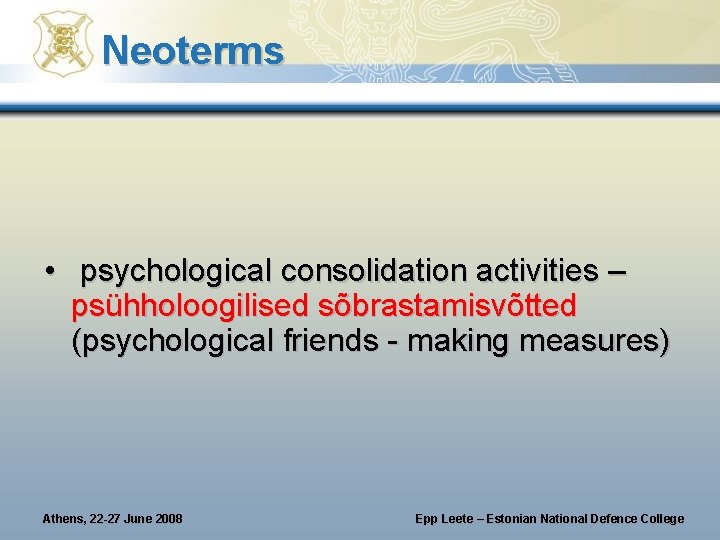
Neoterms • psychological consolidation activities – psühholoogilised sõbrastamisvõtted (psychological friends - making measures) Athens, 22 -27 June 2008 Epp Leete – Estonian National Defence College
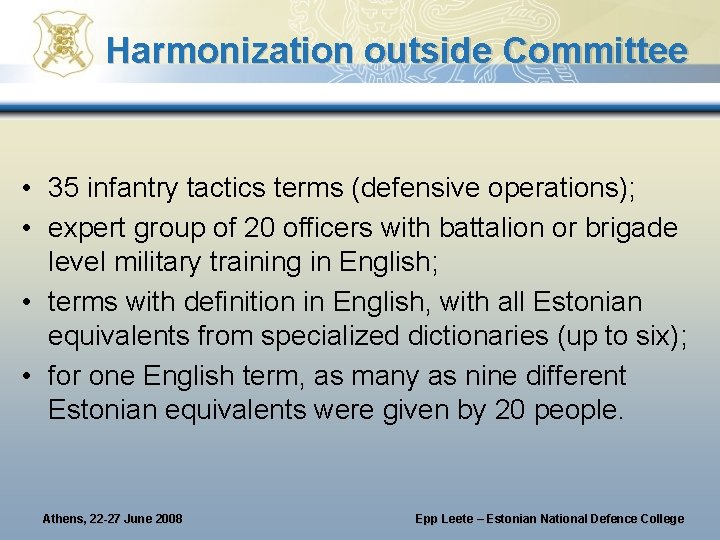
Harmonization outside Committee • 35 infantry tactics terms (defensive operations); • expert group of 20 officers with battalion or brigade level military training in English; • terms with definition in English, with all Estonian equivalents from specialized dictionaries (up to six); • for one English term, as many as nine different Estonian equivalents were given by 20 people. Athens, 22 -27 June 2008 Epp Leete – Estonian National Defence College
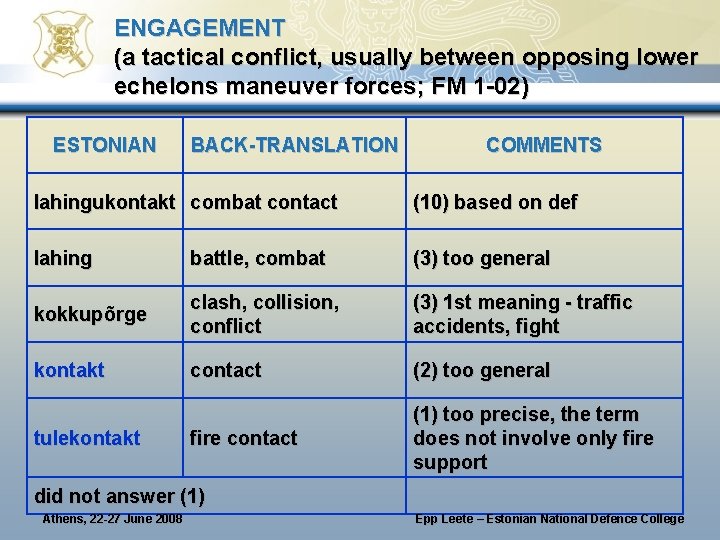
ENGAGEMENT (a tactical conflict, usually between opposing lower echelons maneuver forces; FM 1 -02) ESTONIAN BACK-TRANSLATION COMMENTS lahingukontakt combat contact (10) based on def lahing battle, combat (3) too general kokkupõrge clash, collision, conflict (3) 1 st meaning - traffic accidents, fight kontakt contact (2) too general fire contact (1) too precise, the term does not involve only fire support tulekontakt did not answer (1) Athens, 22 -27 June 2008 Epp Leete – Estonian National Defence College
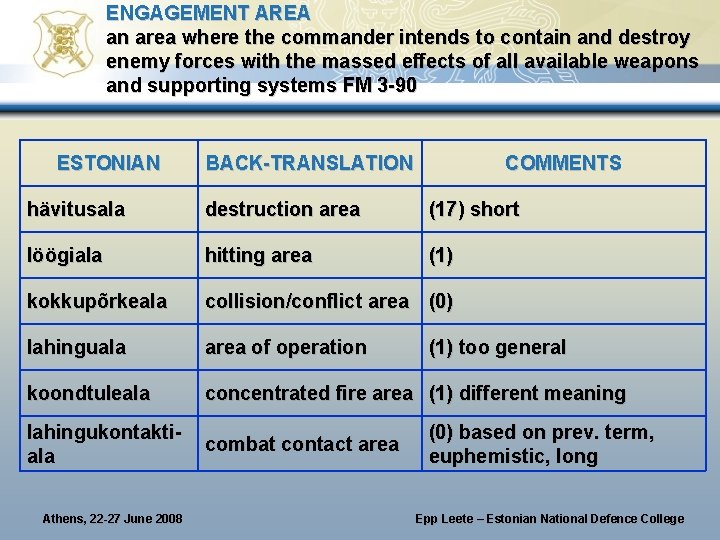
ENGAGEMENT AREA an area where the commander intends to contain and destroy enemy forces with the massed effects of all available weapons and supporting systems FM 3 -90 ESTONIAN BACK-TRANSLATION COMMENTS hävitusala destruction area (17) short löögiala hitting area (1) kokkupõrkeala collision/conflict area (0) lahinguala area of operation koondtuleala concentrated fire area (1) different meaning lahingukontaktiala combat contact area Athens, 22 -27 June 2008 (1) too general (0) based on prev. term, euphemistic, long Epp Leete – Estonian National Defence College
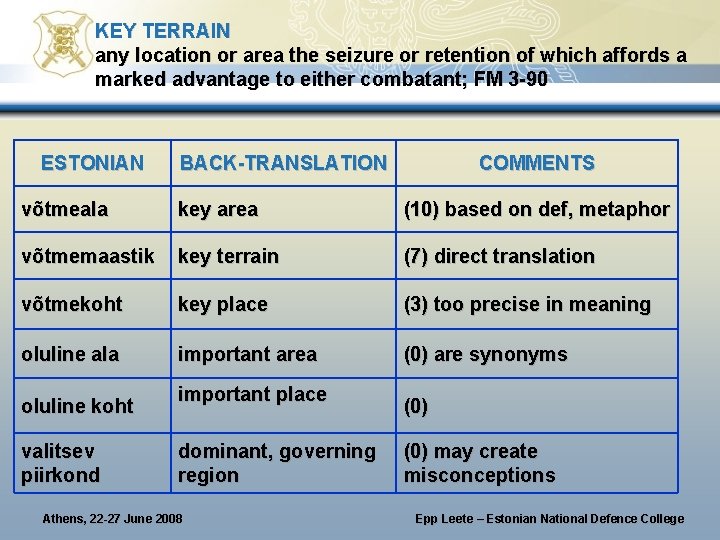
KEY TERRAIN any location or area the seizure or retention of which affords a marked advantage to either combatant; FM 3 -90 ESTONIAN BACK-TRANSLATION COMMENTS võtmeala key area (10) based on def, metaphor võtmemaastik key terrain (7) direct translation võtmekoht key place (3) too precise in meaning oluline ala important area (0) are synonyms oluline koht valitsev piirkond important place dominant, governing region Athens, 22 -27 June 2008 (0) may create misconceptions Epp Leete – Estonian National Defence College
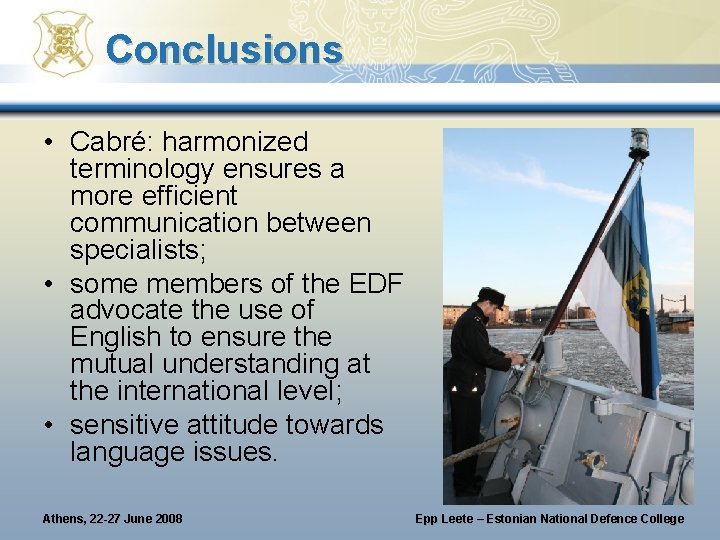
Conclusions • Cabré: harmonized terminology ensures a more efficient communication between specialists; • some members of the EDF advocate the use of English to ensure the mutual understanding at the international level; • sensitive attitude towards language issues. Athens, 22 -27 June 2008 Epp Leete – Estonian National Defence College
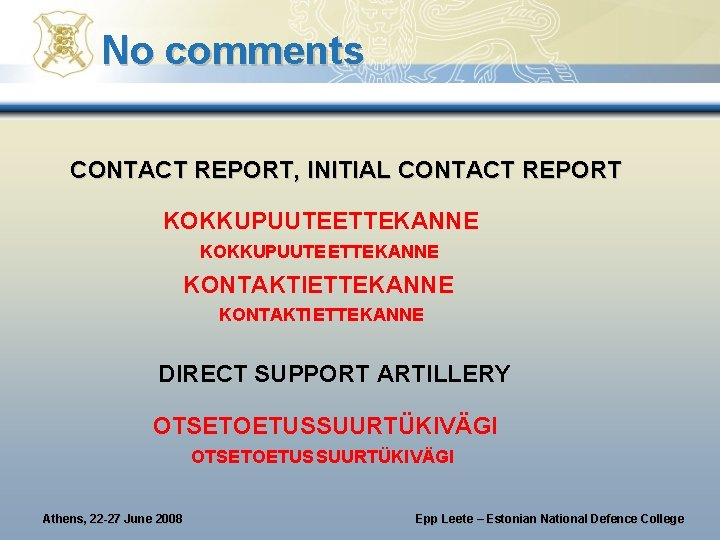
No comments CONTACT REPORT, INITIAL CONTACT REPORT KOKKUPUUTEETTEKANNE KOKKUPUUTE ETTEKANNE KONTAKTIETTEKANNE DIRECT SUPPORT ARTILLERY OTSETOETUSSUURTÜKIVÄGI OTSETOETUS SUURTÜKIVÄGI Athens, 22 -27 June 2008 Epp Leete – Estonian National Defence College
THANK YOU FOR YOUR ATTENTION TÄNAN TÄHELEPANU EEST Athens, 22 -27 June 2008 Epp Leete – Estonian National Defence College