Entrepreneurship for Computer Science CS 15 390 Market
- Slides: 17
Entrepreneurship for Computer Science CS 15 -390 Market Segmentation and Research Lecture 7, February 3, 2019 Mohammad Hammoud
Today… • Last Session: • Founding dilemmas • Today’s Session: • Market Segmentation • Announcements: • The supervisor of each project team will work with the team to create seven major milestones with a tentative timeline. The milestones are: (1) team formation [justification, equity split, etc. , ], (2) idea, (3) market research, (4) business model, (5) prototype, (6) valuation, and (7) business plan • Next lecture’s case study is “Piazza”
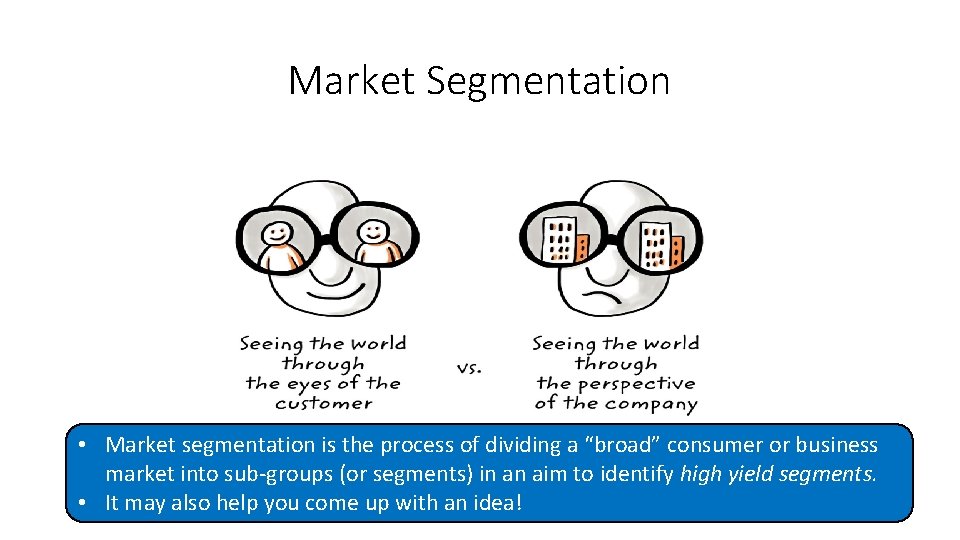
Market Segmentation • Market segmentation is the process of dividing a “broad” consumer or business market into sub-groups (or segments) in an aim to identify high yield segments. • It may also help you come up with an idea!
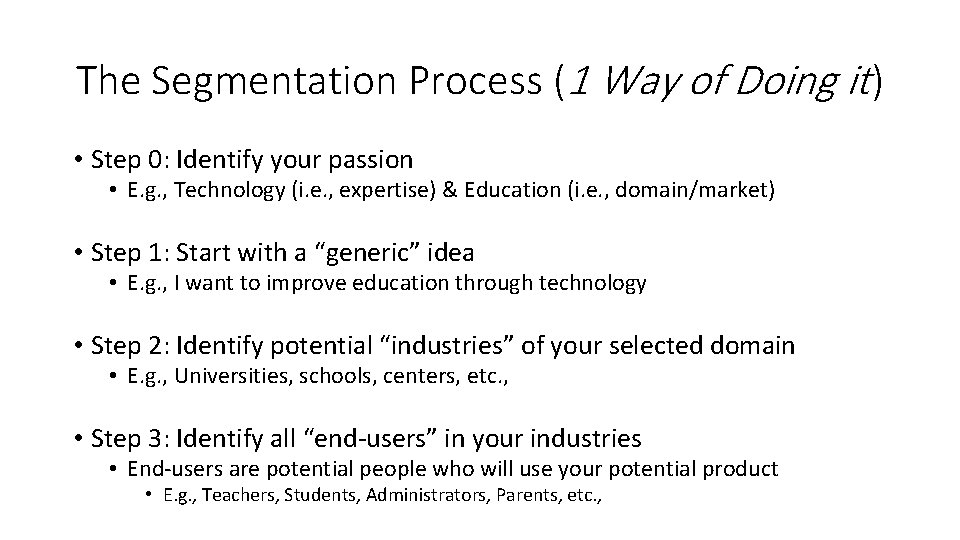
The Segmentation Process (1 Way of Doing it ) • Step 0: Identify your passion • E. g. , Technology (i. e. , expertise) & Education (i. e. , domain/market) • Step 1: Start with a “generic” idea • E. g. , I want to improve education through technology • Step 2: Identify potential “industries” of your selected domain • E. g. , Universities, schools, centers, etc. , • Step 3: Identify all “end-users” in your industries • End-users are potential people who will use your potential product • E. g. , Teachers, Students, Administrators, Parents, etc. ,
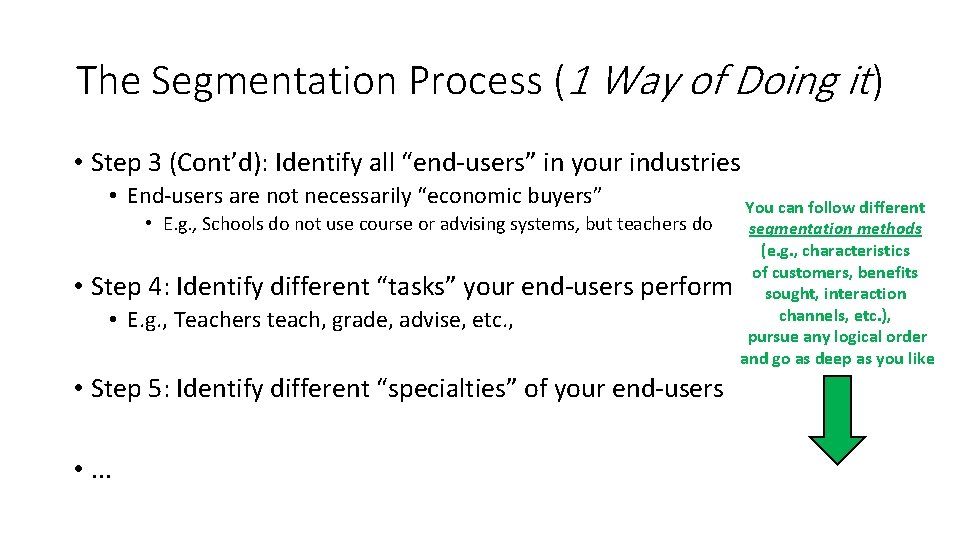
The Segmentation Process (1 Way of Doing it ) • Step 3 (Cont’d): Identify all “end-users” in your industries • End-users are not necessarily “economic buyers” • E. g. , Schools do not use course or advising systems, but teachers do • Step 4: Identify different “tasks” your end-users perform • E. g. , Teachers teach, grade, advise, etc. , • Step 5: Identify different “specialties” of your end-users • . . . You can follow different segmentation methods (e. g. , characteristics of customers, benefits sought, interaction channels, etc. ), pursue any logical order and go as deep as you like
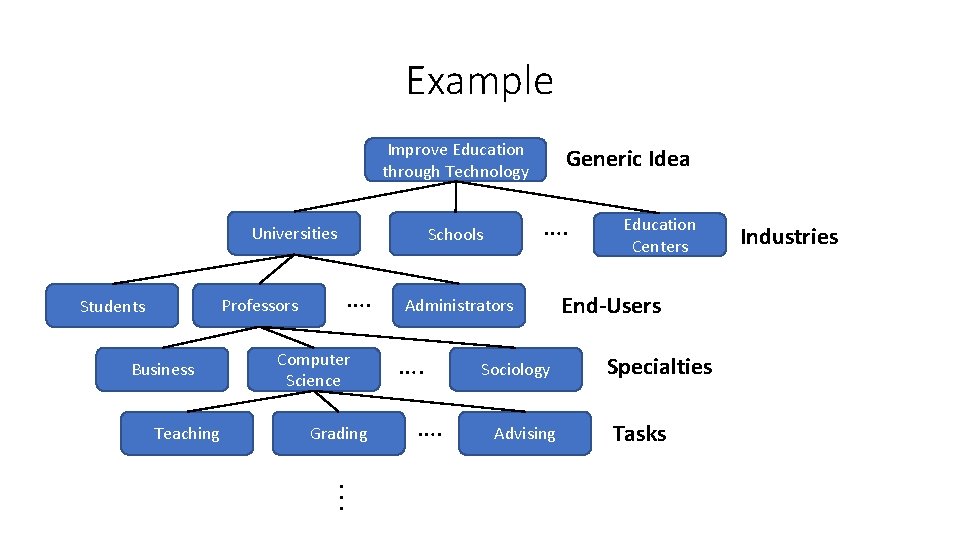
Example Improve Education through Technology Universities Business Teaching …. Schools …. Professors Students Computer Science Grading . . . Generic Idea Administrators …. …. Sociology Advising Education Centers End-Users Specialties Tasks Industries
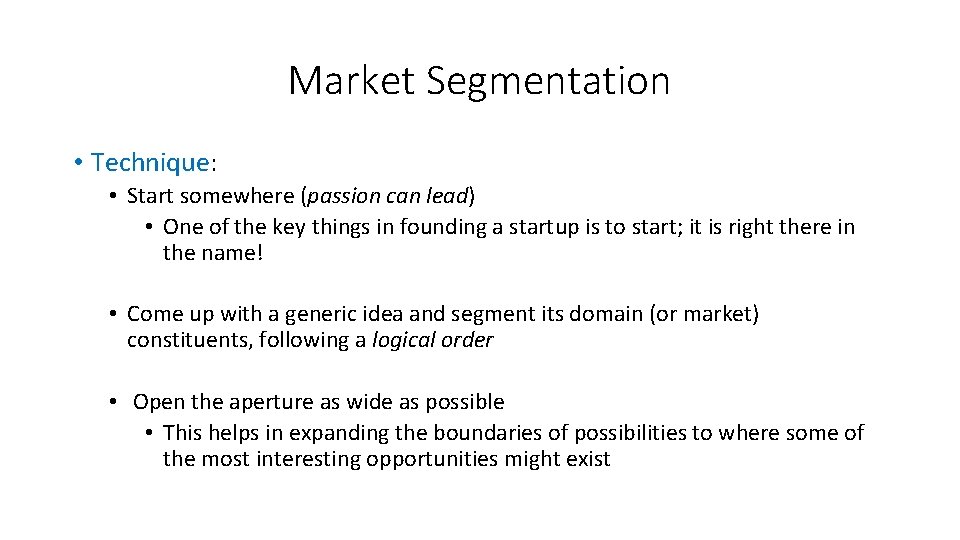
Market Segmentation • Technique: • Start somewhere (passion can lead) • One of the key things in founding a startup is to start; it is right there in the name! • Come up with a generic idea and segment its domain (or market) constituents, following a logical order • Open the aperture as wide as possible • This helps in expanding the boundaries of possibilities to where some of the most interesting opportunities might exist
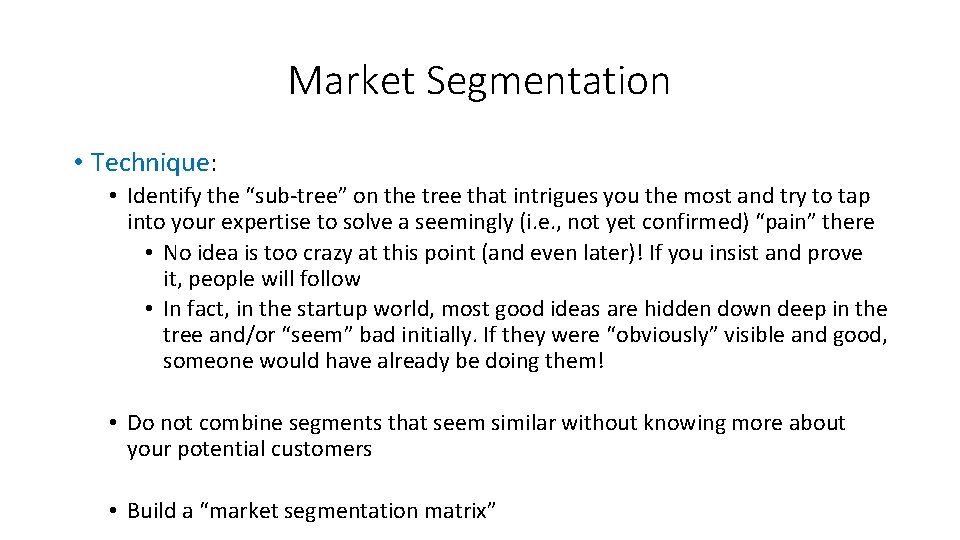
Market Segmentation • Technique: • Identify the “sub-tree” on the tree that intrigues you the most and try to tap into your expertise to solve a seemingly (i. e. , not yet confirmed) “pain” there • No idea is too crazy at this point (and even later)! If you insist and prove it, people will follow • In fact, in the startup world, most good ideas are hidden down deep in the tree and/or “seem” bad initially. If they were “obviously” visible and good, someone would have already be doing them! • Do not combine segments that seem similar without knowing more about your potential customers • Build a “market segmentation matrix”
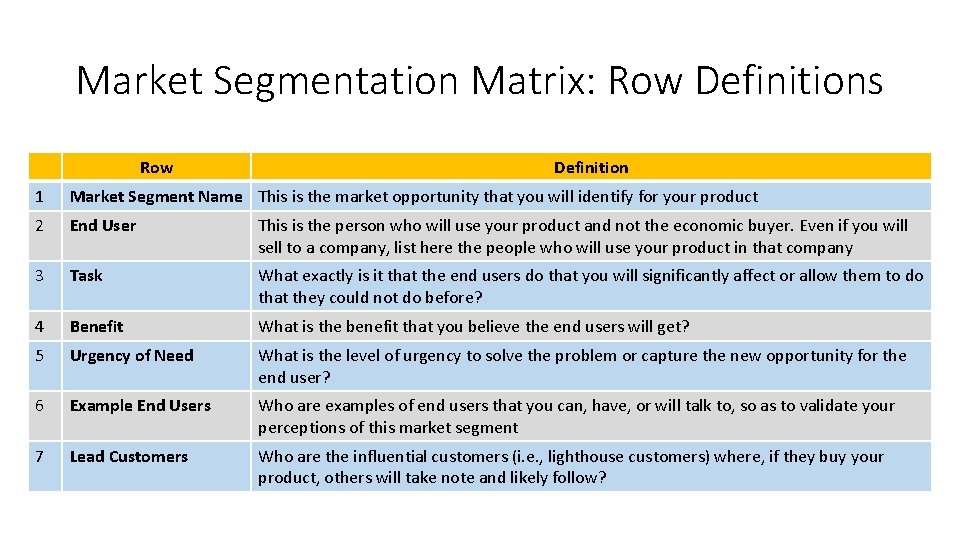
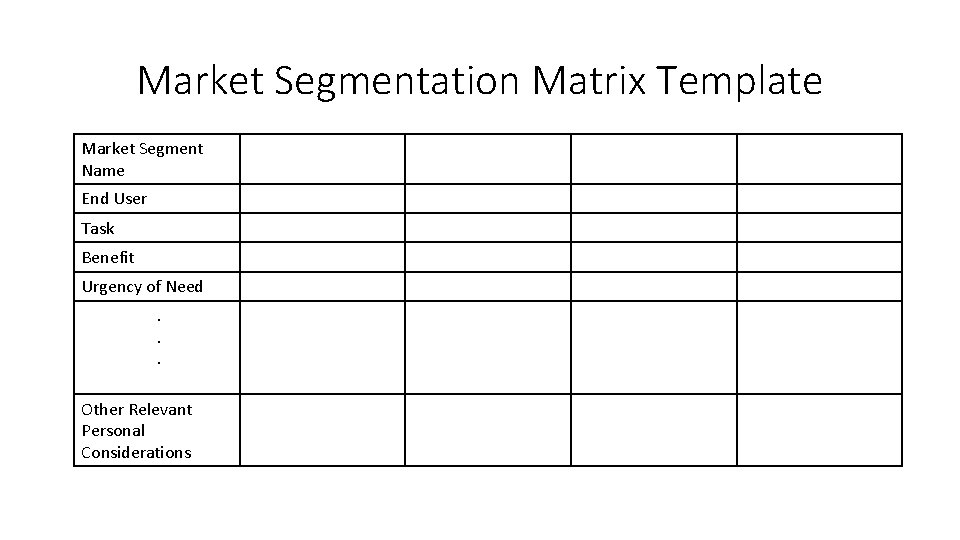
Market Segmentation Matrix: Row Definitions Row Definition 1 Market Segment Name This is the market opportunity that you will identify for your product 2 End User This is the person who will use your product and not the economic buyer. Even if you will sell to a company, list here the people who will use your product in that company 3 Task What exactly is it that the end users do that you will significantly affect or allow them to do that they could not do before? 4 Benefit What is the benefit that you believe the end users will get? 5 Urgency of Need What is the level of urgency to solve the problem or capture the new opportunity for the end user? 6 Example End Users Who are examples of end users that you can, have, or will talk to, so as to validate your perceptions of this market segment 7 Lead Customers Who are the influential customers (i. e. , lighthouse customers) where, if they buy your product, others will take note and likely follow?
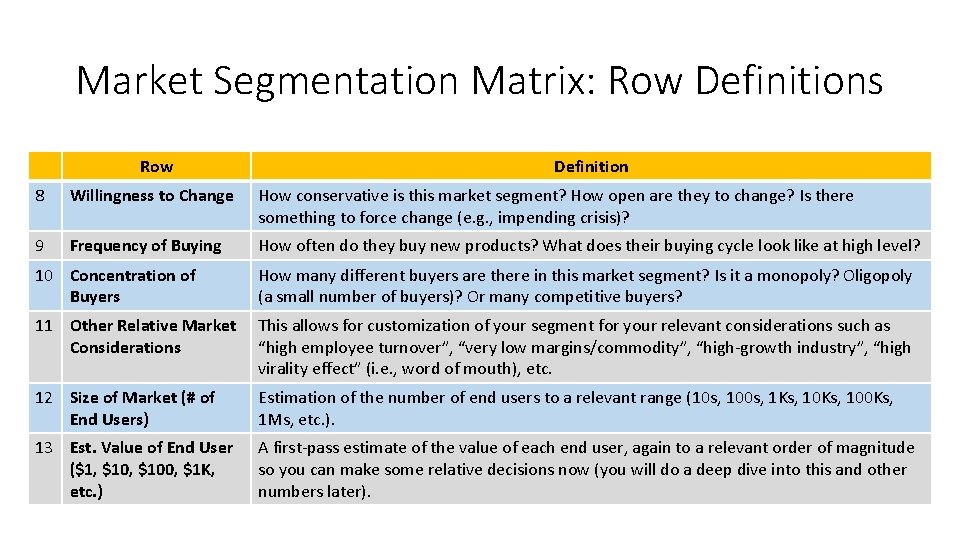
Market Segmentation Matrix: Row Definitions Row Definition 8 Willingness to Change How conservative is this market segment? How open are they to change? Is there something to force change (e. g. , impending crisis)? 9 Frequency of Buying How often do they buy new products? What does their buying cycle look like at high level? 10 Concentration of of Buyers How many different buyers are there in this market segment? Is it a monopoly? Oligopoly (a small number of buyers)? Or many may competitivebuyers? 11 Other Relative Market Considerations This allows for customization of your segment for your relevant considerations such as “high employee turnover”, “very low margins/commodity”, “high-growth industry”, “high virality effect” (i. e. , word of mouth), etc. 12 Size of Market (# (# of of End Estimation of the number of end users to a relevant range (10 s, 100 s, 1 Ks, 100 Ks, Users) End Users) 1 Ms, etc. ). 13 Est. Value of of End User ($1, $100, $1 K, etc. ) A first-pass estimate of the value of each end user, again to a relevant order of magnitude so you can make some relative decisions now (you will do a deep dive into this and other numbers later).
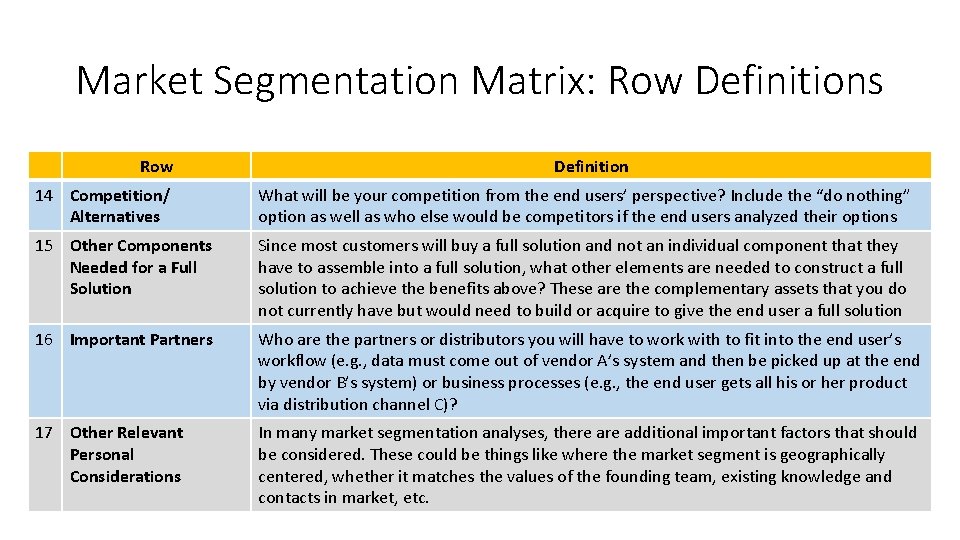
Market Segmentation Matrix: Row Definitions Row Definition 14 Competition/ Alternatives What will be your competition from the end users’ perspective? Include the “do nothing” option as well as who else would be competitors if the end users analyzed their options 15 Other Components Needed for a Full Solution Since most customers will buy a full solution and not an individual component that they have to assemble into a full solution, what other elements are needed to construct a full solution to achieve the benefits above? These are the complementary assets that you do not currently have but would need to build or acquire to give the end user a full solution 16 Important Partners Who are the partners or distributors you will have to work with to fit into the end user’s workflow (e. g. , data must come out of vendor A’s system and then be picked up at the end by vendor B’s system) or business processes (e. g. , the end user gets all his or her product via distribution channel C)? 17 Other Relevant Personal Considerations In many market segmentation analyses, there additional important factors that should be considered. These could be things like where the market segment is geographically centered, whether it matches the values of the founding team, existing knowledge and contacts in market, etc.
Market Segmentation Matrix Template Market Segment Name End User Task Benefit Urgency of Need. . . Other Relevant Personal Considerations
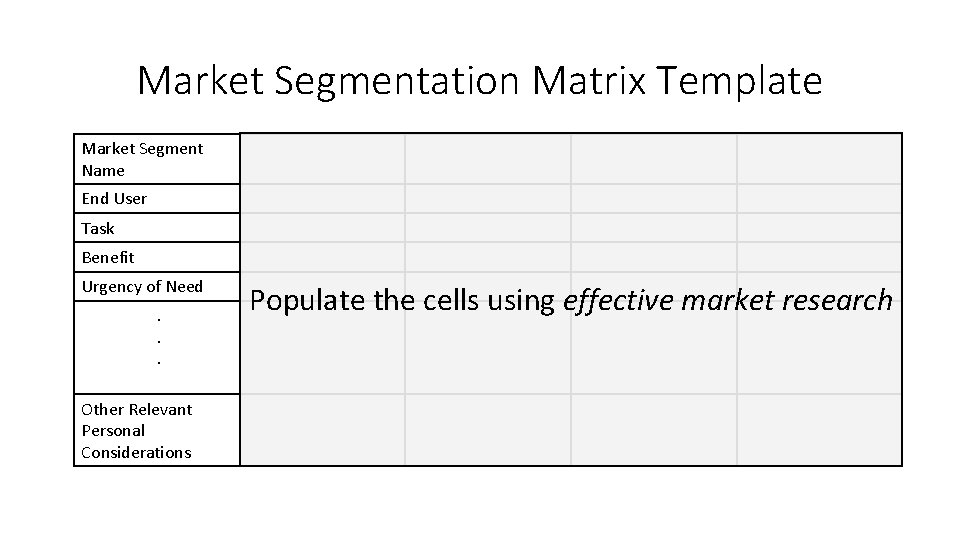
Market Segmentation Matrix Template Market Segment Name End User Task Benefit Urgency of Need. . . Other Relevant Personal Considerations Populate the cells using effective market research
Effective Market Research • Conducting “effective” market research is a fundamental skill that underlies the entire process of starting a company • Some Characteristics: • Multi-dimensional: It spans various (potential) customer dimensions, including rational, emotional, economical, social, and cultural, among others • Continuous: • It informs every stage in starting and running a company • Customers and markets change over time, so what is true one year may be invalid the next
Effective Market Research • Some Characteristics: • Non-tradable: It is dangerous to outsource market research, especially if it involves direct interactions with (potential) customers • Hypothesis Validator: It plays a critical role in validating or invalidating hypotheses quickly, especially “before” starting product development (as a result, you can spend more time building products that customers want) • Hypothesis Generator: It serves in generating new types of hypotheses that can be validated through experiments, especially when done qualitatively
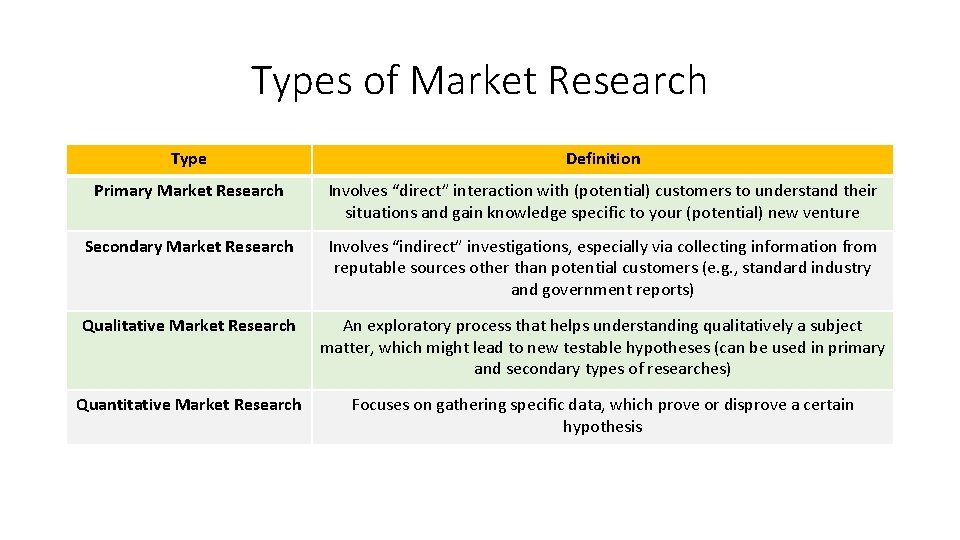
Types of Market Research Type Definition Primary Market Research Involves “direct” interaction with (potential) customers to understand their situations and gain knowledge specific to your (potential) new venture Secondary Market Research Involves “indirect” investigations, especially via collecting information from reputable sources other than potential customers (e. g. , standard industry and government reports) Qualitative Market Research An exploratory process that helps understanding qualitatively a subject matter, which might lead to new testable hypotheses (can be used in primary and secondary types of researches) Quantitative Market Research Focuses on gathering specific data, which prove or disprove a certain hypothesis
Next Class • Conclude with Effective Market Research • Discuss How to Select a Beachhead Market