English as a Lingua Franca of Medicine English

- Slides: 22
English as a Lingua Franca of Medicine English is Not Enough Language Learning in Europe 2004 Olomouc, April 23 -25, 2004
Pavel Kurfürst Institute of Foreign Languages Faculty of Medicine Palacký University in Olomouc
Institute of Foreign Languages n n established 1996 languages for specific purposes (LSP) (medicine, health care management) q Latin / Latin foreigners q English q German q Czech foreigners 5 members 830 students (winter sem. 2003/04)
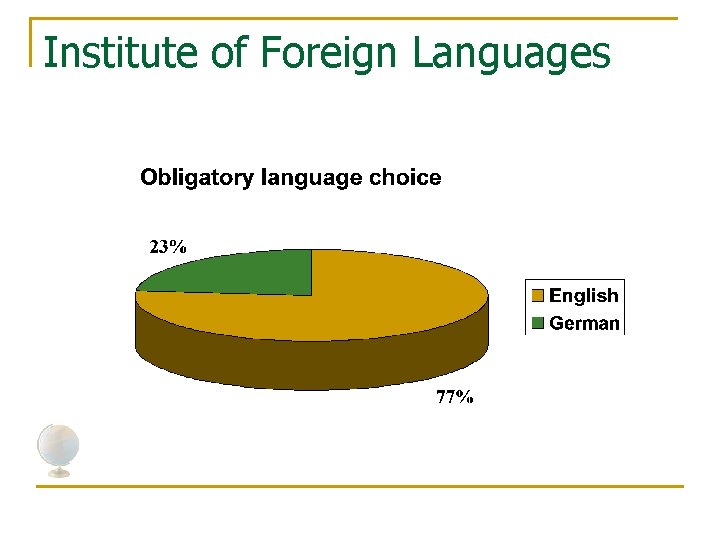
Institute of Foreign Languages
Languages in medicine n n terminology from ancient Greek (Hippocrates - 4 th/5 th cent. BC) Latin took over - new Latin terms most terms 2, 000 years old modern terminology q precision of Greek and Latin terms q new terms from modern languages (Italian, French, German, English) q more or less similar in most European languages
Languages in medicine n n n On the Fabric of the Human Body Renaissance anatomical atlas (16 th cent. ) by Andreas Vesalius in Latin (De Humani Corporis Fabrica) translated only into Russian English translation q Northwestern University (Illinois, USA) q 2003 Book I published (7 books) q on-line access - Internet version
ELF of science Most of the scientific, technological and academic information in the world is expressed in English and over 80% of all the information stored in electronic retrieval systems is in English. The Cambridge Encyclopaedia of the English Language, 1997
ELF of science n n of some 100, 000 scientific journals published worldwide, 50% are in English "hard core" of world scientific publishing, composed of about 4, 000 to 5, 000 journals, for the most part entirely in English the US have the greatest concentration of databases, the most influential ones (eg SCI), over 90% of the information in these US databases extracted from articles in English taken mostly from English-language journals in European databases the position given to other languages is hardly any greater and references in English predominate Truchot C. , Key Aspects of the Use of English in Europe, Council of Europe, Strasbourg 2002
ELF of science n n most journals of repute published in other languages resorted to English to secure an international audience the dominant / the sole language for discussions in symposia, congresses etc. work in scientific laboratories where there are foreign researchers in academic circles, networks, programmes and institutions (eg EU's scientific programmes) Truchot C. , Key Aspects of the Use of English in Europe, Council of Europe, Strasbourg 2002
ELF of science n n disciplines in which German scholars claim English as their working language q physics 98% q medical science 72% q history 20% q law 8% The spread of English in the Arab world in the field of higher education - the schools of science, engineering, medicine and business teach through the medium of English or a hybrid variety which uses a blend of English and Arabic Zughoul M. R. , Journal of Language and Learning, 2003
ELF of science doctoral theses in English: q Uppsala University, Sweden, 1993 -1994: n nearly 100% of theses in exact sciences, engineering and medicine q Switzerland, 1996: n especially German-speaking universities n Zurich 61% (natural sciences) q Germany: n English alone widely used n often combined with German Truchot C. , Key Aspects of the Use of English in Europe, Council of Europe, Strasbourg 2002
ELF of medicine The lingua franca of medicine, and most scientific fields, is English. The world’s most widely cited medical journals are published in English. As such, clinicians and researchers whose native language is not English must learn it to avail themeselves to the large body of medical knowledge published in English. William Hersh – Li Zhang, Oregon Health Sciences University, Portland, USA
ELF of medicine n n n US medical information is the world’s premier source US medical research, treatment, education and ethics set the standards non-US practitioners send their students and their patients to the USA non-US visits to the AMA web site 1. 5 million hits per week in 2000 50% of JAMA editions distributed outside the USA American Medical Association, 2000
ELF of medicine n n Switzerland: 4 national languages, 3 official (German, French, Italian + Romansh) IFMSA-CH (Swiss medical student org. ) research on language choices on a mailing list English: q preferred language of intra-Swiss communication (75%) q the main concern is not perfect English q its own variety of English - features of Pan Swiss English or international English Journal of Computer-Mediated Communication, 2003
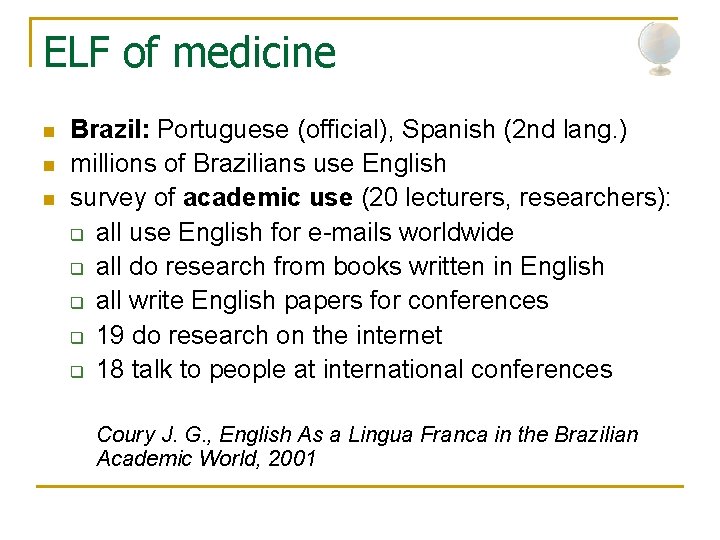
ELF of medicine n n n Brazil: Portuguese (official), Spanish (2 nd lang. ) millions of Brazilians use English survey of academic use (20 lecturers, researchers): q all use English for e-mails worldwide q all do research from books written in English q all write English papers for conferences q 19 do research on the internet q 18 talk to people at international conferences Coury J. G. , English As a Lingua Franca in the Brazilian Academic World, 2001
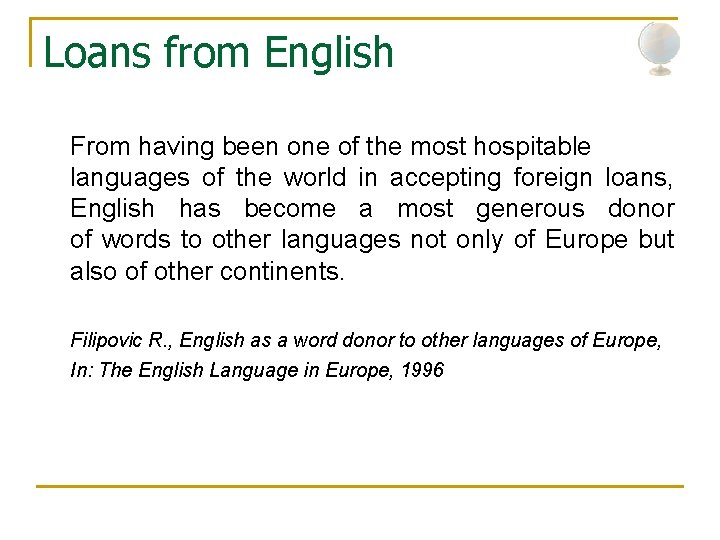
Loans from English From having been one of the most hospitable languages of the world in accepting foreign loans, English has become a most generous donor of words to other languages not only of Europe but also of other continents. Filipovic R. , English as a word donor to other languages of Europe, In: The English Language in Europe, 1996
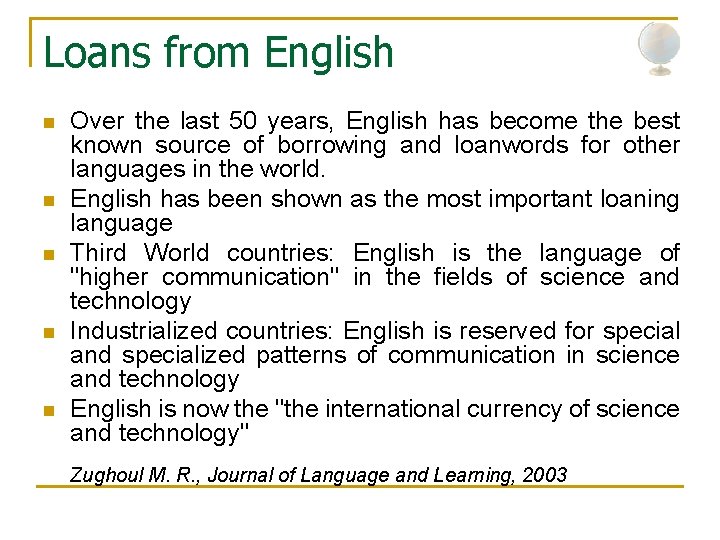
Loans from English n n n Over the last 50 years, English has become the best known source of borrowing and loanwords for other languages in the world. English has been shown as the most important loaning language Third World countries: English is the language of "higher communication" in the fields of science and technology Industrialized countries: English is reserved for special and specialized patterns of communication in science and technology English is now the "the international currency of science and technology" Zughoul M. R. , Journal of Language and Learning, 2003
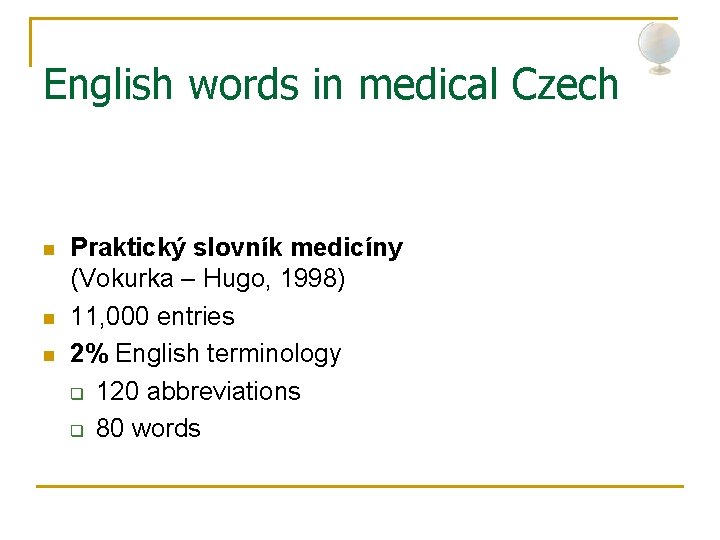
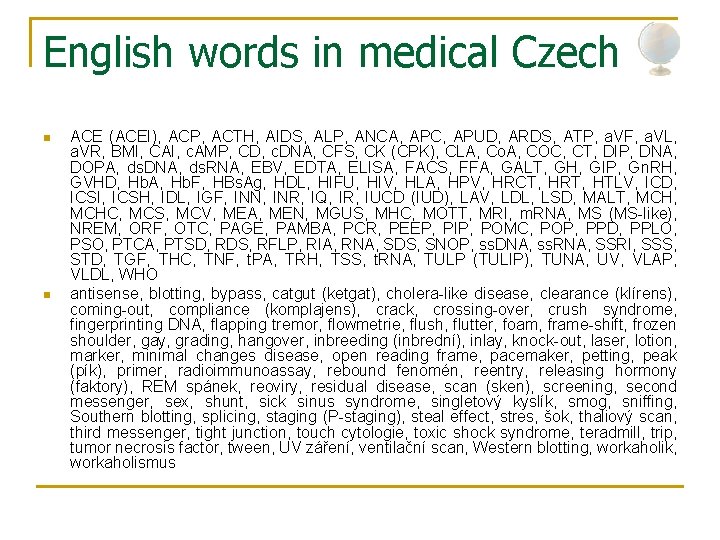
English words in medical Czech n n n Praktický slovník medicíny (Vokurka – Hugo, 1998) 11, 000 entries 2% English terminology q 120 abbreviations q 80 words
English words in medical Czech n n ACE (ACEI), ACP, ACTH, AIDS, ALP, ANCA, APC, APUD, ARDS, ATP, a. VF, a. VL, a. VR, BMI, CAI, c. AMP, CD, c. DNA, CFS, CK (CPK), CLA, Co. A, COC, CT, DIP, DNA, DOPA, ds. DNA, ds. RNA, EBV, EDTA, ELISA, FACS, FFA, GALT, GH, GIP, Gn. RH, GVHD, Hb. A, Hb. F, HBs. Ag, HDL, HIFU, HIV, HLA, HPV, HRCT, HRT, HTLV, ICD, ICSI, ICSH, IDL, IGF, INN, INR, IQ, IR, IUCD (IUD), LAV, LDL, LSD, MALT, MCHC, MCS, MCV, MEA, MEN, MGUS, MHC, MOTT, MRI, m. RNA, MS (MS-like), NREM, ORF, OTC, PAGE, PAMBA, PCR, PEEP, PIP, POMC, POP, PPD, PPLO, PSO, PTCA, PTSD, RDS, RFLP, RIA, RNA, SDS, SNOP, ss. DNA, ss. RNA, SSRI, SSS, STD, TGF, THC, TNF, t. PA, TRH, TSS, t. RNA, TULP (TULIP), TUNA, UV, VLAP, VLDL, WHO antisense, blotting, bypass, catgut (ketgat), cholera-like disease, clearance (klírens), coming-out, compliance (komplajens), crack, crossing-over, crush syndrome, fingerprinting DNA, flapping tremor, flowmetrie, flush, flutter, foam, frame-shift, frozen shoulder, gay, grading, hangover, inbreeding (inbrední), inlay, knock-out, laser, lotion, marker, minimal changes disease, open reading frame, pacemaker, petting, peak (pík), primer, radioimmunoassay, rebound fenomén, reentry, releasing hormony (faktory), REM spánek, reoviry, residual disease, scan (sken), screening, second messenger, sex, shunt, sick sinus syndrome, singletový kyslík, smog, sniffing, Southern blotting, splicing, staging (P-staging), steal effect, stres, šok, thaliový scan, third messenger, tight junction, touch cytologie, toxic shock syndrome, teradmill, trip, tumor necrosis factor, tween, UV záření, ventilační scan, Western blotting, workaholik, workaholismus
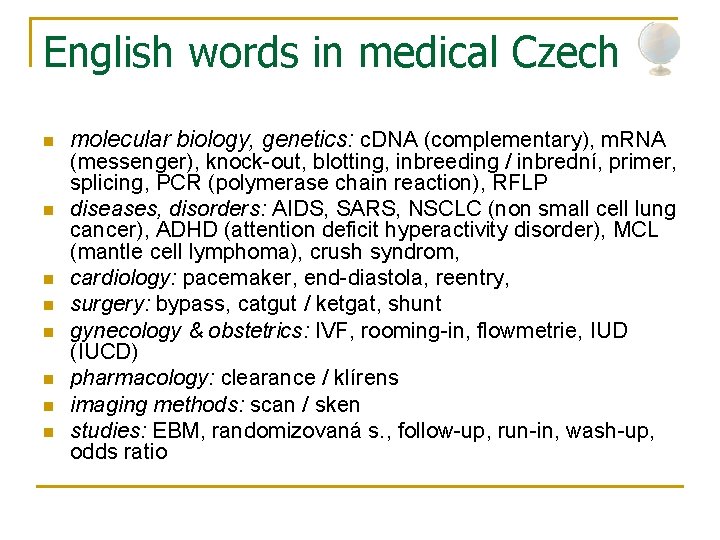
English words in medical Czech n n n n molecular biology, genetics: c. DNA (complementary), m. RNA (messenger), knock-out, blotting, inbreeding / inbrední, primer, splicing, PCR (polymerase chain reaction), RFLP diseases, disorders: AIDS, SARS, NSCLC (non small cell lung cancer), ADHD (attention deficit hyperactivity disorder), MCL (mantle cell lymphoma), crush syndrom, cardiology: pacemaker, end-diastola, reentry, surgery: bypass, catgut / ketgat, shunt gynecology & obstetrics: IVF, rooming-in, flowmetrie, IUD (IUCD) pharmacology: clearance / klírens imaging methods: scan / sken studies: EBM, randomizovaná s. , follow-up, run-in, wash-up, odds ratio
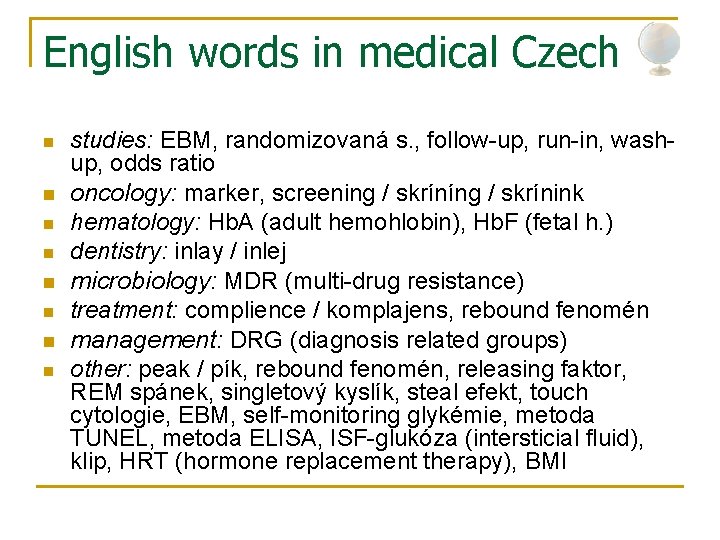
English words in medical Czech n n n n studies: EBM, randomizovaná s. , follow-up, run-in, washup, odds ratio oncology: marker, screening / skríníng / skrínink hematology: Hb. A (adult hemohlobin), Hb. F (fetal h. ) dentistry: inlay / inlej microbiology: MDR (multi-drug resistance) treatment: complience / komplajens, rebound fenomén management: DRG (diagnosis related groups) other: peak / pík, rebound fenomén, releasing faktor, REM spánek, singletový kyslík, steal efekt, touch cytologie, EBM, self-monitoring glykémie, metoda TUNEL, metoda ELISA, ISF-glukóza (intersticial fluid), klip, HRT (hormone replacement therapy), BMI
www. ucjlf. upol. cz kurfurst@seznam. cz