Engaging Families in the Assessment Process and Communicating
- Slides: 12
Engaging Families in the Assessment Process and Communicating Assessment Data By: Cheryl D. Thomas
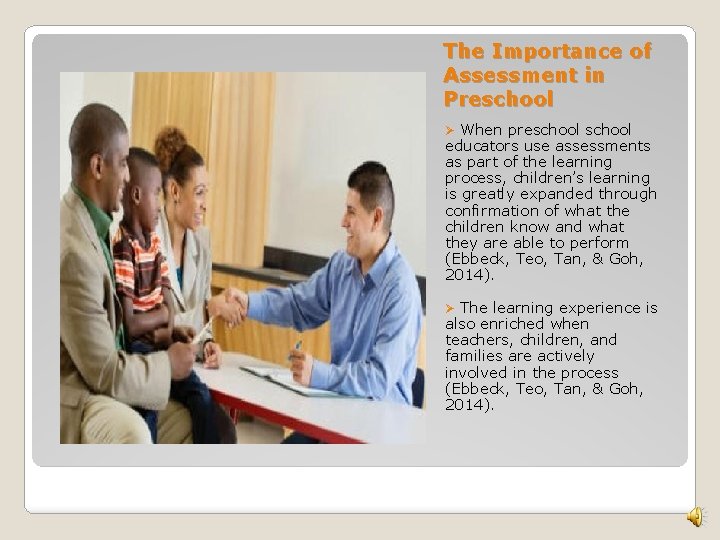
The Importance of Assessment in Preschool When preschool educators use assessments as part of the learning process, children’s learning is greatly expanded through confirmation of what the children know and what they are able to perform (Ebbeck, Teo, Tan, & Goh, 2014). Ø The learning experience is also enriched when teachers, children, and families are actively involved in the process (Ebbeck, Teo, Tan, & Goh, 2014). Ø
Educators may use blogs to communicate with families about individual children. The blogs may be used to share pictures, videos, and provide families with direct resources that may be needed for an individual child. In addition (Elicker & Mc. Mullen, 2013). Various ways for educators to involve families in the assessment process.
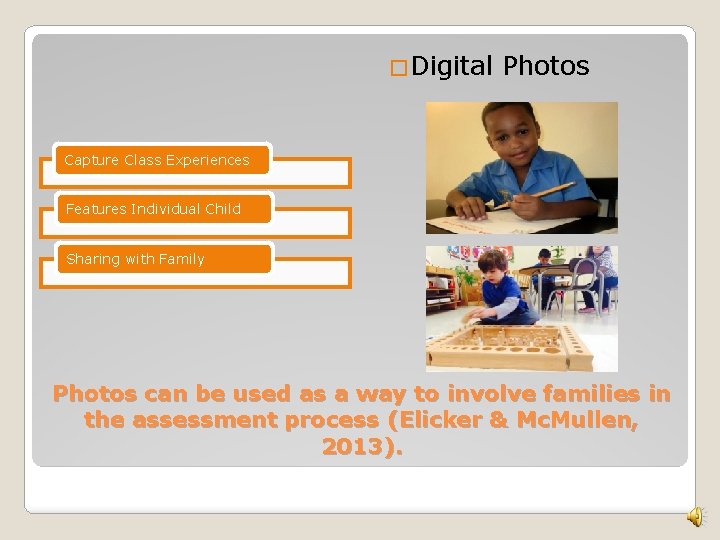
�Digital Photos Capture Class Experiences Features Individual Child Sharing with Family Photos can be used as a way to involve families in the assessment process (Elicker & Mc. Mullen, 2013).
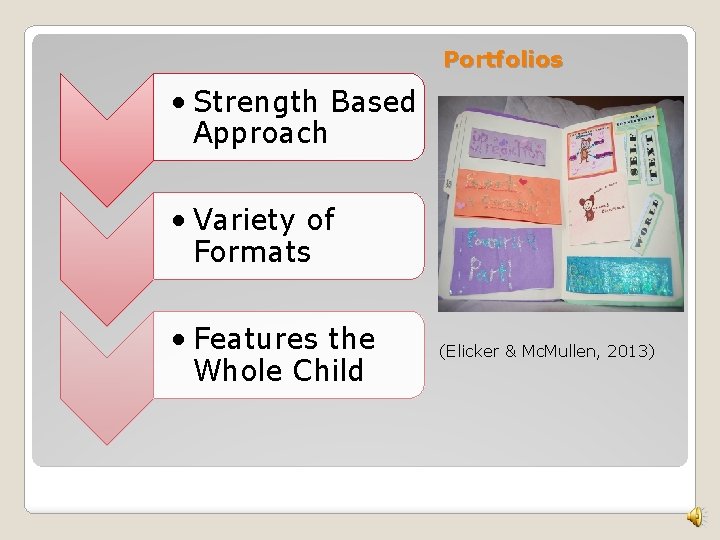
Portfolios • Strength Based Approach • Variety of Formats • Features the Whole Child (Elicker & Mc. Mullen, 2013)
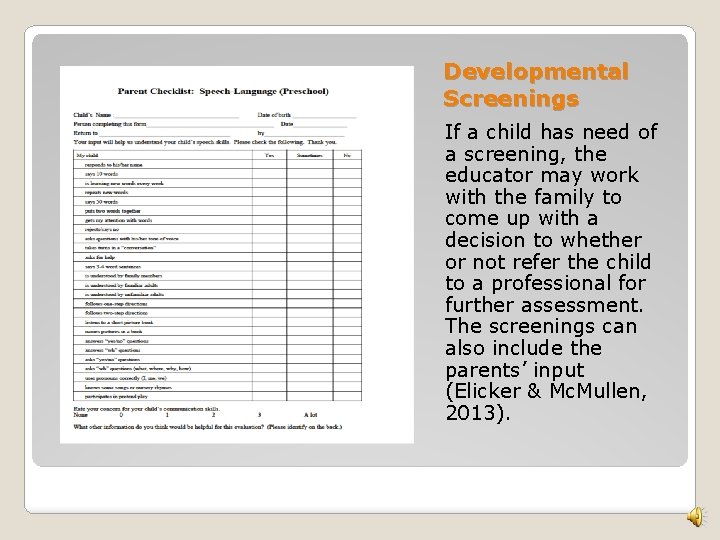
Developmental Screenings If a child has need of a screening, the educator may work with the family to come up with a decision to whether or not refer the child to a professional for further assessment. The screenings can also include the parents’ input (Elicker & Mc. Mullen, 2013).
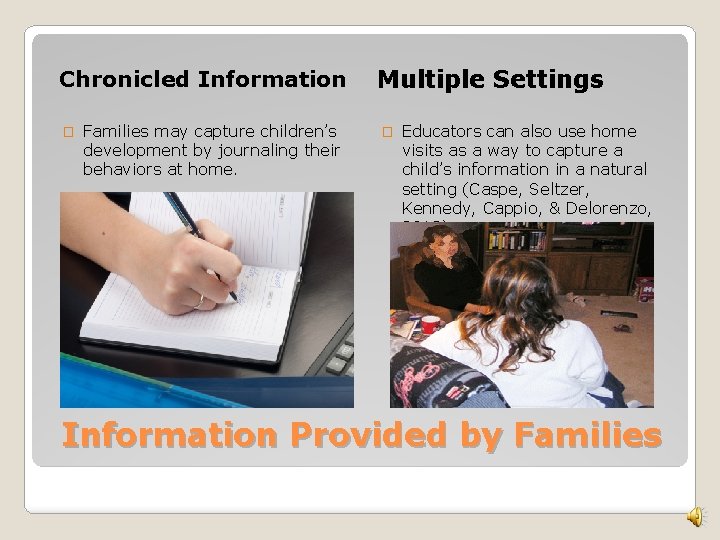
Chronicled Information � Families may capture children’s development by journaling their behaviors at home. Multiple Settings � Educators can also use home visits as a way to capture a child’s information in a natural setting (Caspe, Seltzer, Kennedy, Cappio, & Delorenzo, 2013). Information Provided by Families
Language and Literacy can be integrated in home with parents sharing highly imaginative oral stories with vivid vocabulary and detail instead of reading a book. This is great tool for parents of pre-k students (Caspe et al. , 2013). Communicating Assessment Results Assessment results do provide educators and parents an overview of how children are developing. However, it is not enough for parents to only gain understanding of how the child is developing. They must also receive resources and tools that will help support a caring parent-child relationship (Caspe, Seltzer, Kennedy, Cappio, & Delorenzo, 2013). This is especially important in terms of using home-school related activities that strengthen culture and are developmentally appropriate (Caspe et al. , 2013).
Teachers must help families make the connection between assessment results and the required state standards (Caspe et al. , 2013) Assessments and State Standards
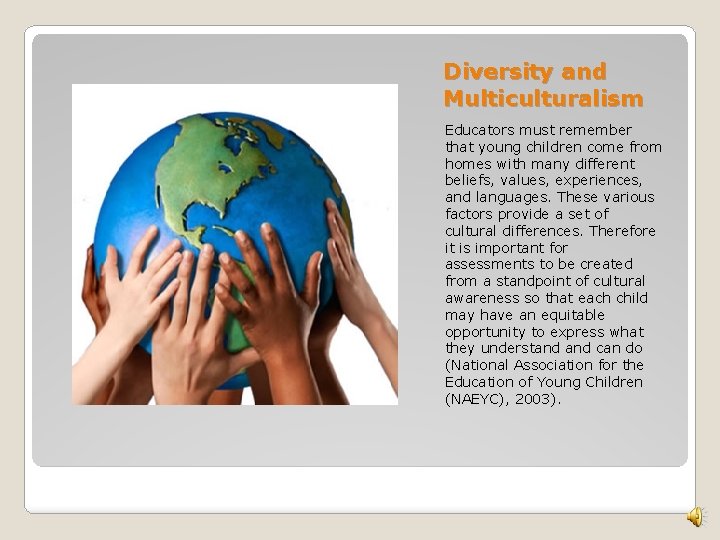
Diversity and Multiculturalism Educators must remember that young children come from homes with many different beliefs, values, experiences, and languages. These various factors provide a set of cultural differences. Therefore it is important for assessments to be created from a standpoint of cultural awareness so that each child may have an equitable opportunity to express what they understand can do (National Association for the Education of Young Children (NAEYC), 2003).
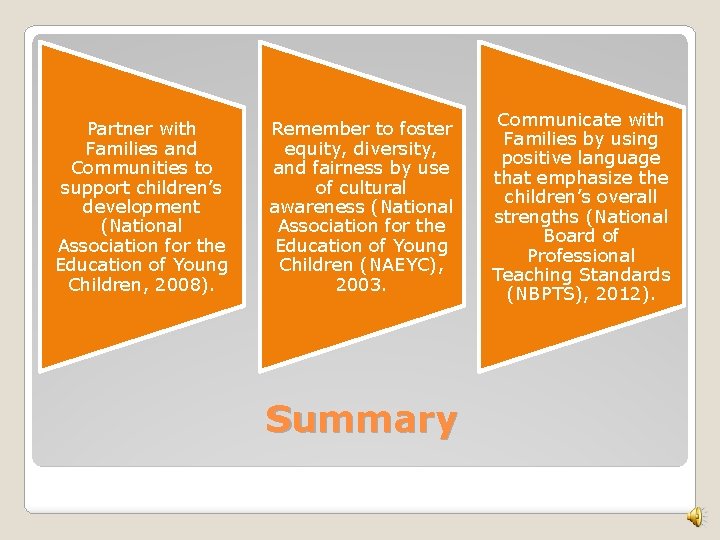
Partner with Families and Communities to support children’s development (National Association for the Education of Young Children, 2008). Remember to foster equity, diversity, and fairness by use of cultural awareness (National Association for the Education of Young Children (NAEYC), 2003. Summary Communicate with Families by using positive language that emphasize the children’s overall strengths (National Board of Professional Teaching Standards (NBPTS), 2012).
Caspe, M. Setlzer, A. , Kennedy, J. L. , Cappio, M. , & De. Lorenzo, C. (2013). Engaging families in the child assessemnt process. Young Children, 68(3), 8 -14. Retrieved from https: //www. naeyc. org/resources/pubs/yc National Association for the Education of Young Children (NAEYC). (2003). Early childhood curriculum, assessment, and program evaluation. Retrieved from https: //www. naeyc. org/files/naeyc/file/positions/CAPEexpand. pdf National Association for the Education of Young Children. (2008). Overview of the NAEYC early childhood program standards. Retrieved from https: //www. naeyc. org/files/academy/file/Overview. Standards. pdf National Board for Professional Teaching Standards (NBPTS). (2012). Early childhood generalist standards (3 rd ed. ). Retrieved from http: //boardcertifiedteachers. org/sites/default/files/ECGEN. pdf Ebbeck, M. , Teo, G. C. , Tan, C. , & Goh, M. (2014). Relooking assessment: A study on assessing developmental learning outcomes in toddlers. Early childhood Education Journal, 42(2), 115 -123. Elicker, J. , & Mc. Mullen, M. B. (2013). Appropriate and meaningful assessment in family-centered programs. Young Children, 68(3), 22 -27. Retrieved from https: //www. naeyc. org/resources/pubs/yc References