Electronic Physics Dr Ghusoon Mohsin Ali Conductivity of

- Slides: 11
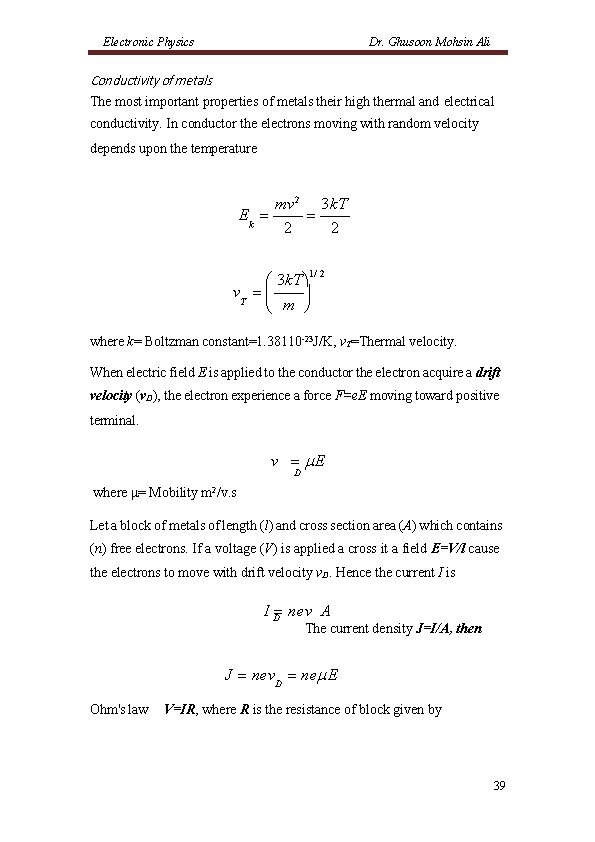
Electronic Physics Dr. Ghusoon Mohsin Ali Conductivity of metals The most important properties of metals their high thermal and electrical conductivity. In conductor the electrons moving with random velocity depends upon the temperature mv 2 3 k. T Ek 2 2 1/ 2 3 k. T v. T m where k= Boltzman constant=1. 38110 -23 J/K, v. T=Thermal velocity. When electric field E is applied to the conductor the electron acquire a drift velocity (v. D), the electron experience a force F=e. E moving toward positive terminal. v E D where μ= Mobility m 2/v. s Let a block of metals of length (l) and cross section area (A) which contains (n) free electrons. If a voltage (V) is applied a cross it a field E=V/l cause the electrons to move with drift velocity v. D. Hence the current I is I D nev A The current density J=I/A, then J nev. D ne E Ohm's law V=IR, where R is the resistance of block given by 39
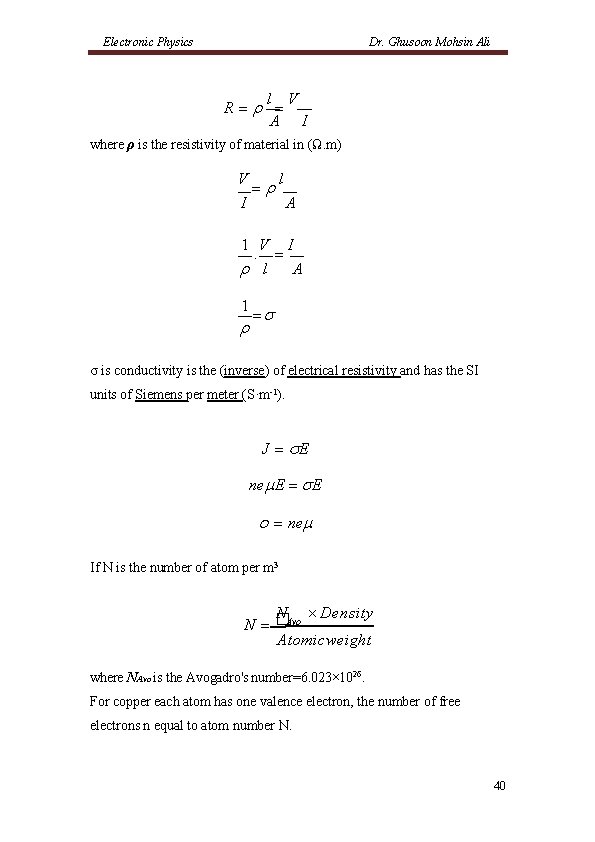
Electronic Physics Dr. Ghusoon Mohsin Ali l V R A I where ρ is the resistivity of material in (Ω. m) V l I A 1 V I. l A 1 σ is conductivity is the (inverse) of electrical resistivity and has the SI units of Siemens per meter (S·m-1). J E ne E E ne If N is the number of atom per m 3 N Density N �Avo Atomicweight where NAvo is the Avogadro's number=6. 023× 1026. For copper each atom has one valence electron, the number of free electrons n equal to atom number N. 40
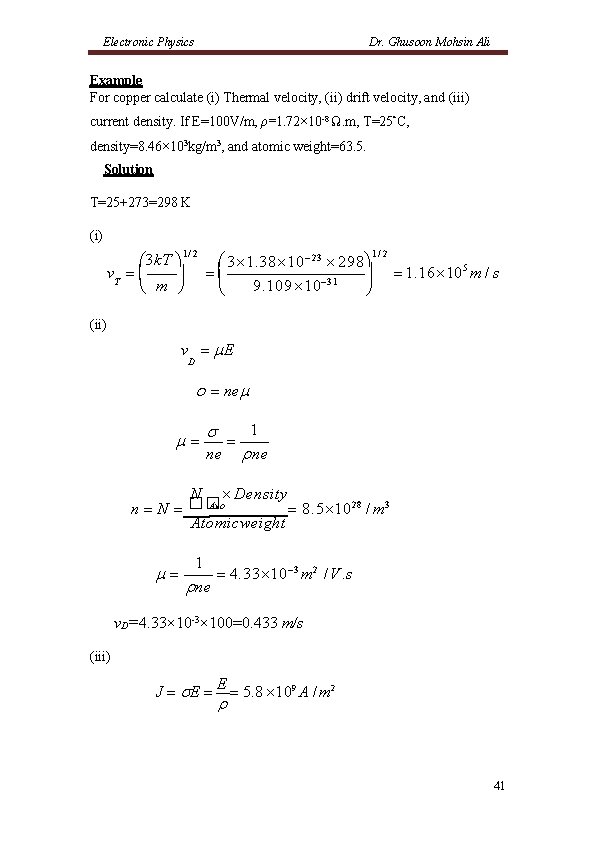
Electronic Physics Dr. Ghusoon Mohsin Ali Example For copper calculate (i) Thermal velocity, (ii) drift velocity, and (iii) current density. If E=100 V/m, ρ=1. 72× 10 -8 Ω. m, T=25°C, density=8. 46× 103 kg/m 3, and atomic weight=63. 5. Solution T=25+273=298 K (i) 1/ 2 3 k. T v. T m 1/ 2 3 1. 38 10 2 3 298 31 9. 109 10 1. 16 10 5 m / s (ii) v E D ne 1 ne ne N Density Avo �� n N 8. 5 10 28 / m 3 Atomicweight 1 4. 33 10 3 m 2 / V. s ne v. D=4. 33× 10 -3× 100=0. 433 m/s (iii) J E E 5. 8 109 A / m 2 41
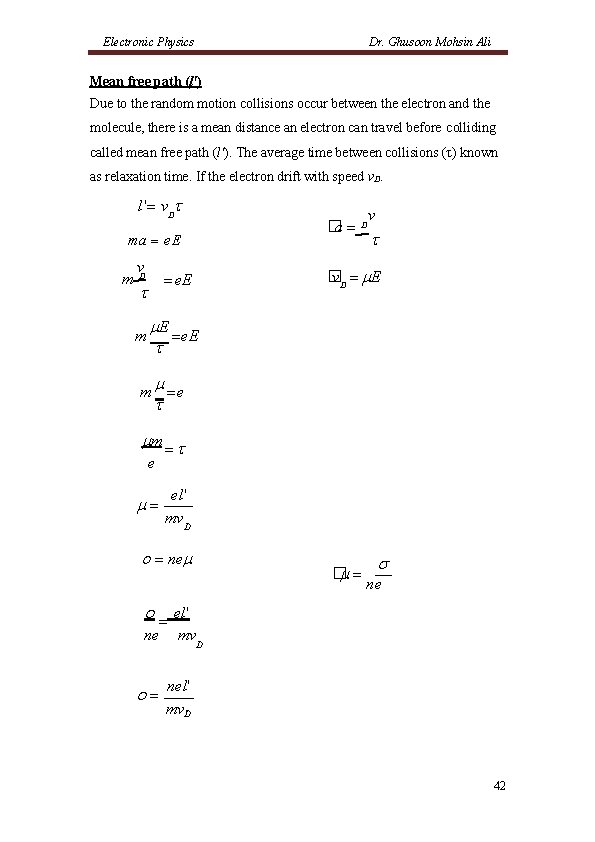
Electronic Physics Dr. Ghusoon Mohsin Ali Mean free path (l') Due to the random motion collisions occur between the electron and the molecule, there is a mean distance an electron can travel before colliding called mean free path (l'). The average time between collisions (τ) known as relaxation time. If the electron drift with speed v. D. l' v. D ma e. E m v. D e. E m �a v D � v D E E e. E m e el' mv. D ne � ne el' ne mv. D nel' mv. D 42
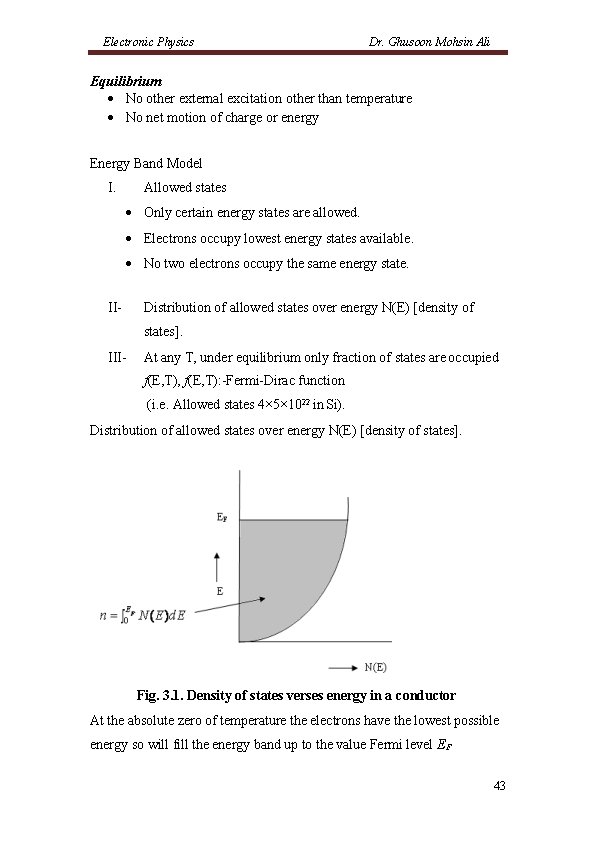
Electronic Physics Dr. Ghusoon Mohsin Ali Equilibrium No other external excitation other than temperature No net motion of charge or energy Energy Band Model I. Allowed states Only certain energy states are allowed. Electrons occupy lowest energy states available. No two electrons occupy the same energy state. II- Distribution of allowed states over energy N(E) [density of states]. III- At any T, under equilibrium only fraction of states are occupied f(E, T), f(E, T): -Fermi-Dirac function (i. e. Allowed states 4× 5× 1022 in Si). Distribution of allowed states over energy N(E) [density of states]. Fig. 3. 1. Density of states verses energy in a conductor At the absolute zero of temperature the electrons have the lowest possible energy so will fill the energy band up to the value Fermi level EF 43
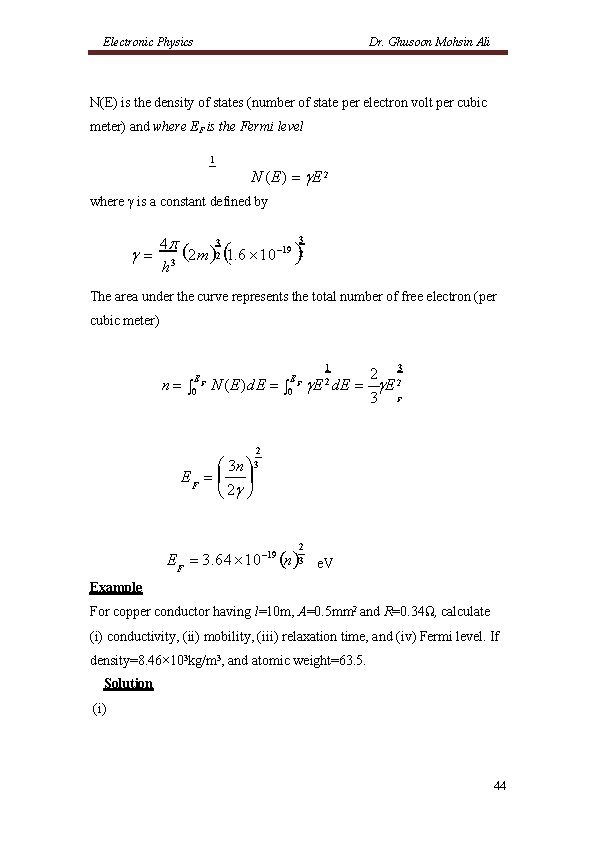
Electronic Physics Dr. Ghusoon Mohsin Ali N(E) is the density of states (number of state per electron volt per cubic meter) and where EF is the Fermi level 1 N (E) E 2 where γ is a constant defined by 3 4 3 2 m 2 1. 6 10 19 h 3 2 The area under the curve represents the total number of free electron (per cubic meter) n EF 0 N (E)d. E EF 0 1 2 2 23 E d. E E 3 F 2 3 3 n EF 2 E F 3. 64 10 19 2 3 n e. V Example For copper conductor having l=10 m, A=0. 5 mm 2 and R=0. 34Ω, calculate (i) conductivity, (ii) mobility, (iii) relaxation time, and (iv) Fermi level. If density=8. 46× 103 kg/m 3, and atomic weight=63. 5. Solution (i) 44
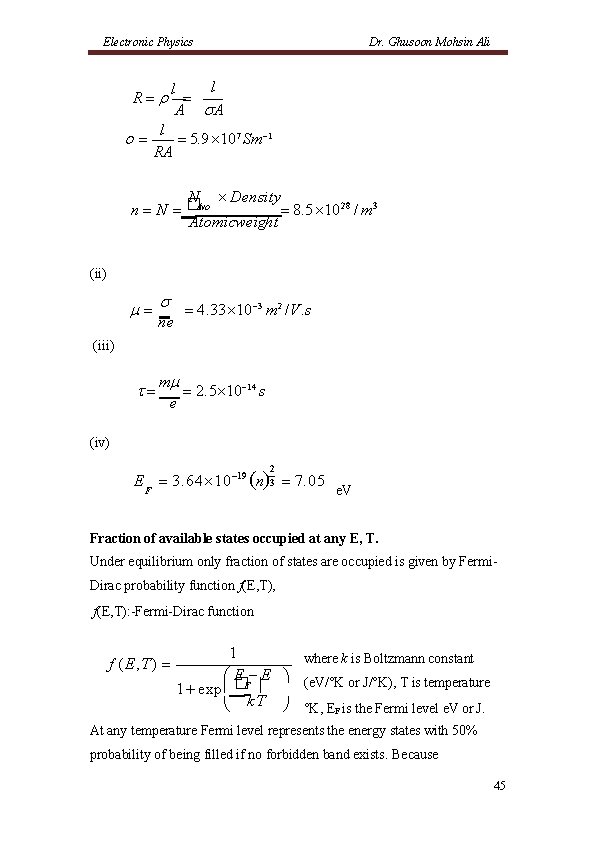
Electronic Physics Dr. Ghusoon Mohsin Ali l l R A A l 5. 9 107 Sm 1 RA N Density n N �Avo 8. 5 1028 / m 3 Atomicweight (ii) 4. 33 10 3 m 2 /V. s ne (iii) m 2. 5 10 14 s e (iv) E F 3. 64 10 19 2 n 3 7. 05 e. V Fraction of available states occupied at any E, T. Under equilibrium only fraction of states are occupied is given by Fermi. Dirac probability function f(E, T), f(E, T): -Fermi-Dirac function f (E, T ) 1 where k is Boltzmann constant E E (e. V/°K or J/°K), T is temperature 1 exp �F k. T °K, EF is the Fermi level e. V or J. At any temperature Fermi level represents the energy states with 50% probability of being filled if no forbidden band exists. Because 45
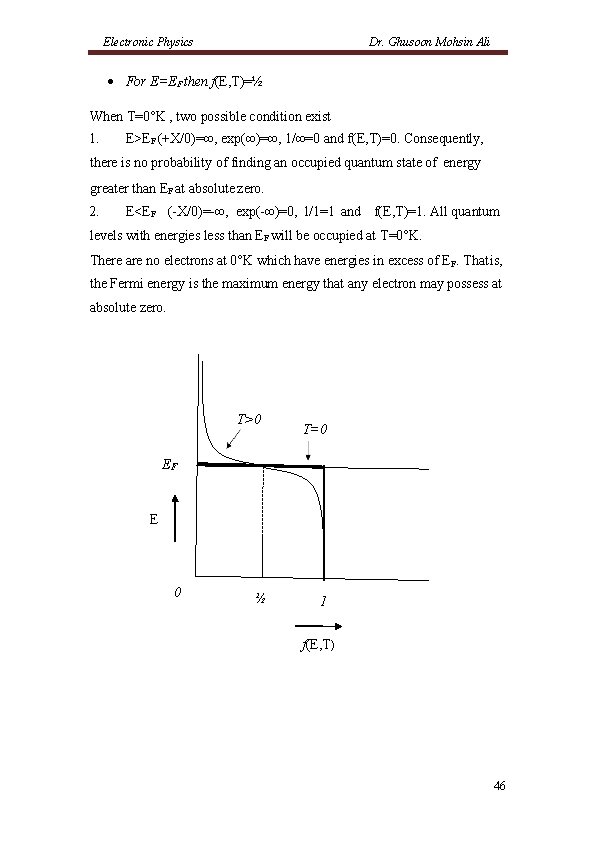
Electronic Physics Dr. Ghusoon Mohsin Ali For E=EF then f(E, T)=½ When T=0°K , two possible condition exist 1. E>EF (+X/0)=∞, exp(∞)=∞, 1/∞=0 and f(E, T)=0. Consequently, there is no probability of finding an occupied quantum state of energy greater than EF at absolute zero. 2. E<EF (-X/0)=-∞, exp(-∞)=0, 1/1=1 and f(E, T)=1. All quantum levels with energies less than EF will be occupied at T=0°K. There are no electrons at 0°K which have energies in excess of EF. That is, the Fermi energy is the maximum energy that any electron may possess at absolute zero. T>0 T=0 EF E 0 ½ 1 f(E, T) 46
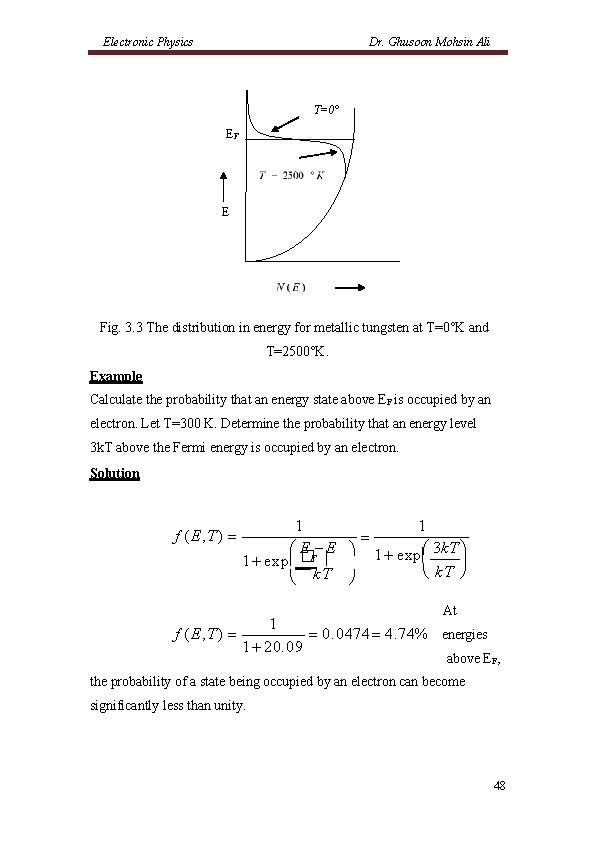
Electronic Physics Dr. Ghusoon Mohsin Ali T=2500°K T=300°K T=0 EF E 0 ½ 1 f(E, T) Fig 3. 2 Fermi-Dirac distribution function f(E) gives a probability that a state of energy E is occupied A plot of the distribution in energy shown below for metallic tungsten at T=0°K and T=2500°K. The area under each curve is simply the total number of particles per cubic meter of the metal; hence the two areas must be equal. Also, the curves for all temperatures f(E, T)=½ for E=EF. Note that the distribution function changes only very slightly with temperature, even though the temperature is 2500°K. Only few electrons have large value of energy. 47
Electronic Physics Dr. Ghusoon Mohsin Ali T=0° EF E Fig. 3. 3 The distribution in energy for metallic tungsten at T=0°K and T=2500°K. Example Calculate the probability that an energy state above EF is occupied by an electron. Let T=300 K. Determine the probability that an energy level 3 k. T above the Fermi energy is occupied by an electron. Solution f (E, T ) 1 1 E E 1 exp 3 k. T 1 exp �F k. T At f (E, T ) 1 0. 0474 4. 74% energies 1 20. 09 above EF, the probability of a state being occupied by an electron can become significantly less than unity. 48
Electronic Physics Dr. Ghusoon Mohsin Ali Work function (Ew): Work function of metal may be defined as the minimum amount of energy that must be given to the its fastest moving electron at 0 o. K in order to enable it to escape from metal. Problems Q 1: For copper conductor having l=5 m, A=0. 1 mm 2 and R=0. 15Ω, calculate (i) conductivity, (ii) mobility, (iii) relaxation time, (iv) Thermal velocity, (v) drift velocity and (vi) Fermi level. If T=300 K, V=5 V, density=8. 46× 103 kg/m 3, and atomic weight=63. 5. Q 2: For tungsten the total number of free electrons (n) and Fermi level. Assume that there are two free electrons per atom. If density=18. 8× 10³ kg/m 3, and atomic weight=184. (Ans. 1. 23× 1029/m 3, 8. 95 e. V) Q 3: Assume the Fermi energy level is 0. 03 e. V below the conduction band energy. (a) Determine the probability of state being occupied by an electron at Ec. (b) Repeat part (a) for an energy state at Ec+k. T. Assume T=300 K. 49