ELECTROLYSIS THEORY Electrolysis the process of separation of

- Slides: 9
ELECTROLYSIS
THEORY: • Electrolysis, the process of separation of chemical compounds with the help of electric current. Electrolysis, the process of separation of chemical compounds dissolved in a liquid with the help of electric current. • Electrolysis is one of the lesson in electrochemistry. • Electrochemistry investigates not only transition of electrical energy to chemical energy but also investigates transition of chemical energy to electrical energy.
THEORY: • Electrolysis investigates transition of electrical energy to chemical energy by means of electrolytic cells. • Electrolysis is commercially important as a stage in the separation of elements from naturally occuring sources such as ones using an electrolytic cells. • Electrolysis is passing of direct electric current through an ionic substance that is molten or dissolved in a suitable solvent, producing chemical reactions at the electrodes and a separation of the materials.
THEORY: • Faraday's First Law: The amount of substance that is separated by chemical change in the cathode or anode during electrolysis is directly proportional to the amount of electrical charge passing through the circuit. • Faraday's Second Law: If the quantity of electricity passed through in each cells during the electrolysis of different electrolytes is the same grams of substances separated by chemical changing are the same an each electrode.
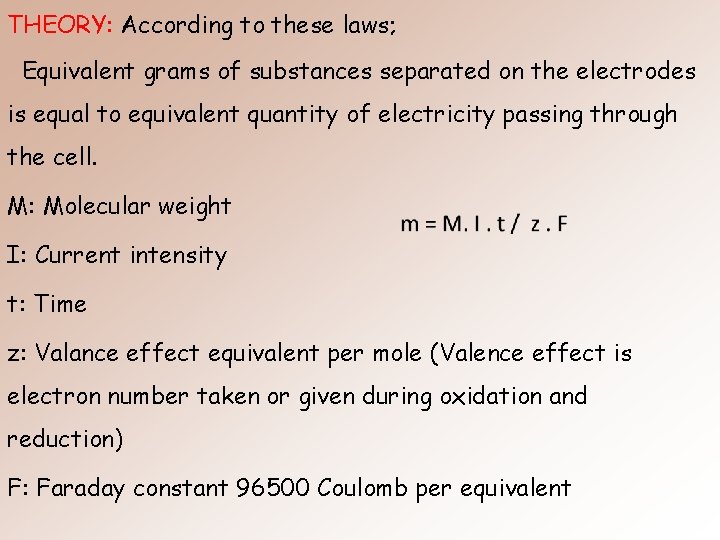
THEORY: According to these laws; Equivalent grams of substances separated on the electrodes is equal to equivalent quantity of electricity passing through the cell. M: Molecular weight I: Current intensity t: Time z: Valance effect equivalent per mole (Valence effect is electron number taken or given during oxidation and reduction) F: Faraday constant 96500 Coulomb per equivalent
Experimental tools: • A direct current electrical supply, provides energy to create or discharge the ions in electrolyte. • Two electrodes, one of is anode the other one is cathode. Two electrodes ( electrical conductors) provide physical interface between the electroylite and the eletrical circuit. • An electrolyte solution that conduct electricity due to separating ions. It is copper sulphate. • A paper clip, to cover copper metal.
Electric current must move from one point to another within substance because of charge carrier. While these charge carries are electrons on the matal ions in the solution. In this experiment our change carries are the ions Cu 2+, SO 4 -2 ions.
Why do we use copper sulphate solutions ? Because we will do copper plating with electrolysis, and we need ions to carry charge in a solution. When current is moved by ions in a solution, some chemical changes take place. We will decide which one is anode, which one is cathode.
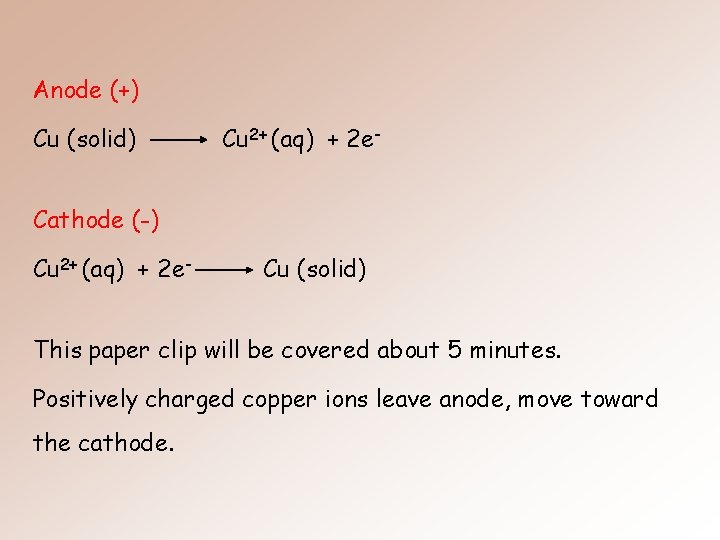
Anode (+) Cu (solid) Cu 2+ (aq) + 2 e- Cathode (-) Cu 2+ (aq) + 2 e- Cu (solid) This paper clip will be covered about 5 minutes. Positively charged copper ions leave anode, move toward the cathode.