Differentiation Copyright Cengage Learning All rights reserved The
- Slides: 25
Differentiation Copyright © Cengage Learning. All rights reserved.
The Chain Rule Copyright © Cengage Learning. All rights reserved.
Objectives n Find the derivative of a composite function using the Chain Rule. n Find the derivative of a function using the General Power Rule. n Simplify the derivative of a function using algebra. n Find the derivative of a trigonometric function using the Chain Rule. 3
The Chain Rule 4
The Chain Rule We have yet to discuss one of the most powerful differentiation rules—the Chain Rule. This rule deals with composite functions and adds a surprising versatility to the rules discussed in the two previous sections. 5
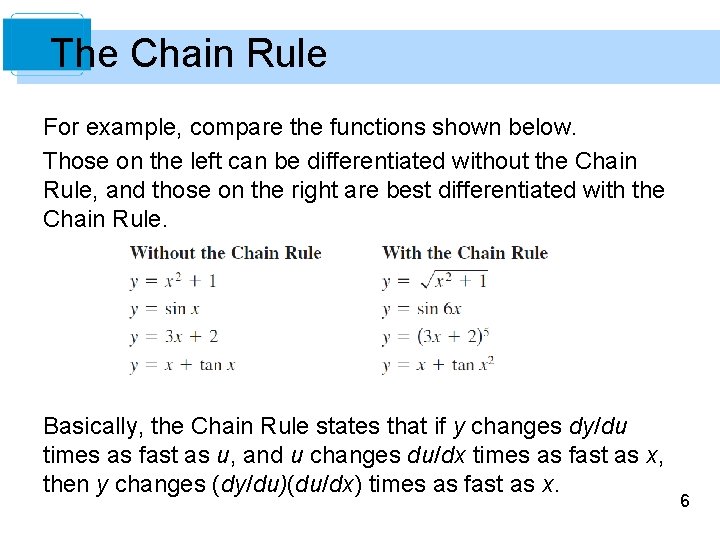
The Chain Rule For example, compare the functions shown below. Those on the left can be differentiated without the Chain Rule, and those on the right are best differentiated with the Chain Rule. Basically, the Chain Rule states that if y changes dy/du times as fast as u, and u changes du/dx times as fast as x, then y changes (dy/du)(du/dx) times as fast as x. 6
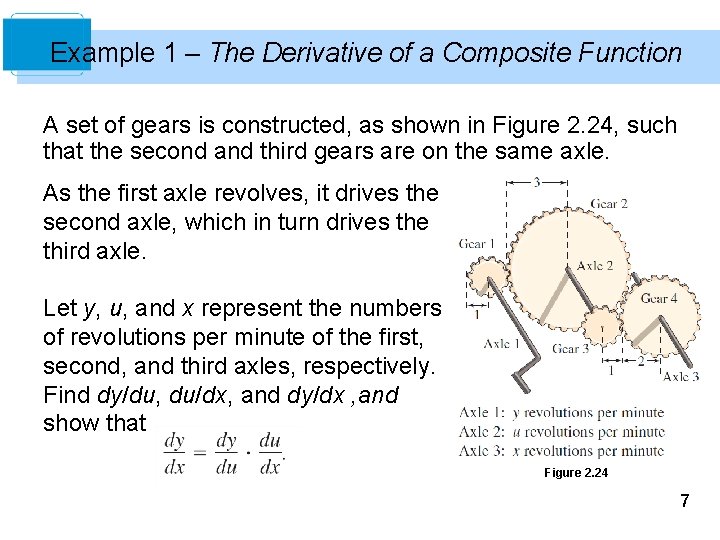
Example 1 – The Derivative of a Composite Function A set of gears is constructed, as shown in Figure 2. 24, such that the second and third gears are on the same axle. As the first axle revolves, it drives the second axle, which in turn drives the third axle. Let y, u, and x represent the numbers of revolutions per minute of the first, second, and third axles, respectively. Find dy/du, du/dx, and dy/dx , and show that Figure 2. 24 7
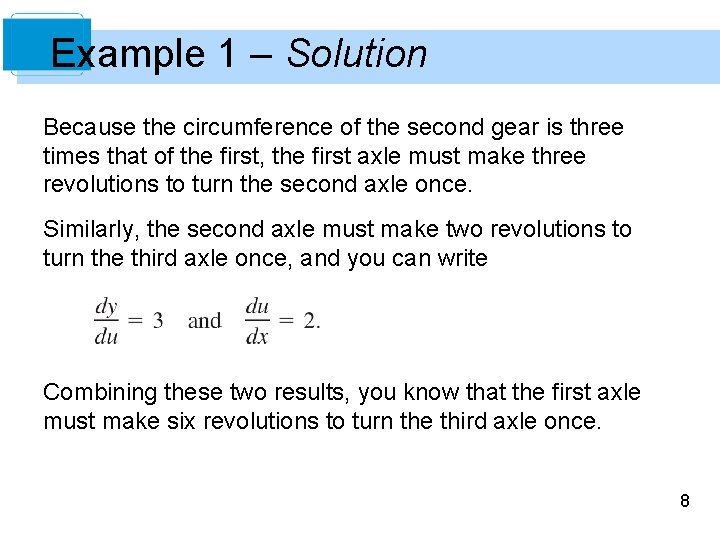
Example 1 – Solution Because the circumference of the second gear is three times that of the first, the first axle must make three revolutions to turn the second axle once. Similarly, the second axle must make two revolutions to turn the third axle once, and you can write Combining these two results, you know that the first axle must make six revolutions to turn the third axle once. 8
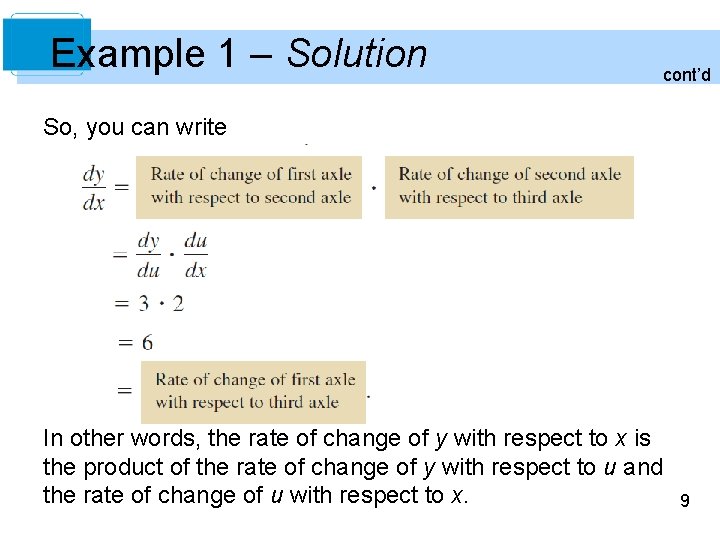
Example 1 – Solution cont’d So, you can write In other words, the rate of change of y with respect to x is the product of the rate of change of y with respect to u and the rate of change of u with respect to x. 9
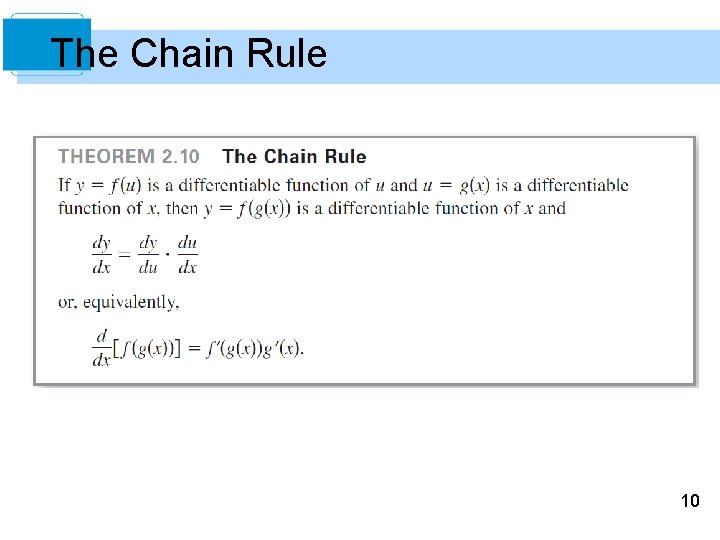
The Chain Rule 10
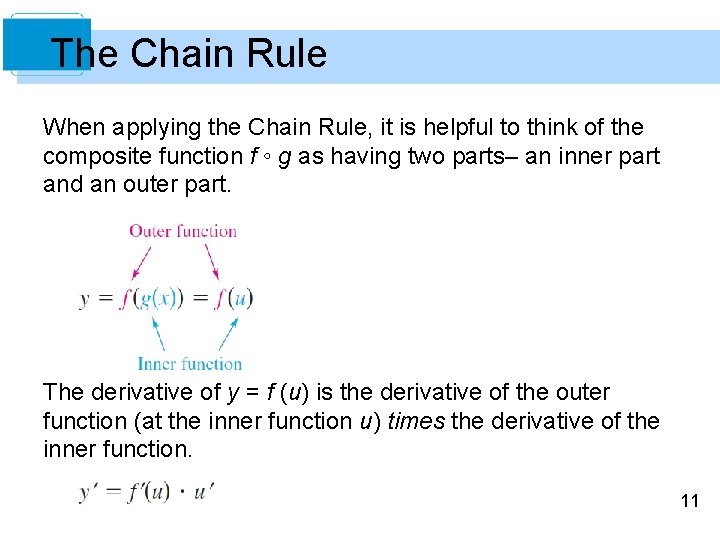
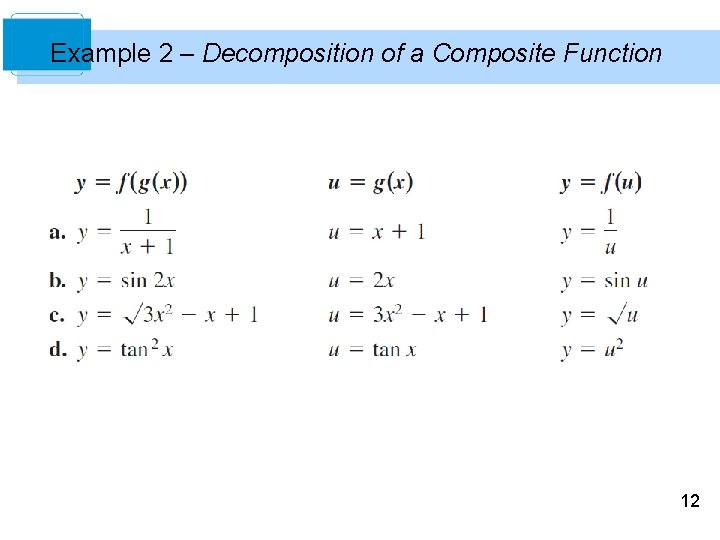
The Chain Rule When applying the Chain Rule, it is helpful to think of the composite function f ◦ g as having two parts– an inner part and an outer part. The derivative of y = f (u) is the derivative of the outer function (at the inner function u) times the derivative of the inner function. 11
Example 2 – Decomposition of a Composite Function 12
The General Power Rule 13
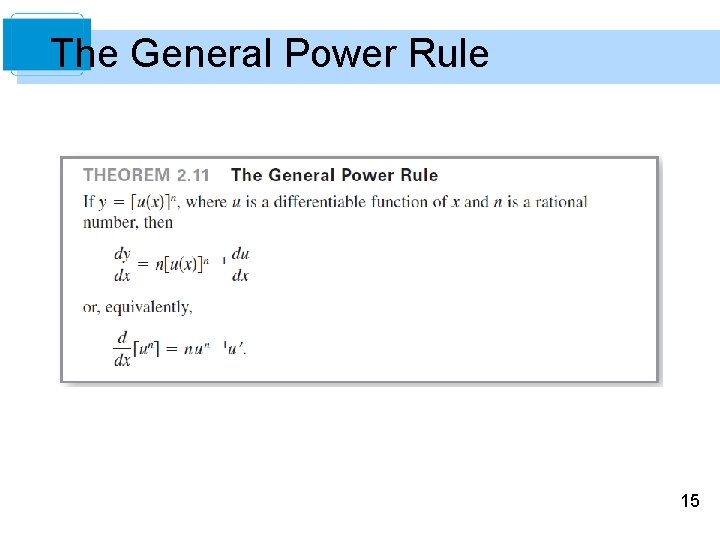
The General Power Rule The function y = [u(x)]n is one of the most common types of composite functions. The rule for differentiating such functions is called the General Power Rule, and it is a special case of the Chain Rule. 14
The General Power Rule 15
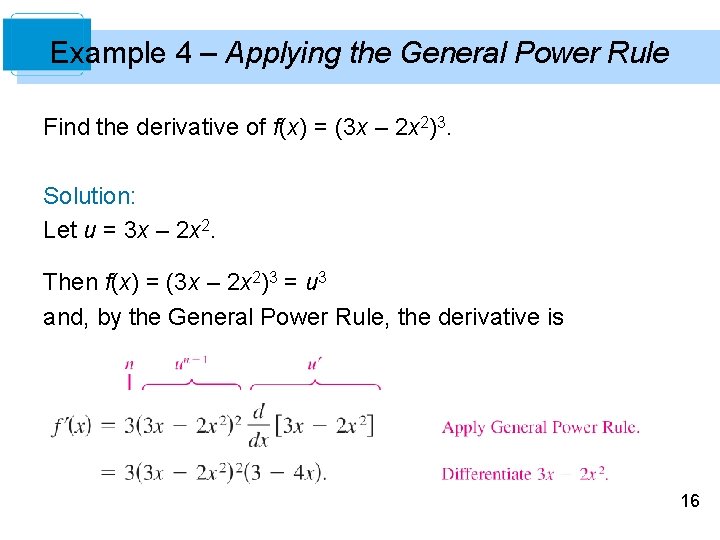
Example 4 – Applying the General Power Rule Find the derivative of f(x) = (3 x – 2 x 2)3. Solution: Let u = 3 x – 2 x 2. Then f(x) = (3 x – 2 x 2)3 = u 3 and, by the General Power Rule, the derivative is 16
Simplifying Derivatives 17
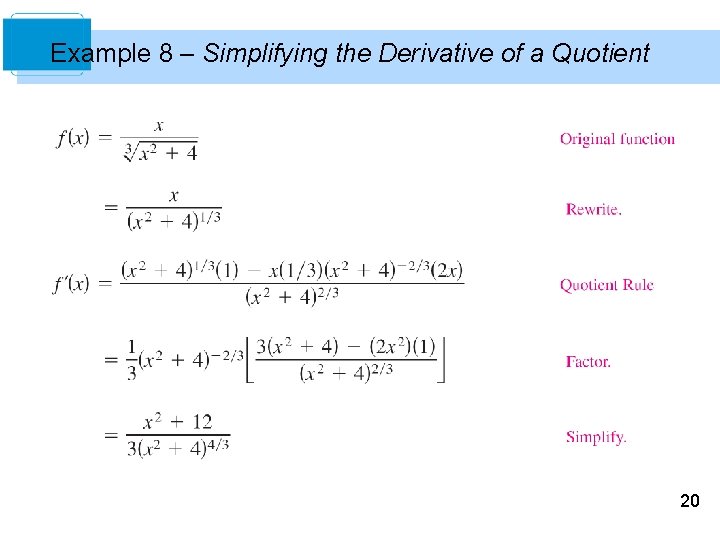
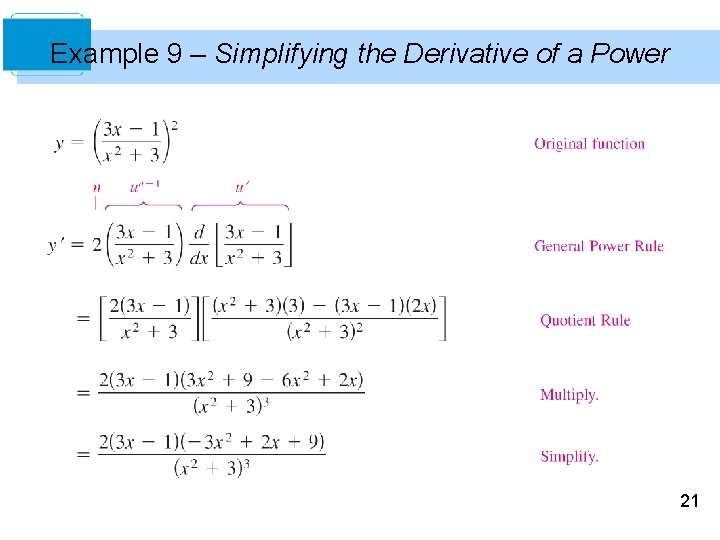
Simplifying Derivatives The next three examples illustrate some techniques for simplifying the “raw derivatives” of functions involving products, quotients, and composites. 18
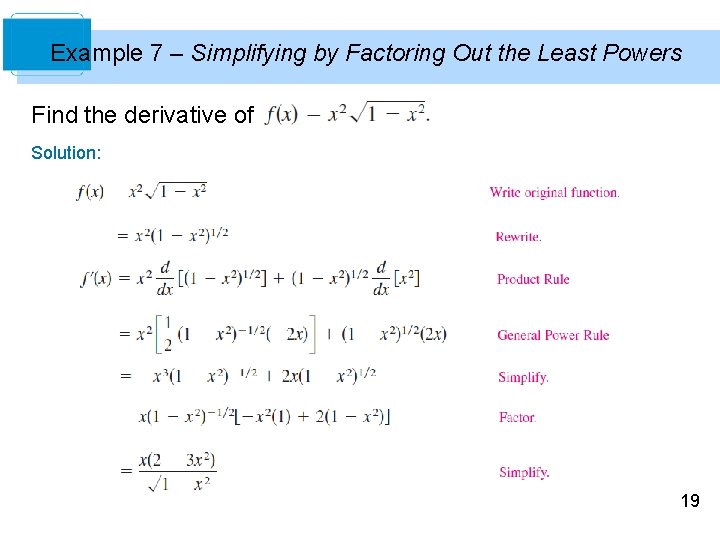
Example 7 – Simplifying by Factoring Out the Least Powers Find the derivative of Solution: 19
Example 8 – Simplifying the Derivative of a Quotient 20
Example 9 – Simplifying the Derivative of a Power 21
Trigonometric Functions and the Chain Rule 22
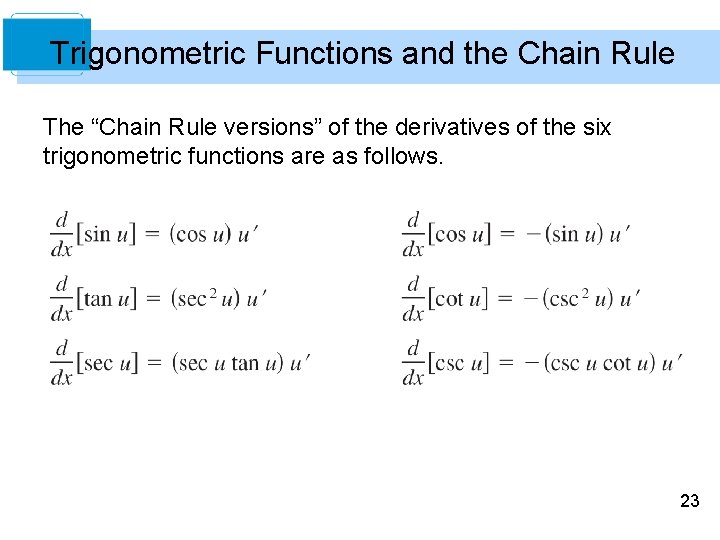
Trigonometric Functions and the Chain Rule The “Chain Rule versions” of the derivatives of the six trigonometric functions are as follows. 23
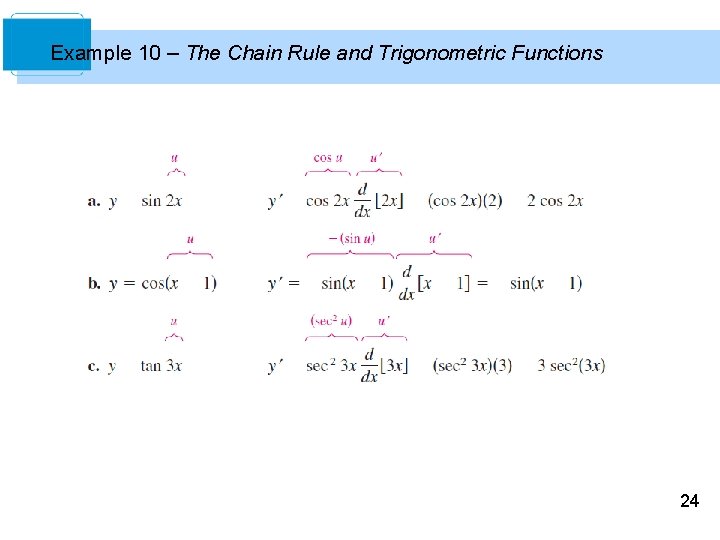
Example 10 – The Chain Rule and Trigonometric Functions 24
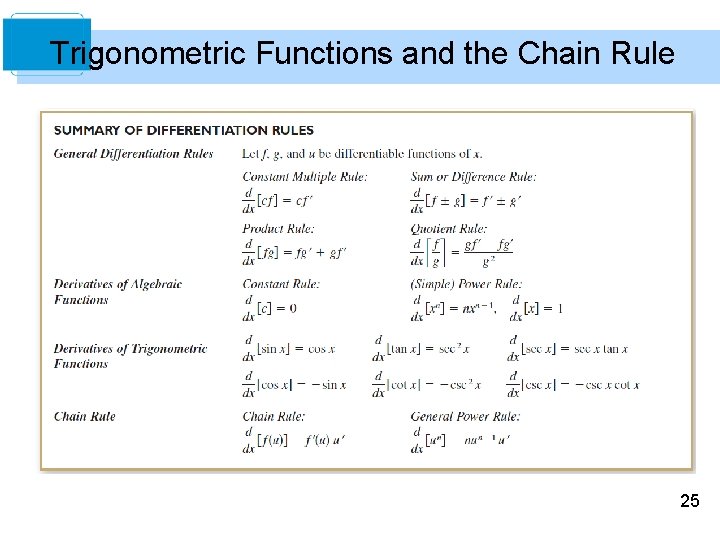
Trigonometric Functions and the Chain Rule 25