DIFFERENTIATED INTEGRATION Prof Dr Cristina Elas Mndez Universidad
- Slides: 17
DIFFERENTIATED INTEGRATION Prof. Dr. Cristina Elías Méndez Universidad Nacional de Educación a Distancia (UNED, Spain) celias@der. uned. es 21/11/2017
DIFFERENTIATED INTEGRATION (DI) � CONCEPT � THESIS � EXISTING FORMS OF DI � LEGAL FRAME � CONSTITUTIONAL IMPLICATIONS � POSSIBLE FUTURE AVENUES
CONCEPT Alexander Stubb (1996): Differentiated integration = “the general mode of integration strategies which try to reconcile heterogeneity within the European Union and allow different groupings of Member States to pursue an array of public policies with different procedural and institutional arrangements”.
CONCEPT � The «second best» option (reasons). � Final aim: progress towards union. � A long history: (Schengen, Eurozone). � Juncker, White Paper on the State of the Union, 2017: Scenario 3: «Those who want more do more» .
THESIS � Differentiated integration is not the best option, but it is a convenient and necessary form of integration. � Complexity of the EU.
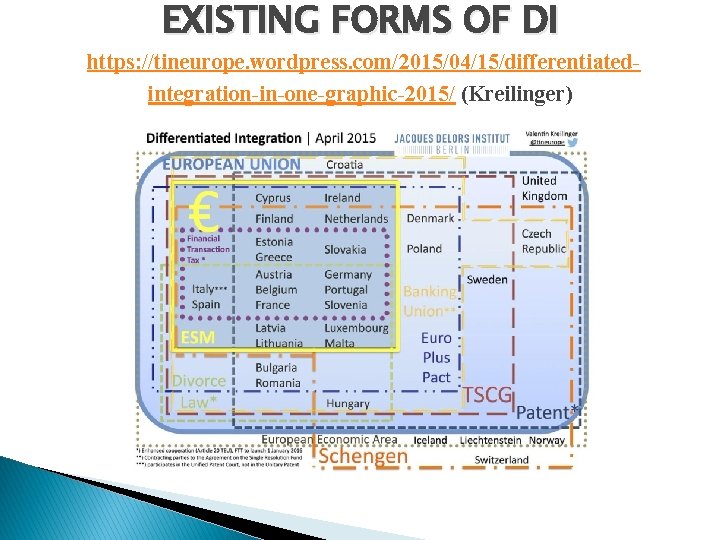
EXISTING FORMS OF DI https: //tineurope. wordpress. com/2015/04/15/differentiatedintegration-in-one-graphic-2015/ (Kreilinger)
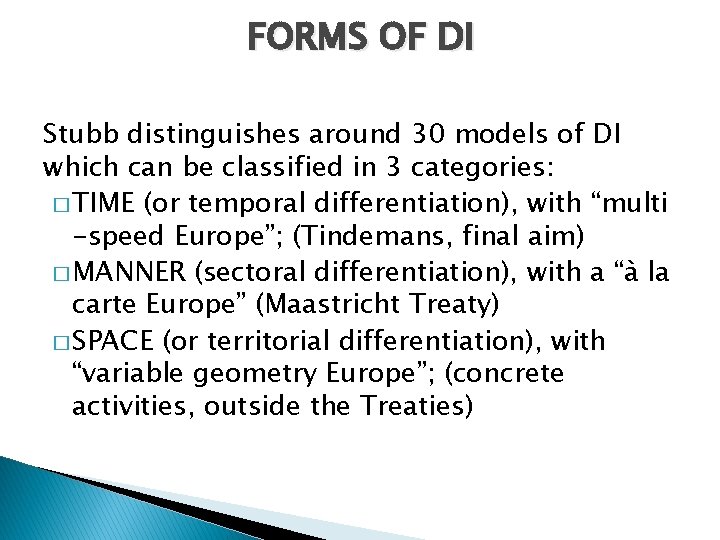
FORMS OF DI Stubb distinguishes around 30 models of DI which can be classified in 3 categories: � TIME (or temporal differentiation), with “multi -speed Europe”; (Tindemans, final aim) � MANNER (sectoral differentiation), with a “à la carte Europe” (Maastricht Treaty) � SPACE (or territorial differentiation), with “variable geometry Europe”; (concrete activities, outside the Treaties)
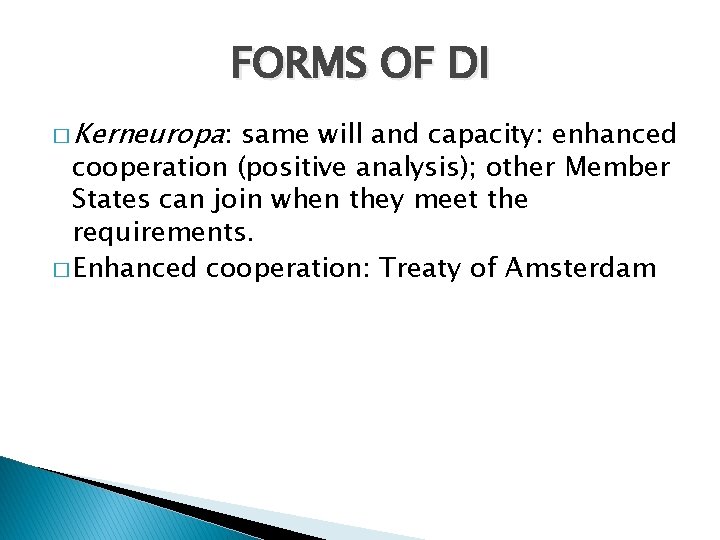
FORMS OF DI � Kerneuropa: same will and capacity: enhanced cooperation (positive analysis); other Member States can join when they meet the requirements. � Enhanced cooperation: Treaty of Amsterdam
FORMS OF DI The terminology is not so relevant. WITHIN the Treaties: multiple and varied possibilities. DI decisions have also been taken OUTSIDE the framework of the Treaties (e. g. Treaty on Stability, Coordination and Governance).
LEGAL FRAME DI is foreseen and allowed in the Treaties. Desirable: -in the framework of the Treaties; -using the existing institutional framework, not parallel structures; -open to all the EEMM; -temporary character.
CONSTITUTIONAL IMPLICATIONS �Possible �Staatenverbund (German Constitutional Court) �Depends on the EU conception �The old dialectics: “enlargement versus deepening”.
CONSTITUTIONAL IMPLICATIONS POSITIVE: �Unblock paralysis situations; �reconcile different interests; �leadership effect on other Member States.
CONSTITUTIONAL IMPLICATIONS NEGATIVE: � Breach of unity; � complex for citizens; � functioning of the institutions; � concurrent legal systems;
CONSTITUTIONAL IMPLICATIONS NEGATIVE: � lack of political efficacy; � legitimacy; � democratic guarantees; � role of the EP and national parliaments; � political accountability.
POSSIBLE FUTURE AVENUES � Work within the Treaties; � Reform � Work the Treaties; outside the Treaties.
POSSIBLE FUTURE AVENUES A small selection of policy areas: � Economic Governance (Eurozone) � Defence (Pe. SCo) � Freedom, Security and Justice (Schengen)
SUMMING UP � Danger � «DI of spreading? can safe the EU» . DI: importance nowadays and in the following years.