
Differentiated Supervision Because Students Are Not the Only
Differentiated Supervision – Because Students Are Not the Only Ones with Differences! Presentation for Teachers and Administrators in the New Canaan Public Schools, New Canaan, CT • What is differentiated supervision? • Why is it necessary? • How do we make teacher evaluations both meaningful and purposeful? • How can school leaders respond to evaluations to make key decisions regarding teacher needs? • How will differentiated supervision ultimately benefit teachers and students?
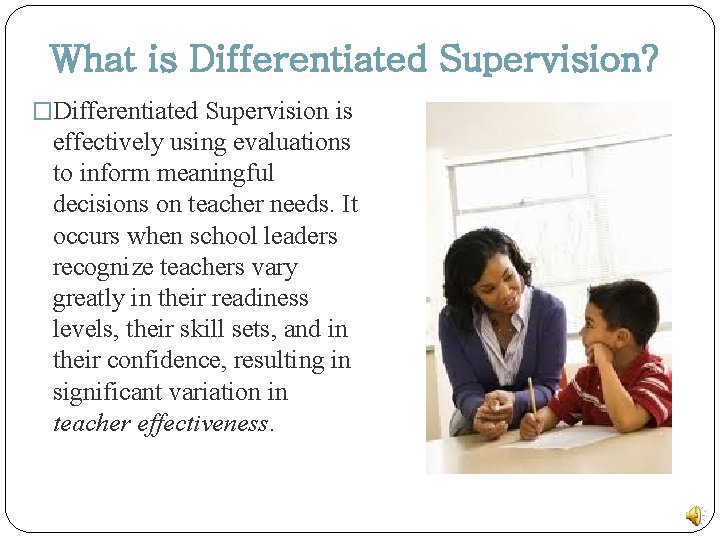
What is Differentiated Supervision? �Differentiated Supervision is effectively using evaluations to inform meaningful decisions on teacher needs. It occurs when school leaders recognize teachers vary greatly in their readiness levels, their skill sets, and in their confidence, resulting in significant variation in teacher effectiveness.
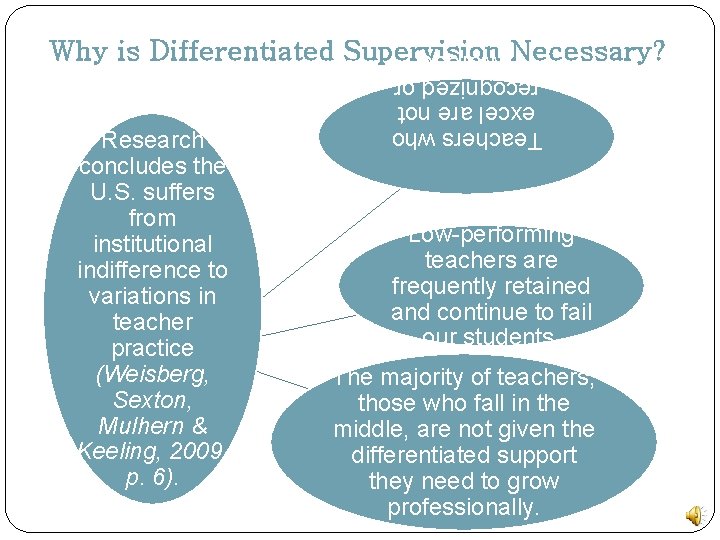
Why is Differentiated Supervision Necessary? Teachers who excel are not recognized or rewarded. Research concludes the U. S. suffers from institutional indifference to variations in teacher practice (Weisberg, Sexton, Mulhern & Keeling, 2009, p. 6). Low-performing teachers are frequently retained and continue to fail our students. The majority of teachers, those who fall in the middle, are not given the differentiated support they need to grow professionally.

Teachers are NOT all the Same! The “Widget Effect, ” as described in a research report by the New Teacher Project, is defined as the failure of our schools to recognize that teacher effectiveness is not the same from classroom to classroom; teachers are not interchangeable parts.
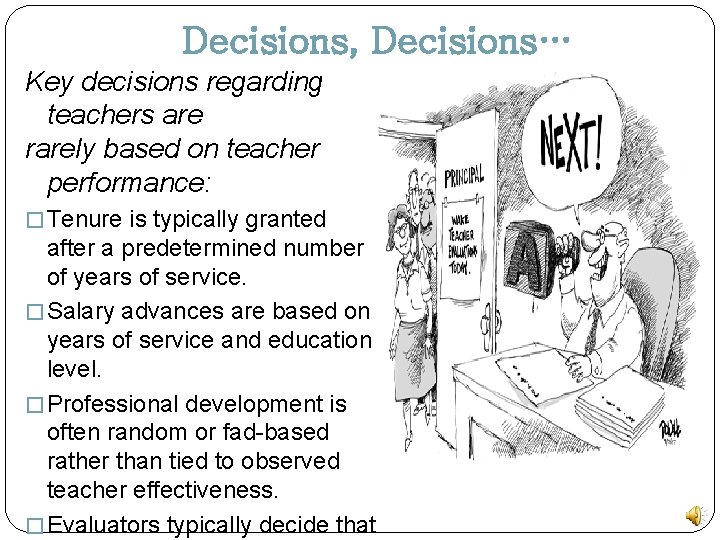
Decisions, Decisions… Key decisions regarding teachers are rarely based on teacher performance: � Tenure is typically granted after a predetermined number of years of service. � Salary advances are based on years of service and education level. � Professional development is often random or fad-based rather than tied to observed teacher effectiveness. � Evaluators typically decide that
Change Required… �Effective Differentiated Supervision requires a cultural shift – administrators and teachers must adjust how they have historically viewed the evaluation system. It must be understood that “the core purpose of evaluation must be maximizing teacher growth and effectiveness” (Weisberg, Sexton, Mulhern & Keeling, 2009, p. 9). �Teachers must stop viewing a positive rating as the singular goal of an evaluation, but instead view it as an opportunity to receive constructive feedback and differentiated
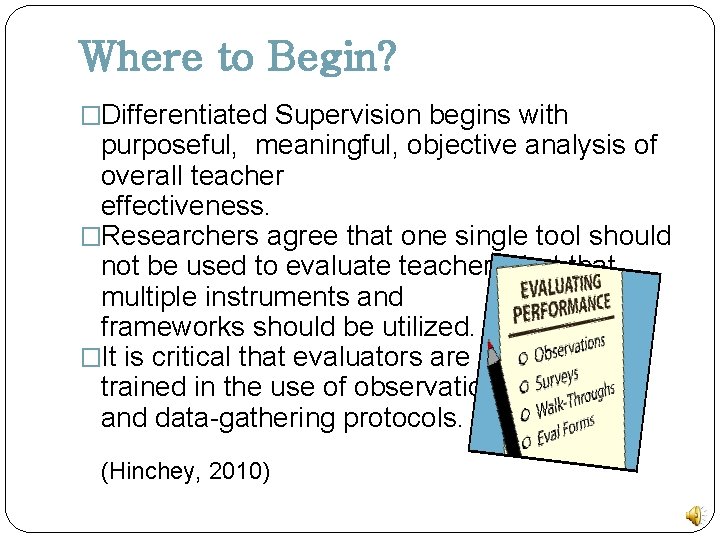
Where to Begin? �Differentiated Supervision begins with purposeful, meaningful, objective analysis of overall teacher effectiveness. �Researchers agree that one single tool should not be used to evaluate teachers, but that multiple instruments and frameworks should be utilized. �It is critical that evaluators are trained in the use of observation and data-gathering protocols. (Hinchey, 2010)
Observation and Evaluation – What’s the Difference? � Observation refers to seeing, hearing, recording, reviewing, and analyzing teacher performance through the school year. �Evaluation is much broader; it refers to making judgments based upon information accumulated on all aspects of the teacher's professional performance, both instructional and non-instructional.
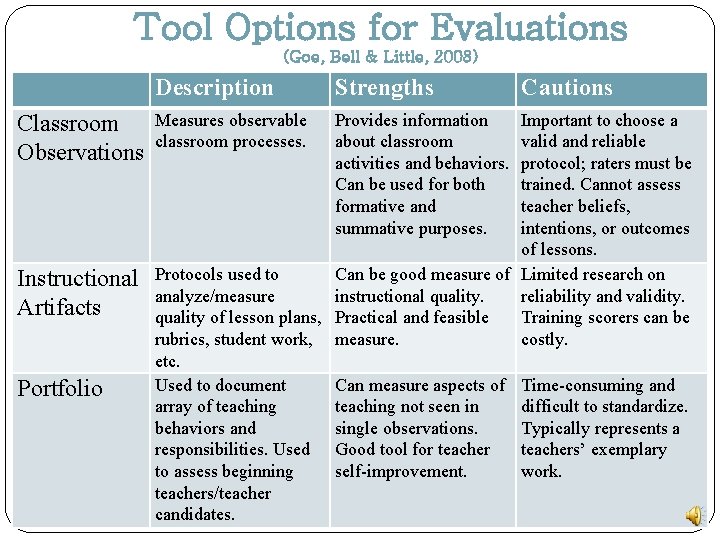
Tool Options for Evaluations (Goe, Bell & Little, 2008) Classroom Observations Instructional Artifacts Portfolio Description Strengths Measures observable classroom processes. Provides information about classroom activities and behaviors. Can be used for both formative and summative purposes. Cautions Important to choose a valid and reliable protocol; raters must be trained. Cannot assess teacher beliefs, intentions, or outcomes of lessons. Protocols used to Can be good measure of Limited research on analyze/measure instructional quality. reliability and validity. quality of lesson plans, Practical and feasible Training scorers can be rubrics, student work, measure. costly. etc. Used to document Can measure aspects of Time-consuming and array of teaching not seen in difficult to standardize. behaviors and single observations. Typically represents a responsibilities. Used Good tool for teachers’ exemplary to assess beginning self-improvement. work. teachers/teacher candidates.
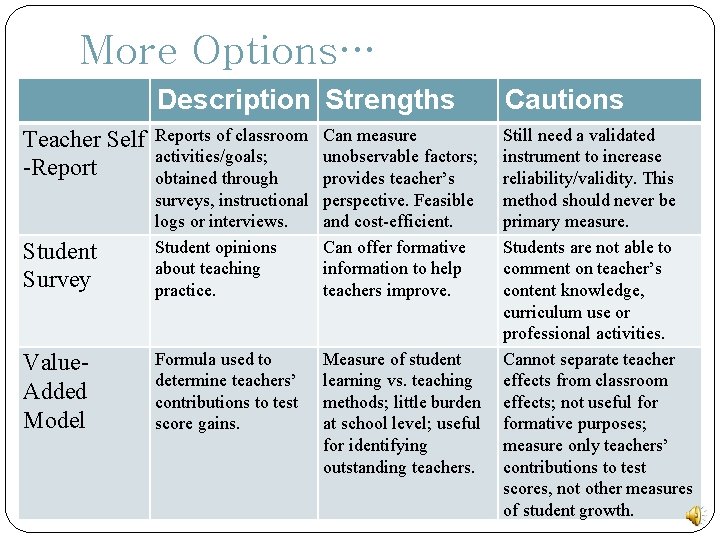
More Options… Description Strengths Cautions Student Survey Reports of classroom activities/goals; obtained through surveys, instructional logs or interviews. Student opinions about teaching practice. Can measure unobservable factors; provides teacher’s perspective. Feasible and cost-efficient. Can offer formative information to help teachers improve. Value. Added Model Formula used to determine teachers’ contributions to test score gains. Measure of student learning vs. teaching methods; little burden at school level; useful for identifying outstanding teachers. Still need a validated instrument to increase reliability/validity. This method should never be primary measure. Students are not able to comment on teacher’s content knowledge, curriculum use or professional activities. Cannot separate teacher effects from classroom effects; not useful formative purposes; measure only teachers’ contributions to test scores, not other measures of student growth. Teacher Self -Report
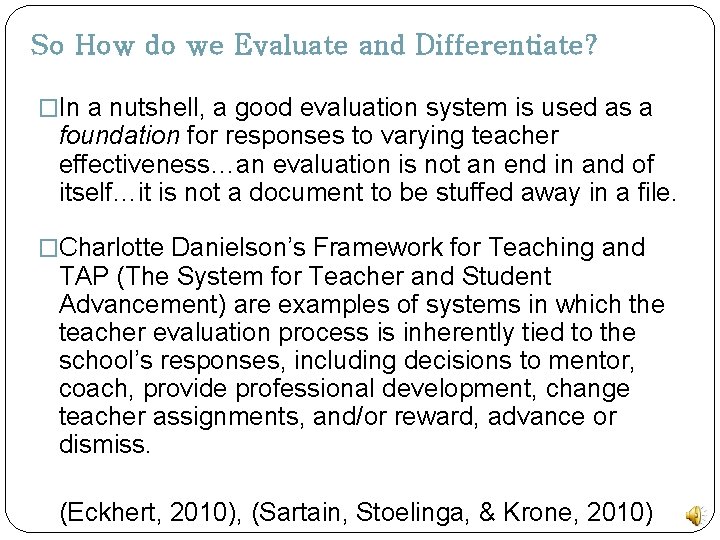
So How do we Evaluate and Differentiate? �In a nutshell, a good evaluation system is used as a foundation for responses to varying teacher effectiveness…an evaluation is not an end in and of itself…it is not a document to be stuffed away in a file. �Charlotte Danielson’s Framework for Teaching and TAP (The System for Teacher and Student Advancement) are examples of systems in which the teacher evaluation process is inherently tied to the school’s responses, including decisions to mentor, coach, provide professional development, change teacher assignments, and/or reward, advance or dismiss. (Eckhert, 2010), (Sartain, Stoelinga, & Krone, 2010)
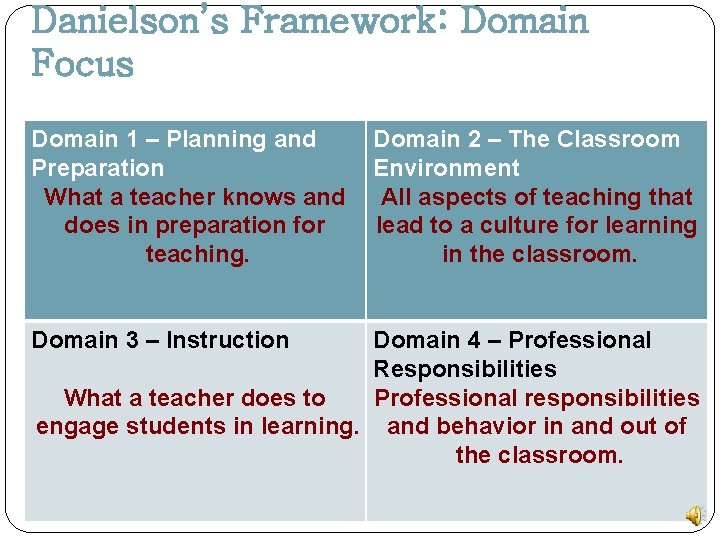
Danielson’s Framework: Domain Focus Domain 1 – Planning and Preparation What a teacher knows and does in preparation for teaching. Domain 3 – Instruction Domain 2 – The Classroom Environment All aspects of teaching that lead to a culture for learning in the classroom. Domain 4 – Professional Responsibilities What a teacher does to Professional responsibilities engage students in learning. and behavior in and out of the classroom.
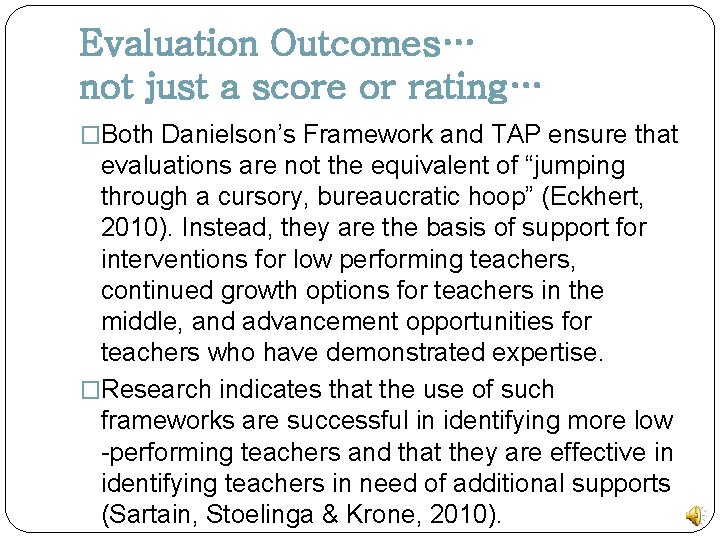
Evaluation Outcomes… not just a score or rating… �Both Danielson’s Framework and TAP ensure that evaluations are not the equivalent of “jumping through a cursory, bureaucratic hoop” (Eckhert, 2010). Instead, they are the basis of support for interventions for low performing teachers, continued growth options for teachers in the middle, and advancement opportunities for teachers who have demonstrated expertise. �Research indicates that the use of such frameworks are successful in identifying more low -performing teachers and that they are effective in identifying teachers in need of additional supports (Sartain, Stoelinga & Krone, 2010).
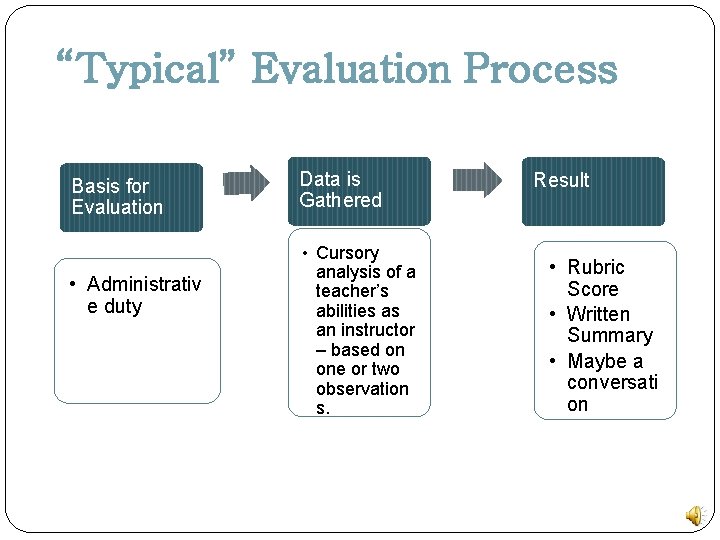
“Typical” Evaluation Process Basis for Evaluation • Administrativ e duty Data is Gathered • Cursory analysis of a teacher’s abilities as an instructor – based on one or two observation s. Result • Rubric Score • Written Summary • Maybe a conversati on
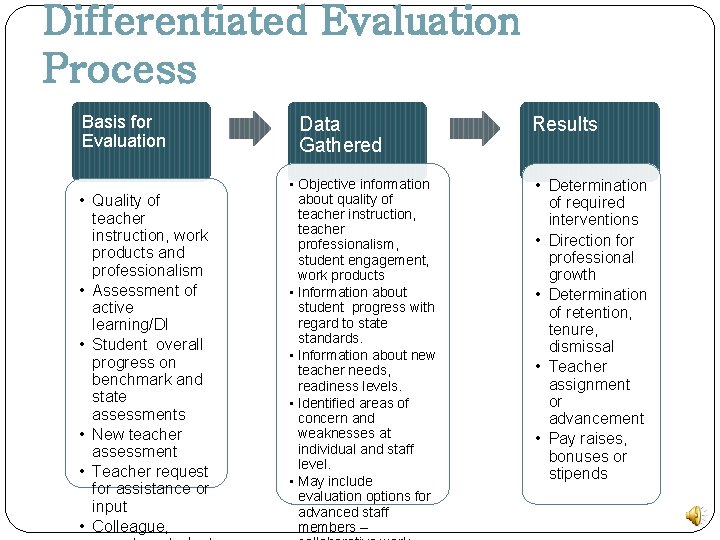
Differentiated Evaluation Process Basis for Evaluation • Quality of teacher instruction, work products and professionalism • Assessment of active learning/DI • Student overall progress on benchmark and state assessments • New teacher assessment • Teacher request for assistance or input • Colleague, Data Gathered • Objective information about quality of teacher instruction, teacher professionalism, student engagement, work products • Information about student progress with regard to state standards. • Information about new teacher needs, readiness levels. • Identified areas of concern and weaknesses at individual and staff level. • May include evaluation options for advanced staff members – Results • Determination of required interventions • Direction for professional growth • Determination of retention, tenure, dismissal • Teacher assignment or advancement • Pay raises, bonuses or stipends
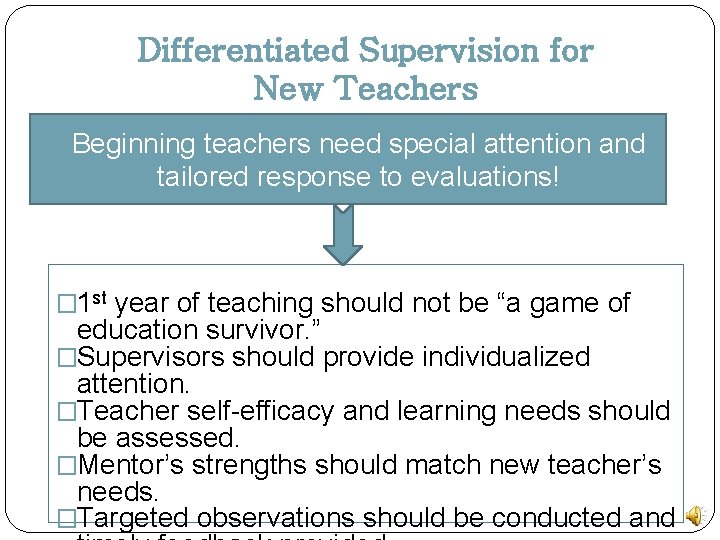
Differentiated Supervision for New Teachers �Beginning teachers need special attention and �tailored response to evaluations! � 1 st year of teaching should not be “a game of education survivor. ” �Supervisors should provide individualized attention. �Teacher self-efficacy and learning needs should be assessed. �Mentor’s strengths should match new teacher’s needs. �Targeted observations should be conducted and
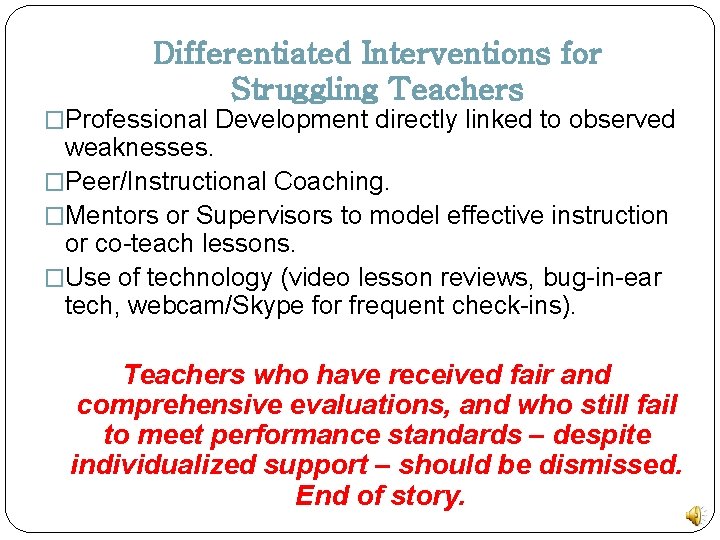
Differentiated Interventions for Struggling Teachers �Professional Development directly linked to observed weaknesses. �Peer/Instructional Coaching. �Mentors or Supervisors to model effective instruction or co-teach lessons. �Use of technology (video lesson reviews, bug-in-ear tech, webcam/Skype for frequent check-ins). Teachers who have received fair and comprehensive evaluations, and who still fail to meet performance standards – despite individualized support – should be dismissed. End of story.
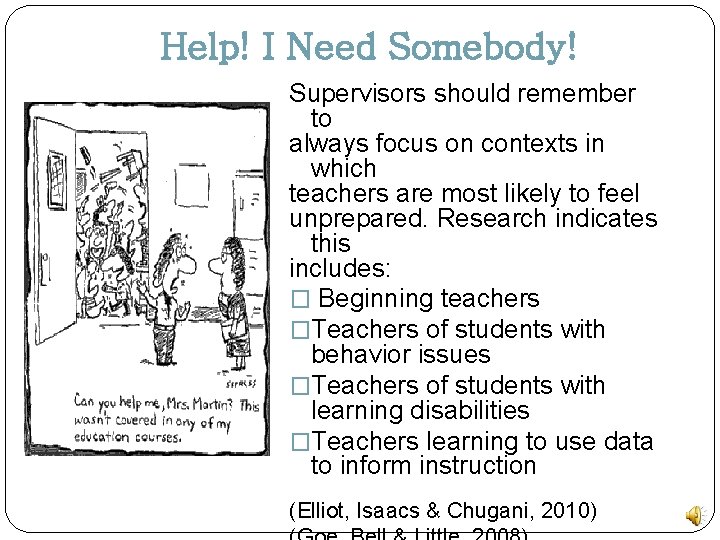
Help! I Need Somebody! Supervisors should remember to always focus on contexts in which teachers are most likely to feel unprepared. Research indicates this includes: � Beginning teachers �Teachers of students with behavior issues �Teachers of students with learning disabilities �Teachers learning to use data to inform instruction (Elliot, Isaacs & Chugani, 2010)
Differentiated Actions for Achieving and Excelling Teachers achieving acceptable standards typically still have room for improvement: �Provide professional Teachers who excel can fall to the wayside if they are not recognized and continually challenged: growth opportunities. �Advance them to roles �Schedule as mentors or master opportunities to teachers. observe exemplary �Train advanced teachers to work with �Assign to data teams, curriculum committees supervisors as teacher evaluators. and/or PD groups.
Group Discussion How does Differentiated Supervision Ultimately Benefit Teachers and Students? Please also share concerns and

References Eckert, D. J. (2010). More than widgets, TAP: A systemic approach to increased teacher effectiveness. The TAP System for Teacher and Student Advancement Created by Lowell Milken. Retrieved from http: //www. tapsystem. org/resources. taf? page=ffo_rpts_eckert Elliott, E. M. , Isaacs, M. L. , & Chugani, C. D. (2010). Promoting self-efficacy in early career teachers: A principal’s guide for differentiated mentoring and supervision. Florida Journal of Educational Administration & Policy, 4(1), 131 -146. Goe, L. , Bell, C. , & Little, O. (2008). Approaches to evaluating teacher effectiveness: A research synthesis. National Comprehensive Center for Teacher Quality. Retrieved from http: //www. tqsource. org/publications/teachereffectiveness. php Hinchey, P. H. (2010). Getting teacher assessment right: What policymakers can learn from research. National Education Policy Center | School of Education, University of Colorado at Boulder. Retrieved April 03, 2011, from http: //nepc. colorado. edu/publication/getting-teacher-assessment-right Sartain, L. , Stoelinga, S. R. , & Krone, E. (2010). Rethinking teacher evaluation: Findings from the first year of the excellence in teaching project in Chicago public schools (Policy brief No. 978 -0 -9814 -6047 -5). Retrieved from http: //ccsr. uchicago. edu/content/publications. php? pub_id=143 Weisberg, D. , Sexton, S. , Mulhern, J. , & Keeling, D. (2009). The widget effect: Our national failure to acknowledge and act on differences in teacher effectiveness. The Widget Effect. Retrieved from http: //widgeteffect. org/downloads/The. Widget. Effect. pdf
- Slides: 21