Development pf Diamond Detector Asuka Hara Sokendai D
- Slides: 10
Development pf Diamond Detector Asuka Hara Sokendai D 3 2020/11/17 KEK Student Day
contents • Detector in the future acceraretor • Why use the Diamond ? • Principle of Diamond detector • Positron-electron Annihilation • Conclusion 2020/11/17 KEK Student Day
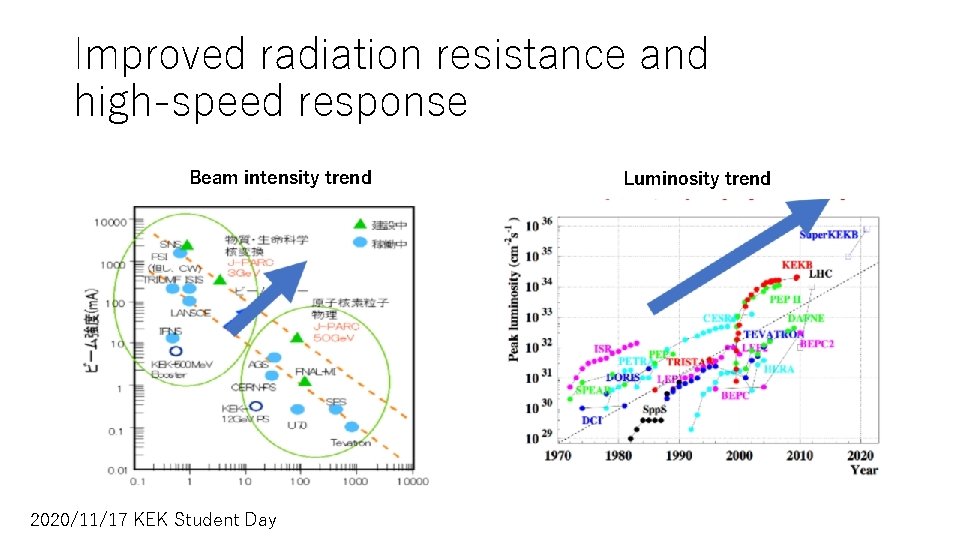
Improved radiation resistance and high-speed response Beam intensity trend 2020/11/17 KEK Student Day Luminosity trend
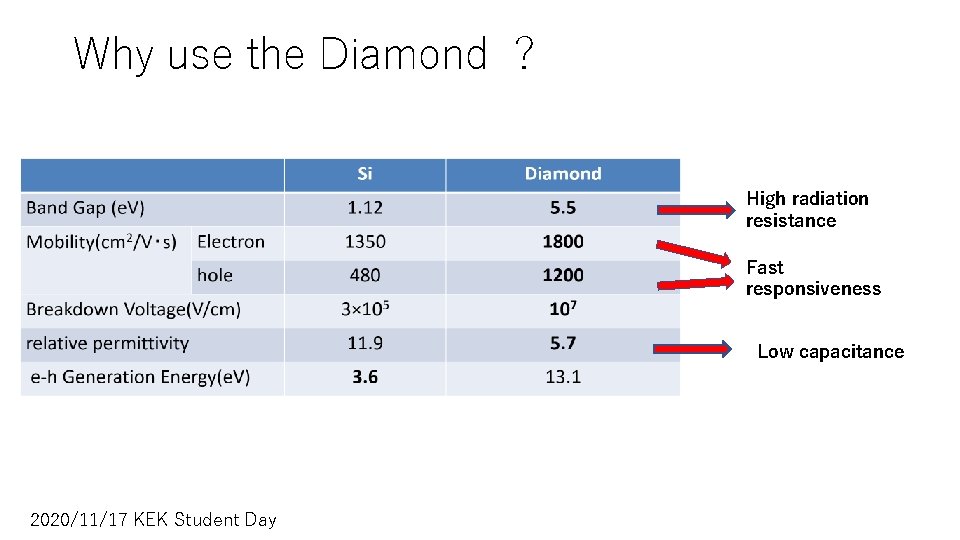
Why use the Diamond ? High radiation resistance Fast responsiveness Low capacitance 2020/11/17 KEK Student Day
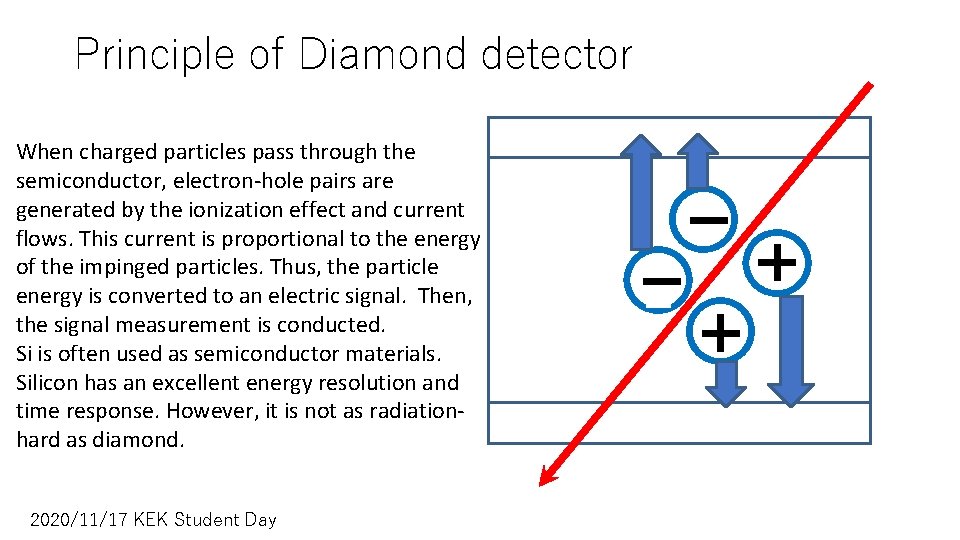
Principle of Diamond detector When charged particles pass through the semiconductor, electron-hole pairs are generated by the ionization effect and current flows. This current is proportional to the energy of the impinged particles. Thus, the particle energy is converted to an electric signal. Then, the signal measurement is conducted. Si is often used as semiconductor materials. Silicon has an excellent energy resolution and time response. However, it is not as radiationhard as diamond. 2020/11/17 KEK Student Day - + z
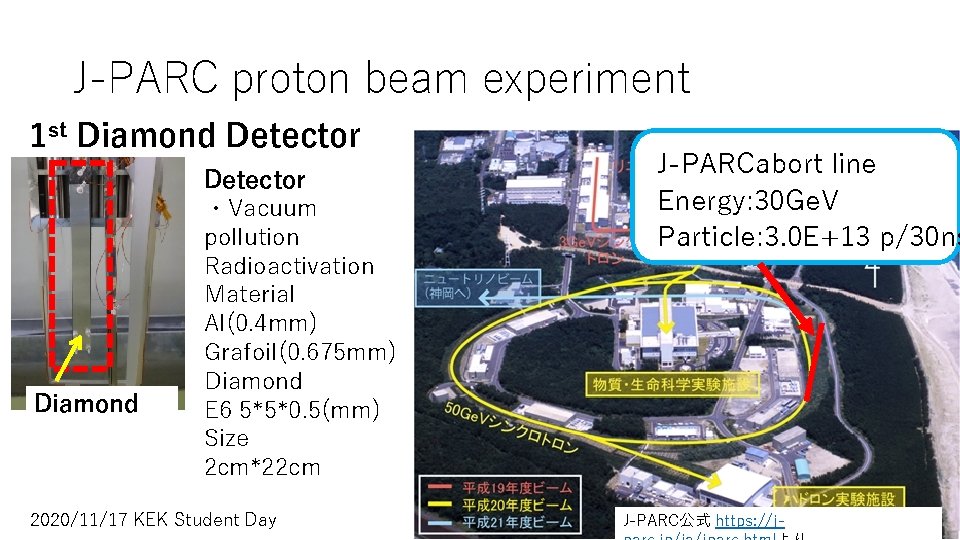
J-PARC proton beam experiment 1 st Diamond Detector ・Vacuum pollution Radioactivation Material Al(0. 4 mm) Grafoil(0. 675 mm) Diamond E 6 5*5*0. 5(mm) Size 2 cm*22 cm 2020/11/17 KEK Student Day J-PARCabort line Energy: 30 Ge. V Particle: 3. 0 E+13 p/30 ns J-PARC公式 https: //j-
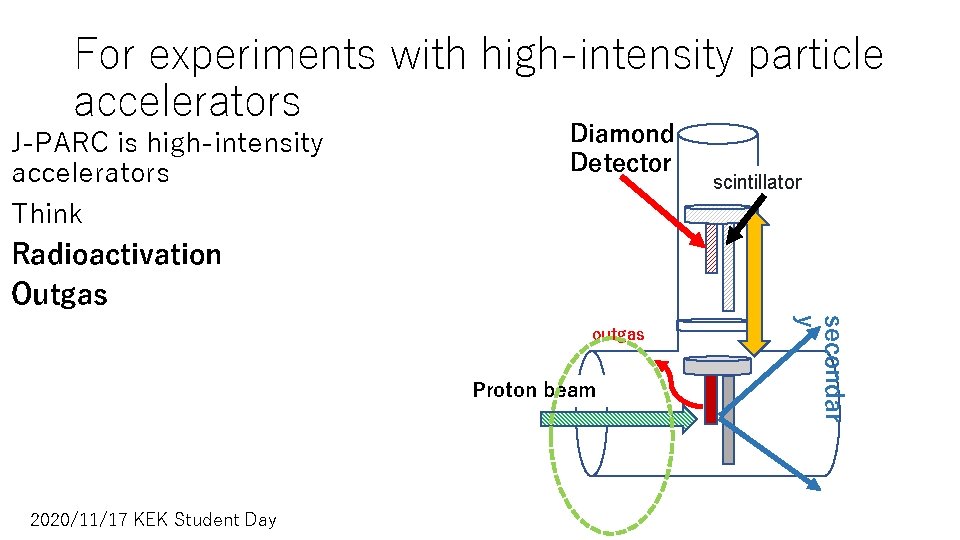
For experiments with high-intensity particle accelerators J-PARC is high-intensity accelerators Think Radioactivation Outgas Diamond Detector Proton beam 2020/11/17 KEK Student Day secondar y outgas scintillator
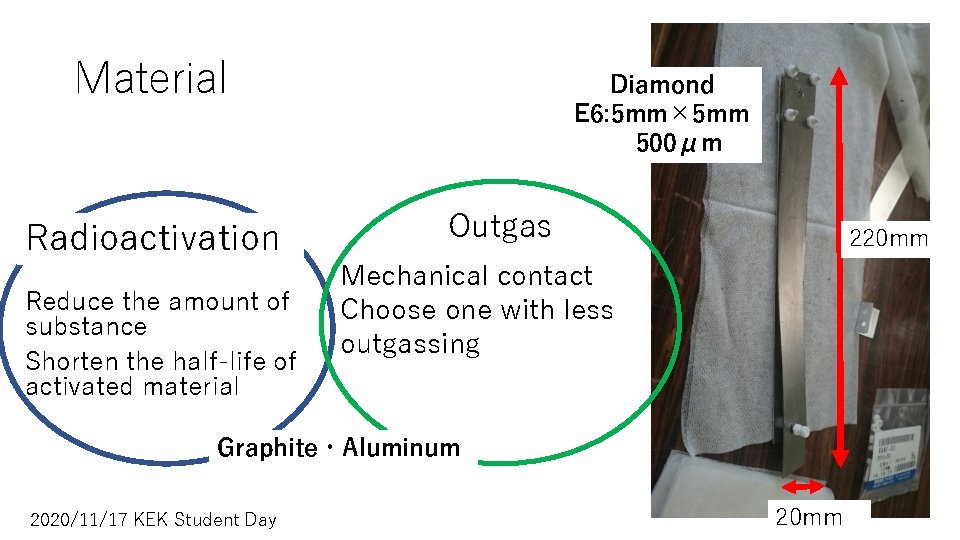
Material Radioactivation Reduce the amount of substance Shorten the half-life of activated material Diamond E 6: 5 mm× 5 mm 500μm Outgas 220 mm Mechanical contact Choose one with less outgassing Graphite・Aluminum 2020/11/17 KEK Student Day 20 mm
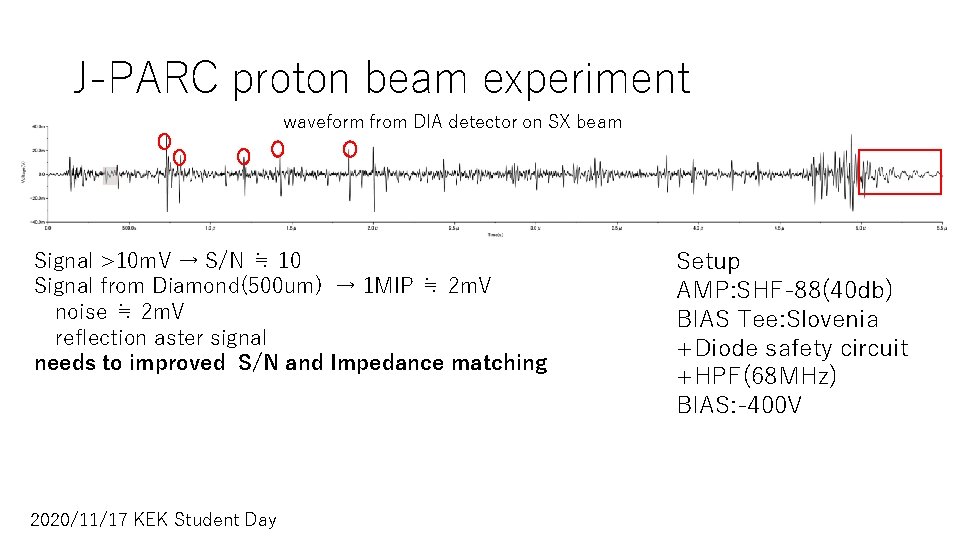
J-PARC proton beam experiment waveform from DIA detector on SX beam Signal >10 m. V → S/N ≒ 10 Signal from Diamond(500 um) → 1 MIP ≒ 2 m. V noise ≒ 2 m. V reflection aster signal needs to improved S/N and Impedance matching 2020/11/17 KEK Student Day Setup AMP: SHF-88(40 db) BIAS Tee: Slovenia +Diode safety circuit +HPF(68 MHz) BIAS: -400 V
Conclusion J-parc proton beam experiment signal from diamond detector needs to improved S/N and Impedance matching 2020/11/17 KEK Student Day