Designing scenarios and RAP model Loveleen De and



- Slides: 22
Designing scenarios and RAP model Loveleen De and Katharina Bollig, ILO Manila 2 June 2015
Agenda Where are we now? • Steps of ABND Designing scenarios • Which recommendations to select? • Fixing the parameters RAP model • Structure of RAP • Advantages and limitations Workshop mechanics
Where are we now?
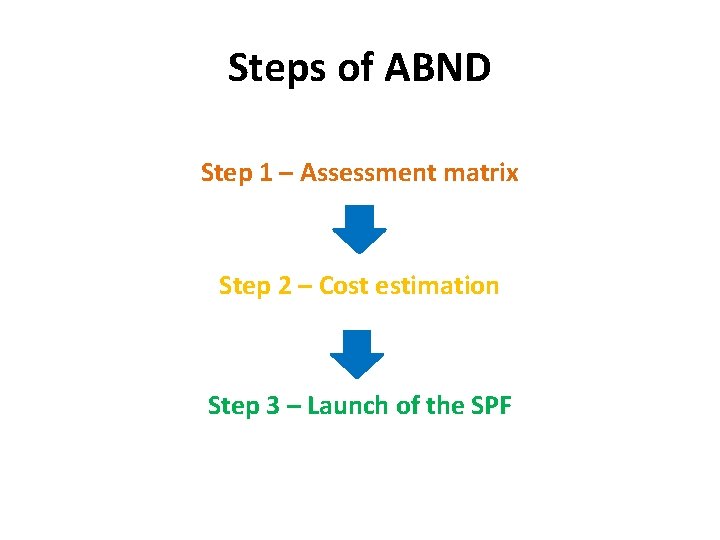
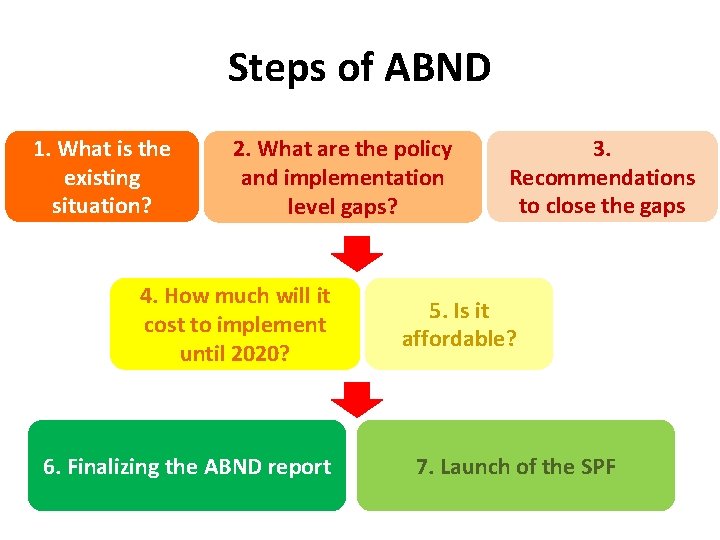
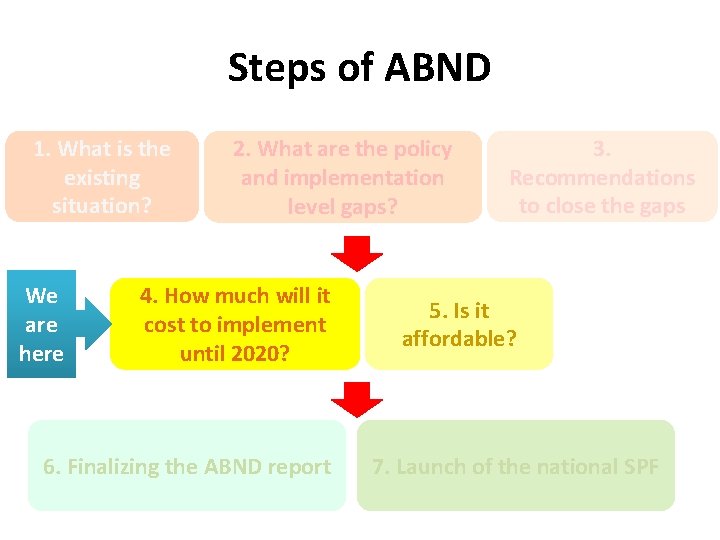
Steps of ABND Step 1 – Assessment matrix Step 2 – Cost estimation Step 3 – Launch of the SPF
Steps of ABND 1. What is the existing situation? 2. What are the policy and implementation level gaps? 4. How much will it cost to implement until 2020? 6. Finalizing the ABND report 3. Recommendations to close the gaps 5. Is it affordable? 7. Launch of the SPF
Steps of ABND 1. What is the existing situation? We are here 2. What are the policy and implementation level gaps? 4. How much will it cost to implement until 2020? 6. Finalizing the ABND report 3. Recommendations to close the gaps 5. Is it affordable? 7. Launch of the national SPF
Designing scenarios
ABND matrix SPF guarantees SPF-1 Health SPOFS provisions Social insurance Social welfare Safety nets LMIs SPF-2 Children Social insurance Social welfare Safety nets LMIs SPF-3 Working age Social insurance SPF-4 Elderly Social insurance Social welfare Safety nets LMIs Existing schemes Policy gaps Recos Imp issues Recos
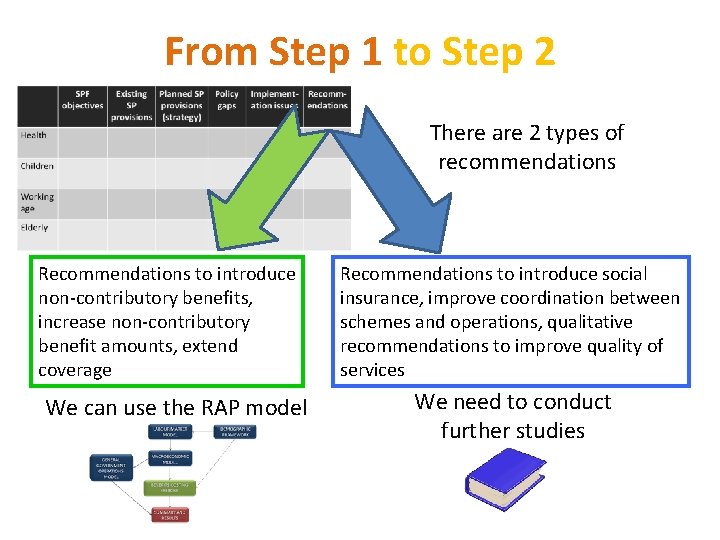
From Step 1 to Step 2 There are 2 types of recommendations Recommendations to introduce non-contributory benefits, increase non-contributory benefit amounts, extend coverage We can use the RAP model Recommendations to introduce social insurance, improve coordination between schemes and operations, qualitative recommendations to improve quality of services We need to conduct further studies
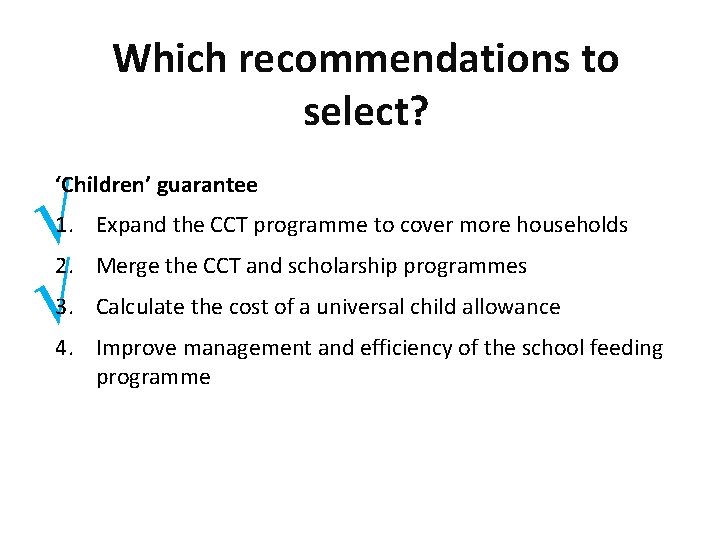
Which recommendations to select? ‘Children’ guarantee √ √ 1. Expand the CCT programme to cover more households 2. Merge the CCT and scholarship programmes 3. Calculate the cost of a universal child allowance 4. Improve management and efficiency of the school feeding programme
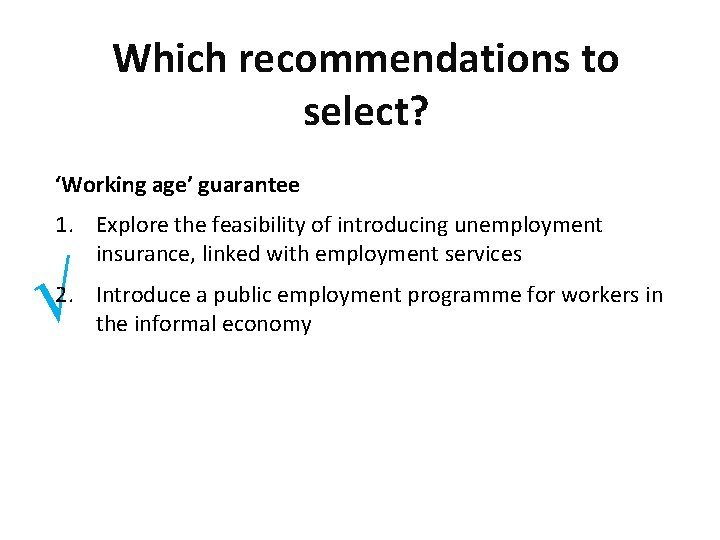
Which recommendations to select? ‘Working age’ guarantee 1. Explore the feasibility of introducing unemployment insurance, linked with employment services √ 2. Introduce a public employment programme for workers in the informal economy
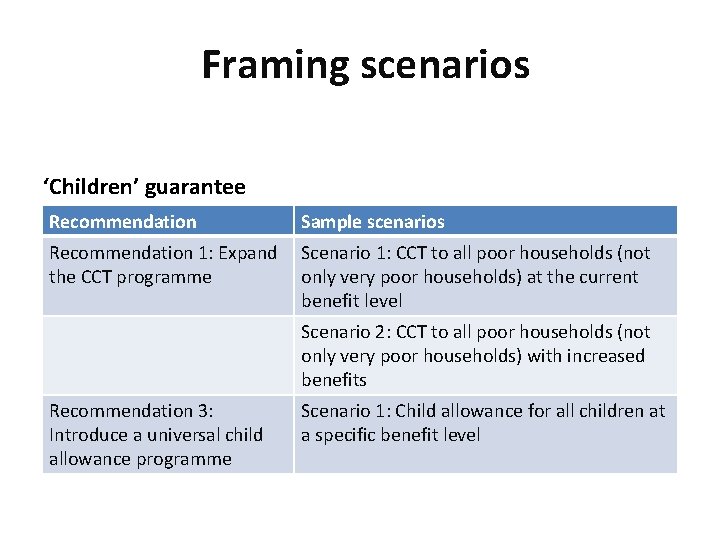
Framing scenarios ‘Children’ guarantee Recommendation Sample scenarios Recommendation 1: Expand the CCT programme Scenario 1: CCT to all poor households (not only very poor households) at the current benefit level Scenario 2: CCT to all poor households (not only very poor households) with increased benefits Recommendation 3: Introduce a universal child allowance programme Scenario 1: Child allowance for all children at a specific benefit level
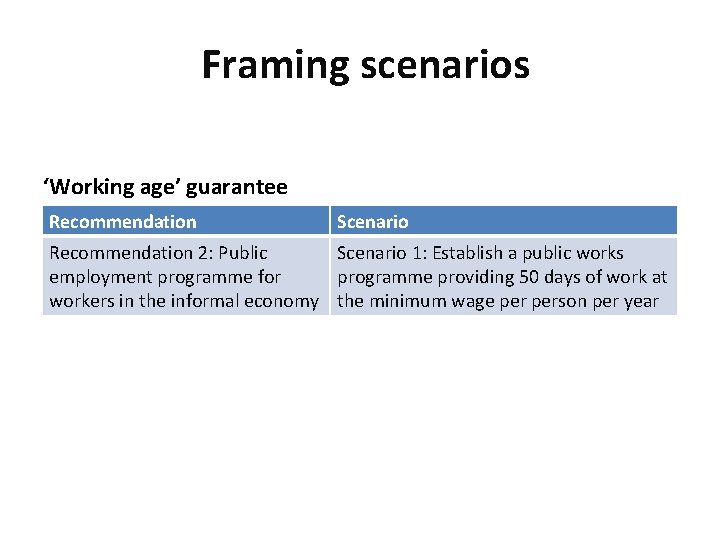
Framing scenarios ‘Working age’ guarantee Recommendation Scenario Recommendation 2: Public Scenario 1: Establish a public works employment programme for programme providing 50 days of work at workers in the informal economy the minimum wage person per year
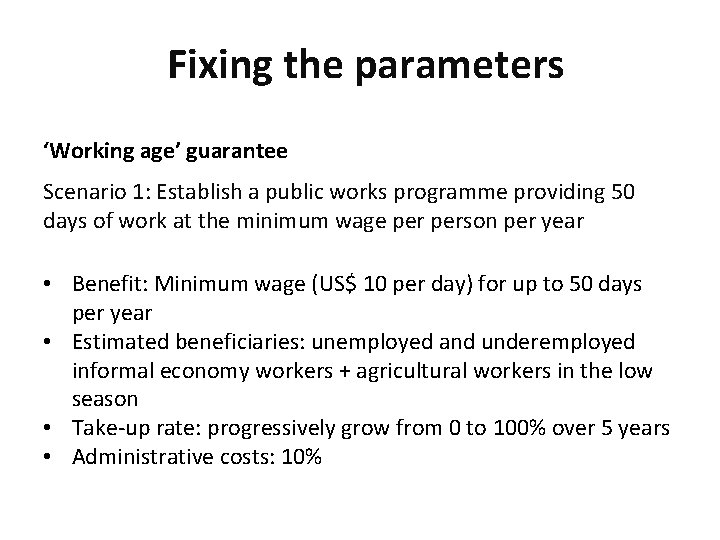
Fixing the parameters ‘Working age’ guarantee Scenario 1: Establish a public works programme providing 50 days of work at the minimum wage person per year • Benefit: Minimum wage (US$ 10 per day) for up to 50 days per year • Estimated beneficiaries: unemployed and underemployed informal economy workers + agricultural workers in the low season • Take-up rate: progressively grow from 0 to 100% over 5 years • Administrative costs: 10%
Rapid Assessment Protocol (RAP) model
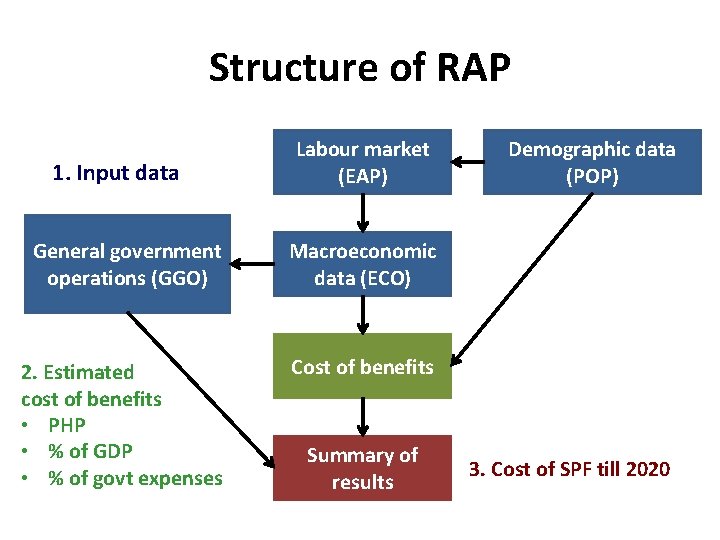
Structure of RAP 1. Input data Labour market (EAP) General government operations (GGO) Macroeconomic data (ECO) 2. Estimated cost of benefits • PHP • % of GDP • % of govt expenses Cost of benefits Summary of results Demographic data (POP) 3. Cost of SPF till 2020
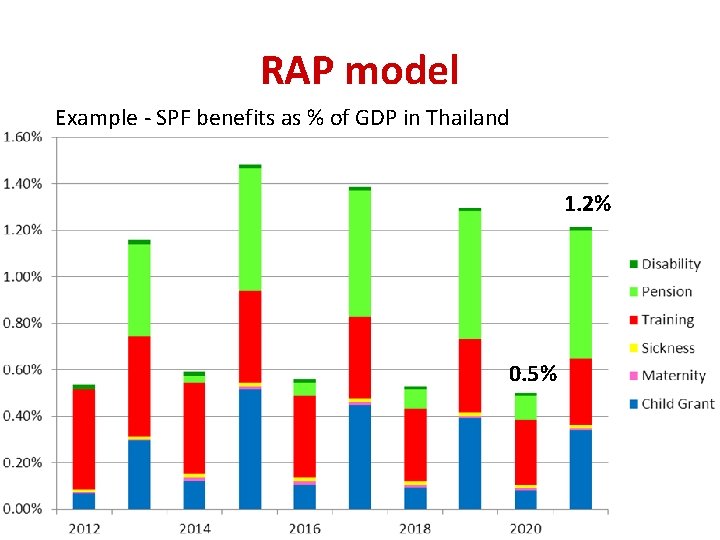
RAP model Example - SPF benefits as % of GDP in Thailand 1. 2% 0. 5%
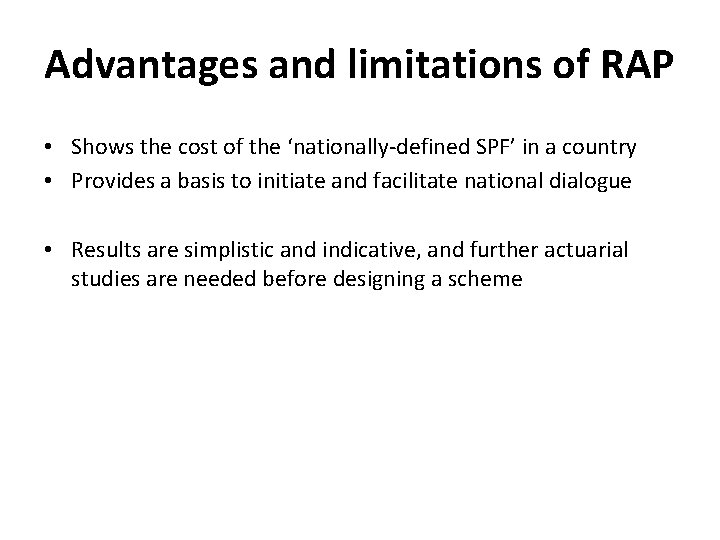
Advantages and limitations of RAP • Shows the cost of the ‘nationally-defined SPF’ in a country • Provides a basis to initiate and facilitate national dialogue • Results are simplistic and indicative, and further actuarial studies are needed before designing a scheme
Workshop mechanics
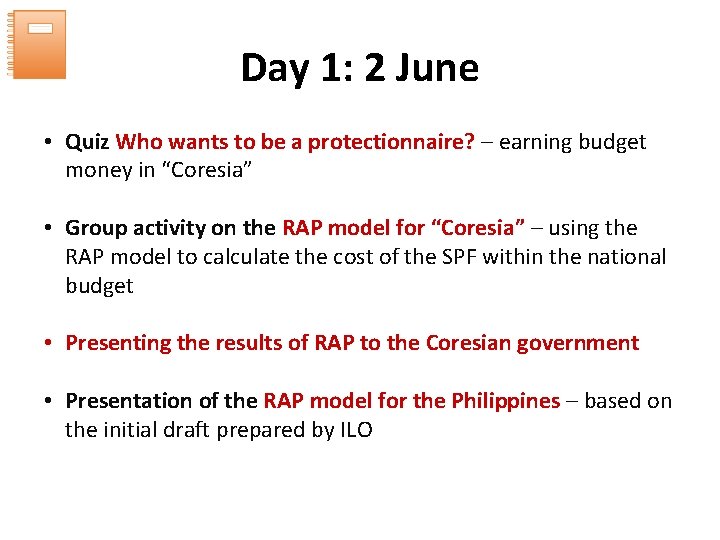
Day 1: 2 June • Quiz Who wants to be a protectionnaire? – earning budget money in “Coresia” • Group activity on the RAP model for “Coresia” – using the RAP model to calculate the cost of the SPF within the national budget • Presenting the results of RAP to the Coresian government • Presentation of the RAP model for the Philippines – based on the initial draft prepared by ILO
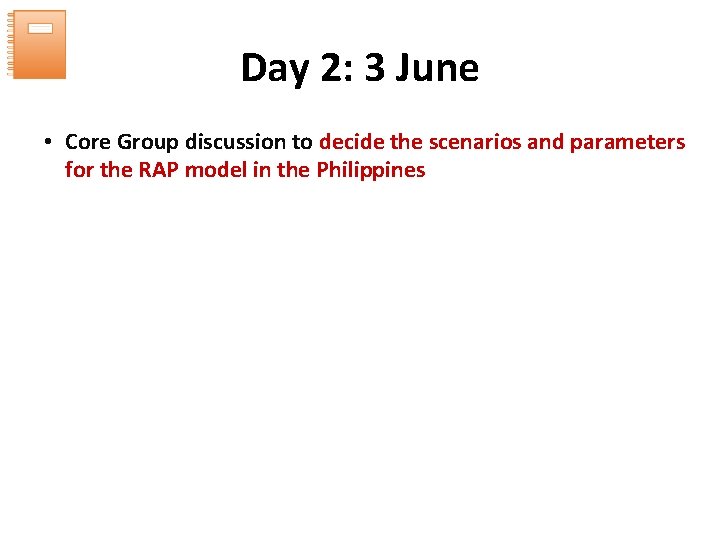
Day 2: 3 June • Core Group discussion to decide the scenarios and parameters for the RAP model in the Philippines
Thank you