Design the Future the Human Spirit Victor Margolin
- Slides: 17
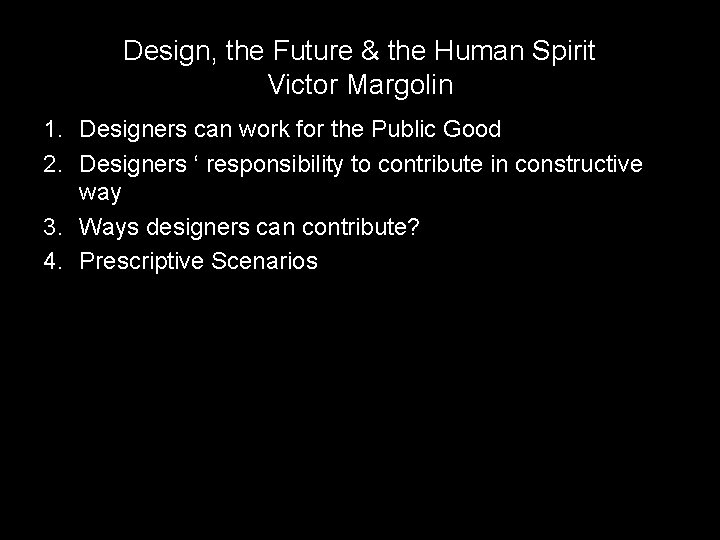
Design, the Future & the Human Spirit Victor Margolin 1. Designers can work for the Public Good 2. Designers ‘ responsibility to contribute in constructive way 3. Ways designers can contribute? 4. Prescriptive Scenarios
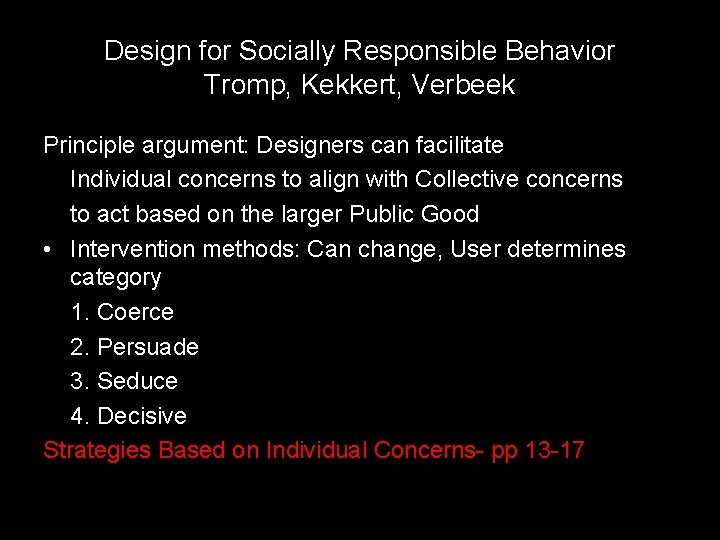
Design for Socially Responsible Behavior Tromp, Kekkert, Verbeek Principle argument: Designers can facilitate Individual concerns to align with Collective concerns to act based on the larger Public Good • Intervention methods: Can change, User determines category 1. Coerce 2. Persuade 3. Seduce 4. Decisive Strategies Based on Individual Concerns- pp 13 -17
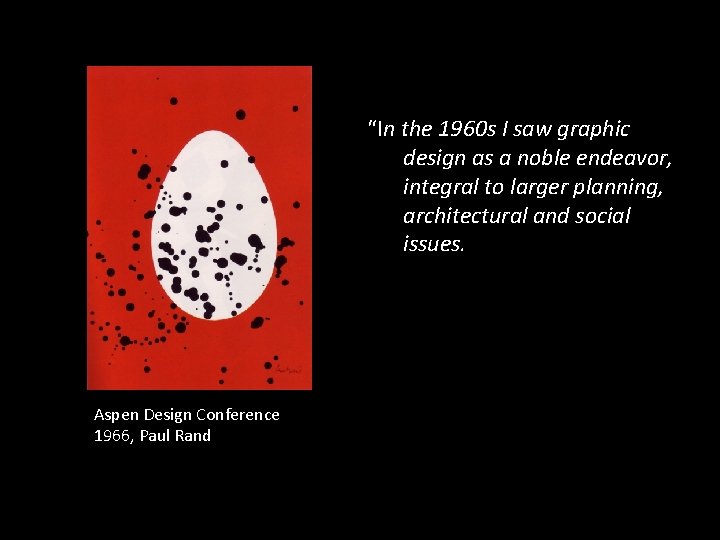
“In the 1960 s I saw graphic design as a noble endeavor, integral to larger planning, architectural and social issues. Aspen Design Conference 1966, Paul Rand
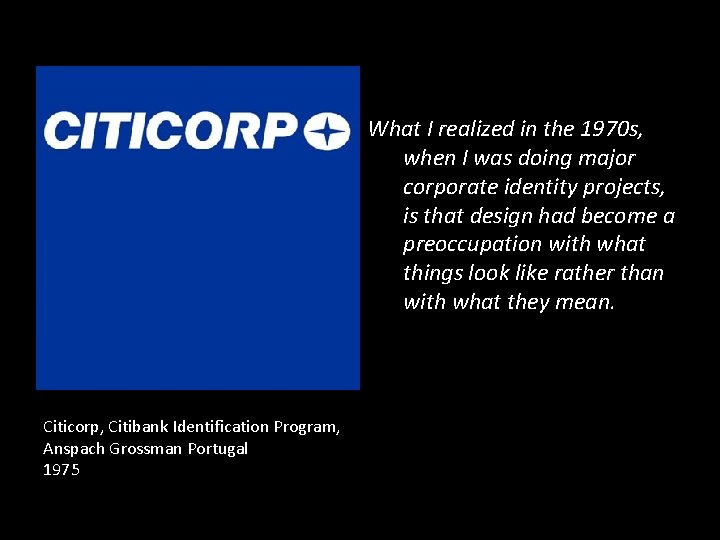
What I realized in the 1970 s, when I was doing major corporate identity projects, is that design had become a preoccupation with what things look like rather than with what they mean. Citicorp, Citibank Identification Program, Anspach Grossman Portugal 1975
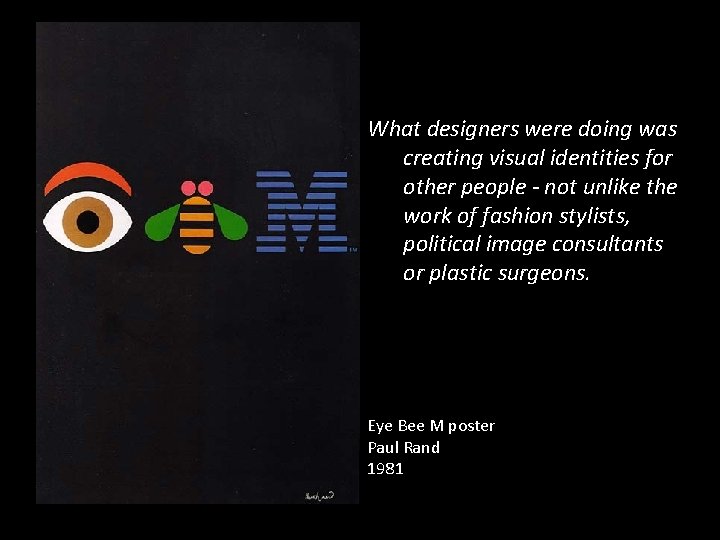
What designers were doing was creating visual identities for other people - not unlike the work of fashion stylists, political image consultants or plastic surgeons. Eye Bee M poster Paul Rand 1981
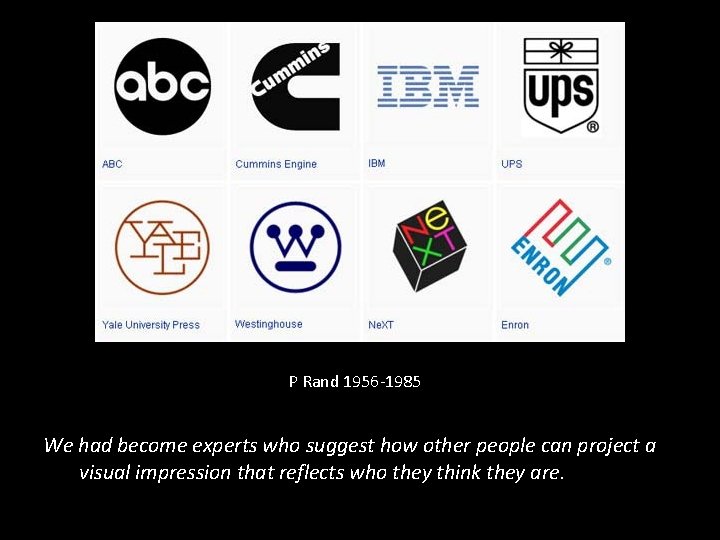
P Rand 1956 -1985 We had become experts who suggest how other people can project a visual impression that reflects who they think they are.
And we have deceived ourselves into thinking that the modernization service we supply has the same integrity as service to the public good. Modernism forfeited its claim to a moral authority when designers sold it away as corporate style. http: //www. designhistory. org/Po st_mod. html P Rand, 1985
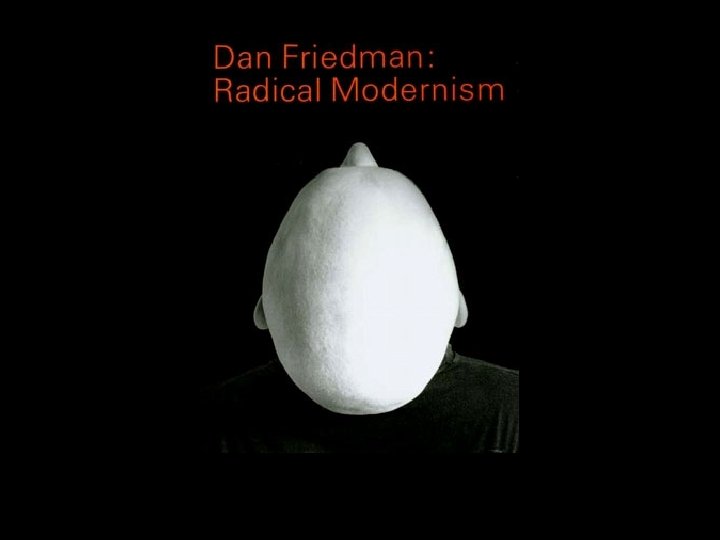
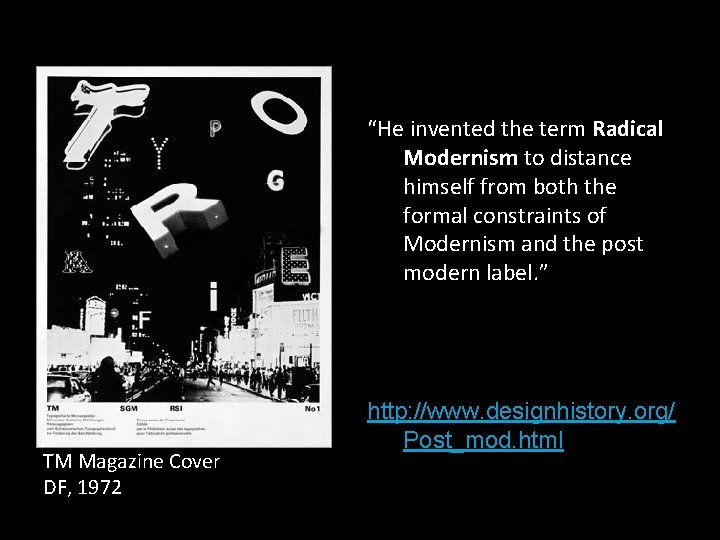
“He invented the term Radical Modernism to distance himself from both the formal constraints of Modernism and the post modern label. ” TM Magazine Cover DF, 1972 http: //www. designhistory. org/ Post_mod. html
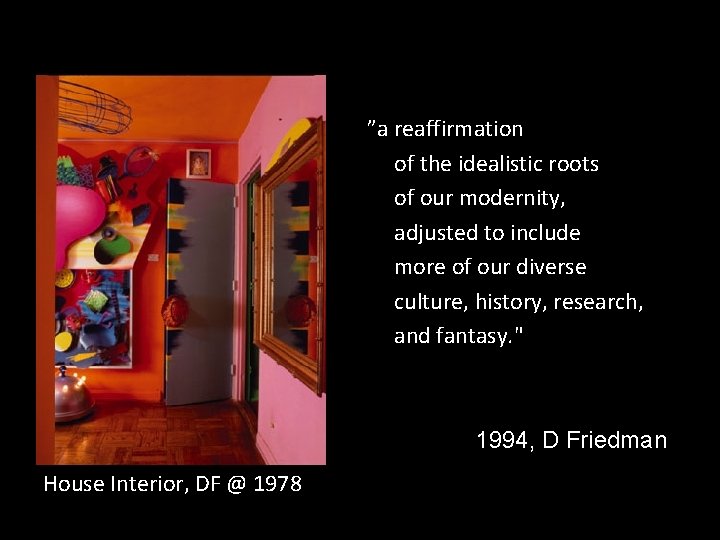
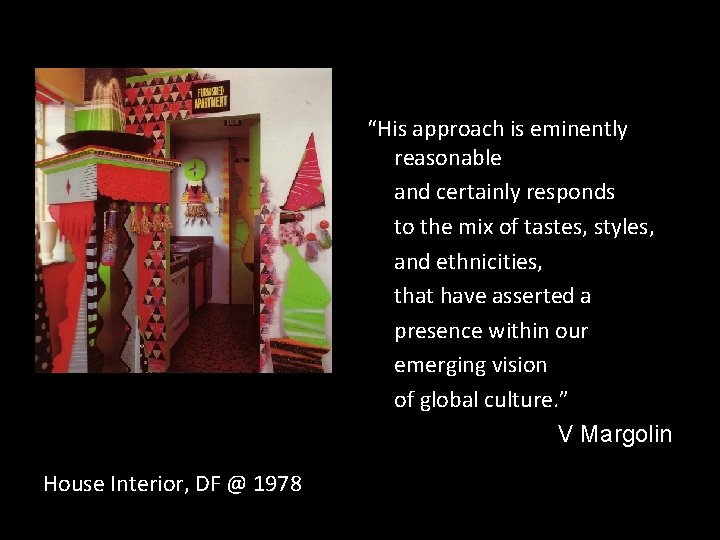
”a reaffirmation of the idealistic roots of our modernity, adjusted to include more of our diverse culture, history, research, and fantasy. " 1994, D Friedman House Interior, DF @ 1978
“His approach is eminently reasonable and certainly responds to the mix of tastes, styles, and ethnicities, that have asserted a presence within our emerging vision of global culture. ” V Margolin House Interior, DF @ 1978
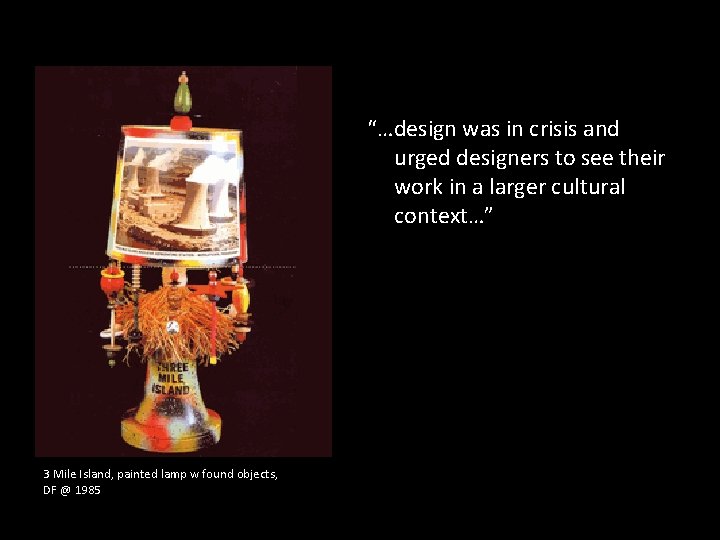
“…design was in crisis and urged designers to see their work in a larger cultural context…” 3 Mile Island, painted lamp w found objects, DF @ 1985
PROJECTS OF OPTIMISM Dan Friedman* • Live & work with passion & responsibility. • Try to express personal, spiritual, & domestic values even if our culture continues to be dominated by corporate, marketing, & institutional values. • Choose to remain progressive; don’t be regressive. Find comfort in the past only if it expands insight into the future, & not just for the sake of nostalgia. • Embrace the richness of all cultures; be inclusive instead of exclusive.
• Think of your work as a significant element in the context of a more important, transcendental purpose. • Use your work to become advocates of projects for the public good. • Attempt to become a cultural provocateur; be a leader rather than a follower.
• Engage in self-restraint; accept the challenge of working with reduced expectations & diminished resources. • Avoid getting stuck in corners, such as being a servant to increasing overhead, careerism, or narrow points of view. • Bridge the boundaries that separate us from other creative professions & unexpected possibilities.
• Use the new technologies, but don’t be seduced into thinking that they provide answers to fundamental questions. • Be radical. *p 209, Radical Modernism Logo for exhibit: Radical Modernism, Moore College of Art & Design, 1994, Philadelphia
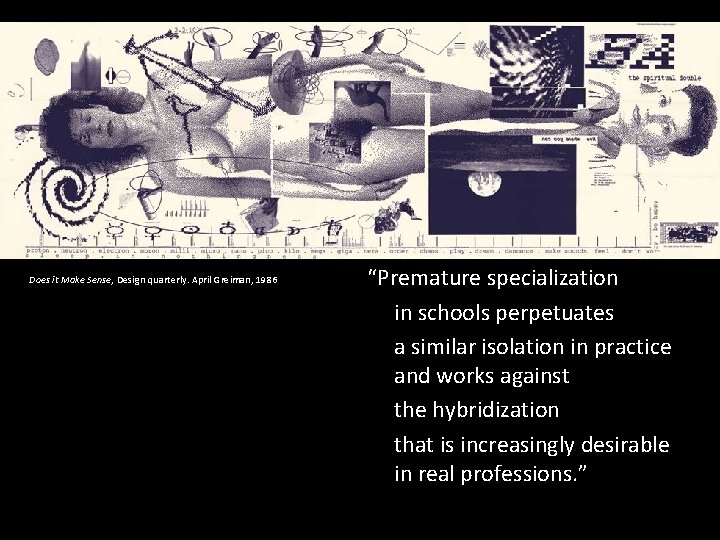
Does it Make Sense, Design quarterly. April Greiman, 1986 “Premature specialization in schools perpetuates a similar isolation in practice and works against the hybridization that is increasingly desirable in real professions. ”