Dan Fleck CS 469 Security Engineering Coming up
- Slides: 8
Dan Fleck CS 469: Security Engineering Coming up: Access Control Policies 1 These slides are modified with permission from Bill Young (Univ of Texas)
Access Control Policies • The basic idea is to introduce rules that control what accesses (i. e. , actions) subjects may take with respect to objects. Coming up: Aside: MAC vs. DAC • The Bell and La. Padula Model is an example of an Access Control Policy. This is a popular way of conceptualizing and implementing security. 2
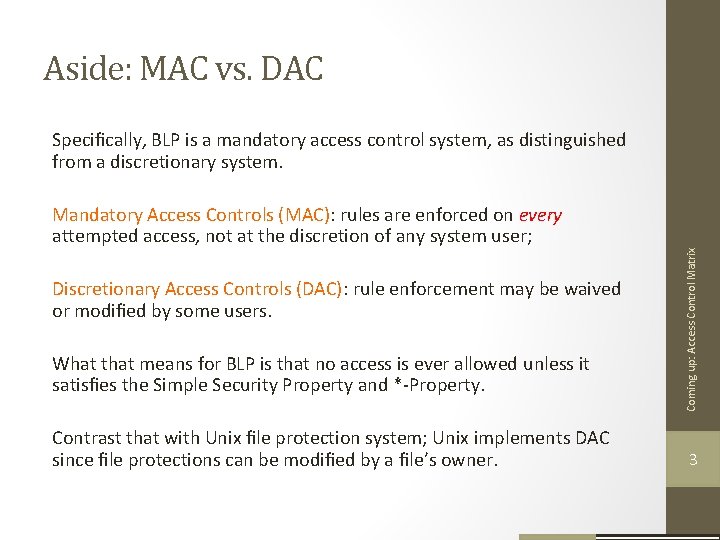
Aside: MAC vs. DAC Mandatory Access Controls (MAC): rules are enforced on every attempted access, not at the discretion of any system user; Discretionary Access Controls (DAC): rule enforcement may be waived or modified by some users. What that means for BLP is that no access is ever allowed unless it satisfies the Simple Security Property and *-Property. Contrast that with Unix file protection system; Unix implements DAC since file protections can be modified by a file’s owner. Coming up: Access Control Matrix Specifically, BLP is a mandatory access control system, as distinguished from a discretionary system. 3
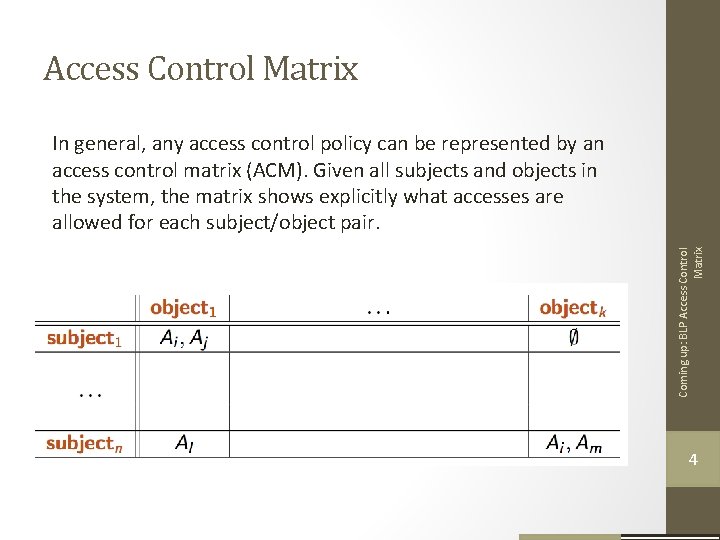
Access Control Matrix Coming up: BLP Access Control Matrix In general, any access control policy can be represented by an access control matrix (ACM). Given all subjects and objects in the system, the matrix shows explicitly what accesses are allowed for each subject/object pair. 4
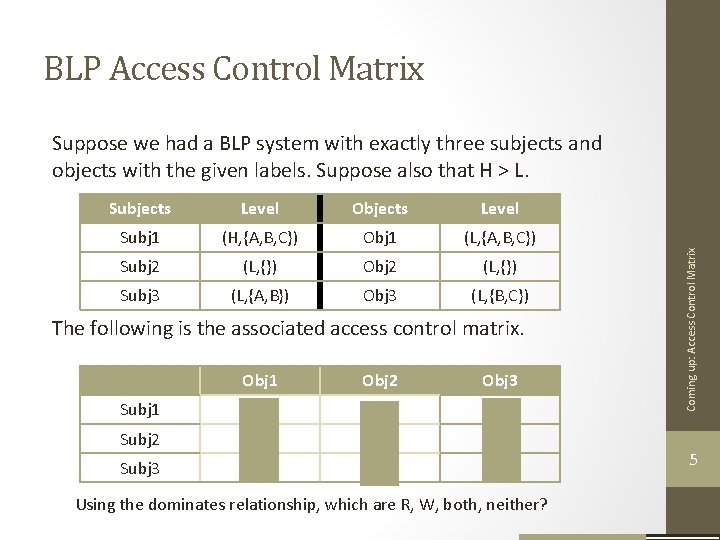
BLP Access Control Matrix Subjects Level Objects Level Subj 1 (H, {A, B, C}) Obj 1 (L, {A, B, C}) Subj 2 (L, {}) Obj 2 (L, {}) Subj 3 (L, {A, B}) Obj 3 (L, {B, C}) The following is the associated access control matrix. Obj 1 Obj 2 Obj 3 Subj 1 R R R Subj 2 W R, W W Subj 3 W R - Using the dominates relationship, which are R, W, both, neither? Coming up: Access Control Matrix Suppose we had a BLP system with exactly three subjects and objects with the given labels. Suppose also that H > L. 5
Access Control Matrix The matrix is implicit in the rules (Simple Security and the *Property), so access permissions can be computed on the fly. Coming up: Real MAC Implementations As with any access control policy, you could define an ACM for a large Bell and La. Padula system. However, the matrix would be huge for most realistic systems. 6
• SELinux has MAC options built into the kernel. These are used by default on Red Had (in a limited way) • SUSE and Ubuntu apply MAC using App. Armor which focuses on programs (not users) • Windows from Vista forward implements Mandatory Integrity Control (MIC) and Integrity Levels which a user/process acts: • Low, medium, high, system, trusted installer • Apple’s OS X implements MAC using a Trusted. BSD implementation Versions of MAC are quite common, although none are used exclusively! Source: http: //en. wikipedia. org/wiki/Mandatory_Access_Control Coming up: Lessons Real MAC Implementations 7
Lessons • BLP is also an example of a mandatory policy in that the rules are enforced on every attempted access. • Any access control policy can be modeled as an explicit matrix. End of presentation • BLP is an example of a class of policies called “access control policies. ” • Most current operating systems use MAC in some limited way. 8 7