Cyclodestructive procedures for nonrefractory glaucoma Manuele Michelessi Amanda

- Slides: 8
Cyclodestructive procedures for non-refractory glaucoma Manuele Michelessi, Amanda K Bicket, Kristina Lindsley Issue 4, 2018 A presentation to: Meeting name Date Trusted evidence. Informed decisions. Better health.
Table of Contents 01 Background 02 Types of studies 03 Key results 04 Conclusions 05 Acknowledgements
01: Background • Glaucoma is a progressive disease of the optic nerve causing loss of vision. • Intraocular pressure (IOP) is the main treatable risk factor for glaucoma. • Cyclodestructive procedures (i. e. , procedures that destroy the ciliary body epithelium) may reduce IOP. • Objective • To assess the effectiveness and safety of cyclodestructive procedures for the management of non-refractory glaucoma (i. e. , glaucoma in an eye that has not undergone incisional glaucoma surgery).
02: Types of studies Participants • One randomized controlled trial (RCT) with 92 participants (92 eyes) with glaucoma Interventions 1. Head-to-head trials of cyclophotocoagulation (CPC) using different types of lasers, delivery methods, parameters, or a combination of these factors
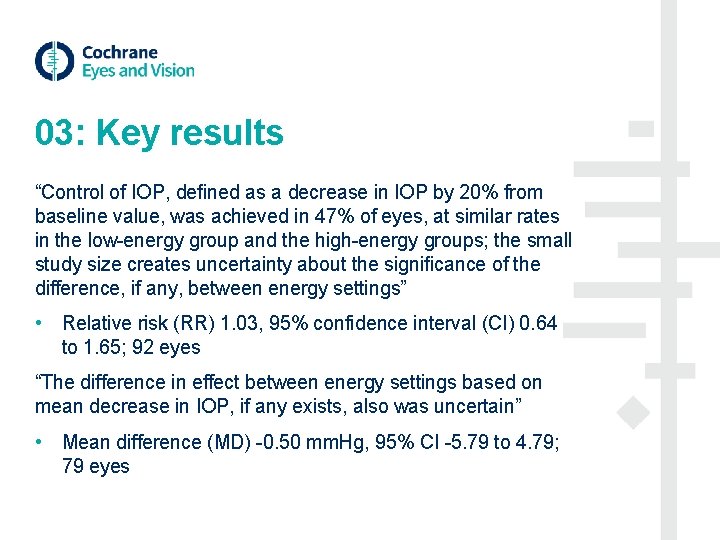
03: Key results “Control of IOP, defined as a decrease in IOP by 20% from baseline value, was achieved in 47% of eyes, at similar rates in the low-energy group and the high-energy groups; the small study size creates uncertainty about the significance of the difference, if any, between energy settings” • Relative risk (RR) 1. 03, 95% confidence interval (CI) 0. 64 to 1. 65; 92 eyes “The difference in effect between energy settings based on mean decrease in IOP, if any exists, also was uncertain” • Mean difference (MD) -0. 50 mm. Hg, 95% CI -5. 79 to 4. 79; 79 eyes
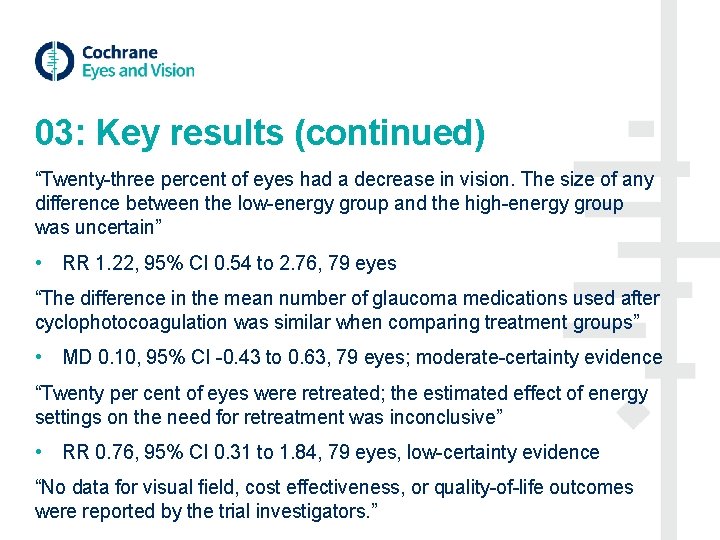
03: Key results (continued) “Twenty-three percent of eyes had a decrease in vision. The size of any difference between the low-energy group and the high-energy group was uncertain” • RR 1. 22, 95% CI 0. 54 to 2. 76, 79 eyes “The difference in the mean number of glaucoma medications used after cyclophotocoagulation was similar when comparing treatment groups” • MD 0. 10, 95% CI -0. 43 to 0. 63, 79 eyes; moderate-certainty evidence “Twenty per cent of eyes were retreated; the estimated effect of energy settings on the need for retreatment was inconclusive” • RR 0. 76, 95% CI 0. 31 to 1. 84, 79 eyes, low-certainty evidence “No data for visual field, cost effectiveness, or quality-of-life outcomes were reported by the trial investigators. ”
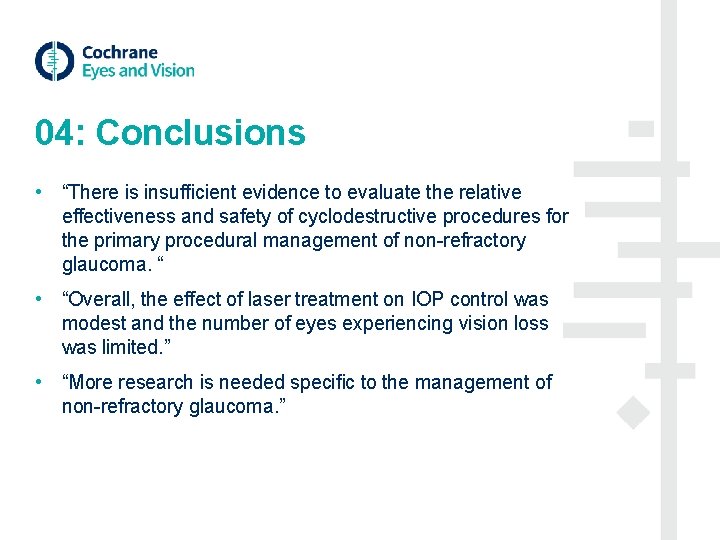
04: Conclusions • “There is insufficient evidence to evaluate the relative effectiveness and safety of cyclodestructive procedures for the primary procedural management of non-refractory glaucoma. “ • “Overall, the effect of laser treatment on IOP control was modest and the number of eyes experiencing vision loss was limited. ” • “More research is needed specific to the management of non-refractory glaucoma. ”
05: Acknowledgements • Cochrane Eyes and Vision US Satellite, funded by the National Eye Institute, National Institutes of Health • Cochrane Eyes and Vision Editorial Base, funded by the UK National Health Service Research and Development Programme • Manuele Michelessi, Amanda K Bicket, Kristina Lindsley Review citation Michelessi M, Bicket AK, Lindsley K. Cyclodestructive procedures for nonrefractory glaucoma. Cochrane Database of Systematic Reviews 2018, Issue 4. Art. No. : CD 009313. DOI: 10. 1002/14651858. CD 009313. pub 2.